



železniční nehoda ve Studénce (2008) Bridge
Objekt se nedochoval — na místě dnes nestojí. Následující text popisuje jeho historii, ne současnou návštěvu.
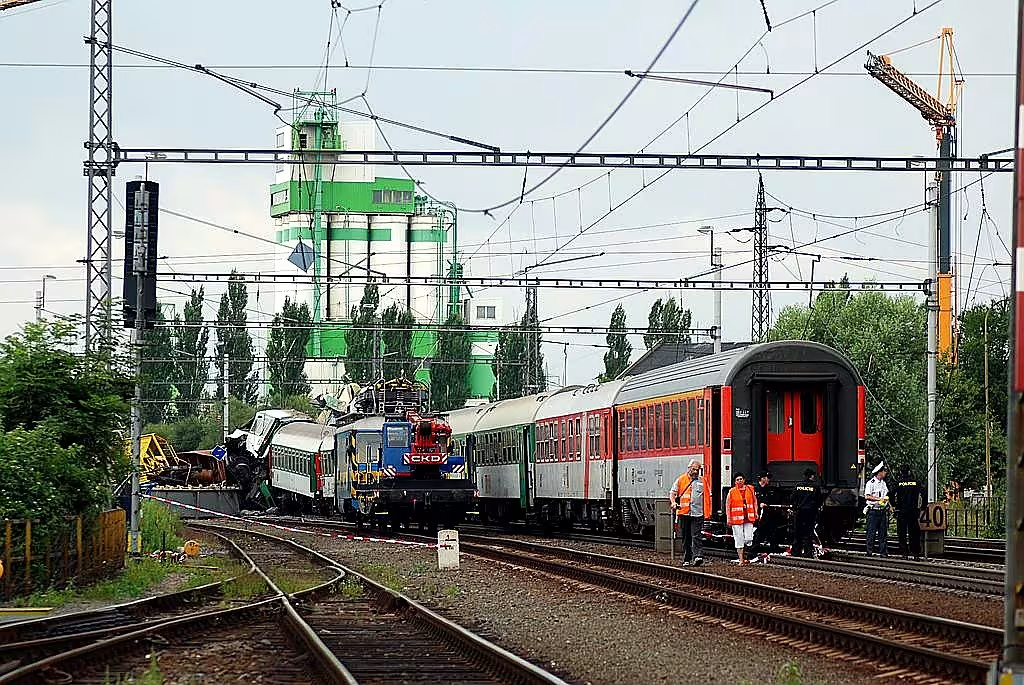
The site of the Studénka train disaster marks a significant moment in modern Czech history, located near the town of Studénka in the Moravian-Silesian Region. On August 8, 2008, a catastrophic event unfolded when a bridge under reconstruction collapsed onto an approaching EuroCity train EC 108 Comenius. This incident resulted in eight fatalities and approximately 95 injuries, highlighting the inherent risks associated with large-scale engineering projects.
The original bridge, constructed in 1961, featured five parallel steel box girders. In 2008, as part of infrastructure improvements, a new concrete deck was being installed on this structure. The reconstruction process involved lifting and moving the existing bridge to accommodate the new design. However, unforeseen dynamic stresses caused the bridge to collapse when parts fell onto the railroad track just as the train approached at high speed.
The crash occurred near the Studénka railway station while the train was en route from Kraków, Poland, to Prague, Czech Republic. The driver's quick response in engaging emergency brakes and moving to a safer part of the train likely saved his life. Despite this, the locomotive and several carriages derailed upon impact, with one carriage sustaining significant damage.
Rescue operations were swift, thanks to the Integrated Rescue System (Integrovaný záchranný systém), which facilitated rapid medical attention for all injured passengers. Firefighters from Studénka and surrounding areas, along with ambulances and helicopters, ensured that victims received prompt care at nearby hospitals in Ostrava, Nový Jičín, Frýdek-Místek, Opava, Bílovec, Olomouc, and Valašské Meziříčí. The efficient response underscored the importance of coordinated emergency services.
In the aftermath, public scrutiny focused on determining responsibility for the disaster. Accusations were directed at both the Czech Railways company and the construction firm Dopravní stavby Ostrava. Legal proceedings extended over 11 years, culminating in September 2022 with suspended sentences for five employees of the construction companies involved.
The incident not only led to a tragic loss of life but also prompted discussions about safety protocols during infrastructure projects. The new bridge was eventually inaugurated on July 24, 2009, nearly identical to its predecessor, symbolizing resilience and progress despite the earlier tragedy.
Today, the site serves as a poignant reminder of the challenges faced in modern engineering endeavors. While it is not an attraction per se, the historical significance of the Studénka train disaster offers valuable insights into the complexities of infrastructure development and safety considerations. Visitors interested in contemporary history may find this location worth exploring for its lessons on progress and precaution.
Historical milestones
- 2008
- The reconstructed bridge collapsed onto train EC 108 Comenius, causing eight deaths and around 95 injuries.
Architectural development
Constructed in 1961, the original bridge featured five parallel steel box girders. The reconstruction involved lifting and moving the structure for a new concrete deck installation. However, during this process, the bridge collapsed due to unforeseen dynamic stresses.
Historical events
On August 8, 2008, a reconstructed bridge collapsed onto train EC 108 Comenius, resulting in eight fatalities and approximately 95 injuries.
The new bridge, nearly identical to the original, was inaugurated on July 24, 2009.
Points of interest
- The bridge that collapsed during the Studénka train disaster was originally constructed in 1961 and featured five parallel steel box girders, a design choice reflecting engineering practices of that era.
- Despite the tragedy, an interesting aspect of the incident is how the driver's quick reaction to engage emergency brakes likely prevented further casualties, showcasing the crucial role of human intervention in crisis situations.
- The legal proceedings following the disaster extended over 11 years, culminating in September 2022 with suspended sentences for five employees from the construction companies involved, highlighting the prolonged nature of accountability processes in such incidents.
- In a testament to resilience and commitment to infrastructure development, the new bridge was inaugurated on July 24, 2009, nearly identical to its predecessor, symbolizing progress despite the earlier tragedy.
- The disaster prompted significant discussions about safety protocols during infrastructure projects, leading to enhanced scrutiny of construction practices in the Czech Republic.
Guide
This guide is narrated by a synthetic voice generated by artificial intelligence.
Show guide text
This text was created by artificial intelligence and has not been editorially reviewed. It may contain inaccuracies.
In Studénka, approximately 20 kilometers southwest of Ostrava, on August 8th, 2008 at 10 thirty in the morning, the international train Comenius collided with a road bridge structure. The bridge had collapsed onto the railway track just a few seconds before. The train was traveling from Krakow to Prague. Eight people died, five women and three men, and approximately 95 others were injured. The death of the eighth victim was announced by the media only on September 30th, 2008.
The overpass in Studénka carried a second class highway number 464 over railway track number 270. The original bridge from 1961 was 82 meters long. It consisted of five steel girders connected into a lattice and joined at the top with a reinforced concrete road deck slab. During reconstruction, the damaged slab was to be demolished and replaced with a new one. In order not to work over the tracks, the builders hydraulically lifted the entire bridge and moved it approximately 28 meters toward the Bílovci side. The bridge was shifted on steel carriages moving along runways that rested on auxiliary lattice towers.
Two days before the accident, the bridge began being pushed back. Already the first four meter step became complicated because the carriages got blocked, and the displacement ended with a day's delay. On the day of the disaster, the second step was being prepared. For reasons that were not clearly established, the Bílovci end of the bridge suddenly dropped by several decimeters and the entire roadway began to oscillate violently. The supports held for a few more seconds, so most of the workers managed to escape. Then the bridge, weighing several hundred tons, collapsed into the track bed. It deformed in such a way that in the space of the third track it reached all the way down to ground level.
The construction company did not consider the morning work to be serious enough to inform the railway operator and request traffic restrictions. They requested a closure and special supervision only in the evening. The trains therefore traveled at full speed. The Comenius train arrived at almost the highest permitted speed with approximately 400 passengers, and it had a ten minute delay. The bridge fell directly in front of it and the locomotive struck it at the height of the buffers. Driver Jiří Šindelář managed to record how the bridge oscillated and fell.
The destroyed bridge could not be repaired. A new one, almost identical to the original, was opened on July 24th, 2009, less than a year after the accident.
Businesses nearby
Do you run a restaurant, accommodation, shop, museum, rental, wellness or other visitor service near this monument? Show yourself directly to the people heading to it — this is how they will see you in the app and on the web:
Events nearby
Zdroj akcí: otevřená data měst a obcí ČR (Národní katalog otevřených dat) a kalendář akcí Národního památkového ústavu.
Nearby
Located near the town of Studénka in Moravian-Silesian Region, the site is close to Ostrava. The area features typical Central European landscapes with nearby infrastructure developments.
Visualizations and artistic views


The visualisations are generated by artificial intelligence and serve as inspiration.
Photos from the area
Real photos taken near the monument

Zdroj a licence jsou uvedeny u každého snímku.
Tips from visitors
No tips yet. Be the first!
Log in and add your tip.
Sources and literature
Photos: Martin Grill from Brno, Czech Republic / CC BY-SA 2.0 — Wikimedia Commons. The author and licence also appear when you hover over the image.
Faktickým podkladem tohoto textu byl článek na Wikipedii, jehož autory jsou přispěvatelé Wikipedie. Článek je dostupný pod licencí CC BY-SA 4.0.
Location on the map

Příběhy a pověsti
Legendy, pověsti a příběhy spjaté s touto památkou
Fotografie návštěvníků
Zatím žádné fotografie. Buďte první, kdo přidá fotografii z návštěvy!
Log in a přidejte svou fotografii nebo hodnoťte.
Za ověřenou návštěvu v aplikaci získáte víc bodů — poznáme podle GPS, že jste na místě.
Reviews and comments