



Vila čp. 143 Villa
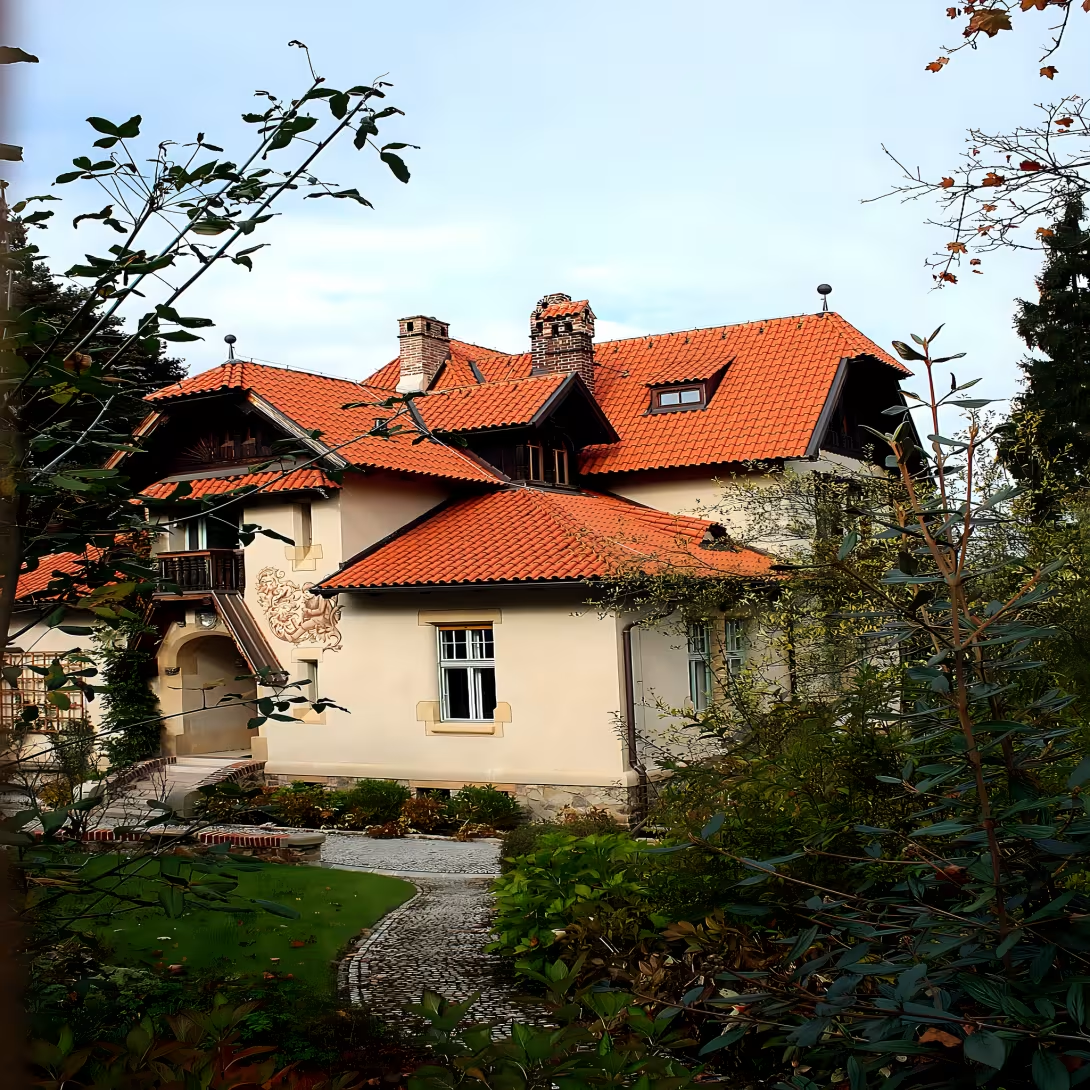
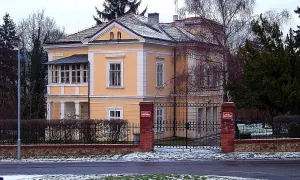
Franto's villa in Dobřichovice no. 143 is a single-storey residential building built in 1903- 1904, which represents a combination of historical styles and Art Nouveau. The construction is important with its architectural value and unique decorative elements.
The villa was built as a summer residence for Prague's gynecologist Jaroslav Franta. He worked as an assistant in the obstetrician's U Apolinář and was co-founder of the gynecology-obstetrics institution in Praze- Podolí. The project was designed by the architect Kamil Hilbert, who accepted the contract despite being fully busy at the time with work on the completion of the St. Vitus Cathedral.
The architectural solution of the house includes a very chipped floor plan and a complex system of roofs with skylights, shards with shards and chimneys made of brick wall. The style of the building connects elements of neo-gothic, neo-Renaissance and Art Nouveau with inspiration from folk architecture and an English rural house. Significant elements include decorative carved wooden veranda and paintings on the facades on which the decorator Láďa Novák worked. In the corner of the villa there is a stone statue of Madonna by Jan Kastner. The communication axis of the house consists of an entrance hall with a staircase. The living space, kitchen and bedroom families were situated on the elevated ground floor, guest rooms were located on the floor and the basement was the apartment of the janitor.
The villa was built in 1903- 1904. Since 1958 it has been registered as a cultural monument and has undergone reconstruction in the 21st century.
As a symbolic reference to the owner's profession, there was placed on the roof of the villa a banners with a stork, a symbol of obstetrics.
The residence in Brunshov is a rare example of architecture from the period when the era of history and Art Nouveau culminated. Its preservation and rich ornaments make this monument a valuable historical entity worth paying attention to.
Then and now
Drag the slider to compare how the landmark may have looked when it was built with the view today.
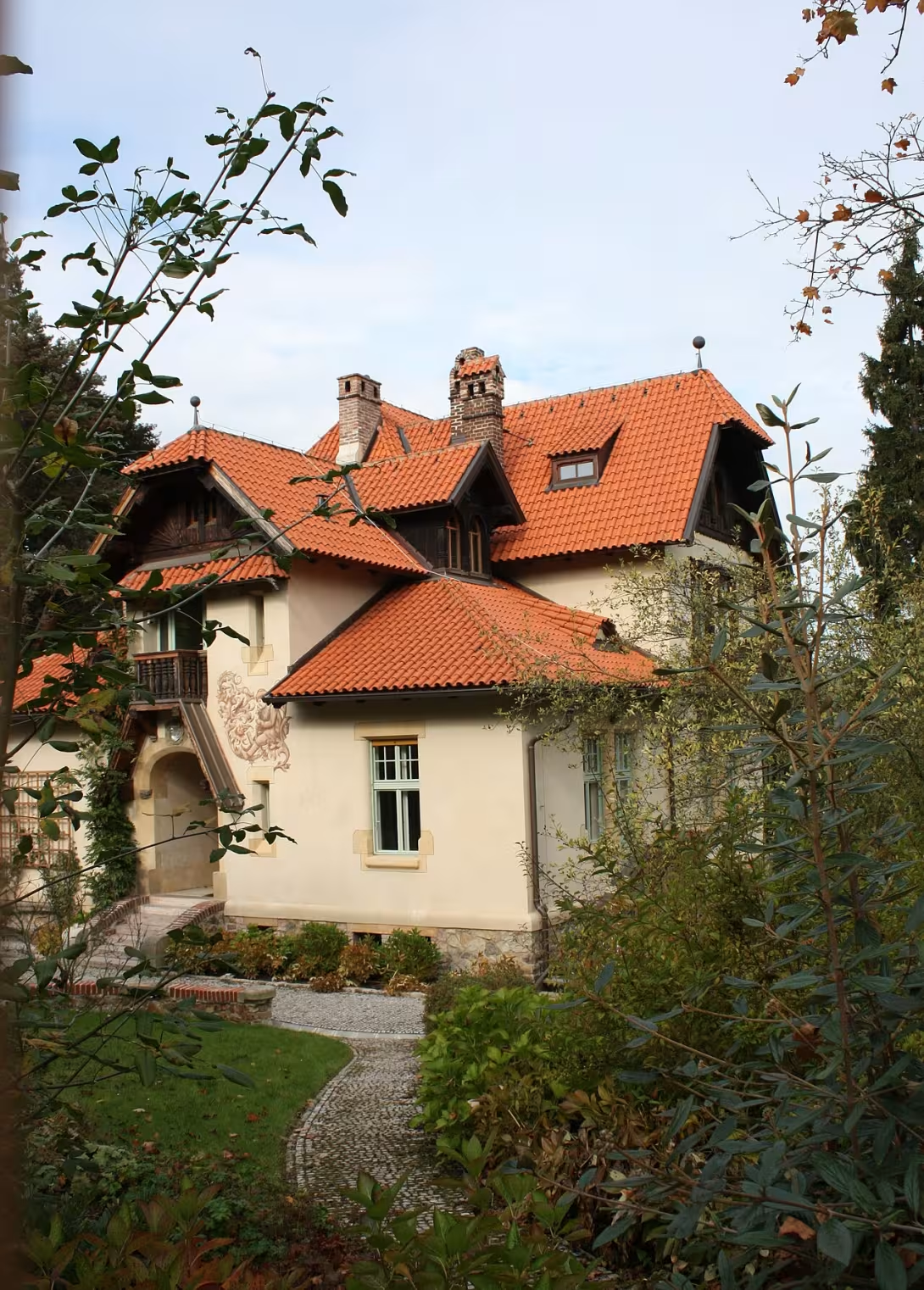

The historical appearance on the left is an AI-generated visualisation and serves as inspiration only.
Historical milestones
- 1903- 1904
- Position of Franta's villa in Dobřichovice no. 143.
- 1958
- Registration of the villa as a cultural monument.
Architectural development
The villa was built in 1903- 1904 as a combination of neo-Gothic, neo-Renaissance and Art Nouveau. The facades are decorated with the work of the decorator Láda Novák and stone statue of the Madonna by Jan Kastner. The building was renovated in the 21st century.
Historical events
1903- 1904: villa construction; 1958: a cultural monument; 21st century: reconstruction of the building.
Owners
Jaroslav Franta (built for it in 1903- 1904)
Points of interest
- The villa was built as a summer residence for Prague's gynecologist Jaroslav Franta. - The project was designed by architect Kamil Hilbert, who accepted the contract despite his work on the completion of the St. Vitus Cathedral. - The style of the building connects elements of neo-Gothic, neo-Renaissance and Art Nouveau with inspiration from folk architecture and an English country house. - In the corner of the villa there is a stone statue of Madonna by Jan Kastner. - On the roof was placed a well-designed bead with a stork as a symbol of obstetrics and a reference to the owner's profession.
Guide
Show guide text
This text was created by artificial intelligence and has not been editorially reviewed. It may contain inaccuracies.
Welcome to Dobřichovice. You are standing in front of just one of the most important and beautiful places in this area, before a villa with the number hundred forty-three, which many know under the name of Frank's villa. Stop for a moment, take a breath, and just feel the building that stands before you. It's a one-story residential house that carries the spirit of the early 20th century. If you look at it, you might see it as calm, elegance and a certain sense of cosy, which was typical of the summer residence of Prague's intelligence. It is a place where personal comfort has been combined with high art, and it is this connection we will be talking about today.
Let us now look at how this building was built and in what context it was built. It was a short but very intense process that took place in the years of tyres nine hundred and three to tyres nine hundred and four. The villa was built as a summer residence for Mr Jaroslav Franta, who was a respected gynecologist in Prague. Imagine the time, turn of the century, when it was almost obvious for successful doctors, lawyers and experts from the capital to seek refuge in nature. Prague was a fast-growing city at that time, full of noise and dust, and therefore the richer layers pulled into the surrounding villages to find peace, clean air and space for regeneration. Dobřichovice was the ideal choice for such purposes, and Mr Franta had the space created here to be his personal paradise.
Now pay full attention to the appearance of the house itself. What you see before you is not just an ordinary house, but the work of one of the most important Czech architects of his time, Kamil Hilbert. Look at the overall composition of the building. Hilbert here created a fascinating mix of different styles, which at that time required great courage and mastery. Notice how the elements of history and Art Nouveau intersect in the building. The Art Nouveau was then a very modern direction, which emphasized organic shapes, decorativeness and the effort to combine art with everyday life. Historism then followed past epochs, giving the house some seriousness and stability.
At the same time, we will find here very interesting influences of folk architecture, which gives the house some domestic well-being and solid anchoring in the local environment. Kamil Hilbert was also inspired in the design by English rural houses, which is evident in the overall nature of the construction and how it naturally fits into the surrounding landscape. And if you think about the essentials, you'll see traces of neo-gothic and neo-Renaissance. It is a truly rich cocktail of architectural currents that do not lie here but complement each other. Another very characteristic feature that you can perceive when you go around the house is a very fragmented plan. The building is not a simple square or rectangle, but its shape is diverse and fragmented, which creates a game of light and shadow on the facade and gives the villa both dynamics and depth.
When we think about Kamil Hilbert, it's fascinating to realize in what huge contrast this man was in. At the time he designed this cozy summer villa in Dobřichovice, he also worked on one of the largest and most demanding projects in our history - the completion of the St. Vitus Cathedral in Prague. Imagine the incredible spread in scale and emotion. On the one hand the monumental, noble cathedral, which was supposed to express national pride, faith and eternity, and on the other hand this private, intimate space for one doctor's family rest. Hilberta probably enjoyed this diversity at work and allowed him to express various aspects of his talent - from the ability to create monumental units to the ability to design detailed and human spaces.
In addition to Franta and architect Hilbert, other personalities like Láďa Novák and Jan Kastner are associated with this place. Although their role may not be so visible in the walls themselves, their presence in the history of this house helps to create an overall picture of the social life that once took place here. Imagine summer evenings, calls to the patio, visits to friends and intellectual discussions that have certainly taken place in these areas. The villa was not only a place for sleep, but a centre of social intercourse for the people who formed the society's elite.
Perhaps you are now wondering why this villa is so valued today and why it is in our list of monuments. It's not just her aesthetic beauty, it's that she's an authentic witness to her time. Its value was officially recognized in the year nine hundred fifty-eight, when the villa was registered as a cultural monument. This means that the state has acknowledged that this house has an irreplaceable value for our history and architecture. It's basically a book of stone and wood that tells us about the ambitions, tastes and lifestyle of people from the beginning of the last century. It's proof of how housing was approached at the time and the role that harmony with the environment played in a man's life.
An interesting question that you can think about is how the house was actually lived. Each corner, every end of the building and every window offered a different view of the garden and a different atmosphere in the interior. Kamil Hilbert wanted not only to create a living machine here, but a space that would promote peace and contemplation in complete harmony with the surrounding nature. It is a fascinating idea that one person could change from planning the vaults of the largest temple of the country to planning the placement of rooms in the summer house in Dobřichovice.
Now that you know the story of Frank's villa, I suggest you go around it one more time. Feel the details of her appearance, think about the people who spent their summer days here, and imagine how there was laughter here over a century ago, how gardens smelled, and how there were conversations about science, medicine and art. Note how the building changes depending on which side you're looking at and how the shape of the building adapts to the terrain.
I hope that this short journey into history has attracted you and that you have been able to imagine the atmosphere of the summer residence from the beginning of the twentieth century. Dobřichovice has up their sleeve yet many other secrets and beautiful corners that await their discovery. We wish you a pleasant continuation in your exploration of this beautiful village and we hope that your visit to Franta's villa inspired you to further interest in our architecture. Thank you for your attention and goodbye.
Tips for visitors
For the best experience we recommend a visit on bright days when the sun best illuminates the facade. The best time to observe the details of architecture is in the morning or in the afternoon.
You can also visit the property by car through public transport.
For a visit we recommend taking water and comfortable clothes suitable for outdoor movement. Families with children can appreciate the possibility of peaceful observation of historical buildings nearby.
The best places for images are pavements near the house, where the whole building is well seen. There are no other specific places to visit in the surroundings, so we recommend focusing on the architecture itself.
Frequently asked questions
Can the monument be visited?
This is a residential or farm building, not a museum with opening hours. Please view it from public space and respect the owners' privacy. We have no information about access to the interior.
Where is the monument?
Location: Dobřichovice, Středočeský kraj. The map on this page shows the exact spot.
Why is the monument protected?
It is listed in the Central List of Cultural Monuments of the Czech Republic as a cultural monument (register no. 1000129178).
Businesses nearby
Do you run a restaurant, accommodation, shop, museum, rental, wellness or other visitor service near this monument? Show yourself directly to the people heading to it — this is how they will see you in the app and on the web:
Events nearby
Zdroj akcí: otevřená data měst a obcí ČR (Národní katalog otevřených dat) a kalendář akcí Národního památkového ústavu.
Nearby
🏰 Historic sites (138)
- sv. Jan Nepomucký 1.0 km
- sv. Václav 1.1 km
- Letní residence Velmistra řádu Křížovníků s červenou hvězdou 1.1 km
- Immaculata 1.2 km
- Teploměr 1.2 km
- Cesta mramoru 1.8 km web
- Obětem první světové války 2.3 km
- Brandejsova hrobka 2.5 km
- František Másílko 18.5.1945 3.0 km
- zřícenina hrádku Karlík 3.2 km
- Řitka 3.3 km
- Pomník padlých rudoarmějců 4.0 km
- Obětem válek 4.0 km
- Bedřich a Hana Markusovi 4.3 km
- Rodina Bulova 4.3 km
- Hradiště Kazín 4.3 km
- zámek Trnová 5.1 km web
- neuskutečněná bitva o Líšnici 5.2 km
- Klášter Skalka 5.9 km
- Trampský hřbitov 6.0 km
🍽️ Restaurants and dining (530)
- U Nádraží 0.2 km Tyršova 112 +420 737 122 893
- Ciderie 0.6 km
- Na schůdkách 0.8 km Tyršova 84 +420 603 533 878
- U chudáka 0.9 km
- Rychta 0.9 km Květoslava Mašity 216 web
- Literární kavárna 1.0 km Květoslava Mašity 249 web
- Cukrárna Mistral 1.0 km
- Zámecký had 1.1 km
- Jez dobré naděje 1.1 km Tyršova 1154 +420 777 274 401 web
- U Věže 1.1 km Křižovnické náměstí 1 +420 704 466 341
- Pizzeria La Teresia 1.1 km
- VB Saloon 1.1 km
- Pod Vinicí 1.1 km
- Sportbar No. 64 1.2 km
- Hikari 1.3 km Pražská 1101 +420770603908 web
- Kebab stánek Amina 1.3 km 775249721
- Hostinec Na hřišti 1.3 km
- Květiny André 1.6 km Nad Nádražím 604 +420 775 301 752
- Stará Bárka 1.8 km Pražská 467 +420 737 804 599 web
- Pivovar MMX 2.2 km Pražská 452 +420 257 711 296 web
🏨 Accommodation (57)
- Palace Inn Hotel 3.3 km Všenorská 45 +420 7245 980 05 web
- Atrium-Accomm 4.2 km
- Kemp Řevnice 4.3 km
- Slánka 4.4 km Vrážská 121 web
- Pension Perseus 5.1 km web
- převis Babka 5.4 km
- Autocamp Ostrov - Zadní Třebáň 5.7 km +420 777 150 241 web
- Lávka Park Skochovice 6.0 km Vltavská 634 web
- Matyáš 6.0 km
- Penzion Spálený mlýn 6.1 km
- tábořiště 6.3 km
- Světluška 6.3 km
- Malý mnich 7.1 km náměstí F. X. Svobody 54 +420 777295577 web
- Karlštejn 7.3 km +420 311 600 900 web
- Romantický Hotel Mlýn Karlštejn 7.5 km
- Penzion Vinice 7.5 km web
- Koruna 7.5 km
- Pod Dračí skálou 7.7 km
- Penzion Hájovna u Dubu 7.9 km
- Squash 8.3 km
🚲 Rentals and sport (82)
- JojoGym 0.6 km 5. května 1064
- Tenisový areál TJ Sokola Dobřichovice 0.6 km web
- Olympia Fitness & Wellness 0.7 km Květoslava Mašity 409 +420 257 711 071 web
- Sportovní hala Bios 1.2 km
- TJ Sokol Dobřichovice 1.2 km
- DBIKES 3.2 km Mokropeská 2027 +420 774 745 387 web
- Hala Věry Čáslavské 3.5 km
- Kola Štorek 4.1 km
- TJ 4.2 km
- Čumrda 4.6 km
- Cykloservis Kramata 5.8 km Třebaňská 262 +420 604 438 030 web
- Střelnice Třebotov 5.8 km
- CYCLESTAR, s.r.o. 7.5 km
- Zastávka Měchenice PPS 7.8 km
- Biotop Radotín 7.8 km
- Sportovní hala Radotín 7.9 km +420 608 262 805 web
- Centrum Třešňovka 8.3 km +420602122355 web
- Ski a Bike Centrum Radotín (SBCR) 8.3 km Na Betonce 114/2 +420 222 367 700 web
- broková střelnice 8.4 km
- Sokolovna 8.7 km
🥾 Hiking and nature (216)
- U lomu 0.7 km
- Červená Hlína 1.3 km
- Korunka 1.3 km
- Chlum 1.3 km
- Na Krásné Vyhlídce 1.5 km
- Kámen 1.9 km
- Krásná stráň 2.2 km
- Naděje DCh 2.3 km
- Vyhlídka na Karlík 2.4 km
- Vršek 2.5 km
- Hvíždinec 2.6 km
- Hvíždinec 2.7 km
- Bukovka 2.7 km
- Hvíždinec 3.1 km
- Velká skála 3.1 km
- Skalice 3.3 km
- Vyhlídka Homole 3.3 km
- Dobřich 3.4 km
- Pod Skalicí 3.5 km web
- Čabrak 3.5 km
Accommodation nearby
Trips and activities nearby
Guided tours, tickets and activities nearby from GetYourGuide
Affiliate link: if you buy from the partner, we may receive a commission. The price for you does not change.
Search tours and activities →Themed route
Vila čp. 143 Type: Monumental protected building Why is it worth visiting: This villa presents a rare example of architectural style in the village Dobřichovice. Its historical value and unique appearance make it the main magnet for lovers of history and architecture.
Vile basin No. 143 Type: Private area Why is it worth a visit: Walk through the courtyard allows you to look into the owners' privacy and admire the details of garden modifications. Here you can appreciate the harmony between the construction work and the natural environment surrounding the building.
Facade of Villa No. 143 Type: Architectural element Why is it worth a visit: A detailed tour of the facade reveals the craft art and materials used in the construction. Every primate of the facade tells the story of the time when the villa was built and the taste of its creators.
Park at Villa No. 143 Type: Green area Why is worth a visit: The surrounding park green provides a quiet environment for relaxing and photographing. Trees and shrubs provide the whole area with a romantic atmosphere and create an ideal framework for admiring the villa.
Internal exposure to Villa No. 143 Type: Interior Why is it worth a visit: If it is accessible, the interior of the villa offers a view of the original amenities and disposition. Visitors can look into the life that took place here and appreciate the quality of the internal space processing.
Seasonal recommendations
In the spring the garden around the villa awakens to life and the colours of the first flowers complement the architecture beautifully. The light is fine in this period and does not shine, which is ideal for observing the details of the construction. I recommend arriving in the morning when the air is the purest. Dress well, because morning cold can be a friend who quickly turns into a warmer afternoon.
The summer months bring full sun and dense green vegetation to Dobřichovice, which shaded the surroundings. The atmosphere is alive and full of energy. Due to the increased number of visitors in the main summer season, it is best to arrive immediately after opening to enjoy peace. Remember light summer clothes, headgear and plenty of fluids because the sun can be very strong.
Autumn offers the most impressive view thanks to the golden and brown shades of leaves surrounding the historic building. The morning fog gives the place a tajmen touch. It is good to visit the memory in the afternoon when the light is the hottest. Prepare your coat and comfortable shoes because the road on a moist surface can be difficult.
Zimą works in peace and quiet, especially if everything is covered with snow or freeze. The landscape is rough and architecture stands out against the background of bare branches. The opening time is shorter in this period, so check in advance. The necessity is very warm clothes and solid shoes, preferably around noon when the day is longest and the light most.
Visualizations and artistic views


The visualisations are generated by artificial intelligence and serve as inspiration.
Photos from the area
Real photos taken near the monument

Zdroj a licence jsou uvedeny u každého snímku.
Tips from visitors
No tips yet. Be the first!
Log in and add your tip.
Sources and literature
Photos: Kenyh / CC BY-SA 3.0, rozlišení zvýšeno umělou inteligencí — Wikimedia Commons. The author and licence also appear when you hover over the image.
Faktickým podkladem tohoto textu byl článek na Wikipedii, jehož autory jsou přispěvatelé Wikipedie. Článek je dostupný pod licencí CC BY-SA 4.0.
Location on the map





Příběhy a pověsti
Legendy, pověsti a příběhy spjaté s touto památkou
Fotografie návštěvníků
Zatím žádné fotografie. Buďte první, kdo přidá fotografii z návštěvy!
Log in a přidejte svou fotografii nebo hodnoťte.
Za ověřenou návštěvu v aplikaci získáte víc bodů — poznáme podle GPS, že jste na místě.
Reviews and comments