






Vila čp. 672 Villa
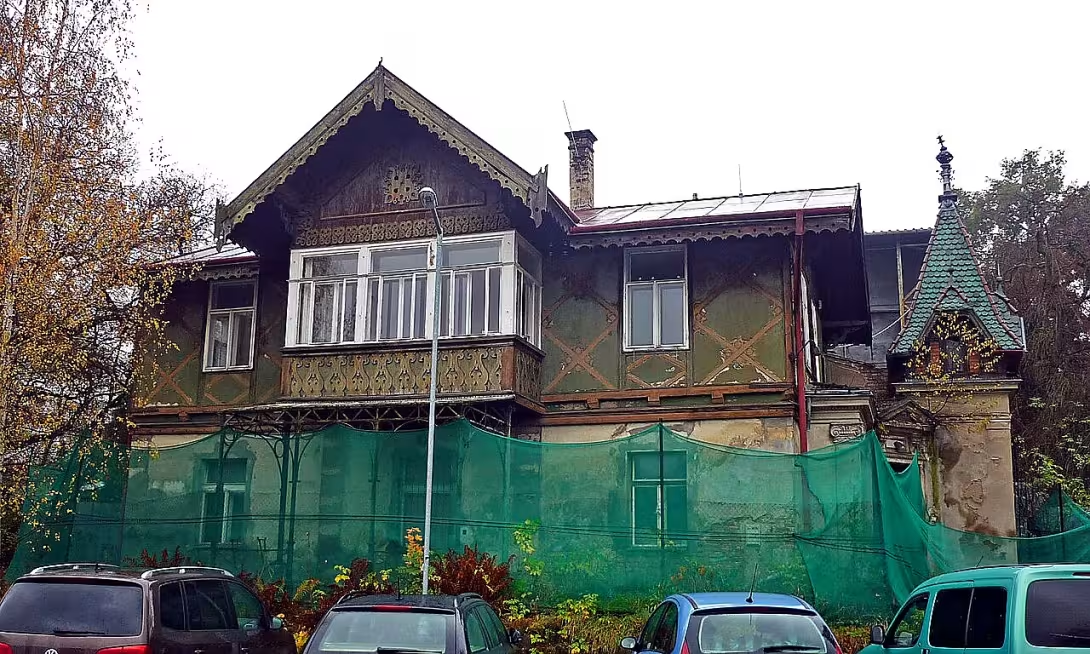
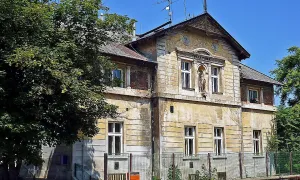
Lüdersdorf Villa in Žatci is a representative Neo-Renaissance residence from 1884. It was created as part of an extensive production site for cardboard and paper boxes. The building at Komenský alley 672 has been a protected cultural monument since 2006 and represents an important proof of industrial development of the city in the 19th century.
The building of the villa was commissioned by the Žetek businessman and chairman of the local German evangelical village Moritz Lüdersdorf. The project was developed by architect Josef Petrovský, the author of the whole plant built from 1878 to 1889. The location of the villa on the premises reflected the economic boom at the time, when the Lüdersdorf factory became the largest operation of its kind throughout Austria-Hungary.
This two-storey, loose building has a broken roof. Architectural rendition combines rich Neo-Renaissance stucco decoration with a non-traditional element on the first floor, where there is a wooden ornament decorated tiles. It deliberately evokes the appearance of mountain structures typical of Switzerland or Austria. The building includes a tower with a headroof, several balconies and a roof view terrace. The original plot also included a garden with a fence.
The villa served the Moritz Lüdersdorf family as a home until the end of World War II. After 1945, as a result of the redeployment of the German population from Czechoslovakia, the property was nationalized and transferred to state ownership.
The key milestones are the year 1884 when the construction was completed and the year 2006 when it was declared a cultural monument. The building is valuable primarily as evidence of the connection of representative housing with the industrial architecture of the end of the 19th century.
Today this monument reminds of the era of rapid industrial development Žatka and the social importance of the then business class. Visiting the villa offers an opportunity to explore a specific architecture that combines neoRenaissance elements with the Alpine aesthetics, and thus recognize one of the important chapters of the city's history.
Historical milestones
- 1878
- Initiated exhibition of industrial installation
- 1884
- Reconcentration of villas
- 1889
- Concentration of exhibition of the whole industrial area
- 1945
- Significant property after redeployment of the German population
- 2006
- The declaration of the object for a protected cultural object
Architectural development
The villa was built as a free two-storey building with a broken roof and a sightseeing terrace. A characteristic element is the combination of neoRenaissance stucco decoration with wooden ornament tiles on the floor. The original area included a garden with a fence.
Historical events
1884: Construction of the villa according to the design of Josef Petrovský. 1945: The transfer of the Lüdersdorf family and the nationalisation of property. 2006: Declaration of the Villa for Cultural Heritage.
Owners
Moritz Lüdersdorf (1884-1945), followed by the Czechoslovak State.
Points of interest
- The villa was created as part of a factory complex for the manufacture of cardboard and paper boxes, which was the largest operation of its kind in Austria-Hungary at the time. - Architectural rendering combines neo-Renaissance stucco decoration with wooden cladding to remind of the appearance of mountain buildings from Switzerland or Austria. - Part of the building is a tower with a jachlan roof, several balconies and a roof view terrace. - The construction was completed in 1884 and has been a protected cultural monument since 2006. - The object served as home to the Moritz Lüdersdorf family until the end of World War II, then nationalized.
Guide
Show guide text
This text was created by artificial intelligence and has not been editorially reviewed. It may contain inaccuracies.
Welcome to the beautiful city of Žatec. Right now, when you put on your headphones and stopped at this place, you're in front of one of the most important buildings in this area. You're standing right in front of villa six hundred seventy-two. If you look at her, you'll probably feel her nobility and importance immediately. This building is not just an ordinary house, it is a witness of the ancient era, when the city, the whole empire, was to be changed by the power of industry and human ingenuity. Feel the atmosphere radiating from this place. It has a sense of peace, but also of the old, period movement that brought success and wealth here.
Now let's go back in time together to understand why this place looks just like this. This villa, which people know under the name of Lüdersdorf's villa, has its origins deep in the eighteenth century, but its true bloom began much later. The whole story of this building is inseparably linked to the development of industry in this part of the city. Already in the year one thousand eight hundred seventy eight, a huge industrial site began to grow in this area. It was not just an ordinary plant, but a whole world of production that focused on making cardboard and cardboard boxes. The whole complex was built gradually and completed only in the year one thousand eight trăm eighty-nine, but the villa that you are standing before was completed several years earlier, namely in the year one thousand eight hundred eighty-four. This building was to serve as a representative residence for the man behind all this.
Now pay attention to the architecture itself, because it is in detail that the greatest beauty lies. Look at the face of this building. Architect Josef Petrovský, who had the honour to design this house, chose a neo-Renaissance style for his rendition. This means that when looking at a building you can perceive harmony, order and rich richness of forms. If you look closer to the walls, notice the beautiful stucco decoration. These decorative elements, which are on the facade, add elegance to the house and express the status of its owner. And now try to look even higher. Notice the tower that gives the building height and makes it dominant in this place. It's an element that makes you look up and perceive the overall structure of the house.
And now I have something special to ask you. Try to focus on the first floor of the building. Notice how the appearance of the walls changes here. You can see a wooden cladding. This connection of stone or decorated ground floor with wooden floor is very interesting. This element was designed to resemble the appearance of mountain structures that you will find high in Alpine areas. It's like the elegance of the city palace meets the cosy and natural appearance of the mountain cottage. This combination of styles is unique to this villa and creates an interesting contrast between nobility and home in its appearance.
Speaking of this villa, we can't forget the man behind it all. Moritz Lüdersdorf was a man who kept making history in this place. He was a successful businessman who built an empire in this area. Imagine his life, his ambition and his vision. This villa was not just his home, it was his business card, a symbol of his success in a field that was only then beginning to control world trade. Living in such a house, close to its vast factory site, must have been an expression of control and strength.
And here comes the most interesting thing I would like to give you. You may think it's just a beautiful house for one rich person, but the truth is much bigger. This whole area, including this villa, was in its time a unique one. This cardboard and carton factory was the largest operation of its kind throughout Austria-Hungary. Imagine the great power, the massive production that took place here. This villa was the heart of this huge machine that supplied markets throughout the empire at that time. It is a fascinating notion that it was here, in this quiet place, that a force was created that had a huge impact on the entire economy at that time.
But the history of this place was not just about growth and success. There were times of great change. After a year of a thousand and nine hundred forty-five, when there were major political changes and relocations of the German population, this property was taken over by the State. The building went through many periods, but its value never disappeared. That is why it was officially declared a protected cultural monument in the year two thousand and six. It means that today, when you look at it, you're looking at a rare treasure that we have to protect for all future generations so that they can also feel the breath of history that still hangs in the air.
Now that you've looked at the main features of this beautiful building and recognized its story, I suggest you continue your walk. Žatec has many other secrets and beauty waiting for you. Let yourself be carried away by the atmosphere of this city and enjoy every moment you spend near it. Thank you for spending this moment with me and for being interested in this amazing piece of history. I wish you a wonderful journey.
Tips for visitors
To visit the villa we recommend to choose a sunny morning, when the natural light will highlight the neo-Renaissance details of the facade and allow you to take quality pictures without disturbing shadows. Parking is possible in adjacent streets near the historical centre, while public transport is available for verification in the current connection search engine. With you take comfortable shoes for walking around the city and the camera, as the exterior of the villa offers unique architectural features that excel especially in side lighting. In the vicinity of the villa you can visit the picturesque historical center of Žatce, walk along the river Ohře or admire unique hop buildings that are typical of this city. The location is suitable for families with children thanks to the proximity of the park areas near the river, where children can relax after a tour of historical architecture.
Businesses nearby
Do you run a restaurant, accommodation, shop, museum, rental, wellness or other visitor service near this monument? Show yourself directly to the people heading to it — this is how they will see you in the app and on the web:
Events nearby

Zdroj akcí: otevřená data měst a obcí ČR (Národní katalog otevřených dat) a kalendář akcí Národního památkového ústavu.
Nearby
Historické centrum města Žatec, řeka Ohře, chmelařské stavby v okolí.
Accommodation nearby
Themed route
Thematic cruise route from Žatka
1. Historical Center of Žatec - Type: Urban historical areas - Why it is worth a visit: The historical center Žatce offers a view of ancient architecture and a beautiful panoramic look on the city. It is the ideal place to understand the history and culture of this area.
Vila čp. 672 - Type: Historical villa - Why is it worth a visit: This villa is a representative of architecture from the past and offers a unique view of the lifestyle of the then residents. It is the main destination of the route where you can enjoy quiet moments in a beautiful environment.
3. River of the Bend - Type: Natural bath - Why is worth a visit: The River Ohře is an ideal place for relaxation and relaxation. You can enjoy a moment on its shores, or look at the water landscape from the postcard.
4. Chillar buildings - Type: Historical industrial monument - Why is it worth visiting: These buildings are witnessing a rich hop tradition in the area. These are interesting comments from the past which point to the importance of hops for the local economy.
This route offers a view of the history and culture of Žatce, while allowing you to enjoy the natural beauty of the region.
Seasonal recommendations
Spring: In the spring period Villa No. 672 lights up the freshness of nature, when the first flowers and trees bloom green. The atmosphere is full of hope and new life, making the visit extremely comfortable for nature lovers. This season it is recommended to visit in the first half of the day when the temperature is mild and the crowds are usually few. Get dressed enough for changing weather - a light coat can be useful in colder wounds.
Summer: In the summer season, the lighting is sunny and nature offers its full beauty, making the villa a special experience. The atmosphere is warmer and suitable for active trips. The best time to visit is in the morning or late afternoon to avoid strong temperatures and unnecessary crowds. We recommend light clothing and protective replacement for sun rays.
Autumn: In autumn, Villa No. 672 illuminates itself with a changing colour spectrum of leaves, bringing a unique atmosphere of peace and quiet. It is advisable to visit the memory at the beginning or mid-day when the temperature is still pleasant. Dress up according to the weather - a mild coat can be useful, especially in colder afternoon hours.
Winter: In winter, Villa No. 672 offers a calm and quiet atmosphere under the cover of snow or ice pebbles, which is ideal for lovers of cold weather. Visit her in the morning or in the first half of the day, because opening hours may be shorter and crowds are usually few. Hot clothes, including fur coat and hat, are essential for a comfortable experience.
Visualizations and artistic views

The visualisations are generated by artificial intelligence and serve as inspiration.
Photos from the area
Real photos taken near the monument


Zdroj a licence jsou uvedeny u každého snímku.
Tips from visitors
No tips yet. Be the first!
Log in and add your tip.
Sources and literature
Photos: SchiDD / CC BY 3.0 — Wikimedia Commons. The author and licence also appear when you hover over the image.
Faktickým podkladem tohoto textu byl článek na Wikipedii, jehož autory jsou přispěvatelé Wikipedie. Článek je dostupný pod licencí CC BY-SA 4.0.
Location on the map
Příběhy a pověsti
Legendy, pověsti a příběhy spjaté s touto památkou
Fotografie návštěvníků
Zatím žádné fotografie. Buďte první, kdo přidá fotografii z návštěvy!
Log in a přidejte svou fotografii nebo hodnoťte.
Za ověřenou návštěvu v aplikaci získáte víc bodů — poznáme podle GPS, že jste na místě.
Reviews and comments