



vila Františka Bílka Villa
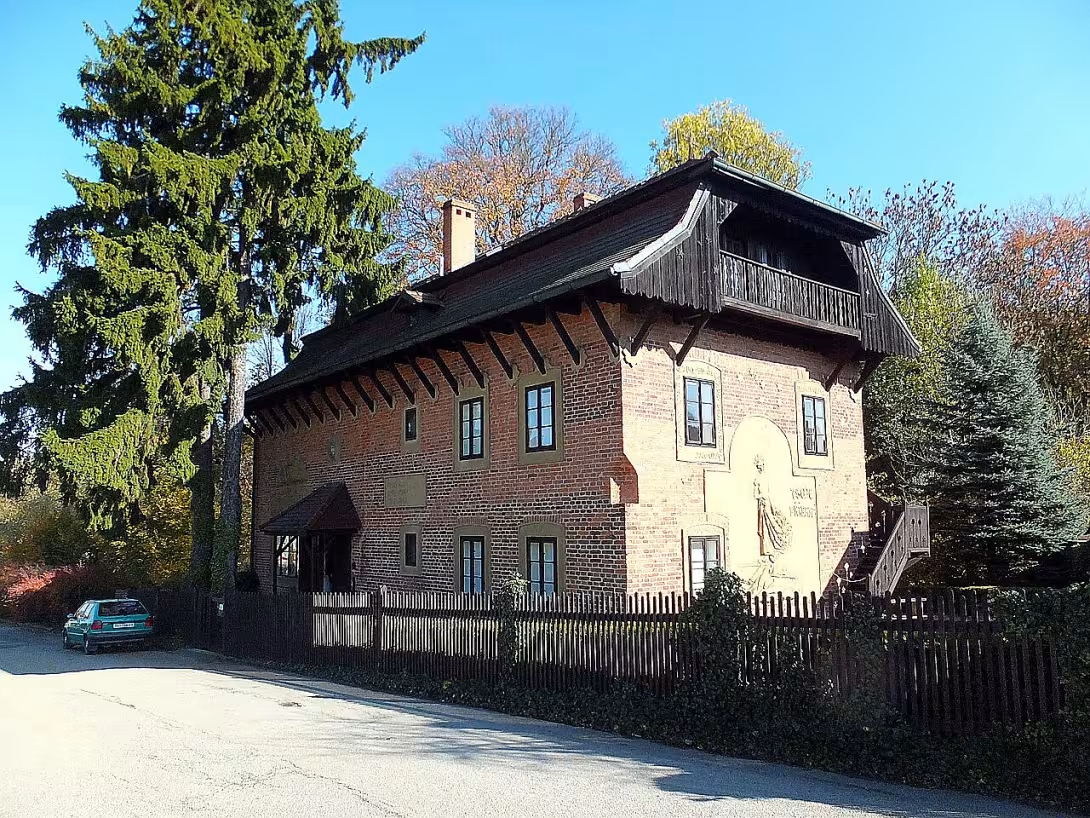
The protein villa in Chýnov is an atypical storey building from 1898, the author of which is sculptor and architect František Bílek. The object that the artist called Chaloupka has been listed among cultural monuments since 1958. Today it serves as a museum exhibition and memorial reminiscent of the author's work.
The villa was established in the late 19th century, when symbolism and secession were promoted in the Czech art. František Bílek implemented the construction in the garden of the parent farm between April and August 1898. European culture then responded to rapid industrial development by returning to natural materials and distinctive architectural expression. This was demonstrated in Bílkov's work by the choice of materials and overall concept of the house.
The construction made of unwashed bricks and wood has a rectangular plan. A characteristic element is the Mansard roof supported by oblique wooden supports. The facade makes unique inscriptions, characters and figural reliefs; The largest stucco decoration is located on the south front. The interior includes two pairs of living rooms on the ground floor and the first floor and a large, high studio. It is architecturally designed as an English staircase hall with a narrow gallery on the level of the first floor.
The villa was long held by the White family. František Bílek used it as a workplace and meeting place of important personalities, such as Julius Zeyer, Otokar Březina, Zdenka Braunerová, Karel Dostál-Lutinov or Sigismund Bouška. At the end of his life, in 1939, the artist moved to the villa permanently. After his death in 1942, the object was long lost. In 1990 the villa was purchased from the family by the Gallery of the Capital City of Prague and in 1994 the building underwent a total renovation under the direction of architect Rudolf Kristian. During the 20th century the building was subjected to a number of modifications, namely in 1898, 1902, 1905, 1907, 1928, 1929 and 1991.
Today the villa works as a space for museum exhibition of works by František Bílek. Visitors can view the rooms closely linked to the life and creation of this creator. Due to its architectural uniqueness and historical importance, the villa represents a valuable proof of artistic thinking at the turn of the 19th and 20th centuries. Visiting the monument offers the opportunity to become familiar with the authentic environment in which Bílek formed and where he met the leaders of the culture at the time.
Historical milestones
- 1898
- Construction of the villa by František Bílk.
- 1958
- Writing a villa among cultural monuments.
- 1990
- Sale of the Prague Gallery.
- 1994
- Renovation of the building by architect Rudolf Kristian.
Architectural development
The villa was built from unwashed bricks and wood, with the Mansard roof supported by oblique wooden supports. During the 20th century it underwent many modifications in the years 1902, 1905, 1907, 1928, 1929 and 1991. In 1994, the overall renovation under the leadership of architect Rudolf Kristian took place.
Historical events
In 1898 construction of the villa took place in the garden of parents František Bílek. In 1939, the artist moved to the villa permanently. In 1990, the villa was purchased by the Prague Gallery and subsequently renovated in 1994.
Owners
The Bílková family, since 1990 Gallery of the City of Prague.
Points of interest
- The author called the building Chaloupek. The building was built in the garden of the parent farm between April and August of 1898. - The facade is decorated with inscriptions, characters and figural relief, with the largest stucco decoration on the south side. - The inner space contains a high studio, which is designed as a staircase hall with a narrow gallery on the level of the first floor. - The villa served as a meeting place for important personalities, such as Julius Zeyer, Otokar Březina or Zdenka Braunerová. - The building was subjected to many modifications in 1898, 1902, 1905, 1907, 1928, 1929 and 1991.
Guide
Show guide text
This text was created by artificial intelligence and has not been editorially reviewed. It may contain inaccuracies.
Welcome to this extraordinary building that carries the incredible power of artistic expression. You're standing in front of Frantisek Bílka's villa in Chýnov. You may only see an interesting house at first sight, but believe me, this is one of the most important points in the whole area. Feel the atmosphere that still persists here, and try to look at this building through the eyes of the person who lived and created it.
Let us return together to time, namely 1898. This was the year when a whole new chapter began to be written here. The main hero of this story is a man whose name has been associated with this building since the first stone - František Bílek. He was a man of extraordinary talent, sculptor and architect who wanted to express his own vision of the world in this building. To him, it wasn't just an ordinary villa, it wasn't just a house for living. He called her the Chaloupka. With this simple but modest word, he wanted to express the closeness to nature and perhaps some spiritual depth he sought in this place. This building was created as his own workplace, as a place where he could be alone with his thoughts and his parts, but also as a space that was supposed to be the living heart of culture.
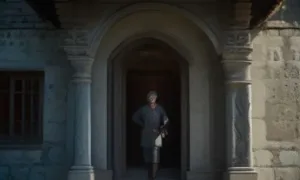
Now pay attention to the very form of the object in front of you. Look at his contours. The construction has a very clear, rectangular plan, which gives it a sense of stability and peace. Notice the roof. It's a mansard roof that gives the whole house its specific, rich look. But the most important thing is right on the facade, on the wall that's just calling you. If you look closely, you will see that the facade is not just a smooth surface. It is decorated with inscriptions and figural reliefs, i.e. those performing shapes that tell stories without a word. If you could move around the house, notice that the largest and wealthiest stucco decoration, the art work of fine material, is located on the south side of the building. These details are not just ornaments, they're traces of the artist's hands trying to link architecture to the spirit.
Now imagine what kind of conversations have happened here in the past. This villa was not only a silent hiding place of the creator, but it became a magnet for the most important personalities of the then culture. Imagine those people sitting here discussing art, life and the future. Those who were guests here and were closely associated with this place include Julius Zeyer or the poet Otokar Březina. Zdenka Braunerová, Karel Dostál-Lutinov or Sigismund Bouška were also present. It was a place where the greatest minds of the time met where new ideas were born and culture became a living, tangible force. When you look at these walls, you realize that you are witnessing a place that was the topic of these big meetings.
Although this construction may seem to you as an eternal element of the landscape, its history is full of important breakthroughs. Did you know that this whole building was built incredibly quickly? The author had it created in a single year, between April and August of 1898. It is almost unimaginable nowadays how quickly a man could embody his vision into such detail. Since then, time has changed, but the villa has remained. In 1958, its high value was recognised and registered among cultural monuments, thereby ensuring that its uniqueness was not forgotten. Later, in 1990, she moved to the Prague Gallery and in 1994 she underwent an important renewal by architect Rudolf Kristian. This allows you to look at a building today that retains its original beauty and integrity.
If you were able to enter the inner space, you would encounter something that is absolutely crucial to this house. Inside is a large artistic space, a large studio. It is dealt with very specifically as a staircase hall. Imagine the space, the height, and the light that permeates into the place where works of art were created before. It is a space that is designed to inspire amazement and allow freedom of movement and thought.
Now I want to leave you with one interesting thing that might make you look at this building a little bit differently. Think about the contrast between how this object was cared for in the past and how we care about it today. This villa, which the author called only Chaloupka, has become a monumental symbol of culture, which belongs to the whole nation. There's something mysterious about it that such a small name can hide such great meaning.
Thank you for your time and attention to this memory. We hope that this view of the history and architect František Bílek has helped you better understand why this place is so special. Do not stop, continue to walk and perceive the surroundings that are so closely connected to this villa. We wish you a wonderful time to discover this place.
Tips for visitors
The best time to visit is in the morning on working days when you avoid larger groups and enjoy the quiet atmosphere of the White Chaloupka. The light in the interior at this time is ideal for viewing details of sculptures.
If you use public transport, check the connection at the current connection search engine, the stop is within walking distance.
For photography we recommend to capture non-traditional architectural elements of the villa from the outside where its unique shape stands out. In order to respect the protection of exhibited works of art, check the rules for photography in advance.
In the surroundings we recommend to visit the city Chýnov itself with its historical character and also the famous Chýnov cave, which offers an interesting natural experience and is easily accessible from the villa.
For families with children, the visit is suitable as an educational walk in the arts. We recommend that you bring comfortable shoes to move around and snack, as a tour of the villa is rather a communal experience without great facilities for children.
Frequently asked questions
Can the monument be visited?
Some buildings of this kind are open for guided tours, others serve another purpose or are privately owned. We have not verified whether and when this monument is open – please ask the operator.
What are the opening hours and admission?
We have not verified the opening hours or admission. Current information is published by the operator.
Where is the monument?
Location: Chýnov, Jihočeský kraj. The map on this page shows the exact spot.
Why is the monument protected?
It is listed in the Central List of Cultural Monuments of the Czech Republic as a cultural monument (register no. 1000126786).
Businesses nearby
Do you run a restaurant, accommodation, shop, museum, rental, wellness or other visitor service near this monument? Show yourself directly to the people heading to it — this is how they will see you in the app and on the web:
Nearby
Město Chýnov, Chýnovská jeskyně.
Accommodation nearby
Themed route
Thematic cruise route: Villa František Bílka and surroundings
1. Villa František Bílka (villa) Type: historical residence Why it is worth a visit: This important architectural monument is known for its unique construction and history. The villa was designed for the famous Czech painter František Bílek, which makes it an ideal place for those interested in art and architecture.
2. City Chýnov (city centre) Type: historical town Why is it worth a visit: After visiting the villa, visit the city centre where you will find ancient architecture and an opportunity to explore local shops and restaurants. The city offers a view of the history and culture of the region.
3. Chýnov cave (cave) Type: natural monument Why is worth visiting: This cave is an ideal place for those who like geology and nature. Its underground worlds offer beautiful views and interesting information about the geological history of the region.
4. Ambient forests Chýnova (forest walk) Type: natural environment Why is it worth a visit: After exploring the cave enjoy a quiet walk in the surrounding woods. These places offer beautiful views and an opportunity to relax in nature.
5. Ambient field paths (walk) Type: rural surroundings Why is it worth a visit: Explore comfortable field trips around Chýnova, which will lead you to other picturesque places and allow you to enjoy a quiet neighborhood without disturbing urban noise.
This route offers a combination of history, nature and relaxation in one of the most beautiful Czech regions.
Seasonal recommendations
Spring: During the spring season vila Františka Bílka is fertilized by flowering gardens that offer a wonderful view and pleasant fragrant air. The sun's rays light the building in mild light, stressing its historical architecture. For a visit it is advisable to come in the early spring season when the crowd is still little and the gardens begin to bloom. We recommend wearing clothes suitable for mild temperature and bearing in mind the possibility of rain.
Summer: In summer vila Františka Bílka offers ideal conditions for visiting, when nature is in full bloom and gardens are revived with diverse colors. The sunlight illuminates the building in the most beautiful brightness, allowing it to capture its historical details. Summer is a time of great crowds, so we recommend to come early in the morning and wear light clothes suitable for warm weather.
Autumn: In the autumn period, vila Františka Bílka offers a quieter atmosphere when gardens turn into emerald and yellowish colors. The sunlight is less intense and illuminates the building in a warm shade, creating a romantic mood. Autumn is the perfect time to visit because of a smaller crowd and pleasant temperature. We recommend wearing clothes suitable for mild cold weather.
Winter: In winter, vila Františka Bílka offers a unique view, where the surrounding area is covered with snow and the building is lit with warm lights. The winter atmosphere brings a calm mood and allows you to enjoy historical architecture in a different light.
Visualizations and artistic views


The visualisations are generated by artificial intelligence and serve as inspiration.
Photos from the area
Real photos taken near the monument


Zdroj a licence jsou uvedeny u každého snímku.
Tips from visitors
No tips yet. Be the first!
Log in and add your tip.
Sources and literature
Photos: Miloš Hlávka / CC BY-SA 3.0 — Wikimedia Commons. The author and licence also appear when you hover over the image.
Faktickým podkladem tohoto textu byl článek na Wikipedii, jehož autory jsou přispěvatelé Wikipedie. Článek je dostupný pod licencí CC BY-SA 4.0.
Location on the map



Příběhy a pověsti
Legendy, pověsti a příběhy spjaté s touto památkou
Fotografie návštěvníků
Zatím žádné fotografie. Buďte první, kdo přidá fotografii z návštěvy!
Log in a přidejte svou fotografii nebo hodnoťte.
Za ověřenou návštěvu v aplikaci získáte víc bodů — poznáme podle GPS, že jste na místě.
Reviews and comments