






Vila Otto Zweiga Villa
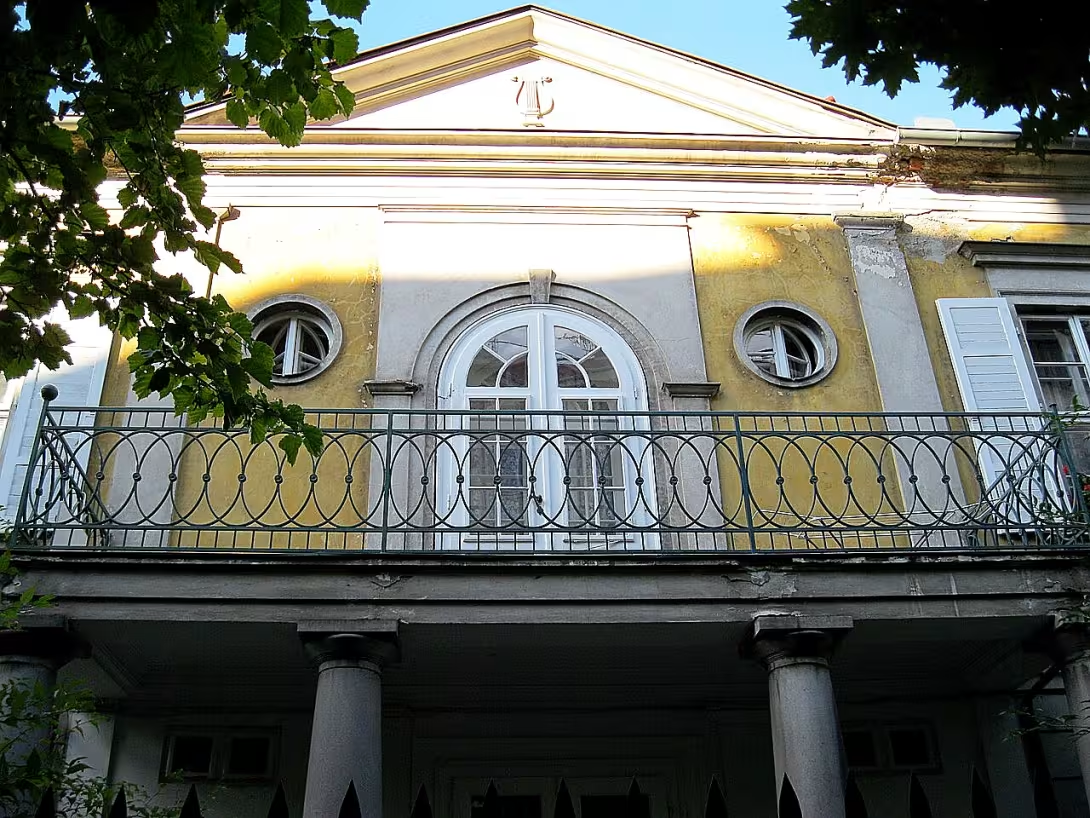
Vila Otto Zweiga at the address of Allied Class 16 in Olomouci-center represents one of the most important examples of late historical architecture. This Neo-Empire-style building was built in 1931 for the Jewish malt maker Otto Zweig. Today it is a protected cultural monument. Its architectural character, symmetrical column porticus with balcony and rich artistic details attract the attention of historians and tourists.
The history of the villa begins in 1916 when the husband and wife Hermann and Adéla Konstandt bought the property near the park. In 1919 they approached young architect Paul Engelmann and his teacher Adolf Loos to develop a project of villas with ancient elements. Although the design was prepared, the construction never took place. In 1928, they sold the land to the men of Zweigs. This happened at a time when political tensions in Central Europe intensified between the first and second world wars. In 1931 the villa was finally built according to the design of Viennese architect Franz Kuhn, who inspired himself by the Viennese Empire.
The building is characterized by its symmetrical portics and precise artistic processing. The floor object with a rectangular plan has a mansard roof covered with eternity with almost the surface of the upper part. The main facade is decorated with column porticus with balcony and tympanone with stucco lyre. The ground floor is divided into two functionally different parts. The men's apartment on this floor contains five spacious and richly equipped rooms. On the side side there is an attached garage and the rear part connects with a two-arm staircase leading to the garden.
The ownership of the villa changed dramatically during World War II. On 15 May 1942, the building was seized by the members of the Hitler Youth, leading to the tragic fate of the owners. In July of the same year, the husbands Otto and Anna Zweig went to Terezin. That's where they were deported to the Treblinka extermination camp on October 15th, where they both died.
Vila Otto Zweiga is today registered as a cultural monument and its importance goes beyond architecture. Her fate resembles the tragedy of many Jewish families during the Holocaust. It offers visitors the opportunity to explore a unique example of late historical architecture and to think about the tragic events of the past that shaped today's world.
Visiting the villa is also a reminder of the need to remember and learn from history. The architecture of the construction and the fate of its owners are important chapters in the history of Olomouce and the whole region behind the discovery.
Historical milestones
- 1916
- Mr. and Mrs. Constandt purchased land near the park.
- 1928
- Sell the land to the Zweigs.
- 1931
- Implementation of the building of the villa.
- 1942
- Taking up the villa of German youth organizations.
- 1958
- The building has been declared a protected monument.
Architectural development
The original project from 1919 for Paul Engelmann and Adolf Loose was not implemented. The final construction from 1931 was inspired by the Vienna Empire. The building has a mansard guard and facades decorated with barefoot and pillasty.
Historical events
The villa was built in 1931. On 15 May 1942, the building was seized by German youth organisations. In July 1942, the Zweigs' husbands went to Terezin.
Owners
Hermann and Adéla Konstandt (since 1916), Otto and Anna Zweig (since 1928).
Points of interest
- The villa was built in 1931 for the Jewish malt man Otto Zweig. - The building is characterized by a symmetrical column portico with a balcony and rich artistic details. - In 1919, a design was prepared with ancient elements, but the construction did not take place. The villa was built according to the design of Viennese architect Franz Kuhn. - On May 15, 1942, the building was taken by Hitler Youth.
Guide
Show guide text
This text was created by artificial intelligence and has not been editorially reviewed. It may contain inaccuracies.
Welcome to this beautiful building, which carries the echo of years ago and the elegance that we encounter so rarely in today's world. You are standing in front of Otto Zweig's villa, one of the most important examples of late historical architecture throughout our region. Before you go any further, I suggest you stop for a moment, soak up the atmosphere of this place and let the feeling of peace that brings you here a spacious garden and harmonious arrangement of the entire area. Look at the building in front of you. Its rectangular plan and balance of lines immediately give the impression of stability and nobility. Feel how architecture in symbiosis with the surrounding environment tries to create a whole that is not just a habitable house but a real work of art.
To understand why this villa is standing right here and why it looks like you see it, we need to go back deep into the past, into the early twentieth century. The story of this land did not begin in 1931, as it might seem, but much earlier. Already in 1916, Mr. and Mrs. Konstandt bought this property in close proximity to the park, putting the first stone below the future importance of this place. But then ambition had to wait. It was in 1919 that the first design was prepared, which was strongly influenced by ancient elements, but the circumstances at that time did not allow this vision to become a reality. The land remained in wait for several years until in 1928 it became the property of the Zweigs' husbands. It is for them that this location has become a symbol of a new beginning and success.
Now pay attention to the architecture itself, which now surrounds you. Notice how the building is built in the new Empire style. This style seeks to return to tradition, order and aesthetics, which act timeless. If you look directly at the main part of the building, your view will probably immediately attract a symmetrical column port. It is precisely this element that gives the villa its majestic character. The column port with the balcony forms the dominance of the entire facade and creates a deep, shadow area that gives the facade plastic and depth. Note the rich artistic details that are spread throughout the building. Although it may seem to be a simple geometric form from a distance, if you look closely, you will see a precise work that suggests a high art standard of that time. The whole building was realized according to the designs that were based on Viennese architecture, which is evident from the specific elegance and precision that you feel in every detail. On the names of architects such as Franz Kuhn, Paul Engelmann or the famous Adolf Loos, the highest expertise and influential ideas of the then Europe are merged in this building.
Let us now move on to the human destinies inherent in this construction. Imagine 1931 when the villa was completed. For her owner, Otto Zweig, this building was the express of his position and success. Otto Zweig was a Jewish malt tree, a man who in the then Olomouci represented a model of entrepreneurship and social importance. Together with his wife Anna, they probably experienced their best moments here, surrounded by the beauty of the garden and the calm of this place. The villa wasn't just their home, it was their family's business card.
However, history often has its dark and unexpected pages. If you look at the building, you may not realize how deep the shadows fell on this house in later years. In 1942, during the darkest chapters of our century, the villa was violently captured by German youth organisations. The space that was created for family happiness and privacy became an instrument of other ideology. This sudden and drastic shift in the use of the building reminds us how fragile the existence of even the most beautiful architecture can be in confrontation with history. Fortunately, however, the building was saved and in 1958 it was officially declared a monument protected object, thereby ensuring that its legacy remains preserved for future generations.
If you have an appetite for further discovery, pay attention to one interesting thing that carries a hint of mystery. You may have noticed the unusual harmony and classical proportions. It is interesting that if we saw the construction in its original, undone form from 1919, it would look much more like an ancient temple than this elegant villa. It is this transition from strictly ancient elements to the sophisticated new empirical style that you see now shows the fascinating development of aesthetic perception between the two world wars. It's like the building went through its own evolution before it finally formed into the form you admire today.
Now I'm not going to slow you down any more. I suggest you walk around the entire area, observe how light changes on the facade and how the garden intertwines with the architectural lines of the house. Every corner of this villa has a story waiting for you to reveal it with your own eyes. Thank you for spending this moment with me and for being interested in this important piece of Olomouc history. I wish you a pleasant continued walk and I hope that this view from the past will leave you with a permanent quite. Goodbye.
Tips for visitors
The best time to visit is in the spring or autumn season, when the weather is pleasant and the park around the villa offers a beautiful view. This period also allows you to photograph the building in favourable light conditions, when the sun is lower in the sky and illuminates the architecture in an attractive way.
Parking is located near the park around the villa. You can also use public transport, which is available for passengers to Olomouce. Check the current connection and transport options before visiting.
When planning a visit, bring a hat or a parasol to protect the sun. It is also important to have suitable shoes for walking around the park and perhaps some light clothes if you plan to spend more time outside.
The best place for photography is on the north side of the building, where architectural details are illuminated with excellent light. Don't forget to include the park in your pictures, which gives the overall picture a romantic atmosphere.
In the surroundings you can visit other historical monuments Olomouce. The park around the villa offers a peaceful walk, which can be an ideal leisure activity for families with children. Children can also enjoy the park space to play.
Businesses nearby
Do you run a restaurant, accommodation, shop, museum, rental, wellness or other visitor service near this monument? Show yourself directly to the people heading to it — this is how they will see you in the app and on the web:
Nearby
There's a park nearby.
Accommodation nearby
Trips and activities nearby
Guided tours, tickets and activities nearby from GetYourGuide
Affiliate link: if you buy from the partner, we may receive a commission. The price for you does not change.
Search tours and activities →Themed route
1. Vila Otto Zweiga (facade) - Admire the exterior appearance and architectural elements of the construction. 2. Vila Otto Zweiga (interiors) - Explore internal rooms and exposition. 3. Park (surrounding greenery) - Take a walk in the adjacent park and enjoy the peace.
Seasonal recommendations
Spring brings to the garden the awakening of nature and fresh colors of flowering trees. Soft spring light highlights the facade details and creates an optimistic atmosphere. We recommend wearing layers of clothing because the weather is variable. The ideal time for visiting is in the morning when the air is the cleanest and parks look best.
The summer season is characterized by a dense shade of foliage and intense colors surrounding the green. The sun hits the building sharply, creating significant contrasts and rich shades. Due to the high season and the higher attendance, it is advisable to come right at the opening to avoid crowds. Don't forget light, breathable clothes and plenty of fluids.
Autumn around the villa is melancholy thanks to golden leaves and frequent morning fog. The atmosphere is calmer and light becomes golden, which is ideal for observing architecture in softer tones. It is practical to wear moisture resistant shoes and a warm sweater. The best is to plan a visit until late afternoon when the light is most moody.
In winter, the memory is dominated by silence and minimalist appearance of naked branches that can be covered with fine frost. The atmosphere is cramped and intimate, which allows you to focus more on the construction itself. It is necessary to choose warm, waterproof clothes and to verify shortened opening times. We recommend a visit in the morning when natural light is strongest.
Visualizations and artistic views

The visualisations are generated by artificial intelligence and serve as inspiration.
Photos from the area
Real photos taken near the monument


Zdroj a licence jsou uvedeny u každého snímku.
Tips from visitors
No tips yet. Be the first!
Log in and add your tip.
Sources and literature
Fotografie: Lehotsky / CC BY-SA 3.0 — Wikimedia Commons. The author and licence also appear when you hover over the image.
Faktickým podkladem tohoto textu byl článek na Wikipedii, jehož autory jsou přispěvatelé Wikipedie. Článek je dostupný pod licencí CC BY-SA 4.0.
Location on the map
Příběhy a pověsti
Legendy, pověsti a příběhy spjaté s touto památkou
Fotografie návštěvníků
Zatím žádné fotografie. Buďte první, kdo přidá fotografii z návštěvy!
Přihlaste se a přidejte svou fotografii nebo hodnoťte.
Za ověřenou návštěvu v aplikaci získáte víc bodů — poznáme podle GPS, že jste na místě.
Reviews and comments