






Vinohradská vodárenská věž Water tower
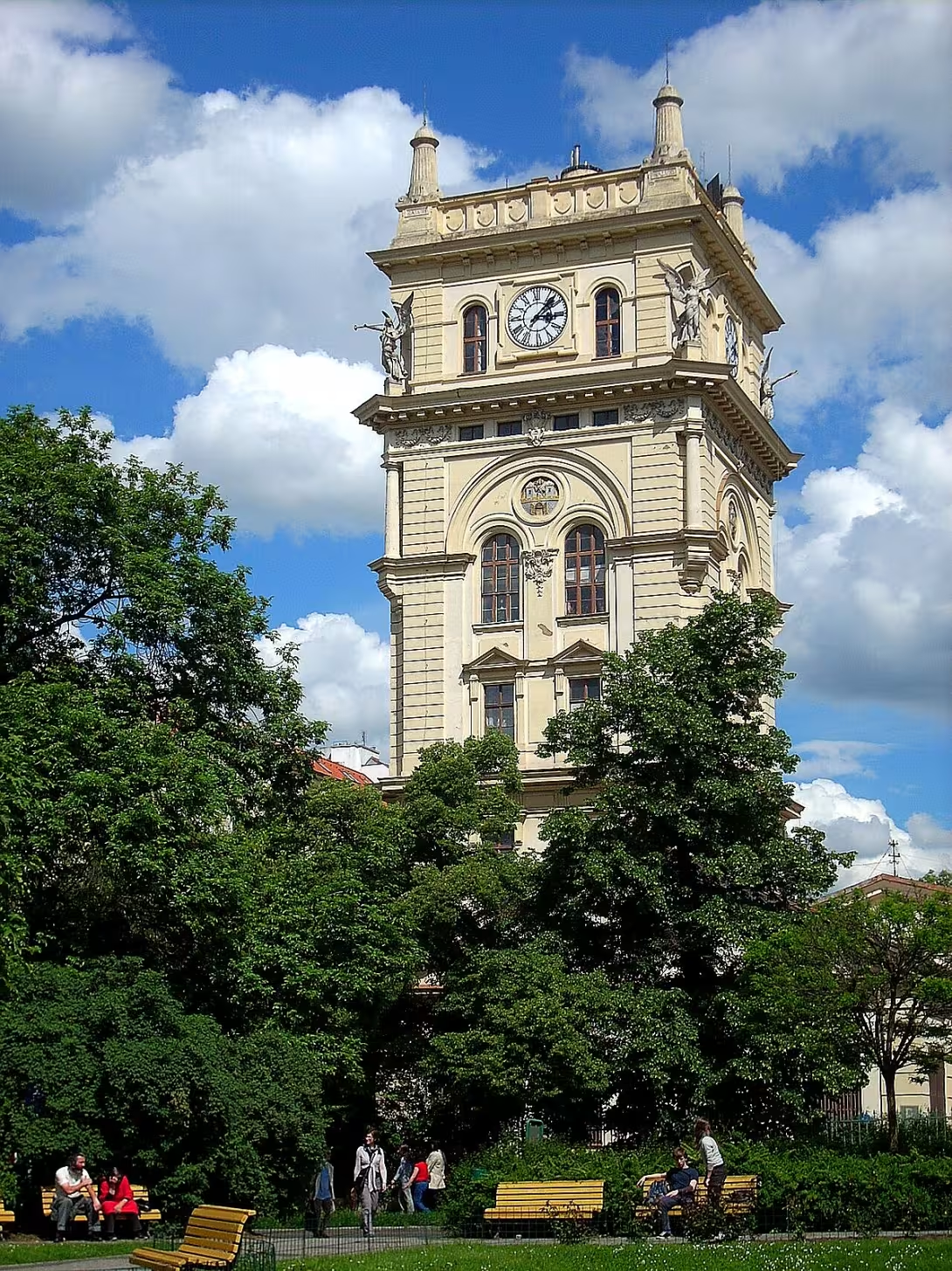
Vinohradská vodárenská věž is a neo-Renaissance water work from 1882, located on Crown Street in Prague 10. Originally, it was a key part of the water supply system of the city of Royal Vinohrady and is now being converted into an information centre on the water of Hydropolis.
The construction, designed by architect Antonín Turk, was part of a complex system for water supply, which included a water plant in Podoli, underground water and gas stations. In 1891, the system was extended by two-chamber underground water and a new boiler room. The original steam engines were replaced by electric pumps after 1914.
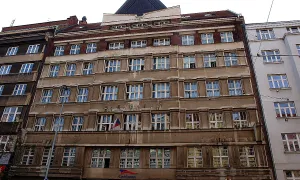
The building is a seven-storey prism tower with a neo-Renaissance facade decorated with statues of honking angels on corner pylons. There are hours on the attics and below them there are signs of the Royal Vinohrad in circular medallions. At a height of 40 metres there is a sightseeing terrace, which served as a lookout tower with a view up to the Giant Mountains. The building is part of the City Monument Zone Vinohrady, Žižkov, Vršovice.
In 1962, both the gas station and the tower water station were disabled and the tower was subsequently converted into a residential area. In 1991 the building was declared a cultural monument, and in 1993 a reconstruction took place with a restaurant of sculptures. In the mid-1990s the building was taken over by the capital city of Prague from the Prague Waterways.
Since 2024, a large reconstruction of the building has taken place to the Hydropolis water awareness centre, which is expected to be opened in the autumn of 2027.
Vinohradská vodárenská věž is an important technical and architectural element of Prague infrastructure from the end of the 19th century. When the reconstruction is completed, it will serve as a modern educational space worth visiting.
Then and now
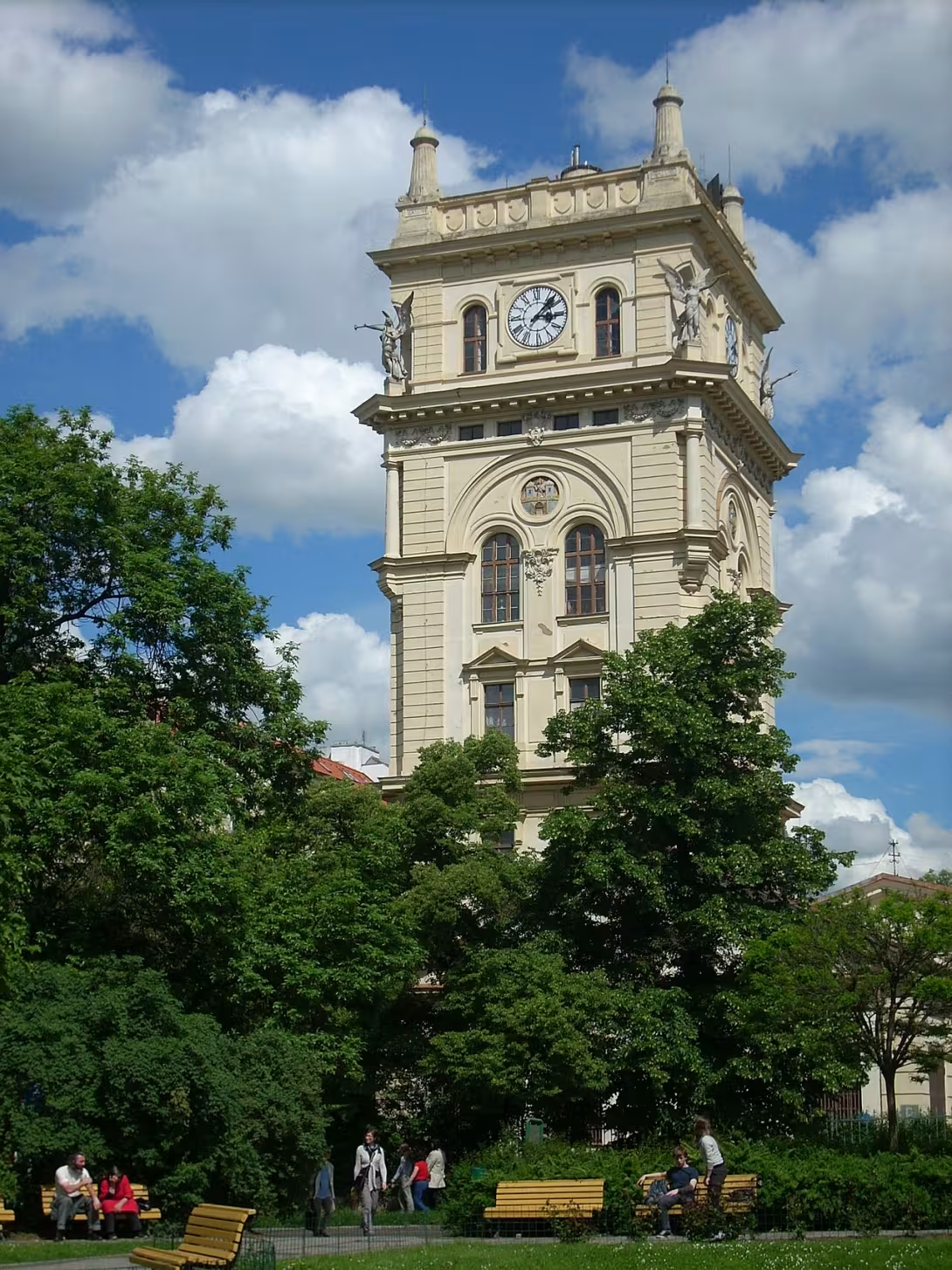
Drag the slider to compare how the landmark may have looked when it was built with the view today.
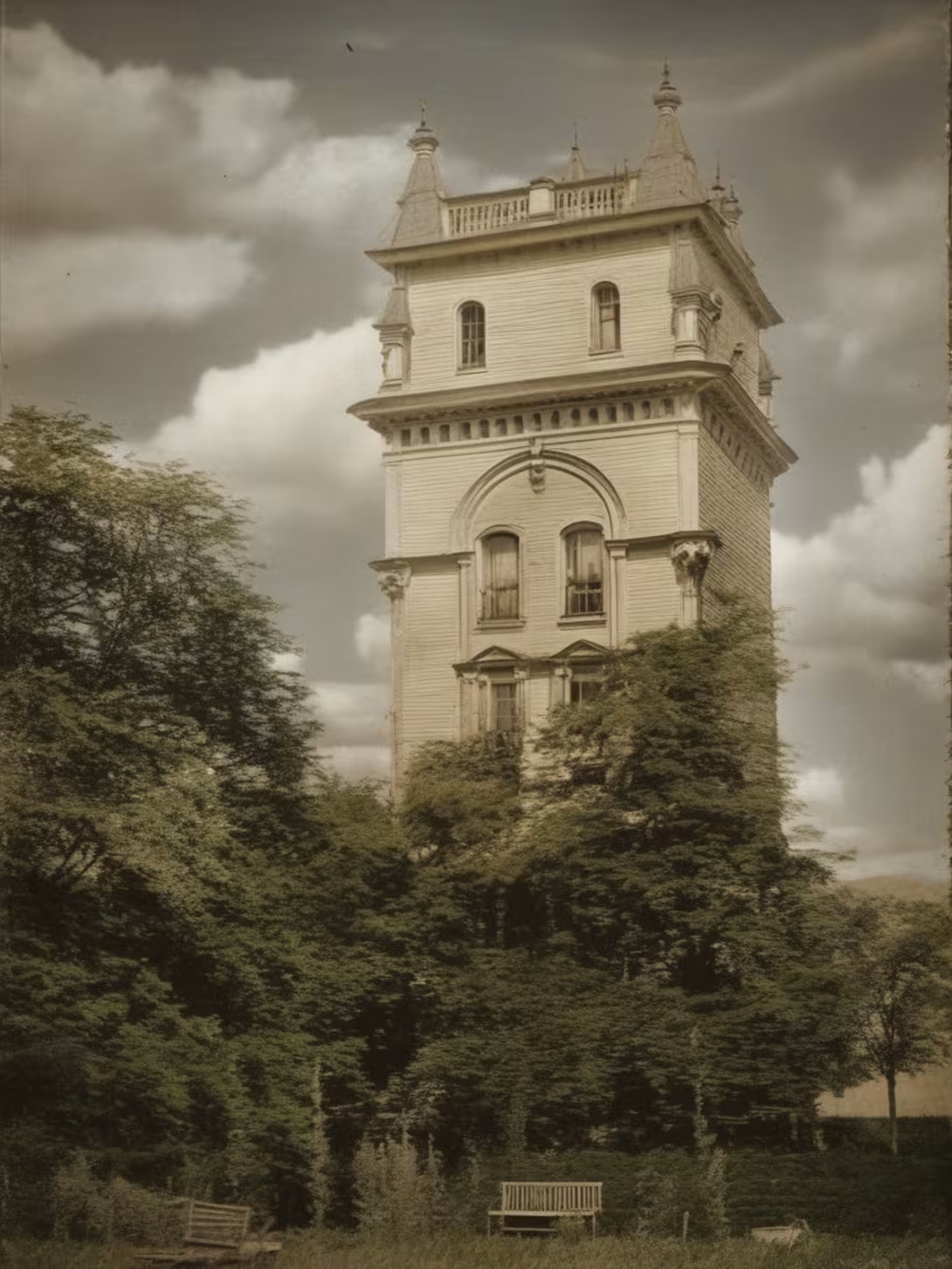
The historical appearance on the left is an AI-generated visualisation and serves as inspiration only.
Historical milestones
- 1882
- Position of the tower in the neo-Renaissance style
- 1891
- Completion of underground water tower and new boiler room
- 1962
- Decommissioning and conversion to residential premises
- 1991
- Declaration of construction for cultural monument
- 2024
- Beginning of the reconstruction to the Hydropolis Lighting Centre
Architectural development
The construction was built in a neo-Renaissance style according to the design of architect Antonín Turk. In 1891 it was supplemented with an underground water and a new boiler room. In the past, the sculpture decoration was renovated and the building is now converted into a modern lighting centre.
Historical events
1882: Tower position, 1891: Completion of underground water and boiler room, 1962: Discharge and conversion to flats, 1991: Declaration for cultural monument.
Owners
Prague Water Works (until the mid-1990s), Prague Capital City (since the mid-1990s)
Points of interest
- It's a neo-Renaissance water work from 1882 designed by architect Antonín Turk. - The building is a seven-storey prism tower with angel statues and a view terrace at 40 meters high. - From the sightseeing terrace there is a view to Giant Mountains. - In 1962, the tower was disabled and converted into an apartment space. - The original steam engines were replaced by electric pumps after 1914.
Guide
Show guide text
This text was created by artificial intelligence and has not been editorially reviewed. It may contain inaccuracies.
Welcome to the heart of Prague's Vinohrads. Right now you're facing one of the most distinctive and interesting buildings in this part of town. Stop for a second, take a deep breath and just look up. In front of you is Vinohradská vodárenská věž, a building that combines practical engineering design with the aesthetic beauty of past epoch. It is a building that dominates the landscape of Vinohrady and reminds us of a time when the city was rapidly developing and looking for modern ways to ensure the basic needs of its inhabitants.
Let us now return together in time more than 140 years ago. We're in 1882. At that time, Royal Vinohrady was an ambitious project, a new urban neighborhood that grew like a sponge. With this growth, the necessary need has come to build a reliable supply system for drinking water. That's why this tower was built. However, it was not just an ordinary utility building, but part of a complex water work that included a filling station and large underground tanks. The whole project was intended to ensure a stable water economy so that both residents and companies in this part of Prague did not have to fight water shortages.
Now, if you focus on the building itself again, pay attention to its appearance. The architect Antonín Turk, who designed this construction, chose a neo-Renaissance style. This means that the building draws inspiration from the Renaissance, but interprets it in the spirit of the late nineteenth century. Look at its overall form. It's a seven-story prism tower, which, with its stability and rhythm, seems very noble. Note the details on the facade that give the construction a human dimension and a poetic touch. If you look carefully, you'll see statues of angels who seem to be guarding this source of life that the water for the city was. It's fascinating how the architect Turk was able to turn a purely technical object, such as water, into a real work of art.
Now pay attention to the height of the building. Tower is 40 meters high. At that time, it was a real dominance from which to monitor the surroundings. On the very top there is a sightseeing terrace. Imagine how the people who stepped on it must have felt. From this point it is possible to look to the remote Giant Mountains in good visibility. It's an incredible contrast when you're standing in the center of a busy city and you can see the highest mountains of our countries in the distance.
However, the history of this tower is not only about water and architecture, but also about constant changes and adaptation to new times. After the basic construction in 1882, the system continued to expand. In 1891, construction of underground water tower was completed and a new boiler room was built to make the system work even more efficiently. The tower thus served as the heart of the Vinohradsky water system for many decades.
Just imagine how many generations of Pražani had running water in the taps thanks to this construction. However, as technology evolved and the city grew, the old systems became obsolete. The year 1962 came, which in the life of the tower was a major turning point. The water tower has been disabled. Instead of being demolished, which happened in many older buildings at the time, there was a very unusual decision. The building was converted into an apartment space. Imagine how strange it must have been to live in a former water tower. Instead of the thunder of pumps and the noise of water, there were suddenly noises of normal family life, cooking in the kitchens and reading in the rooms. The tower became a home from the technical object.
But this unusual fate of the building led to people becoming more aware of it as an architectural unique. In 1991, Vinohradská vodárenská věž was officially declared a cultural monument. This recognised that its value exceeds its original benefit and is an important witness to the history of Prague's engineering and urbanisms.
And now we're getting to the present. If you look at the building today, you may notice signs of change. In 2024, a new, very ambitious chapter began in the history of this place. The tower is undergoing extensive reconstruction because it becomes an education center called Hydropolis. It's a poetic circle of fate. The building that once served to distribute water is now a place where people will be told the story of water, its importance to life and the way in which we are to treat it in the future. From the apartment house it returns to what it was from the beginning - to water, although not in the form of supply, but in the form of education and education.
Now that you're standing in front of this seven-story tower, try to imagine the invisible world beneath your feet. There were once large tanks and pipes beneath the surface of the aisle that formed a complex network. It was all controlled from this center, which you are now seeing. It is a reminder that many of the things that we take for granted today, such as water in our homes, have required enormous efforts in the past, brilliant plans of architects such as Antonín Turk, and the courage to build things that serve generations.
Take one last look up to the angels and the scenic terrace. Feel the atmosphere of this place, where it meets the neo-Renaissance elegance with industrial history and modern vision of education. Vinohradská vodárenská věž is not just a pile of bricks and stone, it is a living organism that was changing along with Prague.
Now we invite you to move on slowly and explore the surrounding streets of the Vinohrads, which are filled with similar hidden jewels. Perhaps in the future your steps will lead you inside Hydropolis when the reconstruction is complete, and you will be able to experience the atmosphere of this unique place in person. Thank you for spending a moment with us at this fascinating monument. We wish you a pleasant continuation in your discovery of beautiful Prague. Goodbye.
Tips for visitors
For the best visual experience we recommend a visit on clear days, when the Neo-Renaissance details of the building are most visible. However, due to the ongoing reconstruction, it is necessary to check in advance whether the object is accessible to the public at the moment.
Transport to the place is possible by combination of public transport and by car. Please check the current connection and parking possibilities in the surrounding area using internet search engines or mobile applications for urban transport.
When visiting, it is recommended to bring drinking water and comfortable shoes for possible walks. It is ideal for families with children to use time to walk in nearby neighborhoods that offer an interesting urban atmosphere.
For photo lovers, the best moments during the morning or late afternoon hours are when the light is softer and better accentuates the architecture of the tower. The best angles for images can be found from nearby streets around the monument.
After the tour you can go for a walk in the neighboring urban areas such as Vinohrady, Žižkov or Vršovice, which are part of the monument zone and offer many other attractions.
Businesses nearby
Do you run a restaurant, accommodation, shop, museum, rental, wellness or other visitor service near this monument? Show yourself directly to the people heading to it — this is how they will see you in the app and on the web:
Events nearby

Zdroj akcí: otevřená data měst a obcí ČR (Národní katalog otevřených dat) a kalendář akcí Národního památkového ústavu.
Nearby
Městská památková zóna Vinohrady, Žižkov, Vršovice
Accommodation nearby
Trips and activities nearby
Guided tours, tickets and activities nearby from GetYourGuide
Affiliate link: if you buy from the partner, we may receive a commission. The price for you does not change.
Search tours and activities →Themed route
1. City Monument Zone Vinohrady (type: Monument Zone). It offers a walk between historic buildings with beautiful architecture. 2. Vinohradská vodárenská věž (type: water work). The main destination of the trip, which represents a unique technical monument. 3. Žižkov (type: urban district). It is sought after for its specific atmosphere and hilly streets. 4. Vršovice (type: city district). They complete the route by looking at neighbouring historical surroundings.
Seasonal recommendations
In the spring around Vinohrad comes to life and the trees start to gain fresh green color. The light is delicate and pleasant in this period for the observation of architecture and ongoing work. I recommend visiting the morning hours when the air is the cleanest. Dress well because spring weather is very variable and morning cold can be surprising.
In summer, the moon brings intense sunlight and full vegetation, which guards historical objects. Due to higher temperatures and more people around it is best to arrive at the beginning of the day. Don't forget enough fluid and protective headgear if you move near the building sites.
Autumn season offers a melancholy atmosphere and wonderful golden shades in nearby parks. Morning fog gives the water tower a mysterious touch. It is advisable to wear waterproof shoes and warmer layers of clothing because humidity and cooler air are common at this time.
In winter the daylight is short and the air is sharp, highlighting the shape of the building and temporary scaffolding. The atmosphere is quieter in the streets and the traffic is the lowest. It is necessary to choose a very warm outfit and schedule a tour so that it can be done within a short light hours before the darkness begins soon.
Visualizations and artistic views


The visualisations are generated by artificial intelligence and serve as inspiration.
Photos from the area
Real photos taken near the monument

Zdroj a licence jsou uvedeny u každého snímku.
Tips from visitors
No tips yet. Be the first!
Log in and add your tip.
Sources and literature
Photos: Eliška Jindříšková / CC BY-SA 3.0 — Wikimedia Commons. The author and licence also appear when you hover over the image.
Faktickým podkladem tohoto textu byl článek na Wikipedii, jehož autory jsou přispěvatelé Wikipedie. Článek je dostupný pod licencí CC BY-SA 4.0.
Location on the map
More monuments – Vinohrady
Show all in the municipality
Příběhy a pověsti
Legendy, pověsti a příběhy spjaté s touto památkou

Fotografie návštěvníků
Zatím žádné fotografie. Buďte první, kdo přidá fotografii z návštěvy!
Log in a přidejte svou fotografii nebo hodnoťte.
Za ověřenou návštěvu v aplikaci získáte víc bodů — poznáme podle GPS, že jste na místě.
Reviews and comments