



Vinohradský hřbitov Cemetery
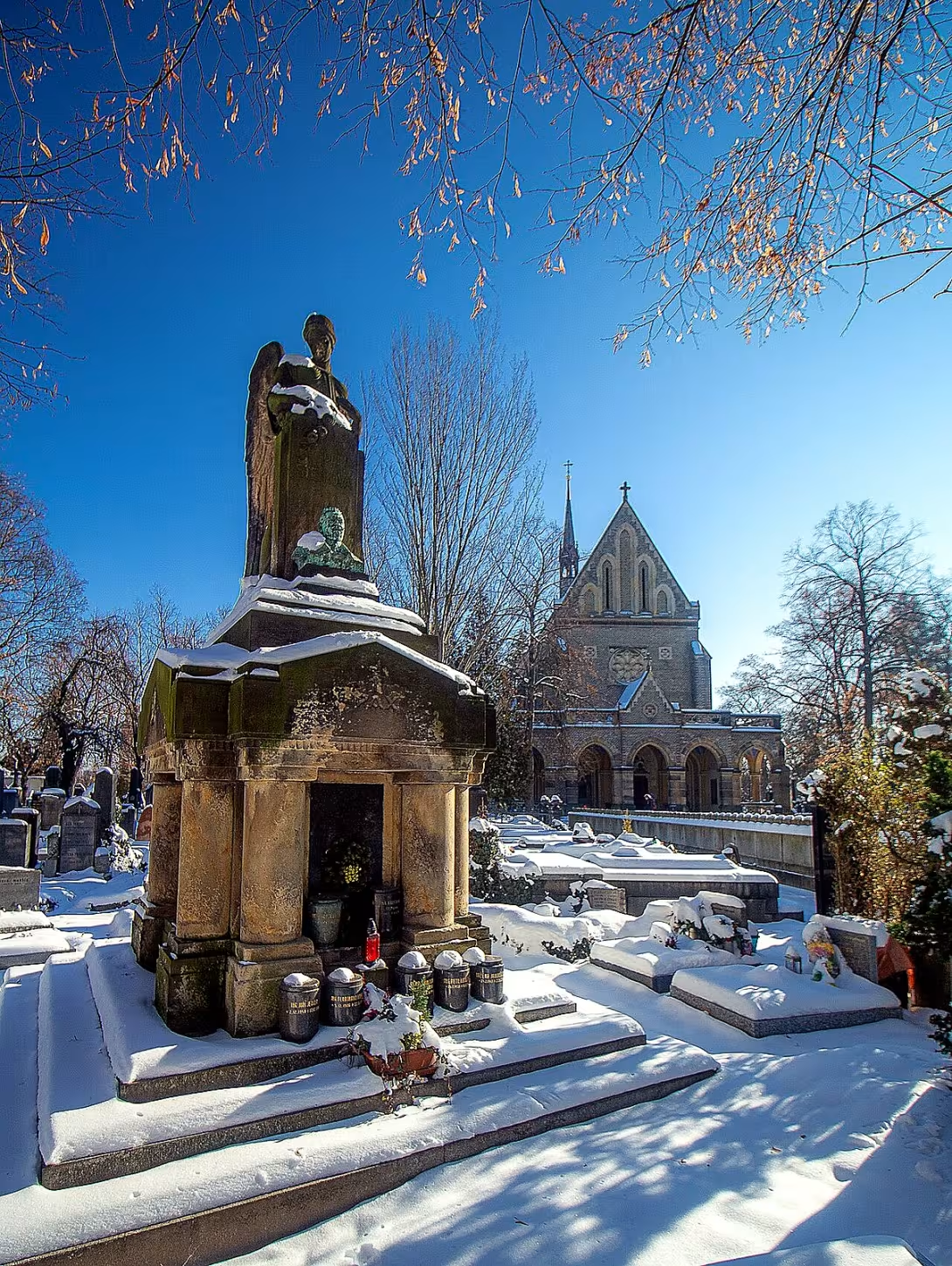
Vinohradský hřbitov is a public burial ground in Prague's Prague 10, founded in 1885. According to the number of buried, it is the third largest cemetery in Prague, registered in the state list of real cultural monuments.
The creation of the cemetery in 1885 was related to the development of Vinohrad. The growing number of Prague townships during the period of historism has provoked the need for new burial facilities. In the early days, the complex was used primarily to store the remains of rich families from this environment.
The area was gradually expanded in three stages. The first took place in 1897 when St. Wenceslas Chapel was built in the centre of the cemetery. The second took place in 1912 and the third in 1922. Most tombs and tombs come from the turn of the 19th and 20th centuries and from the period of the first republic.
The building management is provided by the contribution organization Høbitova and funeral services of Prague, namely the cemetery administration Vinohrady. On the east and south side, the place of the creepy crematorium is connected.
This place is significant thanks to the high number of people buried in culture, science, politics and sport. These include, for example, the first President of the Czech Republic Václav Havel and his wife Olga Havlová, the writer Jaroslav Foglar, architect Jan Kotera, sculptor Otto Gutfreund or the first graduate doctor in Bohemia Anna Honzáková. The music composers Julius Fučík and Viktor Kalabis, journalist Egon Erwin Kisch and car racers Čenek and Elišek Junko are also stored here.
The cemetery is easily accessible by tram lines passing through the Vinohradska class. The Vinohradský cemeteries stop is located right at the entrance.
The monument represents a valuable archive of Prague history and social development. Visiting this place allows you to know the fates of important personalities who shaped Czech culture and society.
Then and now
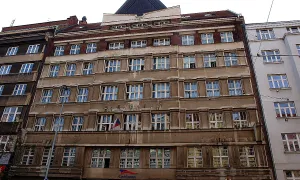
Drag the slider to compare how the landmark may have looked when it was built with the view today.
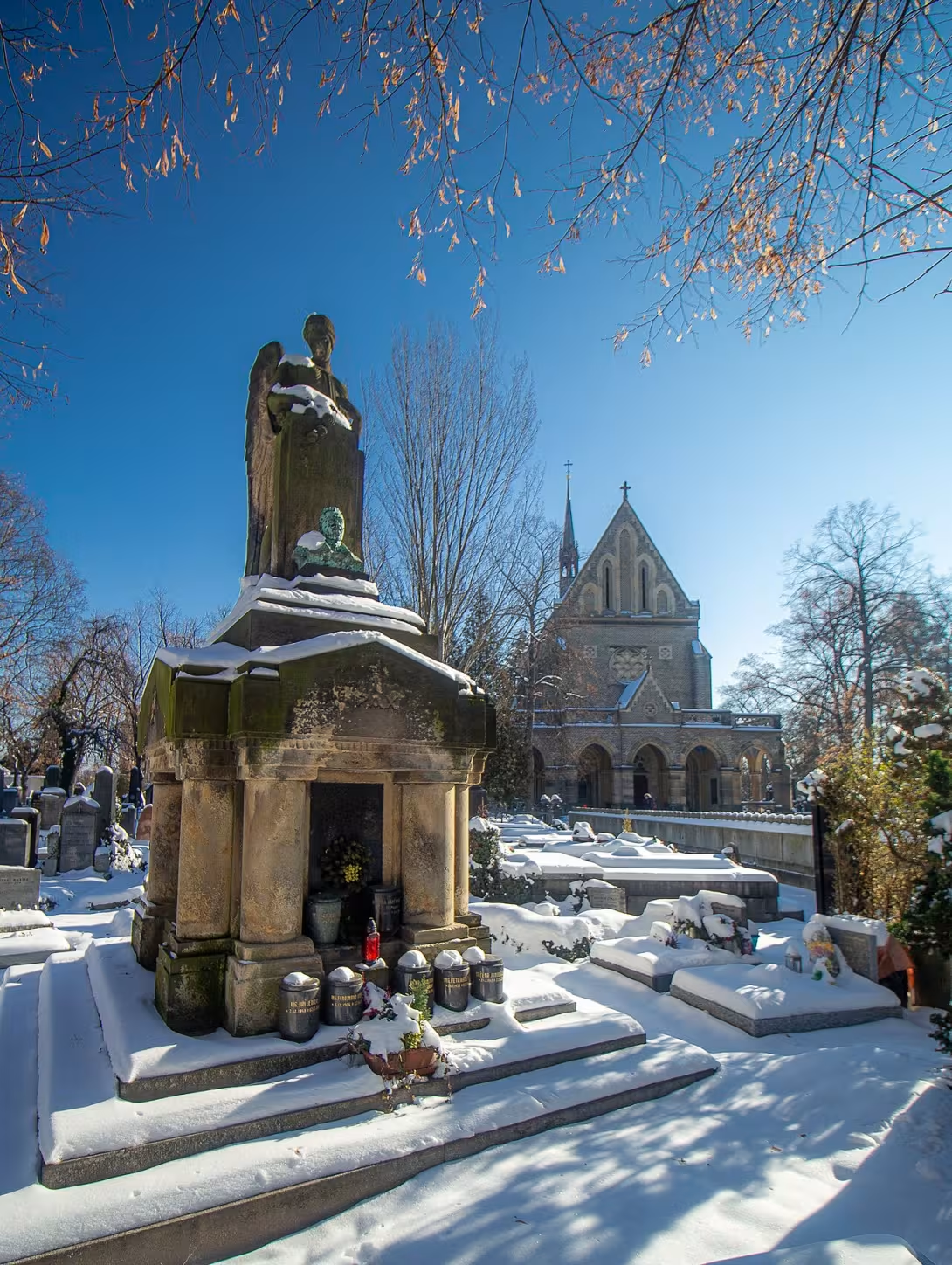
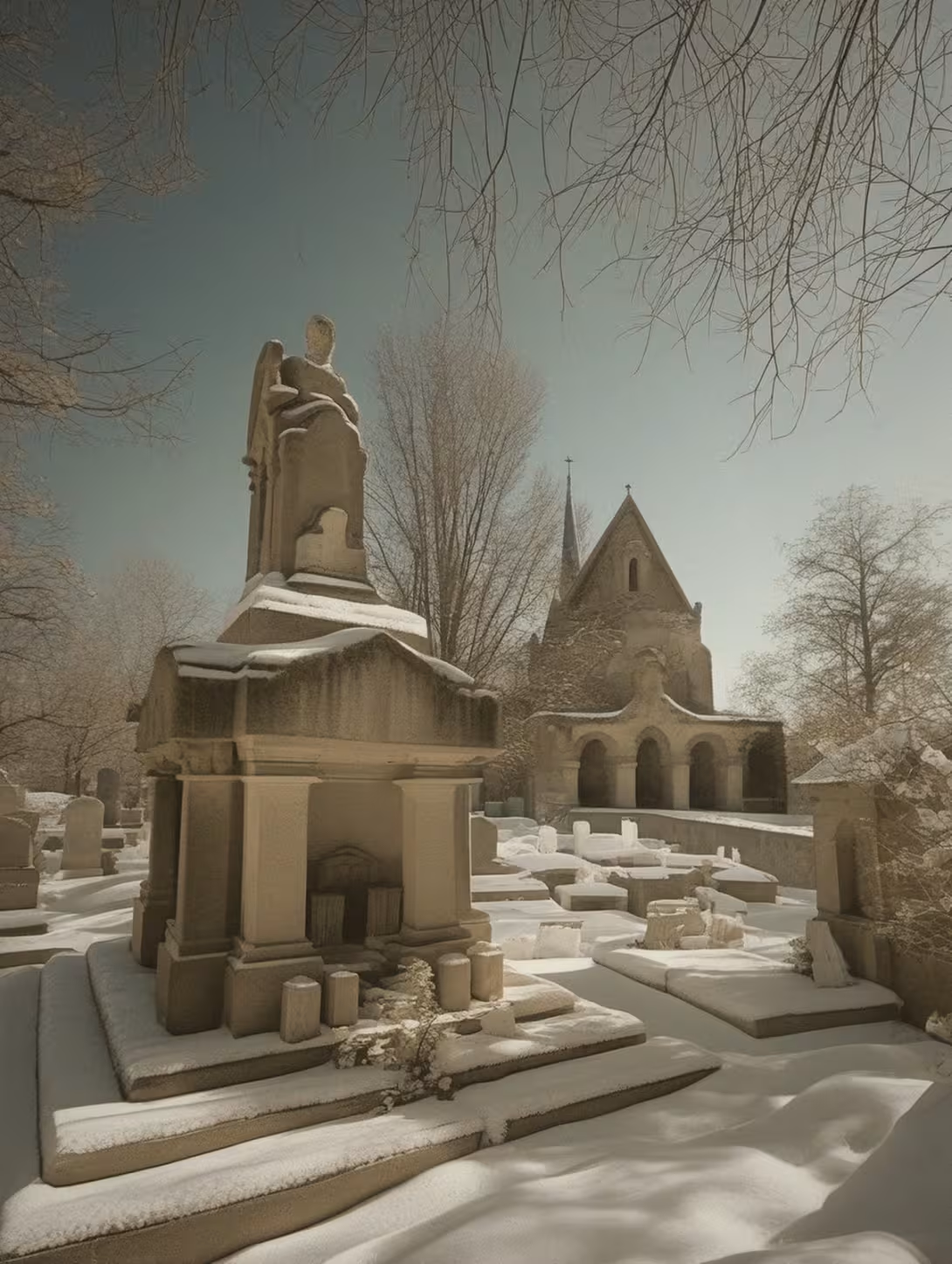
The historical appearance on the left is an AI-generated visualisation and serves as inspiration only.
Historical milestones
- 1885
- The establishment of the Vinohradsky cemetery.
- 1897
- The first expansion of the cemetery and construction of the chapel of St. Wenceslas.
- 1912
- Second extension of the compound.
- 1922
- The third expansion of the cemetery.
Architectural development
The cemetery was gradually expanded in three phases. In 1897 the chapel of St. Wenceslas was built in the centre of the complex. Most tombs and tombs come from the turn of the 19th and 20th centuries and from the time of the first republic.
Historical events
The creation of the cemetery in 1885 and its subsequent enlargement in 1897, 1912 and 1922.
Owners
Cemetery and funeral services of Prague, Cemetery administration Vinohrady
Points of interest
- The cemetery was founded in 1885 and is the third largest in Prague. - It's listed in the state list of real-estate cultural monuments. - In 1897 the chapel of St. Wenceslas was built in the centre of the complex. - The location is a significant high number of people buried in culture, science, politics and sport. - Václav and Olga Havlov, Jaroslav Foglar or Anna Honzáková are stored here.
Guide
Show guide text
This text was created by artificial intelligence and has not been editorially reviewed. It may contain inaccuracies.
Welcome, distinguished visitors. You are standing just outside the gates of the Vinohradské cemetery, a place that combines silence, respect and the deep history of one of the most beautiful approximately century-old areas in Prague. Now, if you look in front of you, you will see a vast space that serves as the final resting place. Feel the atmosphere of this place where the natural greenery intersect with the ranks of graves and monuments. It is a space that, at first glance, welcomes you with its peace and dignity, which is very rare in the heart of a busy city.
Now let's look together at how this place came to be. Vinohradský hřbitov was founded in a thousand eight hundred and eighty-five. At that time it was about the need to create a dignified public burial ground for the growing Prague suburbs. It was not originally intended for all. It was mainly used to store the remains of the families of rich Prague townspeople who wanted for their nearby place to reflect their social status and property. That is why this place is so special today in terms of its history and appearance.
When you start walking slowly through the area, pay attention to the surrounding architecture. Notice the tombs that will surround you. There are mainly works from the turn of the nineteenth and twentieth centuries, but also from the period of the first republic. It is this combination of periods that creates the unique character of the entire complex. Follow the details on the monuments and see how the taste and style changed over the decades. Due to its value, the whole complex is listed in the state list of real cultural monuments, which means it is protected as an important part of our national heritage.
It's also interesting how the cemetery expanded in time. The original area of a thousand eight hundred and eighty-five was not sufficient, so several stages of enlargement occurred. The first enlargement took place in the year of a thousand eight hundred ninety-seven, when the chapel of St. Wenceslas was built in the centre of the complex. If you look around now, look for this very building, which is the spiritual center of the entire space. Further enlargement followed in the year one thousand nine hundred twelve and then in the year one thousand nine hundred twenty-two. These gradual expansion shows how the rós cemetery together with the development of the surrounding Vinohrad.
Now I want to invite you to think about the people who are resting here. Vinohradský hřbitov is not only a set of rocks and greenery, but mainly a library of lives. It is the third largest cemetery in Prague according to the number of buried and there are a large number of personalities that have fundamentally influenced Czech culture, science, politics and sport.
If you go through the tombs, you might find names you know from school books or newspapers. For example, important political leaders such as Václav Havel or Emil Hácha are stored here. If you are interested in the world of literature and thinking, you will find here tombs of personalities like Jaroslav Foglar or Jan Gebauer. For art and architecture lovers there are Otto Gutfreund or František Václav Goller.
Všimněte si také jmen z oblasti vědy a kultury, jako jsou například Jan Friedländer, Oskar Fischer nebo Julius Fučík. Seznam osobností je velmi dlouhý a zahrnuje i takové jména jako Zdenka Baldová, Karel Barvitius, Otakar Batlička, Jiří Bažant, Marie Bečvářová, Vlastimil Bedrna, František Běhounek, Emil Bergmann, Hugo Boettinger, Blanka Bohdanová, Zdeněk Borovec, František Borový, Eva Bosáková, Josef Ceremuga, Karel Matěj Čapek-Chod, Jaroslav Čeleda, František Alexander Elstner, Jan Fadrhons, Helena Friedlová, Jaroslav Gleich, Bohumila Grögerová, František Gross, Jiří Grossmann, Josef Gruss, Darja Hajská, Elena Hálková, Mirko Hanák, Jarmila Hašková nebo Miloš Havel. Každý z těchto náhrobků vypráví svůj vlastní příběh o životě, úspěchu a konečném loučení.
Now let's stop at one interesting thing that may not be visible at first sight, but it gives this place depth. Imagine that this quiet place in the year one thousand eight hundred and eighty-five was a symbol of the modern development of Prague. The fact that it is a cultural monument today is not just because of architecture, but because of how powerful the various layers of society are represented here. From rich townspeople to the most important statesmen and artists. It is the mirror of Prague history, where people lie next to each other who may never have spoken, but in death they share one common, peaceful space.
The mystery remains the creators of many of these beautiful tombs. Although there are high-level works, the authors of many remain unknown. It is fascinating to think that anonymous craftsmen and architects have created a space that thousands of visitors admire today and serves as a monument to Czech identity.
Now that you know the basic contours of this place, I suggest you continue your walk at your own pace. Let yourself be led through the streets between the tombs, stop by the names that interest you, and feel the silence that rules here. Watch how the light moves through the trees and how the details of the old monuments change with every step you take.
Vinohradský hřbitov is a place for contemplation and silent admiration of history. I hope that this brief introduction has helped you to better understand the importance of this complex and that you will take a sense of peace and respect from it to those who rest here. Explore the rest of the complex, visit the chapel of St. Wenceslas and let the history of Prague 10 consume you.
Thank you for your attention and I wish you a peaceful and inspiring walk. Goodbye.
Tips for visitors
The best time to visit is late autumn or spring, when the colour of old trees accompanies a quiet atmosphere of the place. Transport is possible by car and public connections; Check the specific routes and connections in the maps. When walking we recommend to take comfortable shoes for walking along the cemetery paths and plenty of water. For photo lovers, morning or late afternoon hours are best, when the low light highlights the details of old tombstones and monuments. In the nearby area you can visit the Vinohradian class or the creepy crematorium. Families with children can use the place to quietly observe nature and study the history of old families.
Frequently asked questions
Can the monument be visited?
Cemeteries and graves are usually accessible; please respect the dignity of the place. We have not verified the opening hours of this cemetery.
Where is the monument?
Location: Vinohrady. The map on this page shows the exact spot.
Why is the monument protected?
It is listed in the Central List of Cultural Monuments of the Czech Republic as a cultural monument (register no. 1000156917).
Businesses nearby
Do you run a restaurant, accommodation, shop, museum, rental, wellness or other visitor service near this monument? Show yourself directly to the people heading to it — this is how they will see you in the app and on the web:
Events nearby

Zdroj akcí: otevřená data měst a obcí ČR (Národní katalog otevřených dat) a kalendář akcí Národního památkového ústavu.
Nearby
Vinohradská třída, strašnické krematorium.
Accommodation nearby
Trips and activities nearby
Guided tours, tickets and activities nearby from GetYourGuide
Affiliate link: if you buy from the partner, we may receive a commission. The price for you does not change.
Search tours and activities →Themed route
1. Vinohrady class Type: Road Why: This journey serves as an ideal starting point for arriving in this part of the city.
Vinohradský hřbitov Type: Funeral area Why: The main destination of your trip where you can discover historical monuments and peaceful journeys.
3. Type: Building Why: This construction is part of the local area and represents the final point of the route.
Seasonal recommendations
Spring: In the spring, this place awakens to life. The trees start to green and the first flowers appear on the beds, creating a fresh and hopeful atmosphere. The light is soft and soft in this period. It is advisable to take layered clothes because the morning cold can still feel. The best time to visit is in the morning when the atmosphere is quietest.
Summer: In the summer months there is a rich green and high crown trees offer a pleasant shade. The sun shines strongly and creates sharp contrasts between monuments. I recommend you choose light clothes and take water with you. It is ideal to visit a place in the late afternoon when the air is more pleasant and the light is golden.
Autumn: Autumn brings melancholy and wonderful color changes to space. Leaf turns colour into yellow and brown, which creates a colour carpet on the road. The morning fog gives the place a special mystery. It is important to have firm shoes suitable for wet and warmer layers of clothing. The sun is low, which highlights the shape of the monuments.
Winter: Zimą makes the cemetery very quiet and raw. The bare branches of trees and any frost or snow create a sense of calm and stopping. Days are short and light is weak. It is necessary to cover yourself thoroughly in warm clothing, including gloves and scarves. It's best to come around noon to use the longest light during the day.
Visualizations and artistic views


The visualisations are generated by artificial intelligence and serve as inspiration.
Photos from the area
Real photos taken near the monument

Zdroj a licence jsou uvedeny u každého snímku.
Tips from visitors
No tips yet. Be the first!
Log in and add your tip.
Sources and literature
Photos: VitVit / CC BY-SA 4.0 — Wikimedia Commons. The author and licence also appear when you hover over the image.
Faktickým podkladem tohoto textu byl článek na Wikipedii, jehož autory jsou přispěvatelé Wikipedie. Článek je dostupný pod licencí CC BY-SA 4.0.
Location on the map
More monuments – Vinohrady
Show all in the municipality
Příběhy a pověsti
Legendy, pověsti a příběhy spjaté s touto památkou
Fotografie návštěvníků
Zatím žádné fotografie. Buďte první, kdo přidá fotografii z návštěvy!
Log in a přidejte svou fotografii nebo hodnoťte.
Za ověřenou návštěvu v aplikaci získáte víc bodů — poznáme podle GPS, že jste na místě.
Reviews and comments