



Vodní mlýn Bešťák Water mill
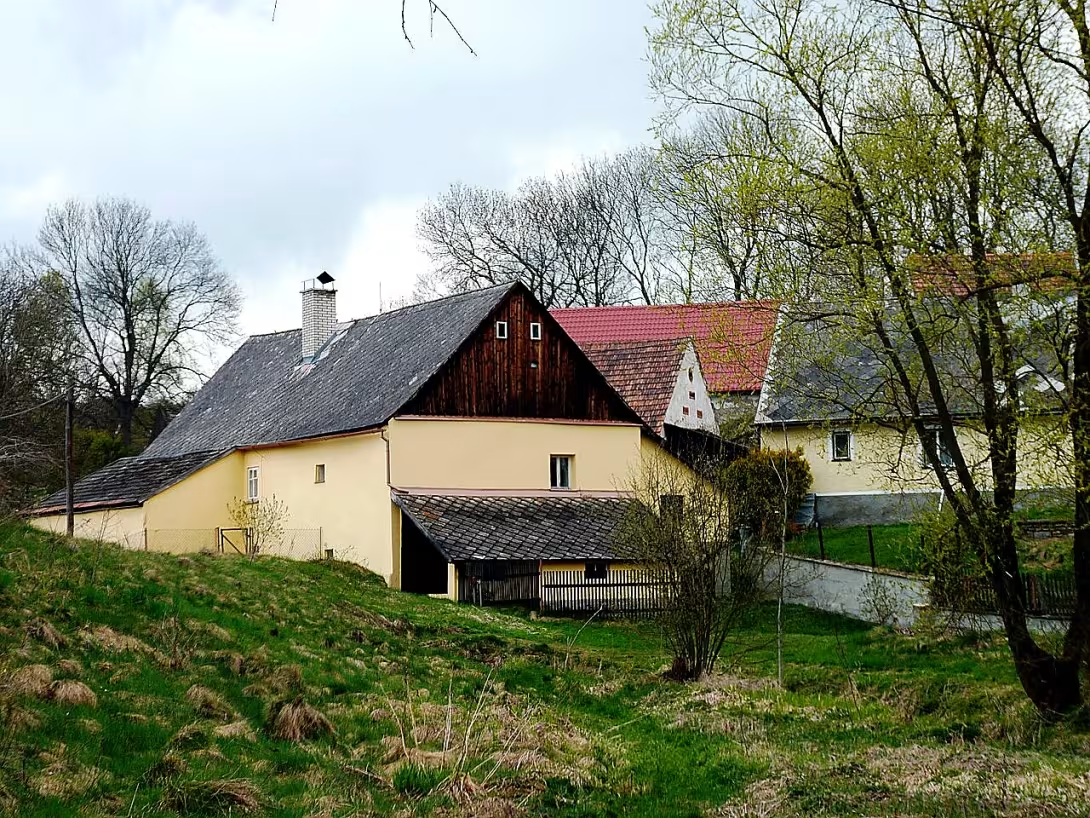
Vodní mlýn Bešťák is a historical building on the western edge of the village Planik u Čehana in Klatovy district. The mill is located on the river Sáslav, it was built around the middle of the 19th century and is today protected as a real cultural monument of the Czech Republic.
The construction was created at a time when the Czech countries were undergoing an industrial revolution and development of milling industry. The then modernization of agricultural production and the introduction of technical innovations reflected the construction of mills. The specific founders or owners did not receive more detailed reports, but the preserved inventory dates from 1900 to 1940.
Architecturally, the mill developed from the original type with one water wheel to technologically more advanced operation. The original device was powered by one Czech composition. In the first half of the 20th century the complex underwent a major modernization, which included modification of the water supply system and installation of the turbine.
Technical equipment consists of a complex drive system. Water for propulsion was collected over the northern end of the pond dam and led through an open channel approximately 1300 metres long. This channel ended approximately 20 meters north of the mill, where the concrete pipes were connected to the levelling chamber above the turbine. The interesting thing is that the waste water will not fortify back into the river Slava, but it flows through a 150-metre canal into the stream of Bradlava.
A key moment in the history of operation was the turning years of the 30th and 40th century, when the original water bike replaced the modern Francis turbine type Reiffenstein. This 7,2 HP plant represented a significant technological shift in the efficiency of milling production.
Vodní mlýn Bešťák is a valuable evidence of technical development of milling industry in the Czech rural environment. Visiting this place offers the opportunity to look into the history of agricultural technology and to understand the changes that mill operations have undergone during the 19th and 20th centuries.
Historical milestones
- Around 1850
- Construction of a water mill during the industrial revolution.
- 1900-1940
- The period from which the preserved inventory of the mill comes.
- Around 1935
- Modernization of Francis turbine operation and installation.
Architectural development
The building was built in the middle of the 19th century as a classic water mill with one water wheel. In the first half of the 20th century it underwent technological modernization, which included installation of a turbine and modification of the water supply system. The complex includes an extensive system of rivets and waste channels in the Bradlava stream.
Historical events
At the turn of the 1930s and 1940s, there was modernization of the drive mill, when the original water wheel was replaced by a Francis Reiffenstein turbine.
Points of interest
- The mill was built around the middle of the 19th century on the river Sáslav and is today protected as a real cultural monument. - The waste water from the mill forts back to the river Slava, but it flows through a 150-metre canal into the creek Bradlava. - In the first half of the 20th century, the original water wheel was replaced by a modern Francis turbine type Reiffenstein with a 7.2 HP performance. - The water for the mill drive was guided by an open channel approximately 1300 metres long, which started at the north end of the pond dam. - The preserved inventory of the mill dates from 1900 to 1940.
Guide
Show guide text
This text was created by artificial intelligence and has not been editorially reviewed. It may contain inaccuracies.
Welcome to Basht Water Mill. You just stopped by one of the most impressive symbols of human endeavor to use the power of nature. You're standing in a place where the sound of running water becomes a constant escort of every moment. Before your eyes is a building that is not just a simple stone object, but a living witness to the history that took place here, in this part of the landscape near the village Planik. Feel the atmosphere of peace, but it is contrary to the constant movement of water that gives life to this place. The water you're hearing is the river of the Voslav, and it's its tireless stream that's been the main engine of everything that's been going on here for centuries.
Let us now return together in time and understand why this place was created. Imagine half the 19th century. The world around us is going through huge changes that people call an industrial revolution. It's a time when humanity learns to control new powers and find ways to increase its effectiveness. It was during this period, around 1850, that this water mill was built. At that time, modern electricity networks were not available as we know them today, and people had to rely on what the country offered them. Water was the most reliable and efficient source of energy. The mill Besták was not just a building for grinding grain, it was a technological pillar of the local community, a place that ensured the basic needs of people and powered the local economy.
Now pay attention to the construction itself and to what you can see right in front of you. Although time is changing relentlessly, this object has retained its dignity and is today protected as a real cultural monument of the Czech Republic. Looking at the mill, you can realize how things were built to last generations. Notice how the building is located right at the river flow, which was not random, but technically necessary. If you look at the surrounding terrain, you can imagine the complexity of the entire system that had to be built here. The key to operating the mill was a large-scale drive system. Imagine that large open channel that stretches a thousand three hundred meters. This is not just an ordinary moat path for water, it is a precise engineering work that had to ensure that water flows in the right direction, at the right speed and with the right power to the mill mechanism.
If you look at the details that have been preserved here, you're getting to the period between 1900 and 1940. This is the time from which most of the preserved inventory can be seen here. It is a period when traditional craft began to intertwine with modern technology. One of the most important moments in the history of this mill was modernization around 1935. There was a fundamental change in how the power of water is used. The original water bike, which was a symbol of the old world, was replaced by a modern Francis turbine. This transition represents a huge technological leap. The turbine is much more efficient, makes it possible to use water energy much more intensively and shows us how people sought constant progress and optimisation of their operation in the first half of the twentieth century.
Even if we don't know the names of the particular miller who lived here or the architects who designed this project, we can imagine them through their work. Imagine those people who spent all these days here, who had to keep an eye on the water level, clean the jets and make sure the machine doesn't get stuck. They were people who lived in the rhythm of water. Their lives depended directly on how much water flows in the river Slada. It was a job full of responsibility, where any mistake could mean stopping the whole operation. Even though their names remain unknown in history, their legacy here is felt in every stone block and every toothed wheel used here.
Now, I want to invite you to think of one very interesting technical mystery that lies right under your feet. You might expect that all the water that flows through the mill and that was used to drive the machines will just go back to the Symphony River. But the Beast has his own secrets. The waste water from the mill forts back to the main river, but it is guided by another way. There is a special, 150-metre-long canal that takes the water to a whole other place - the brothel stream. This path of water is a fascinating example of how people have managed to adapt to complex terrain and how they have managed to separate what is needed for operation from what must be safely removed. It is proof of precise planning, which must have been absolutely necessary in such an object.
Today the mill no longer serves its original purpose, but its presence here still reminds of the time when water was the greatest ally of man. It's a place where nature meets technology in a quiet but strong dialogue. Let yourself be entertained by this place for a while. See the surroundings, feel the smell of water and forest, and try to hear in spirit the echoes of the past that are still in this space. The Beast is not just a monument, it's a living story about human ingenuity and respect for the elements.
Thank you for joining me on this short journey through time. Now you have enough information to continue your search at your pace. Explore the surrounding terrain, see how the water flows through the sewers, and enjoy the calm this historic place offers. Goodbye.
Tips for visitors
The ideal time for a visit is late spring or summer, when the surrounding nature at the river Slava is the most blooming. During this period you will enjoy the atmosphere of the historic building in the green.
The mill is most easily reached by car on local roads near the village of China. The current connection by public transport is always checked in available search engines.
Do not forget fixed shoes suitable for movement near the water flow. For photography is the most suitable soft light during the morning or shortly before sunset, which beautifully paints the details of the historical architecture of the mill.
In the immediate surroundings you can take a walk along the river of the Festival or the Brotherhood stream, which is an ideal activity for families with children seeking peace in nature. The whole area offers a pleasant environment for light tourism near the village of China.
Since this is a cultural monument, move only on marked paths. Find information about possible access to the building or tours on official information channels.
Frequently asked questions
Can the monument be visited?
This is a technical monument. Some are open as exhibitions, others are out of use or on private land. We have not verified whether this one is accessible.
What are the opening hours and admission?
We have not verified the opening hours or admission. Current information is published by the operator.
Where is the monument?
Location: Plzeňský kraj. The map on this page shows the exact spot.
Why is the monument protected?
It is listed in the Central List of Cultural Monuments of the Czech Republic as a cultural monument (register no. 1403563253).
Businesses nearby
Do you run a restaurant, accommodation, shop, museum, rental, wellness or other visitor service near this monument? Show yourself directly to the people heading to it — this is how they will see you in the app and on the web:
Events nearby
Zdroj akcí: otevřená data měst a obcí ČR (Národní katalog otevřených dat) a kalendář akcí Národního památkového ústavu.
Nearby
The village of China, the river Úslav, the brook Bradlava.
Accommodation nearby
Themed route
1. village Čehan, village. It serves as an ideal starting point for a trip in this quiet area. 2. Potok Bradlava, water flow. It offers a pleasant route in nature, which leads towards the main monument. 3. Vodní mlýn Bešťák, historical mill. The main destination of the trip, which will preserve its historical form and unique location. 4. River Slava, water flow. Beautiful finish of the route at the wider water flow in the surrounding area.
Seasonal recommendations
Spring: In the spring period, Besták Mill is revived by flowers and new leaves, creating a lively atmosphere full of hope and renewal. Sun rays illuminate green meadows around the mill, thus highlighting its historical architecture. To visit this season we recommend to come early in the morning when the place is still quiet and is not crowded with a crowd of tourists. Dress appropriately for variable weather: the day can be warm, but the evening often becomes cold, so it is good to have clothes with you for different conditions.
Summer: For years the Bestak Mill offers the best experience thanks to a long day and warm sunshine, which brings living color to the surrounding nature. This season, the site is a popular destination for tourists, which means a higher number of visitors. We recommend you visit the mill in the morning or late afternoon to avoid peak time and enjoy a quiet tour. Put on light clothes with a sun mask to protect you from UV radiation.
Autumn: In autumn, the Bestík mill is transformed into a colourful landscape park thanks to the bright tree foliage. The atmosphere is calm and quiet, which offers an ideal environment for relaxation and reflective moments. The weather can be variable, so it is advisable to come up with clothes for different conditions - from warm days to cooler evenings. For the best experience we recommend visiting the mill in the early afternoon time when nature is full of blood and crowd less.
Winter: The winter season brings to the mill Besták a quiet atmosphere with covering snow, which adorns its historic buildings. Although opening times are often shorter and the weather may be cold, the experience of silver lining or snow sheets is unique. If you visit the mill this season, we recommend to dress warm and bring a protective cover against moisture. The best time to visit is in the early afternoon when the sun's rays light up the snow-covered landscape and create an impressive landscape.
Visualizations and artistic views


The visualisations are generated by artificial intelligence and serve as inspiration.
Photos from the area
Real photos taken near the monument


Zdroj a licence jsou uvedeny u každého snímku.
Tips from visitors
No tips yet. Be the first!
Log in and add your tip.
Sources and literature
Photos: Krvesaj / CC BY-SA 4.0 — Wikimedia Commons. The author and licence also appear when you hover over the image.
Faktickým podkladem tohoto textu byl článek na Wikipedii, jehož autory jsou přispěvatelé Wikipedie. Článek je dostupný pod licencí CC BY-SA 4.0.
Location on the map
More monuments – Plzeňský kraj
Show all in the region

Příběhy a pověsti
Legendy, pověsti a příběhy spjaté s touto památkou

Fotografie návštěvníků
Zatím žádné fotografie. Buďte první, kdo přidá fotografii z návštěvy!
Log in a přidejte svou fotografii nebo hodnoťte.
Za ověřenou návštěvu v aplikaci získáte víc bodů — poznáme podle GPS, že jste na místě.
Reviews and comments