



Vodní mlýn če. 149 Umgebinde house
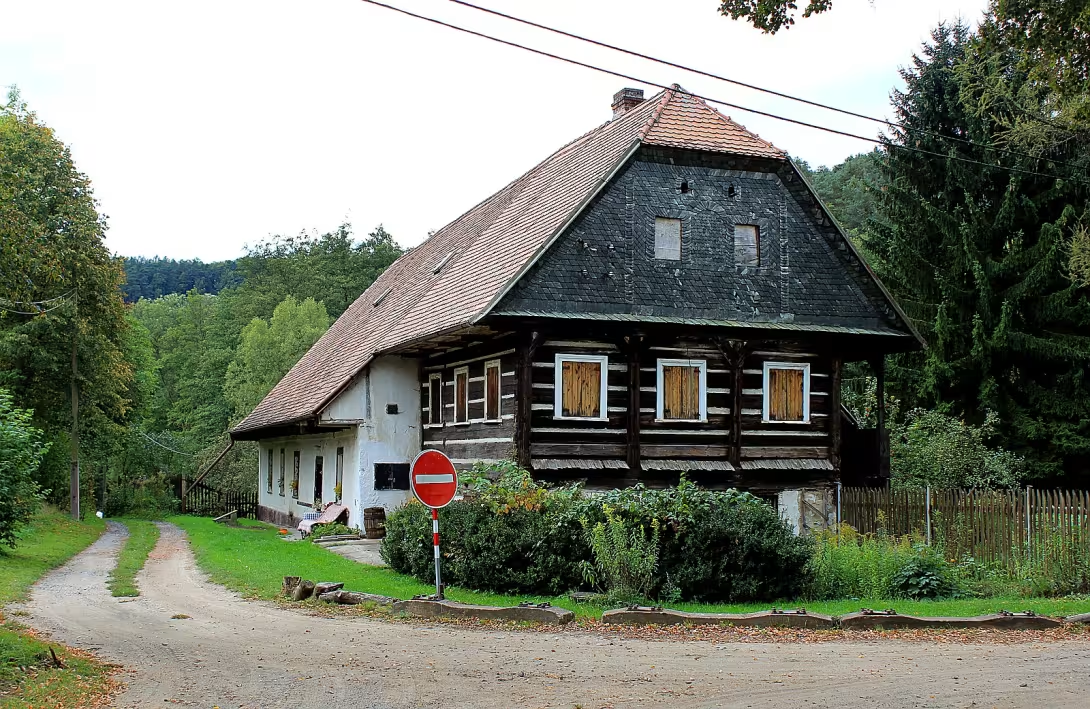
The water mill in Osinaličky, the local part of the village Medonosy in Mělnicka, is a Baroque technical monument situated in the valley of the river Liběchovka. The building is a significant preserved combination of a grafted mill with a pedestal and a walled residential part. His history goes back to the 18th century.
Historical sources demonstrate the existence of the mill already in 1788. At that time the mill stool was produced with the inscription IOSPH FROFT AUS ZEBUZ ANNO 1788 21 MAI. In this period, the Czech countries were in an era of enlightened reforms, which changed social conditions shortly before the outbreak of the French Revolution. During the second half of the 19th century, the original Baroque core of the building was supplemented by a walled residential part.
The building stands on a rectangular plan on the northwest slope by the creek. Architecturally it combines the grafted mill with the pedestal and the pavilions with the adjacent brick part. The roof is asymmetrical, saddle with halves; originally covered with shale. There is an carved pedestal on the northeast shield facade. The interior of the mill stands out with a massive beam ceiling with a medium profiled cross-section and central column. There is a spacious hall on the floor with a beam ceiling under which there is a space with a valed vault with liaison lunettes.
In 1930 he owned the mill Karel Kršmer. At that time the operation underwent modernization thanks to the installation of the Hague turbine, which reached 13 HP at the drop of 4.8 meters. There was also a saw and a bakery. After the end of World War II, the mill was nationalized and closed. The family of miller Rebitz, who previously managed the building, was subsequently relegated to Kühlungsborn in the then German Democratic Republic.
Today, the water mill in Osinaličky is protected as a real-estate cultural monument of the Czech Republic. The building represents valuable proof of the miller's craft and development of folk architecture in the region. Visiting this place offers the opportunity to get to know the technical solutions of mills from the end of the 18th century and to see preserved elements such as mill stool or historical construction details of the building.
Historical milestones
- 1788
- Creation of a mill stool with the inscription "Ioseph Froft aus Zebuz.".
- 1930
- The owner of the mill is Karel Kršmer and the Haag turbine is also in operation.
- 1945
- Nationalisation of the mill and redeployment of the Rebitzkov family to Kühlungsborn.
Architectural development
In the second half of the 19th century, the original Baroque core was supplemented with a brick part. The construction combines a grafted construction with a pedestal and a wall ground floor with a valence vault. The roof is an asymmetrical saddle with a halves.
Historical events
The Hague turbine was installed in the mill in 1930. After the end of World War II, the mill was nationalized and closed, followed by the family of the miller Rebitz.
Owners
Karel Kršmer (1930), rodina Rebitzkova (until 1945).
Points of interest
- The mill is a Baroque technical monument located in the valley of the river Liběchovka. - The history of the mill has been documented since 1788, when the mill stool with the inscription was made. - The building combines a grafted mill with a pedestal and a walled residential part, the roof was originally covered with shale. - In 1930, the operation was modernized by the installation of a turbine, which achieved the performance of 13 horsepower. - There was also a saw and bakery in the past.
Guide
Show guide text
This text was created by artificial intelligence and has not been editorially reviewed. It may contain inaccuracies.
Welcome to the valley of Liběchovka River. You're standing in front of a place that is much more than just a simple building made of wood and stone. In front of your eyes is the water mill in Osinaličky, a baroque technical monument that has been facing the currents of water and curious views of the bystanders for centuries. Feel now the atmosphere of calm that prevails here, and listen to the silent whisper of water that has been the main engine of this place for all eternity. This mill is not just a dead object of history, it's a living story about work, about human fate and the constant movement of time.
Now let's look together at what you see around you. This building is a fascinating example of how people have been able to combine practical needs with solid and durable architecture in the past. Notice how two completely different worlds are mixed here. One part of the mill is made of wood, it is a grafted mill that stands on its pedestal. It's the traditional, old part that evokes the smell of the forest and the craftsmanship of our ancestors. Above this wooden part you can see a hoist that serves as a connecting element and gives the whole its specific appearance. It is immediately followed by a completely different world - the walled residential part. This contrast between the grafting and the wall is typical of this building and shows us how the housing and production needs developed over time and how the buildings expanded. If you could look at the roof, in the past it was covered with shale, which gave the whole mill its serious and dignified appearance.
Now I want to take you deeper into history to understand where this mill comes from. The history of this place has been documented since the 1970s. This is when the world began to change, but the rhythm of life was still closely linked to natural cycles and the power of flowing water. It was this year that one of the most important items was created, which still remained in the interior of the mill. It's a mill stool that has a inscription inscribed on it, attributed to its creation by the name of Ioseph Froft from a place called Zebuz. Imagine the work, the diligence with which this piece of wood was prepared to serve generations. This stool is the key to understanding the continuity of this place.
If we move a century further, we'll see another important chapter. By the year one thousand nine hundred thirty, the mill became part of a more modern era. At that time, Mr. Karel Kršmer was the owner of the mill. This was the time when technology quickly began to drink into the traditional way of production. The mill was no longer just about a simple water wheel, but it was equipped with more advanced machines. The operation was not only a saw, but also a modern Hague turbine, which used water power much more efficiently. This mill was not just a mill, it was a complex business that served the whole area. A bakery and saw were part of the complex, which means that people came here for the basic needs of their daily life - for flour, for pastries and for wood processing.
But history is not only about machines and buildings, it is also about people, their joys and their tragedies. One of the most important names associated with this place is rodina Rebitzkova. This family was part of the history of this mill, but their story also has a sad ending. In the year one thousand nine hundred forty-five there was a major break. The mill was nationalized and rodina Rebitzkova was moved to an area called Kühlungsborn. This moment represents a deep blow in the history of this place, when private ownership and family heirlooms clashed with the great political upheavals of the time. It is a reminder of how much political change can affect even the most decaying and most human aspects of our world.
If you now attempt to enter the inner space in spirit, imagine the atmosphere. Even though the mill is looking at the outside world today, its interior keeps rare details. Imagine the massive beam ceilings that hold the whole structure and that are proof of the incredible strength and quality of the wood at the time. These ceilings are not just bearing elements, they are memory bearers who have seen hundreds of years of work and movement of people. In the interior there is still the mentioned mill stool, which is a silent witness to everything that happened in these premises.
The interesting thing that might interest you is the technical variability of this place. The mill wasn't static. He began as a traditional water mill using the drive, but over time he had to adapt to new science and technical advances. The transition from old methods to using the Hague turbine in the 1930s is an excellent example of how people tried to use nature's power more effectively. This mill was basically a small industrial centre which combined several different crafts and needs.
Now I want to leave you for a while. Stop, observe the surrounding countryside and listen to Liběchovka flow. This mill stands here as a symbol of endurance. Although the owners were changing, although the technology was changing, and even though the political regimes were changing, this object remains. It is a monument that teaches us humility to time and the work of our ancestors.
Thank you for joining us on this short journey through time. We hope that this view of the water mill in Osinaličky helped you better understand its meaning and beauty. Please continue to explore the surroundings, see the beauty of the valley and enjoy the peace this place offers. We welcome you once again and thank you for your attention.
Tips for visitors
The ideal time for visiting is late spring or early autumn, when the valley of Liběchovka is the most photogenic and weather wishes for walks in nature. In these months you will enjoy the quiet atmosphere of the Baroque building without a large number of people.
You can easily get to the mill in the village of Osinalicka by car. If you choose public transport, use the link search engine to travel to the village Medonosy and walk the rest of the way to the village.
Take fixed shoes suitable for movement in the valley and around the water stream. Use soft morning light to take pictures of the grafted grille with a pedestal and a hovel, which will beautifully draw the details of the wooden structure. The best shots will be taken from the opposite bank of the river Liběchovka.
Walk through the valley of the river Liběchovka is easy and suitable for families with children. Children can observe nature around the mill, but we recommend to take care of the water flow and historical parts of the building.
In the immediate surroundings there is a picturesque valley of the river Liběchovka, which is ideal for short trips and observation of technical monuments in its natural surroundings within the village Medonosy.
Frequently asked questions
Can the monument be visited?
This is a residential or farm building, not a museum with opening hours. Please view it from public space and respect the owners' privacy. We have no information about access to the interior.
Where is the monument?
Location: Medonosy, Středočeský kraj. The map on this page shows the exact spot.
Why is the monument protected?
It is listed in the Central List of Cultural Monuments of the Czech Republic as a cultural monument (register no. 1000152872).
Businesses nearby
Do you run a restaurant, accommodation, shop, museum, rental, wellness or other visitor service near this monument? Show yourself directly to the people heading to it — this is how they will see you in the app and on the web:
Nearby
Mlýn se nachází v osadě Osinaličky, části obce Medonosy v okrese Mělník, v údolí říčky Liběchovky.
Accommodation nearby
Themed route
Thematic cruise route: Mill No. 149 and surroundings
1. Mill No. 149 (mill) - Type: historical monument - Why is it worth a visit: This water mill is a fascinating example of the old industry and technology used to restore local needs. When walking through its interior you will realize the importance of mills in the history of the region.
2. Soils (settlement) - Type: settlement - Why is it worth visiting: Osinaličky, part of the village Medonosy, offers a quiet and idyllic environment. Here you can explore rural life and enjoy the natural beauty of the surrounding valley of the river Liběchovka.
3. Valley of the river Liběchovka (nature) - Type: natural environment - Why is it worth visiting: The valley is an ideal place for a short walk or picnic. Its quiet and green landscapes offer shelter from everyday life, allowing you to enjoy nature in peace.
4.Medonosy (municipality) - Type: Municipal residence - Why is it worth a visit: Medonosy is the center of this small but engaging village. Here you can explore local culture and history through architecture and possible exhibitions or events held here.
5. Naves (local centre) - Type: local centre - Why is it worth a visit: Naves Medonosy is an ideal place to relax and meet locals. Here you can enjoy a quiet moment when looking at the countryside or participate in local events.
This route offers you the opportunity to explore the history and culture of the village Medonosy as well as enjoy a quiet moment in the natural environment.
Seasonal recommendations
Spring: In spring the visit to the mill in Medonosách is special because of the light that changes during the day and provides beautiful photographic moments. Nature begins to come to life, trees dress in green and flowering shrubs add color contrast to the historical background of the mill. Visitors should be prepared for possible rain, because spring weather can suddenly be variable. It is recommended to wear multiple layers of clothing and consider buying protective handkerchiefs or coat umbrella. The best time for a tour is in the morning when the crowds are usually smaller and the atmosphere calmer.
Summer: In summer the mill offers visitors an opportunity to enjoy the warmth of sunlight, which softens the stones and wooden structures. Nature is in full bloom and surrounding forests are ideal for relaxation or picnic. Due to the increased number of tourists during the summer months, we recommend arriving at the beginning of the day in order to minimise crowd load. Cream sun creams and protective clothing are necessary to protect against strong UV rays. Don't forget to bring enough drinking water, because warm weather can be challenging.
Autumn: Autumn season brings the mill in Medonosách a unique atmosphere due to the golden and red shades of foliage. This time of year is calmer, which allows you to enjoy historical monuments without crowd congestion. Nature offers beautiful views for lovers of photography and pedestrians. Due to possible rain, it is advisable to wear durable shoes and protective clothing to protect against moisture. The best time to visit is at noon when the crowds are minimal and the sun rays still provide heat.
Winter: The winter season brings a quiet atmosphere in Medonosy with fewer visitors, which is ideal for quiet tours. Beautiful ice and snow landscapes increase aesthetic appeal monuments. Due to shorter opening times and cold temperatures, it is important to wear warm clothes, including leather shoes that protect your feet from freezing conditions. Visitors should be informed of the possibility of closing some parts of the site due to weather conditions, so it is good to know the latest information before leaving. The best time for a tour is at noon when the sun is higher and provides mild heat.
Visualizations and artistic views


The visualisations are generated by artificial intelligence and serve as inspiration.
Photos from the area
Real photos taken near the monument


Zdroj a licence jsou uvedeny u každého snímku.
Tips from visitors
No tips yet. Be the first!
Log in and add your tip.
Sources and literature
Photos: Sovicka169 / CC BY-SA 4.0 — Wikimedia Commons. The author and licence also appear when you hover over the image.
Faktickým podkladem tohoto textu byl článek na Wikipedii, jehož autory jsou přispěvatelé Wikipedie. Článek je dostupný pod licencí CC BY-SA 4.0.
Location on the map





Příběhy a pověsti
Legendy, pověsti a příběhy spjaté s touto památkou

Fotografie návštěvníků
Zatím žádné fotografie. Buďte první, kdo přidá fotografii z návštěvy!
Log in a přidejte svou fotografii nebo hodnoťte.
Za ověřenou návštěvu v aplikaci získáte víc bodů — poznáme podle GPS, že jste na místě.
Reviews and comments