



vodní mlýn a mandl Water mill
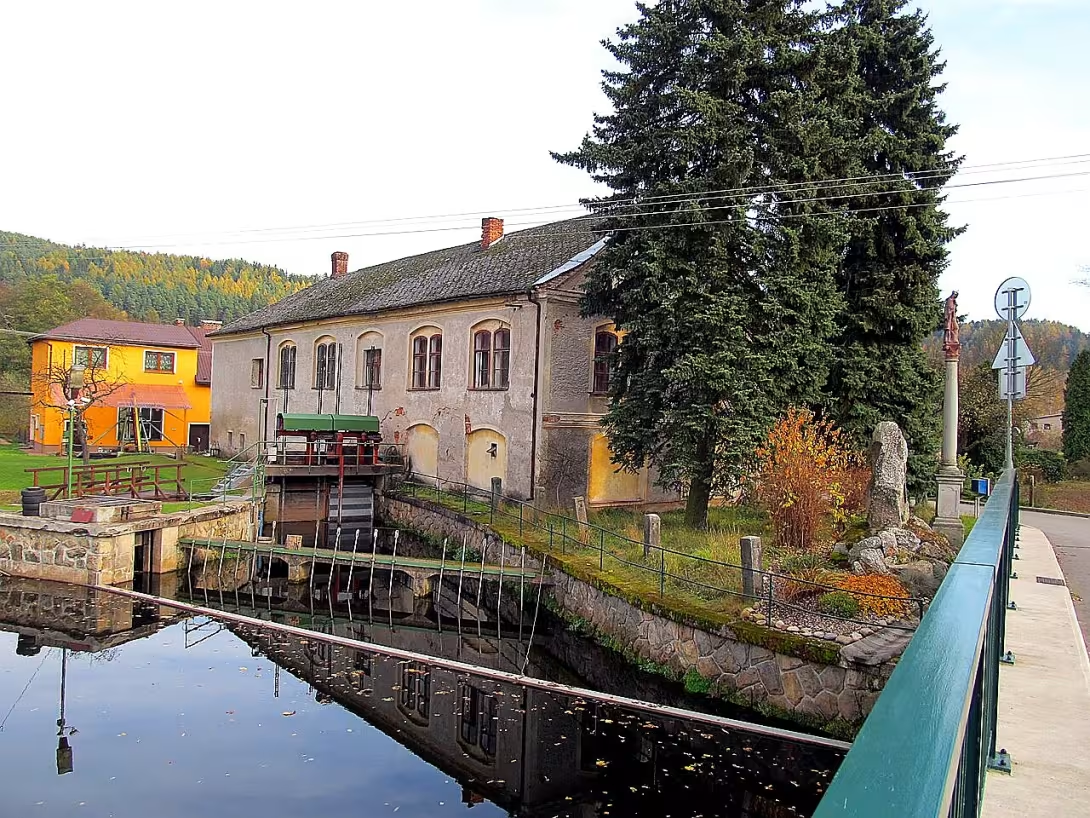
Regner Mill, also known as Havlovický Mill, is located on the eastern edge of the village Havlovice in Trutnov district on the river Úpa. This building is protected as a real cultural monument of the Czech Republic and is especially important as the native place of the patriotic priest Josef Regner-Havlovický.
The mill was built in 1674 by the overseer. At the time of its creation, processes related to the development of industry and agriculture took place in the Czech Republic and European culture was in the Baroque period.
Originally, it was a traditional water mill, where water to the water wheel led from the lake. The technical records include a turbine with a flow rate of 6,5 m ³ / s and a drop of 3.6 m. The list of water works from 1930 lists two wheels for lower water with a flow rate of 2,38 m ³ / s, a drop of 1,69 m and 16 horsepower. Kaplan's turbine and six sandstone grinding stones were preserved in the building.
The Náchodská major owned the mill until 1863 when it was converted into a mill. But this function was short, because two years later it burned down with new machines that were imported from England for 52,000 gold coins. After the fire, the mill wasn't restored. In 1887-1889 he built on the site of the burnt weaving plant Otto Kunkl mandl powered by a small water turbine. In 1893 the mill was auctioned at an estimated price of 27,472 gold pieces. The subsequent owners were Vinzenz Bartosch and Ed. Morawetz, and Hradec's power plants, which in 1943 set up a small hydroelectric power plant with Kaplan turbine at the almond. This power plant has a flow rate of 6 m ³ / s, output 136 kW and annual production of 0,540 gigawatthoh.
The mill is closely connected with the priest Josef Regrere-Havlovický (1794- 1852), who is known from Jirásek Chronicle U Us. On July 22, 1923, his memorial plate with text from Alois Jirásek was revealed on the facade of the mill, which was transferred to the memorial before the mill on June 4, 1944. The festival was accompanied by Kmoch's band from Cologne. The story of the story of J. K. Hraš O vodník and bear from the book of Babicha's exposition is also laid in the mill.
This monument represents an important historical object with the connection of technical history and cultural heritage. It is advisable to visit it for the knowledge of the history of the region and the connection with important personalities.
Then and now
Drag the slider to compare how the landmark may have looked when it was built with the view today.
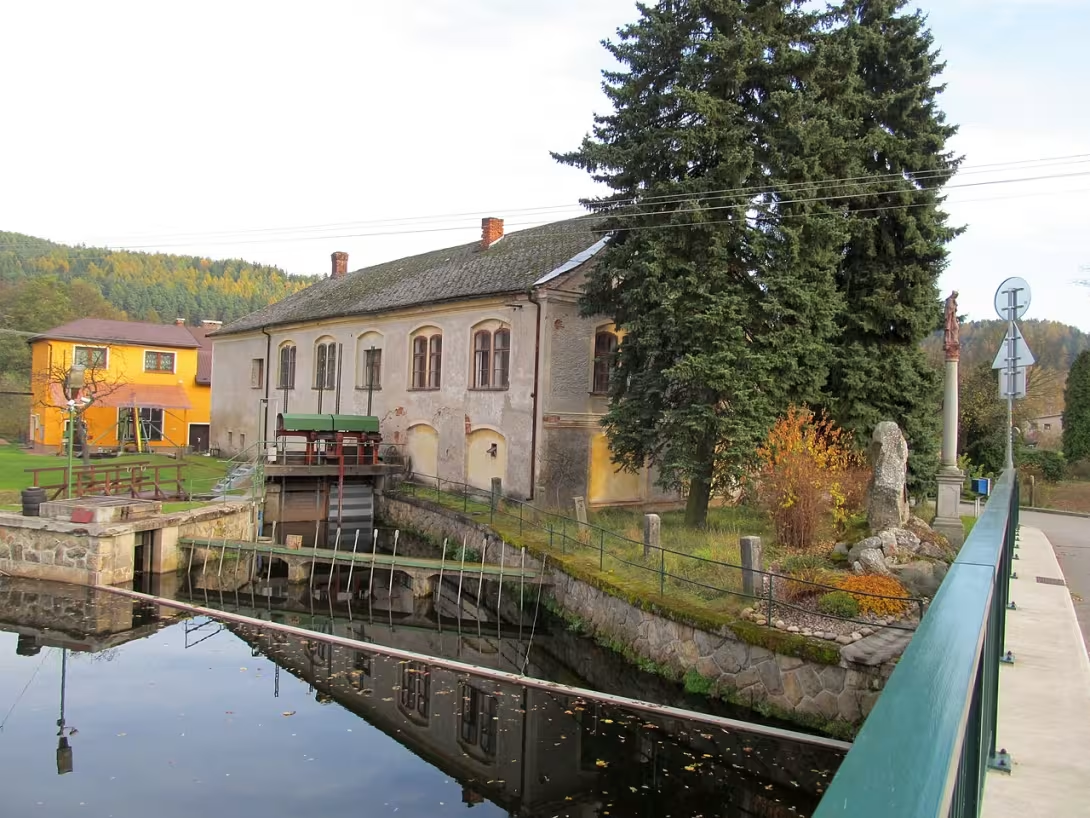
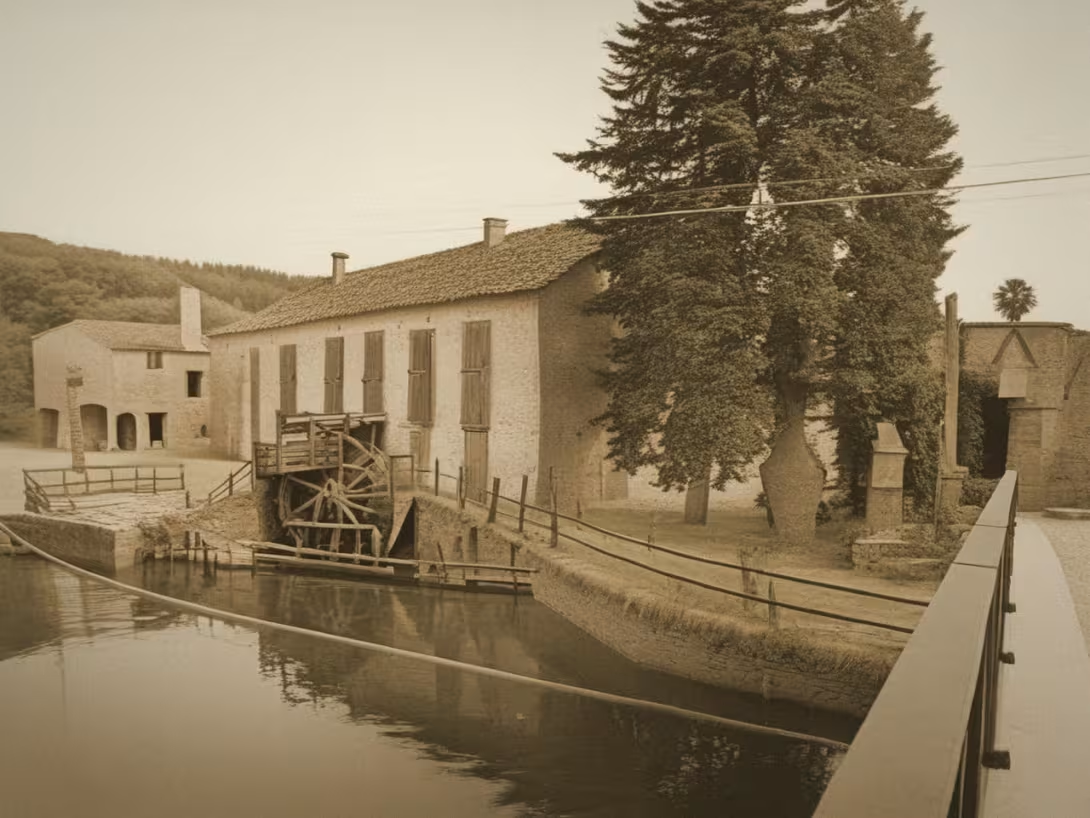
The historical appearance on the left is an AI-generated visualisation and serves as inspiration only.
Historical milestones
- 1923
- Exposing the commemorative record of priest Josef Regner at the facade of the mill.
- 1944
- Transfer the memorial plate from the facade to the monument in front of the mill.
Architectural development
The mill was built as a traditional water mill and later converted into a mill. After the fire, an almond was built in its place, powered by a small water turbine. In 1943, Ed Morawetz and Hradec Hradec established a small hydroelectric power plant with Kaplan turbine.
Historical events
- 1674
- The position of the water mill by the superintendent.
- 1863
- Rebuilding to the mill and its fire.
- 1887
- Almond position powered by small water turbine.
Owners
- 1893
Points of interest
- Regner's Mill is the birthplace of patriotic priest Josef Regner-Havlovický. - Kaplan turbine and six sandstone grinding stones were preserved in the building. - In 1887-1889, Otto Kunkl built a small water turbine-powered almond in the place of the burnt-out weaving plant. In 1943, a small hydroelectric power plant was set up near the almond. - The story of the story of J. K. Hráš About the Aquarius and the Bear from the book of Babicha's telling is laid in the mill.
Guide
Show guide text
This text was created by artificial intelligence and has not been editorially reviewed. It may contain inaccuracies.
Welcome to Havlovice, in a quiet corner where history still breathes in every breath of air and in the noise of flowing water. Right now, you're standing in front of a place that carries centuries of human effort, faith, and craftsmanship. In front of you is a building that has been the heart of the local economy for centuries and witnessed the transformation of the entire region. It's Regner Mill, also known as Havlovický Water Mill. Feel the atmosphere of this place, which is located on the eastern edge of the village itself, in close proximity to the river Úpa. It was this river, with its ever-flowing currents, that was the main reason why this building was placed here. The water was not only a source of life, but a source of energy, which powered wheels and grinding stones.
Let us now return together in time more than 300 years ago. Imagine 1674. At that time, the area was under the influence of the Walloon authorities, which had the mill built this year. In the seventeenth century, the water mill was a key element of every community. It was not just a place for grinding grain, but a place for meeting people, a center of economics and a symbol of stability. This mill has served its original purpose for decades and has become a solid part of the landscape and the lives of local people. When you look at the building today, you realize how many generations of mills have worked here, how many bags of grain have passed through its gates and what the rhythm of life dictated by the flow of the Upa River.
Now pay attention to the appearance of the monument itself. Even though the building was changing over time, you still feel the spirit of the old craft. Look at the facade and see its stability. Although we do not know the names of the particular architects who designed this construction, it is clear that it was built with regard to the practicality and proximity of the water. If you look in front of the mill, you'll see a monument. It is here today that there is a commemorative plaque that reminds one of the most important personalities associated with this place. It's interesting to see how these details work in time. Originally, in 1923, this plate was festively revealed right on the facade of the mill so that everyone who passed by could see immediately who was born here. But two decades later, in 1944, the plate was transferred from the facade to this very monument in front of the building, where it remains still a silent guardian of memory.
And right now, we're coming up with a personality that gives this place a deeper dimension. Regner's mill is not only a technical monument, it is mainly a native place of the patriotic priest Josef Regner-Havlovický. Imagine a young man who grew up in an environment full of work, the noise of water and rural calm, and who later brought his patriotic beliefs into his spiritual service. For many people, this place is a pilgrimage because of him. Josef Regner-Havlovický embodied a union of deep faith and love for the country, and the fact that he was born here, in this mill, gives the building almost sacral dimension. It is a reminder of how the environment in which man grows up can shape his character and future life path.
However, the history of this place is not only about peace and tradition, but also about sharp changes and a new beginning. Let's move to the nineteenth century. There was a fundamental change in 1863. The mill stopped serving only the milling of grain and was converted into a mill. It was a period of industrial revolution when traditional crafts turned into factory production. The water from the river Upa was no longer driven by grinding stones, but also by machinery for textile processing. Unfortunately, this new beginning was short. The building was hit by a fire that was so devastating that the mill was no longer restored. The history of this place might seem to end with this fire, but fate had other plans.
Otto Kunkl appeared on the ruins of the burnt weaving plant between 1887 and 1889. This man decided to build an almond instead of a destroyed building. For those of you who may not know, almond was a machine used for pressing and ironing fabrics to be smooth and shiny. Kunkl's almond was powered by a small water turbine, which was a modern way of using water energy at that time. By doing so, the mill returned to activities that used the power of the river, albeit in a different form. It is fascinating to think how the functions of the building changed depending on the needs of the time: from mill to mill to tonsils.
If you are interested in the technical details that have been preserved in the building, I suggest you think about what remains hidden inside or near the building. The Kaplan turbine was preserved in the building, which is a masterpiece of water technology, which makes it possible to effectively transform the energy of flowing water into mechanical movement. We'll find six sandstone grinding stones along with it. These stones are a silent witness to the oldest era of this place, where, in the rhythm of the water, the grinding crop for the whole area. Imagine those heavy, rough surfaces of sandstone that, for thousands of turns, rubbed each other to feed people in Havlovice and surrounding villages.
There is also one interesting thing that leads us to the mid-20th century. In 1943 another part of the operation was set up at the tonsils, which shows that even in the most difficult times of World War II this place remained active and performed its function. It's evidence of endurance and ability to adapt, which has been encoded in this place since 1674.
Now if you look around again, you'll see more than just an old building by the river. You will see the meeting place of the seventeenth century, the patriotic spirit of priest Josef Regner-Havlovický and industrial ambition of Otto Kunkle. It's a place where the water from the river of Úpa still tells stories about grinding, tissue and pressing, about fire that he destroyed, and about people who had the power to rebuild.
Thank you for stopping with me, accompanied by this audio guide, at Regner's Mill. I hope you have felt the depth of history that persists in these walls and the surrounding air. We now invite you to explore the Havlovice area. Maybe you'll stop by the river, listen to her noise, and try to imagine what the mill sounded like centuries ago when the noise of machines mixed with the voices of working people. I wish you a pleasant continuation in your discovery of the beauty of our region. Goodbye.
Tips for visitors
The best time to visit the Regner Mill is in the spring and autumn months, when nature is the most beautiful and usually you will encounter fewer tourists. Sunshine days are ideal for exploring the surrounding region.
We recommend checking the current connection before visiting.
When planning a trip, remember the clothes suitable for outdoor conditions, shoes and protective sunglasses. If you have an intention of spending time by the river Úpa, it may be a good idea to bring your pocket dishes or water.
The best place for photography is at the beginning of the morning light or in the evening when light is finer and shadow effects are stronger. During the trip you can also see the surrounding forests and meadows offering a beautiful background.
The historical village Havlovice can be visited in the vicinity of the Regner Mill. It may be interesting for families with children to explore the natural environment and perhaps even organise a small treasure search in the surrounding forests.
Frequently asked questions
Can the monument be visited?
This is a technical monument. Some are open as exhibitions, others are out of use or on private land. We have not verified whether this one is accessible.
What are the opening hours and admission?
We have not verified the opening hours or admission. Current information is published by the operator.
Where is the monument?
Location: Havlovice, Královéhradecký kraj. The map on this page shows the exact spot.
Why is the monument protected?
It is listed in the Central List of Cultural Monuments of the Czech Republic as a cultural monument (register no. 1000125784).
Businesses nearby
Do you run a restaurant, accommodation, shop, museum, rental, wellness or other visitor service near this monument? Show yourself directly to the people heading to it — this is how they will see you in the app and on the web:
Events nearby
Zdroj akcí: otevřená data měst a obcí ČR (Národní katalog otevřených dat) a kalendář akcí Národního památkového ústavu.
Nearby
🏰 Historic sites (134)
- Josef Regner 0.0 km
- Tomáš Garrigue Masaryk 0.7 km
- Story of the Lost Castle 0.7 km
- Castle Vizmburk 0.8 km + 420 604 134 241 web
- Table Bathildy 2.4 km
- house Brothers Chapko 3.1 km
- City Museum of Rtyna in Podkrkonoší 3.2 km
- Memorial to War Victims 3.2 km
- Memorial to the victims of World War II 3.3 km
- Sacrifice of the world war 3.4 km
- Red Hora 3.6 km
- Roads Bathildy 3.7 km
- Symphony of the Holy Trinity 4.0 km
- Tomb Viktory 4.0 km
- _ 4.0 km
- Museum of Agricultural Technology 4.4 km
- Exhibition of mining technology 4.9 km
- Memorial to victims of war 5.2 km
- Stanislav Prouza 5.3 km
- Mining monument 5.3 km
🍽️ Restaurants and dining (210)
- Guesthouse America 0.7 km
- Buffet 0.8 km
- U nine crosses 2.1 km
- Janu Railway station 2.6 km
- _ 2.7 km
- U Teeth 2.9 km National 479
- Na Malta 3.0 km web
- Confecrarna 3.1 km nami. Miners 647
- Hampejz 3.3 km
- Café 3.3 km
- Fotbalak 3.4 km
- Restaurant U BULÁ 3.5 km web
- Beer Klondyke 3.8 km
- Restaurant Divadlo 3.8 km
- Restaurant Sokolovna 3.8 km
- Zanzibar 3.8 km Na Veselce 1017
- _ 3.9 km Havlickova 1175
- MlSárna Eduška 3.9 km Smetanova 740 + 420608878910
- Pizza Oxi 3.9 km
- MG's burger 3.9 km
🏨 Accommodation (95)
- Camp Base 0.4 km
- Hostel TJ Sokol Havlovice 1.1 km web
- Pension Lhotax 2.2 km
- Radeč 3.8 km
- Hotel Šrejber 3.9 km Square T. G. Masaryk 92
- Hotel Black Horse 4.1 km
- Camping Tom 4.1 km
- Hotel Karolína 5.0 km
- Autocamp Brodský 5.0 km + 420 739 445 762 web
- Vila Barbora 5.0 km web
- Hostel Youth Home SOS OM 5.7 km + 420 499 829 724; + 420 737 166 780 web
- Hotel Rýzmburk 5.8 km web
- Pension Jívka 7.5 km web
- Autocamp Nasytá 7.8 km
- Land U mlna 7.9 km web
- Summer Camp Belunya 8.3 km
- Pension Radvanice 9.4 km + 420 499 897 355 web
- Ski lift - accommodation 9.4 km web
- Area Pauli 9.5 km
- Hotel Rozkoš 9.7 km + 420 491 452375 web
🚲 Rentals and sport (41)
- Hockey 0.8 km
- Sports and Reality 0.8 km
- Ogar 4.0 km Husband Burdych 1230
- Fire tank - swimming pool 4.0 km
- Hřists 6.1 km
- TJ Falcon 6.8 km
- Na Benfice 9.4 km
- Strengthening machine 9.5 km
- Bicycle Jaroslav Plischil 9.9 km + 420 604668516
- Albisport 10.1 km
- Okolokol 10.1 km
- Jiraskova swimming pool 10.8 km
- Cykla Ryshave 11.0 km Square 563 + 420 491 482 671
- Nextbike Czech Republic 11.6 km
- Nextbike Czech Republic 11.8 km
- Nextbike Czech Republic 11.9 km
- Trutnov Winter Stadium 12.0 km
- Nextbike Czech Republic 12.0 km
- Swimming pool Naved 12.0 km web
- Mebis indoor pool Trutnov 12.0 km
🥾 Hiking and nature (283)
- U Lipek 0.6 km
- Park T.G.M. 0.7 km
- Homole 0.8 km
- Burned Kopec 1.0 km
- Na Signal 1.5 km
- Koncina 1.7 km
- U 2.1 km
- U transformator 2.2 km
- Na 2.5 km
- Place where the Robbery Beech used to stand - called Špetllouv 2.6 km
- Sword 2.7 km
- U Borku 2.8 km
- Falt kopec 3.0 km
- View from the Falto hill 3.1 km
- U Pest 3.1 km
- Fox nora 3.2 km
- Tábor 3.2 km
- Kaplka pod Boušín 3.3 km
- Sacred spring 3.3 km
- Park at the former school 3.4 km
Accommodation nearby
Themed route
Thematic cruise route from Havlovice
1. Main objective: Water Mill and Mandl (Mill) Type: Historical monument Why is it worth a visit: This ancient water mill is a unique architectural monument which represents an important part of the local industrial heritage. Visit and see how the mill was once used to restore the almond.
2. Municipal Office in Havlovce Type: Historical building Why is worth a visit: This historic building served as a centre of local administration and today it is possible to learn more about the history of the village. Its architecture represents a typical style from when it was built.
3. Church of St. John the Baptist Type: Religious monument Why is it worth visiting: This church is not only the spiritual centre of the village, but also architectural pearls with rich historical elements. Its interior offers a view of the artistic and building skills of past generations.
4. Local municipal park Type: Green rest zone Why is worth a visit: The park offers quiet pavements and places to relax, ideal for relaxation after exploring local monuments. It is also a great starting point for short walks in rural surroundings.
5. Municipal Library Type: Cultural institutions Why is worth visiting: The library is not only a place with a rich collection of books, but also a centre for cultural events and educational programs. It is a great place for those who want to learn more about the history and culture of the village.
This route offers a comprehensive view of the cultural and historical aspects of Havlovci.
Seasonal recommendations
In spring the mill will surround the awakening nature and fresh green. The air is full of the smell of flowers and the sound of flowing water makes spring rains more intense. We recommend to dress in layered clothes because the weather is usually variable. It is best to visit the place in the morning when the light is purest.
The summer season brings rich green trees and bright sun, which beautifully illuminates the historical details of the building. At the water there is a refreshing cold and a playful atmosphere. Expect more visitors in the high season, so come first thing in the morning. Remember light clothes and sun protection.
In autumn, the surroundings of the mill turn into golden and red tones, creating a nostalgic mood. The morning mist above the water gives the memory a mysterious look. Due to the humidity of the roads we recommend waterproof shoes. The ideal time for walking is late afternoon when the sun throws long shadows.
In winter there is peace and quiet at the mill, which can be accompanied by a white layer of snow. The contrast of dark wood and freezing landscape is very dreamy. It is necessary to wear warm thermal clothing and tight shoes. The opening times are shorter in this period, so plan a visit ahead.
Visualizations and artistic views


The visualisations are generated by artificial intelligence and serve as inspiration.
Photos from the area
Real photos taken near the monument


Zdroj a licence jsou uvedeny u každého snímku.
Tips from visitors
No tips yet. Be the first!
Log in and add your tip.
Sources and literature
Photos: Ewwwa / CC BY-SA 4.0 — Wikimedia Commons. The author and licence also appear when you hover over the image.
Faktickým podkladem tohoto textu byl článek na Wikipedii, jehož autory jsou přispěvatelé Wikipedie. Článek je dostupný pod licencí CC BY-SA 4.0.
Location on the map

Příběhy a pověsti
Legendy, pověsti a příběhy spjaté s touto památkou

Fotografie návštěvníků
Zatím žádné fotografie. Buďte první, kdo přidá fotografii z návštěvy!
Log in a přidejte svou fotografii nebo hodnoťte.
Za ověřenou návštěvu v aplikaci získáte víc bodů — poznáme podle GPS, že jste na místě.
Reviews and comments