



Vodní mlýn (Nový Knín) Water mill
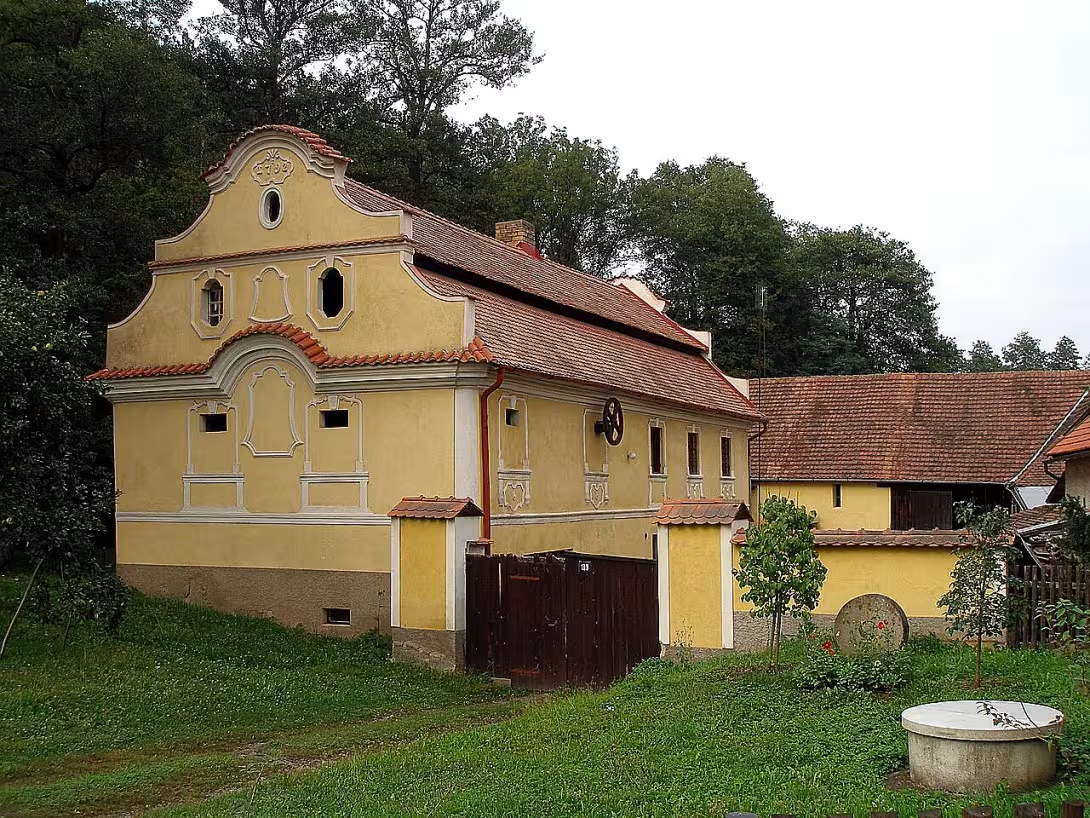
Mlyn Krcál in the New Moustache in the district Příbram is a valuable baroque water mill, which stands in the northern part of the village on the Voznický creek in front of its confluence with Kocába and is protected as a real cultural monument of the Czech Republic. This brick storey object represents an important example of folk and late Baroque construction in Central Bohemia.
There is not much information about the oldest history and specific builders of this building. The historical context of the creation dates back to the last decade of the 18th century. The Czech countries were then under the rule of the Habsburg monarchy during the late Enlightenment Absolutism for the reign of Emperor Franz II. At that time, Europe was deeply affected by the ongoing French revolution and the related changes in the political order of the continent. The 1792 is documented in the cartouche at the top of the southern shield mill.
The building is a walled storey object with a wall made of quarry stone and a brick wall in the shield. It stands on a rectangular floor plan and its Mansard roof is covered with bobbies. Architecturally most valuable are the two wall shields, which are lined up on the sides and decorated with rich, late baroque stucco. On the ground floor facing the road there is a mill with remnants of the original stool. The residential areas in the northern part contain a valenously arched kitchen with sectionals and an unarched hall with stucco frames.
The object used a sophisticated water system. The water led the drive from a small storage tank behind the mill through a tripod at the south end of its dam, while the excess water flowed through a tripod at the north end of the dam. According to the water books, there used to be two water wheels working on the top water with a diameter of 2.5 meters. The names of owners and details of subsequent operational changes are not specified in the available sources.
Today the monument is protected as a real cultural object and represents a valuable example of historical water construction and late Baroque architecture. Visiting this place in the northern part of the New Book offers a view of preserved technical elements and artistically processed shields that document the form of rural buildings at the end of the 18th century.
Historical milestones
- 1792
- The cartouche at the top of the southern shield mill is given in 1792.
Architectural development
The wall mill has a wall made of quarry stone and brick masonry in the shields, the cartouche at the top of the southern shield shows the year 1792. The water was delivered to two water wheels on the top water with a diameter of 2,5 metres by a drive from a small storage tank behind the mill through the spring. On the ground floor facing the road there is a mill with remnants of the original stool. The residential areas in the northern part contain a valenously arched kitchen with sectionals and an unarched hall with stucco frames.
Points of interest
- The mill Krcál is located in the northern part of the village Nový Knín on the Voznický stream in front of its confluence with Kocába and is protected as a real cultural monument. - The historical context of the construction dates back to the last decade of the eighteenth century and the year 1792 is documented in the cartouche at the top of the southern shield mill. - Architecturally most valuable are the two masonry shields, which are lined up on the sides and decorated with rich, late baroque stucco. - On the ground floor oriented to the road there is a mill with the remains of the original stool and residential areas in the north part contain a valenously arched kitchen with sections and an unarched skylight. - According to the water books, there used to be two water wheels working on the top water two and a half meters in diameter.
Guide
Show guide text
This text was created by artificial intelligence and has not been editorially reviewed. It may contain inaccuracies.
Welcome to this lovely place. You are standing right in front of the historic water mill called the Krcál, which is located in the northern part of the picturesque village Nový Knín. You can certainly see the peaceful atmosphere, because this valuable display of folk and late baroque construction in the Pribram district is standing on the Voznické creek, just before its natural confluence with the Kocába River. When you look around you, you see a structure that remembers hundreds of years of human endeavor and wisely resists the trials of time.
Let us now look deeper into the history of this remarkable work. The historical context of this construction dates back to the last decade of the eighteenth century. The exact period of birth of this monument is firmly documented in the cartouche, which is located at the top of the southern shield mill, where we read the year seventeen hundred ninety-two. Unfortunately, we do not know the names of the creators, i.e. builders or architects, but their craftsmanship and their attention to detail speak for them and persist until today. Similarly, it is the case with specific historical figures that would be closely linked to this mill, as chronicles remain silent about them, but the spirit of the then residents and miller has undoubtedly left an invisible mark.
Now pay attention to the architecture itself, which is right in front of you. In front of you is a walled-up storey object, which at first glance captures its Mansard roof. This roof is carefully covered with traditional burnt bags, which are called bobbies. The architecturally most valuable part of the building is undoubtedly both masonry shields. Look closer. They are beautifully lined on the sides and decorated with rich stucco. It is these shields that give the whole building an unmistakable character and show a high level of craft art.
When we think about the key stories of this place, we realize that the mill has played a very important role in the life of the local community for generations. There was a mill of grain for the broad surroundings, people came here with their worries and joys and water flowing through the stream drove the wheels that drove the whole world forward. Although we do not know the names of the particular people from those times, we can live to see the vigil that prevailed here during the morning dawn, and the silence that came with the evening shadows falling to the level of the creek.
The fact that the mill Krcál is officially protected as a real cultural monument is an interesting fact and the great value of this place. This, in itself, shows its uniqueness and the need to protect it for future generations. There is also a small mystery associated with this construction, namely the already mentioned cartouche with the year seventeen hundred ninety-two on top of the southern shield. He is a silent witness to the past who speaks to us without words and makes us think about how life on this river bank has changed over the last 200 years, while running water remains the same.
In conclusion, we'd like to invite you to further explore this picturesque neighborhood. You can walk along the water stream, perceive the roar of the stream and let the charm of the old times, which Nový Knín so generously offers to every perceptive visitor. Thank you for listening to our stories, and we wish you a wonderful experience the rest of your walks. Goodbye.
Tips for visitors
The best time to visit this historic water mill is in the morning during spring or autumn months, when the surrounding nature offers a unique atmosphere and a lighter light for admiring folk and late baroque construction. For transport, you can use a passenger car or public transport to the region of Central Bohemia, and check the specific transport connections in the local connection search engine. Take with you fixed shoes suitable for movement around watercourses, drinking water and camera to capture interesting details of the building. The best places for photography are located in the northern part of the village in the immediate vicinity of the water stream, where you can catch a unique connection of historical architecture with the natural scenery in the morning side light. The Kocába River itself and the Voznický brook are worth paying attention in the vicinity, just before their confluence in the northern part of the New Book. For families with children, this location is ideal for easy walking along with the discovery of old crafts and water engineering in the Příbram district.
Frequently asked questions
Can the monument be visited?
This is a technical monument. Some are open as exhibitions, others are out of use or on private land. We have not verified whether this one is accessible.
What are the opening hours and admission?
We have not verified the opening hours or admission. Current information is published by the operator.
Where is the monument?
Location: Nový Knín, Středočeský kraj. The map on this page shows the exact spot.
Why is the monument protected?
It is listed in the Central List of Cultural Monuments of the Czech Republic as a cultural monument (register no. 1000136821).
Businesses nearby
Do you run a restaurant, accommodation, shop, museum, rental, wellness or other visitor service near this monument? Show yourself directly to the people heading to it — this is how they will see you in the app and on the web:
Events nearby
Zdroj akcí: otevřená data měst a obcí ČR (Národní katalog otevřených dat) a kalendář akcí Národního památkového ústavu.
Nearby
Mlýn stojí v severní části Nového Knína na Voznickém potoce těsně před jeho soutokem s řekou Kocábou v regionu středních Čech.
Accommodation nearby
Themed route
Northern part of the municipality Nový Knín (Region) This tour circuit begins in the northern part of the seat, where the starting point of our journey is connected to the natural flow in the region of central Bohemia. The site offers a view of the historical environment associated with local water flow.
Wagon stream (Water stream) This smaller water flow flows through the northern part of the village and forms the natural axis of the surrounding countryside. It is worth visiting for its peaceful atmosphere and immediate proximity to historical construction.
Vodní mlýn (Nový Knín) (Mill) Our main destination is in the northern part of the New Book. This monument is a traditional building linked to the use of water power in the region of central Bohemia.
Confluence of the Wagon River and the Kocába River (Natural Confluence) Just before this confluence, our primary target is located. The meeting place of both watercourses in the northern part of the village offers an interesting view of the water system in nature.
River Kocaba (Water flow) This water flow is an important natural boundary and a destination in the northern part of the New Book. The surrounding area of the river and its confluence with the creek completes the overall character of this location in central Bohemia.
Seasonal recommendations
Spring brings to the water mill in New Leaders of the awakening nature, where the surrounding trees begin to green and the melting snow increases the level of the stream, which gives the whole place the energetic sound of flowing water. The sun's rays penetrate the still slightly squeaky trees and create interesting shadow games on the old stone walls. The atmosphere is calm and ideal for quiet contemplation at the water. You will not meet many tourists here during this period, so you will enjoy the tour in complete peace. It is convenient to wear fixed waterproof shoes because the field roads in the surroundings are soaked after winter, and a light jacket against the colder spring wind. The best time to visit is in the morning, when the air is the cleanest.
The summer will light up the historic mill in full force, accompanied by rich green leaves and lush shores that provide a welcome shadow. The sun stands high in the sky, and the sharp midday light creates a strong contrast between the sun bath and the dark corners under the mill wheel. The atmosphere is lively and holiday, as the memory of the family with children on trips. The main risks are the larger crowds of visitors especially on weekends, so we recommend to come first thing in the morning before the opening time or in the late afternoon. Take your air clothes, headgear against the sun and plenty of drinking water because the temperatures at the south end of Brd can be quite high.
Autumn turns the surroundings of the New York Mill into a colorful palette of shades of yellow, orange and red, which perfectly contradict the grey wall of the building. The low autumn sun creates soft, warm lighting that is absolutely perfect for taking impressive photos. The atmosphere is melancholy, quiet and very romantic, underlined by the rustling of the fallen leaves under the feet. Tourists have decreased significantly, so you can enjoy the tour completely undisturbed. The practical council is in charge of wearing a warmer sweater and windbreaker, because the dripping fog from the creek can hold on longer. The ideal time to visit is early afternoon, when the sun is still warm.
Winter will cover the whole water mill in white silence if it attacks snow, which will turn down all sounds and give the place a fairy tale. The lighting is very muted and the days are short, which creates an atmosphere of old times when people lived here in close contact with nature. The outdoor areas seem abandoned and mystical. It is necessary to count on a very limited operating time or the need to arrange a tour in advance. Wear the hottest winter clothes, don't forget the hat, gloves and mainly solid winter shoes with anti-slip soles, because wooden and stone elements around the water can freeze. The best time to visit is around noon, when there is the best chance of daylight and slightly higher temperatures.
Visualizations and artistic views


The visualisations are generated by artificial intelligence and serve as inspiration.
Photos from the area
Real photos taken near the monument


Zdroj a licence jsou uvedeny u každého snímku.
Tips from visitors
No tips yet. Be the first!
Log in and add your tip.
Sources and literature
Photos: Miloš Hlávka / CC BY-SA 3.0 — Wikimedia Commons. The author and licence also appear when you hover over the image.
Faktickým podkladem tohoto textu byl článek na Wikipedii, jehož autory jsou přispěvatelé Wikipedie. Článek je dostupný pod licencí CC BY-SA 4.0.
Location on the map





Příběhy a pověsti
Legendy, pověsti a příběhy spjaté s touto památkou

Fotografie návštěvníků
Zatím žádné fotografie. Buďte první, kdo přidá fotografii z návštěvy!
Log in a přidejte svou fotografii nebo hodnoťte.
Za ověřenou návštěvu v aplikaci získáte víc bodů — poznáme podle GPS, že jste na místě.
Reviews and comments