



Vodní mlýn (Větrný Jeníkov) Water mill
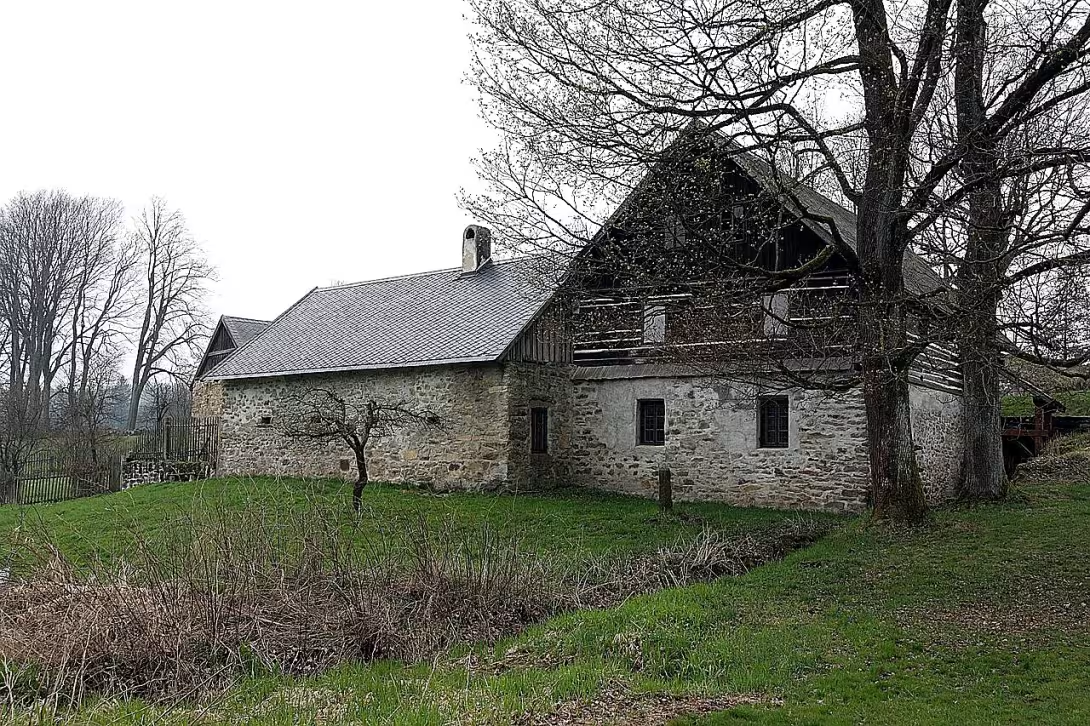
The Lower Mill in Větrné Jeníkov in Jihlava is a historic water mill from the 19th century, located south of the village on the stream of the Jirínský creek. The building is protected as a real-estate cultural monument of the Czech Republic and represents an important document of traditional milling industry. His technical equipment has remained fully operational to this day.
The construction of the mill falls into the period of intensive industrialization in Czech countries, when rural operations were modernised. The exact dating of the building is evidenced by inscriptions on the building: the year 1887 is engraved at the machinery room and the year 1890 is located at the entrance to the barn. These data confirm the time of origin of the individual parts of the complex.
The architectural mill combines the brick ground floor with grafted upper floor. The technical dominance is the wooden water wheel for the top water. It has a diameter of 3.8 meters, a width of 58 centimeters between the wreaths and a depth of 24 centimeters. The water on the bike flows from the pond through the floodgates and stone riverbed, which are connected by wooden vantroks. With full load, the wheel reaches nine revolutions per minute. The distance between the bottom of the trough and the top of the wheel is 13 centimetres and the distance from the bottom of the fridge is 14 centimetres.
The current owner of the building is the artist Leopold Habermann. Its operation on the premises has brought the historical technology a new use, as the water wheel is now powered by blacksmith machines. In addition, in the vicinity of the mill there are loose sculptures, the author of which is Leopold Habermann.
The construction is now fully functional and serves as a living technical monument that links the mill tradition with the art forging. Visiting this place offers the opportunity to see preserved machinery in the original context and to learn about the work of the owner in the authentic environment of the historical building.
Historical milestones
- about 1850
- The truths of the accounts of the mlynarske activity in the locality according to the type of construction
- 1887
- Engineering mill construction work
- 1890
- Reconcentration of the exhibition of the salty in the area of the mill
- 20th century
- Entry of the object into the list of real estate cultural memories
- 21st century
- Renovation of the drive to the covan machines by Leopold Habermann
Architectural development
The building combines the brick ground floor with a grafted floor. The technical equipment includes a functional wooden water wheel with a diameter of 3.8 metres and a system of vantroks for water supply from the pond.
Historical events
In 1887 the dating was engraved at the engine room and in 1890 at the entrance to the barn.
Owners
Leopold Habermann
Points of interest
- The Lower Mill in Větrné Jeníkov is a historic water mill from the nineteenth century, whose technical equipment has remained fully functional to this day. - The building is engraved with years, the year 1887 is located at the machinery room and the year 1890 is located at the entrance to the barn. - The wooden water wheel on the top water has a diameter of 3.8 metres and reaches nine revolutions per minute at full load. - Contemporary owner, art blacksmith Leopold Habermann, uses a water wheel to drive the blacksmith machines. - In the vicinity of the mill are loose sculptures, the author of which is the owner of the building.
Guide
Show guide text
This text was created by artificial intelligence and has not been editorially reviewed. It may contain inaccuracies.
Welcome to the Lower Mill in Windy Jenikov. Right now you're standing in a place where the power of nature meets human finesse and the echoes of the past mingle with the constant noise of water. Before you take another tour, stop for a moment and feel the surrounding atmosphere. In front of your eyes is a historic building that is a fixed point in this landscape. Do you hear that sound? It's a Jirina stream that flows just past and is the very heart of this place. Without its constant current, this mill would have no meaning. Take a look at the building and try to imagine what the surrounding landscape looked like more than a hundred years ago, when it was first started working here with water for the needs of local people.
This object you are now observing is not just an ordinary building. It's a living document of history that tells us the story of how life changed in this area. It is estimated that the miller's work in this place began around the year one thousand eight hundred fifty. At that time, working with cereals and using hydroenergy was absolutely essential to the survival and flowering of communities. The mill stands here as a witness to the time when everything could be resolved by using wood, stone and the tireless work of human hands. But with time, people's needs changed, and with them the mill itself.
Now pay attention to the architecture itself, which is absolutely exceptional for this object. Look at the bottom of the building. See those massive blocks? They're made of quarry stone. This material was selected very deliberately. The stone gives the mill the necessary stability and resistance to moisture, which is a constant partner in this environment. It is a fixed, stationary base that must bear not only the weight of the whole building, but also the constant vibration caused by the movement of the water wheel. Now raise your eyes higher. The top floor looks completely different. It's a grafted structure. You see those wooden beams that form the frame of the building? This contrast between the heavy, cold stone below and the warmer, organic wood above is absolutely typical of this type of historical buildings and creates a very harmonious whole.
When you look at the walls of the building, notice the small but very important details. If you look towards the place where the engine room is located, you'll see a thousand eight hundred and eighty-seven engraved on the facade of the year. This figure tells us when this part of the mill was built to fulfil its technical role. And if your eyes slide to enter the barn, you'll find another mark of the past, one thousand eight hundred and ninety. These engraved years are not just random numbers, they are milestones that show us how this area has been gradually expanding and how each part of it has been added at some time to serve the growing needs of owners and residents.
Now let's move on to the story of the people who formed this mill. One of the most important men whose name is closely linked to this place was Leopold Habermann. It was thanks to his decision and his vision that one of the most important changes in the history of this mill occurred. There has been an unusual shift in the modernisation and adaptation of the new period conditions. The mill stopped focusing only on grinding grain and started using its water power for something completely different. Thanks to the conversion of the drive, it started working with the blacksmith's equipment. Imagine the fascinating transformation where instead of grinding grains, hot iron and hammer power began to work here, all thanks to the same stream of water that has been flowing here for centuries.
And it is here that comes with what is the greatest technical interest in this mill. Look at that giant wooden water bike. It's a really impressive sight. This wheel is designed to use so-called top water. This means that the water falls on the top of the blades, which is a very effective way to get maximum power for machine drive. And do you know how big this machine is? Its diameter is over three and a half meters, exactly three meters and 80 centimeters. Imagine the weight and the incredible power that lies in the wheel when it moves. And what's the most amazing thing about all this? The entire facility, despite its great age, is still fully operational. It's not just a dead piece of history that looks at the world, but it's still a working machine that can transfer the energy of water to the blacksmith's equipment.
So this mill is much more than just an old building. It's a combination of stone, wood and water that has been working together in perfect rhythm for centuries. It is proof of human ingenuity to be able to use what nature offers us and turn it into a tool for work and progress.
Now I won't hold you any longer. I suggest you stop for a while and perceive this space with all your senses. Listen to the rhythmic sound of water, feel the structure of the stone and wood that you have right in front of you, and just watch. This historic water mill is a treasure that deserves your attention and humble admiration. I wish you a nice walk and other interesting discoveries in our surroundings. Goodbye.
Tips for visitors
The best time to visit is during the sunny morning, when the light beautifully depicts the historical facade of the mill and the level of the adjacent pond. Take with you fixed shoes suitable for moving in the natural terrain around the stream and the camera, with the best pictures taken from the bank of the pond where the silhouette of the building is reflected. In the surrounding area you can take a walk along the Jiřín creek, which offers a quiet corner for relaxation. For families with children, the location is ideal for a light nature walk where water birds can be observed on the pond and explore the surrounding landscape.
Frequently asked questions
Can the monument be visited?
This is a technical monument. Some are open as exhibitions, others are out of use or on private land. We have not verified whether this one is accessible.
What are the opening hours and admission?
We have not verified the opening hours or admission. Current information is published by the operator.
Where is the monument?
Location: Větrný Jeníkov, Kraj Vysočina. The map on this page shows the exact spot.
Why is the monument protected?
It is listed in the Central List of Cultural Monuments of the Czech Republic as a cultural monument (register no. 1000136364).
Businesses nearby
Do you run a restaurant, accommodation, shop, museum, rental, wellness or other visitor service near this monument? Show yourself directly to the people heading to it — this is how they will see you in the app and on the web:
Nearby
Jiřínský potok, rybník, obec Větrný Jeníkov.
Accommodation nearby
Themed route
1. Municipality of Větrný Jeníkov, municipality. Walk through the village serves as a pleasant introduction to the trip and familiarisation with the local environment. 2. Pond, water surface. A quiet place to observe water levels and surrounding nature. 3. Jiřín stream, water flow. The path along the creek offers a pleasant shadow and leads visitors directly to the destination. 4. Vodní mlýn (Větrný Jeníkov), mill. The main monument where you can explore the history of grinding grain and admire technical equipment.
Seasonal recommendations
Spring: In the spring season, in Windy Jeníkov, wonderful lighting appears, when the sun's rays shine on the newly revived nature. Trees and shrubs begin to bloom, creating a lively atmosphere around the mill. At this time the visit may be free from winter cold, but it is advisable to prepare for morning and evening cold. It is recommended to visit the memory at noon when the sun warms the most, and to be dressed in such a way that it is protected from sudden cold.
Summer: In the summer months the atmosphere around the water mill in Windy Jeník is full of warmth and life. Sunshine days attract a large crowd of visitors who enjoy the outdoor environment and the beauty of the mill. It is advisable to visit the memory early in the morning or late in the evening to avoid impact temperatures and long fronts. Don't forget the protective sun clothes, hat and plenty of drinking water.
Autumn: In the autumn months Větrný Jeníkov gets color gloss. Tree leaves are golden and red, which provides a beautiful background for photos. The weather is usually quieter and less sudden rainy days than in other seasons. Visit the memory in the middle of the day when the temperature is pleasant, but bring with you clothes for cold lunch hours and a possible rain.
Winter: Winter visit of the Windy Jeníkovsky Mill offers a unique atmosphere where the monument appears in the snow dress. Warm clothes are inevitable because of cold and possible snow. Despite the cold, it is a comfortable time to visit, because you can avoid the summer crowds and enjoy a peaceful and peaceful atmosphere.
Visualizations and artistic views


The visualisations are generated by artificial intelligence and serve as inspiration.
Photos from the area
Real photos taken near the monument

Zdroj a licence jsou uvedeny u každého snímku.
Tips from visitors
No tips yet. Be the first!
Log in and add your tip.
Sources and literature
Photos: RomanM82 / CC BY-SA 4.0 — Wikimedia Commons. The author and licence also appear when you hover over the image.
Faktickým podkladem tohoto textu byl článek na Wikipedii, jehož autory jsou přispěvatelé Wikipedie. Článek je dostupný pod licencí CC BY-SA 4.0.
Location on the map


Příběhy a pověsti
Legendy, pověsti a příběhy spjaté s touto památkou

Fotografie návštěvníků
Zatím žádné fotografie. Buďte první, kdo přidá fotografii z návštěvy!
Log in a přidejte svou fotografii nebo hodnoťte.
Za ověřenou návštěvu v aplikaci získáte víc bodů — poznáme podle GPS, že jste na místě.
Reviews and comments