

Vratislavská zahrada Garden
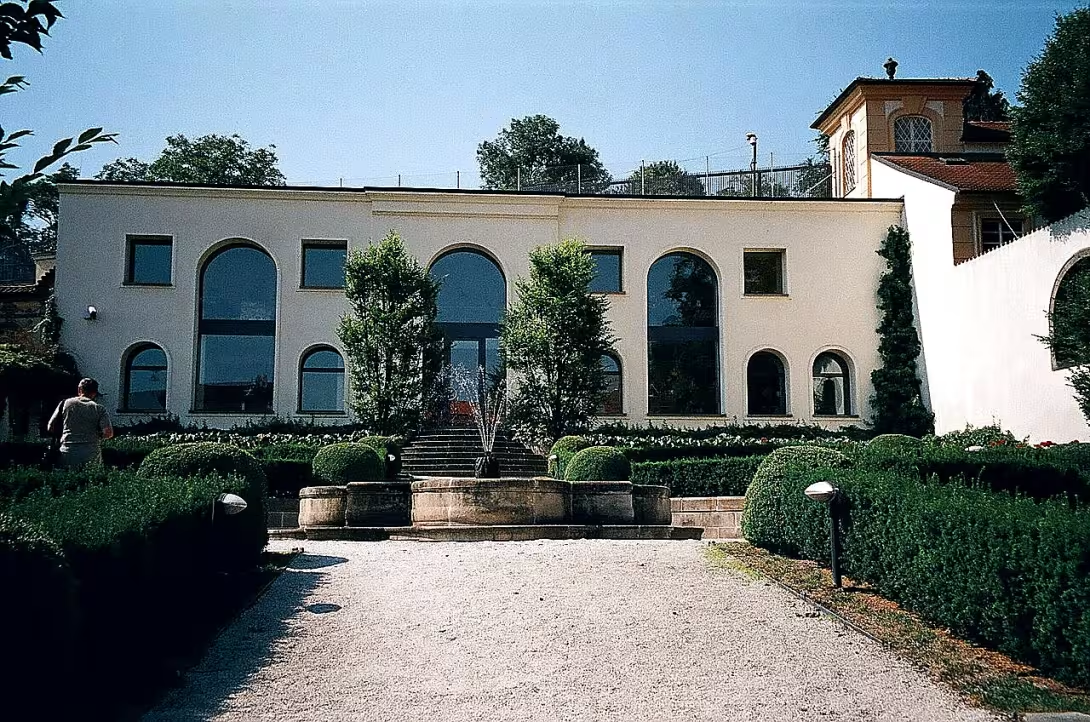
Vratislavská zahrada, also known as Mitrovická, is an early Baroque terrace garden of the Wrocław Palace in Prague 1 in Malá Strana. An object with an area of 0.2 hectares with the highest point at an altitude of 215 metres has been registered as a cultural monument since 1964.
In the place of today's palace, there were originally two buildings on the law of the Church of the Holy Mother before Tyn. The first mention of the east house dates back to 1591, when it was inherited by cooper Václav Svatos. The property was a small garden at the time. In 1671, the buildings were sold to Christopher František Vratislav of Mitrovice. The garden was newly renovated at the time. From this point on, the object was in the administration of the House of Wrocław from Mitrovice.
The garden was built in two main stages. The first stage in 1670-1671 included the establishment of a second terrace with an impressive staircase, grotty, perimeter walls, Sala terrena and an eastern niche in the axis. The second phase took place in the 1920s. Later, in 1824-1894, there was another major construction modification. However, only minimal records of it have been kept, namely the plan and budget for the extension of the garden house.
The garden rises south to the slope towards the Seminar Garden and consists of three terraces. At the highest point, it is concluded by the belarium, i.e. this year's castle. There are two pavilions above the stairwell near the walls that border the neighbouring gardens: in the east with Vrtbovska and in the west with Schönbornsky.
The building is equipped with three garden fountains. On the upper terrace is installed sandstone fountain with lobes and striped plastic with watermark. The second fountain is located in a nobodies perimeter wall; The water in it flows from the plastic bird through the cascade of stones into the sandstone tank. The third fountain is located below the stairs of the palace in nothing surrounded by two arms of staircase. It consists of an overflow bowl with a simple gargoyle, which flows water from the springs under Petřín, and a large sandstone tank.
The ownership of the building took place among several members within the House of Wrocław from Mitrovic. After the death of Count Christopher Karl Wroclaw in 1689, the house was inherited by the son of Jan Václav, the supreme chancellor of the Czech Kingdom. In 1709 he donated half the house to his brother Franz Karl. He later switched the house to the sisters of Mary Joseph Countess Šliková and Maria Elizabeth Countess Althan, who sold it to the royal chamber of George Bernard Vratislav of Mitrovic. The House of Wroclaw owned a palace with a garden until 1948 when it was nationalized.
In 1993, archaeological research was carried out in connection with the construction of underground garages. 109 graves were documented in the area between the north slope of Petrín and the former trough of the Malostran creek. Research confirmed that the area was used as a hardware district in the mid-10th century. Three objects with burned-out bottom filled with slag and iron ore bear witness.
Nowadays, the palace is owned by Maximilian Wratislav from Mitrovic, who began to repair it after the restitution. Since 2008, Vratislavská zahrada has been used by the American Centre and is not open to the public.
This monument is a rare example of an early Baroque terraced arrangement in the centre of Prague. Its historical and archaeological value makes it an important element of the Small Party architecture.
Then and now
Drag the slider to compare how the landmark may have looked when it was built with the view today.
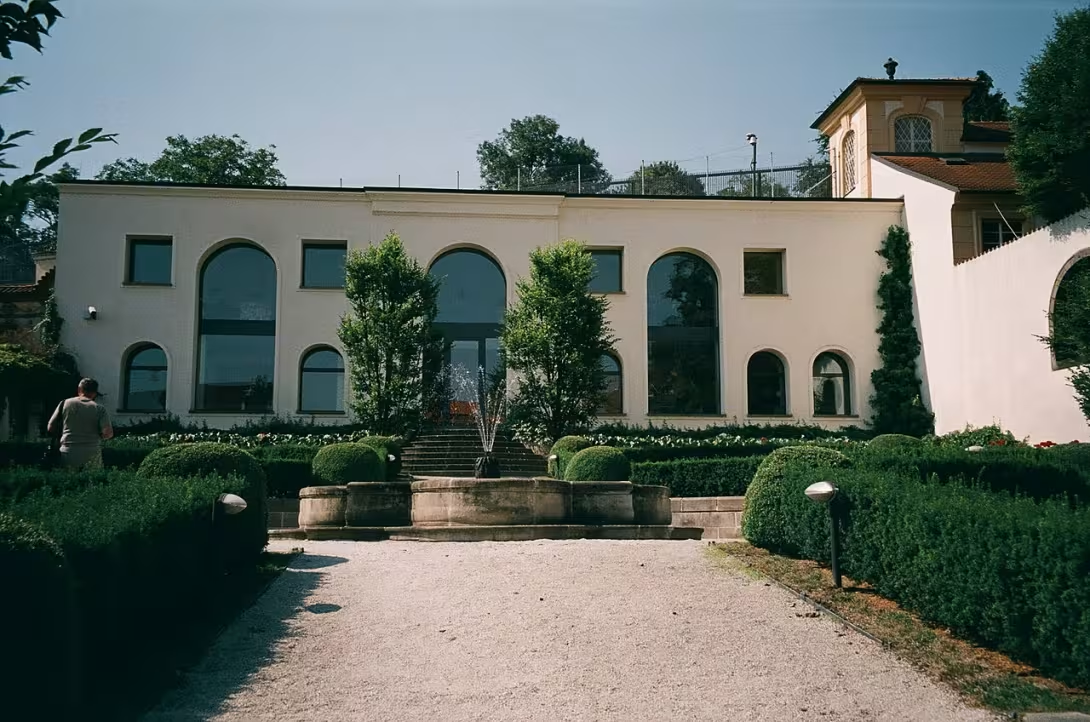
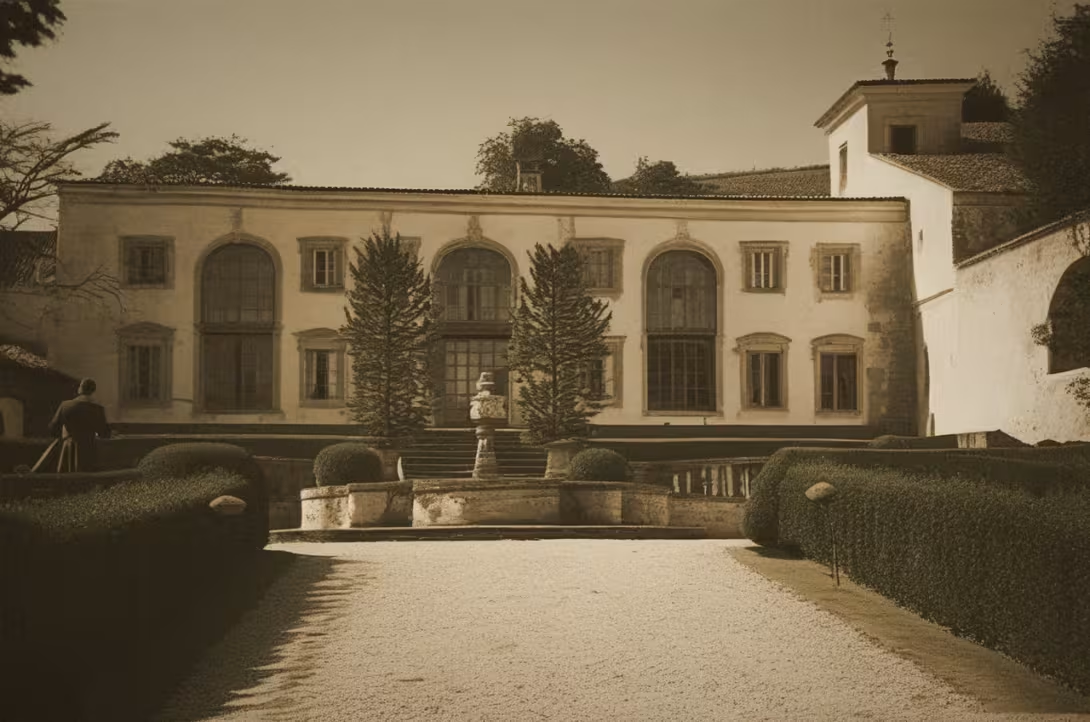
The historical appearance on the left is an AI-generated visualisation and serves as inspiration only.
Historical milestones
- 1670
- The beginning of the first stage of the garden construction.
- 1671
- The garden goes to the administration of the House of Wrocław from Mitrovice.
- 1964
- A list of cultural monuments.
Architectural development
The first phase of construction took place in 1670-1671 when the second terrace, staircase, grotta and Sala terrena were built. The second phase of construction took place in the 1920s. In the years 1824-1894, there was another major construction arrangement, but only minimal records were preserved.
Historical events
1671 - sale of real estate to Christopher František Vratislav from Mitrovice; 1948 - nationalization of palace with garden; 1964 - registration in the list of cultural monuments; 1993 - archaeological research in connection with the construction of garages.
Owners
Václav Svatos (1591), House of Wrocław from Mitrovic (from 1671), Maria Josef countka Šliková and Maria Elizabeth Countess Althanova, Jiří Bernard Vratislav z Mitrovic, State (nationalized 1948)
Points of interest
- The garden is early Baroque, terraced and since 1964 it has been registered as a cultural monument. - At the highest point, the castle ends with three garden fountains. The House of Wroclaw of Mitrovic owned a palace with a garden until 1948. - 1993 archaeological research documented 109 graves. - Research confirmed that the area was used as a hardware district in the mid-10th century.
Guide
This guide is narrated by a synthetic voice generated by artificial intelligence.
Show guide text
This text was created by artificial intelligence and has not been editorially reviewed. It may contain inaccuracies.
Welcome to one of the quietest and most beautiful corners of Little Party. You are standing in front of the Wroclaw Garden, which is also known in some records as the Mitrovická Garden. If you look around you now, you will see an area that will immediately transfer you to a time when the elegance of an early baroque was ruled in Prague. In front of you is a place where nature has joined with human architecture to create space for peace, contemplation and social life of nobility. Feel this atmosphere, which is so rare in the centre of the city, and let yourself forget the noise of the surrounding streets for a moment. Let us now look together at how this place was created and who was behind it. The history of this garden begins in the year of tyre six hundred seventy when the first stage of its construction began. Only a year later, in the year six hundred seventy one, the garden came under the administration of the House of Wrocław from Mitrovice. So imagine that this place was designed as a private paradise for one of the great families of that time. The whole complex was designed to complement the adjacent Wroclaw Palace, and together they formed units that expressed the power, taste and wealth of their owners. It is fascinating to think that the House of Wrocław of Mitrovic owned this palace and garden for many generations, until the year nine hundred forty-eight. So it's a place with a deep family tradition that has survived centuries of history. Now pay attention to the very arrangement of the space, because it is the main beauty of this place. Note that the garden is not flat, but rises south to the slope. The whole area consists of three terraces which connect smoothly. This terraced architecture was very popular at the time of the Baroque because it made it possible to use steep terrain while creating different levels of privacy and prospects. The total area is small, approximately two-tenths of a hectare, but due to its breakdown it is very rich. When you move around the garden, focus on its architectural elements. Notice the pavilions, which served as a place to rest in the shade, and also the belaria, a sightseeing place from where beautiful views of the surrounding city could be opened. These elements provide the garden with rhythm and structure. Another important detail you should not miss is the garden fountain. The whole building is equipped with three such fountains, which, in times of their greatest fame, brought to the garden the sound of flowing water and helped maintain pleasant air temperatures in hot summer days. All of these elements together form a harmonious whole, which, thanks to its value since nine hundred sixty-four, has been registered as a cultural monument. Speaking of history, there's no forgetting the people who lived here and created it. The House of Wrocław of Mitrovic left a trail. The personalities we connect to this place include Kryštof František Vratislav z Mitrovic, Jan Václav Vratislav z Mitrovic, František Karel Vratislav or Jiří Bernard Vratislav z Mitrovic. Imagine them walking on these terraces, discussing politics, art, or family matters, surrounded by the scent of flowers and accompanied by water from the cashew. For these people, the garden was not just a decoration, but a real place of life where they sought to escape the public life's obligations. I will now lead you to something that may be the most interesting part of your visit. If you look at the highest point in the garden, you'll see the castle there. It is this small building element that ends the entire composition of terraces and serves as the peak point of the whole complex. In the Baroque times, the games were symbols of lightness and joy, places where intimate meetings were held or where the owner of the house could read books in peace. In addition to visible elements, there is something that is not visible at first sight, but which is extremely valuable to historians. In the year nine hundred ninety-three archeological research took place here. Even though we see a beautifully maintained garden today, beneath our feet are the layers of time. This research helped document details that would otherwise remain hidden in the country and helped us better understand how this space evolved over the centuries. It is a reminder that every terrace and every stone here has a story that goes deep into the past. Vratislavská zahrada is thus basically an open book about baroque lifestyle. It's a place where the discipline of geometrical breakdown meets natural terrain climb. It's a space that teaches us to slow down and understand the details. Notice how the light divides between the different levels of the terraces and how the feeling changes from space when you climb up to the castle. Now that you've become acquainted with the history, architecture and personalities involved in this place, I suggest you look at the space at your own pace. Go through all three terraces, stop at each of the three porridge and enjoy a moment of silence at the highest point in this year's castle. Feel the contrast between the quiet shelter of the garden and the dynamics of Prague 1 that surrounds you. Thank you for accompanying me on this short journey through the history of the Wroclaw Garden. I hope you found peace and inspiration in this Baroque corner of the Little Party. Now it's up to you to spend the rest of your time in this magical space. I wish you a pleasant rest of the day and a wonderful continuation in discovering the secrets of our city. Goodbye.
Tips for visitors
The best time to visit is spring or late summer when the Baroque terraces are in full bloom and the greenery are the most excellent. Transportation to the centre of Prague is possible by car and public connections; Check the specific routes and connections in the maps.
Take comfortable shoes suitable for walking on terraces and water with you in the garden. Top terraces are the best places for photo lovers, offering a beautiful view of the surroundings; The best light for images is early morning or shortly before sunset.
Within a short walk in the surroundings we recommend to visit Vrtbovská, Schönborská or Seminar Garden, or to head towards Petřín Hill.
Families with children appreciate the quiet space for a short rest from urban noise, although the garden area is relatively small and serves rather for quiet admiration of architecture.
Frequently asked questions
Can the monument be visited?
Parks and gardens are often open to the public, but some have opening hours or are part of a closed site. We have not verified the entry conditions.
What are the opening hours and admission?
We have not verified the opening hours or admission. Current information is published by the operator.
Where is the monument?
Location: Praha 1. The map on this page shows the exact spot.
Why is the monument protected?
It is listed in the Central List of Cultural Monuments of the Czech Republic as a cultural monument (register no. 1000151442_0002). It is protected as part of a larger listed ensemble.
Businesses nearby
Do you run a restaurant, accommodation, shop, museum, rental, wellness or other visitor service near this monument? Show yourself directly to the people heading to it — this is how they will see you in the app and on the web:
Events nearby
Zdroj akcí: otevřená data měst a obcí ČR (Národní katalog otevřených dat) a kalendář akcí Národního památkového ústavu.
Nearby
🏰 Historic sites (786)
- Millennium 0.1 km Tržiště 370/5 +420 257 534 584 web
- Galerie Akademie múzických umění 0.1 km
- Schönbornský palác 0.1 km
- U Tří jetelových lístků 0.1 km
- Mozartovo interaktivní muzeum 0.1 km Karmelitská 33 web
- svatý Mikuláš 0.2 km Malostranské náměstí
- Thun-Hohensteinský palác 0.2 km
- svatý Prokop 0.2 km
- Nejsvětější Trojice 0.2 km
- Památce neznámých dětí 1939-45 0.2 km
- palác Harbuval-Chamaré 0.2 km
- Gingerbread Museum 0.2 km Nerudova 9 web
- Svatováclavská rotunda 0.2 km web
- svatý Jan Křtitel 0.2 km
- Museum Montanelli 0.2 km Nerudova 13
- Ema Destinnová 0.2 km
- Turbovský palác 0.2 km
- Sterneggovský palác 0.2 km
- Aukce aukci 0.2 km
- Muzeum alchymistů a mágů staré Prahy 0.3 km Jánský vršek 8 +420 257 224 508 web
🍽️ Restaurants and dining (5405)
- Kafírna u svatého Omara 0.1 km Tržiště 367/11
- CODA Restaurant 0.1 km Tržiště 9 web
- San Carlo Malá Strana 0.1 km Tržiště 369/7 +420703337317 web
- Beer House Restaurant 0.1 km
- Pizza Saint Nicholas 0.1 km
- Lžička café 0.1 km
- Bread Gap 0.1 km
- Pivovar Mikulas 0.1 km Karmelitská 373/25
- Melichar Trost’s 0.1 km
- A studio Rubín 0.1 km Malostranské náměstí 9 web
- J.J. Murphy's 0.1 km Tržiště 266/4 +420 257 535 575 web
- Malostranský Hostinec 0.1 km Malostranské náměstí 260/11 +420 730 516 585 web
- Národní banka vín 0.1 km Tržiště 17 +420606483087
- U Malého Glena 0.1 km Karmelitská 23 +420 257 531 717 web
- Skalla 0.1 km
- U Mecenáše 0.1 km Malostranské náměstí 261/10 +420 220 515 790 web
- San Carlo Gourmet 0.1 km Tržiště 303/19 +420 257 286 019 web
- Restaurace U Tří Zlatých Hvězd 0.1 km
- Palliardi bar café 0.1 km
- Hamdi's Kebab Street Food 0.1 km +420 602 340 460
🏨 Accommodation (810)
- Aria 0.1 km Tržiště 368/9 +420 225 334 111 web
- ubytovací zařízení Akademie můzických umění 0.1 km
- Three Golden Crowns 0.1 km Malostranské náměstí 11 +420 242 406 965 web
- Alchymist Grand Hotel and Spa 0.1 km Tržiště 303/19 +420 257 286 011 web
- Miss Sophie's Charles Bridge 0.2 km Malostranské náměstí 28 +420 210 011 500 web
- Hostel Santini Prague 0.2 km Nerudova 14 +420 257 316 191 web
- Residence Malostranská 0.2 km Malostranské náměstí 24
- Constans 0.2 km
- Vintage design hotel Sax 0.2 km
- The Charles Hotel 0.3 km Josefská 1
- Apartmány Thunovská 19 0.3 km Thunovská 19
- U Zlaté růže 0.3 km Thunovská 21
- U Zeleného hroznu 0.3 km
- U Černého orla 0.3 km Mostecká 11
- Little Quarter 0.3 km Nerudova 21 +420 257 212 029 web
- MOOo by the Castle 0.3 km Jánský vršek 8 web
- Domus Balthasar 0.3 km Mostecká 5
- Golden Key 0.3 km web
- Dům U Velké Boty 0.3 km +420 257 531 360 web
- U Zlatého kola 0.3 km Nerudova 28
🚲 Rentals and sport (541)
- Euro Segway Prague 0.2 km +420 731 731 013 web
- bazén Tyršův dům 0.4 km
- BUGABOO snow & sk8 0.5 km +420 257 317 172 web
- Sokol Malá Strana 0.5 km web
- PRAGUE BY E-BIKE 0.6 km
- Husky 0.8 km Újezd
- S.P.L.A.V. 1.0 km
- VIBRO 1.0 km Na Valech 32
- U Kotvy 1.1 km
- Slovanka 1.1 km +420 777 870 511; +420 777 800 003 web
- Florbal expert 1.1 km
- Plavecký bazén 1.1 km +420725595756 web
- Darkslide.cz 1.1 km +420 725 378 449 web
- Sportovní klub Hradčany 1.2 km Diskařská 294/1
- Klub Slunečnice 1.2 km Maiselova 7
- HUDYsport 1.2 km Na Perštýně 355/14 +420 224 218 600 web
- Contours Fitness 1.2 km Národní 25
- Fitness Vagon 1.2 km Národní 25
- Finebike 1.3 km web
- Tilak 1.3 km Badeniho 5/29
🥾 Hiking and nature (404)
- Svatomikulášská městská zvonice 0.2 km +420 725 847 927 web
- Malý belvedér 0.3 km
- Lennonova zeď 0.3 km
- Malostranská mostecká věž 0.3 km +420 607 050 434 web
- Nosticova zahrada 0.4 km
- kolo Velkopřevorského mlýna 0.4 km
- Býčí schodiště 0.4 km
- Petřínka 0.5 km
- Katedrála svatého Víta, Václava a Vojtěcha 0.5 km web
- Plečnikova Pyramida 0.5 km
- Vojanovy sady 0.5 km
- Moravská bašta 0.5 km
- Certovka 0.6 km
- Vinárna Čertovka 0.6 km Vinárna Čertovka
- Nejužší ulička v Praze 0.6 km
- Huťský mlýn 0.6 km
- Petřínská rozhledna 0.6 km web
- Dolní Jelení příkop 0.6 km
- Zlatá ulička 0.6 km
- Veršomat 0.6 km
Accommodation nearby
Trips and activities nearby
Guided tours, tickets and activities nearby from GetYourGuide
Affiliate link: if you buy from the partner, we may receive a commission. The price for you does not change.
Search tours and activities →Themed route
Here is a design of a thematic route focused on beautiful garden areas:
1. Vratislavská zahrada (garden space) - The main destination of the trip where you can relax in a quiet environment in the middle of the city. 2. Schönborne Garden (garden area) - A unique place with terraces, located nearby. 3. Vrtbov garden (garden area) - One of the most beautiful Baroque gardens with an amazing view of the roofs around. 4. Seminar garden (garden area) - Another quiet corner for green lovers in the centre of Prague. 5. Petrin (top with park) - Final stop for a nature walk and a view of the whole city.
Seasonal recommendations
In spring, the garden awakens to life, the first flowers bloom, and the trees gain fresh green color. The atmosphere is full of hope and fine sunlight. We recommend light but warm clothes and a visit in the morning when the air is the cleanest.
In the summer months, the space is dominated by thick crowns of trees that provide a pleasant shade before the jar. Colors are rich and intense, which is ideal for nature lovers. In the high season it is advisable to choose breathable substances and visit the place in the early morning or late evening to avoid the greatest heat.
Autumn brings golden and red shades of leaves to the garden that create a nostalgic mood. The light is softer and golden, which gives the memory special depth. It's practical to bring a waterproof coat or a sweater and hit the beautiful weather in October before the last leaves fall.
Zimą is a minimalist and peaceful space, often in the dark or under a layer of snow. Nature rests and the architecture of the surroundings excels in a sharp, winter light. In advent time it is necessary to choose warm and waterproof shoes and a fat coat, while the best is a short walk during short daylight.
Visualizations and artistic views


The visualisations are generated by artificial intelligence and serve as inspiration.
Photos from the area
Real photos taken near the monument


Zdroj a licence jsou uvedeny u každého snímku.
Tips from visitors
No tips yet. Be the first!
Log in and add your tip.
Sources and literature
Photos: Kramar.Jan / CC BY-SA 4.0 — Wikimedia Commons. The author and licence also appear when you hover over the image.
Faktickým podkladem tohoto textu byl článek na Wikipedii, jehož autory jsou přispěvatelé Wikipedie. Článek je dostupný pod licencí CC BY-SA 4.0.
Location on the map
Příběhy a pověsti
Legendy, pověsti a příběhy spjaté s touto památkou

Fotografie návštěvníků
Přidat fotografiiZatím žádné fotografie. Buďte první, kdo přidá fotografii z návštěvy!
Máte k místu vzpomínku nebo zajímavý příběh?
Log in a přidejte svou fotografii nebo hodnoťte.
Za ověřenou návštěvu v aplikaci získáte víc bodů — poznáme podle GPS, že jste na místě.
Reviews and comments