



Vyskočilova vila Mosque
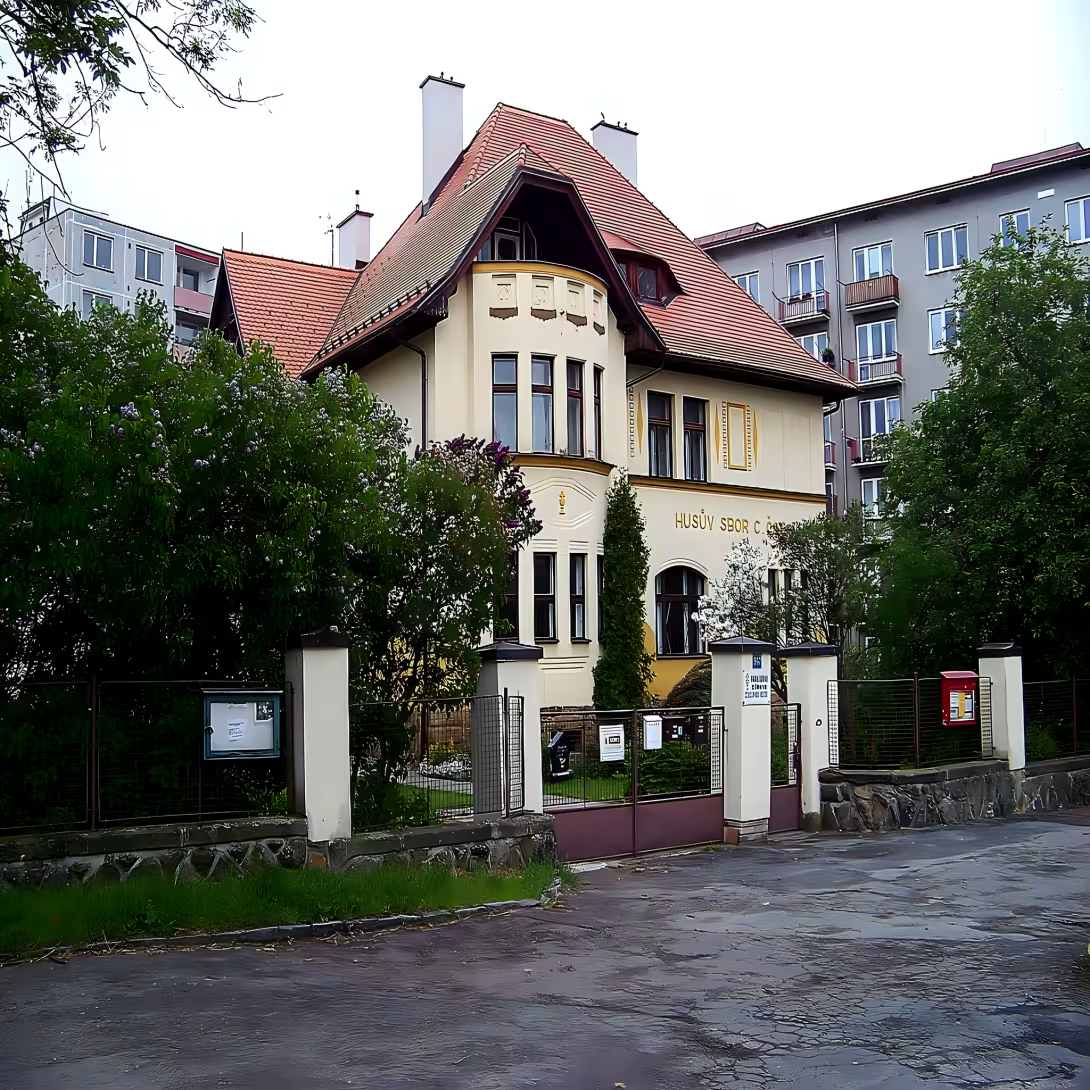
Vyskočilova vila in Mlýnská street in České Třebová is an important Art Nouveau building from 1908 to 1910. On 30 August 2018 it was included in the list of cultural monuments of the Czech Republic. The building was built according to the design of architect Alois Dryák and in its time represented one of the most luxurious residences in the region. Since 1930 it has served the needs of the Czechoslovak Hussite Church.
The villa was built at the request of the grain and lime merchant Miroslav Vyskok, filed at the end of April 1908. The investor wanted a representative residence near his family mill and therefore entrusted the implementation to Českotřebov builder František Plasšil. The construction was completed on 19 January 1910. The foundation of the villa falls into the final phase of Austria-Hungary, i.e. the period of development of urban culture and Art Nouveau Art, which predates social changes of the early 20th century.
The architectural solution combines cubic volume with high valb roof and corner risalite. It ends with a rounded patrol bay and a balcony under the halibut roof. The side facade is complemented by a short wing with a glazed porch and a shield, which refers in its form and wide submersion to traditional folk architecture. The rear part of the building defines the mass of the main staircase with the tiered window and the tower part of the service staircase with the walled floor. The material composition of the exterior uses contrast between the plinth of the stone masonry, smooth plaster in two shades of ochre and wooden elements. The roof is covered with a burnt beaver cover.
The interior is arranged around the central hall with wooden staircase. On the ground floor there was a salon, study, winter garden, dining room and kitchen. The floor served as a residential area with bedrooms and guest rooms. The attic was reserved for servants and family of gardener Rudolf Hüble. The original floors, chandeliers, wall tiles and doors with cut glass have been preserved in the villa.
The fate of the mansion is closely linked to Miroslav's life. He committed suicide after financial losses from stock exchange speculation on May 9, 1930. The Church of Czechoslovak Hussite purchased the building and set up the Husova Choir. From 1947 to 1948, the complex was expanded with a wooden object with a hall that served as a puppet scene of Dawn. An important historical event is a visit to the heir to the throne of Karl Franz Joseph, later the last Austrian emperor. He spent the night here in 1912 with his wife Zita during the transfer of his Dragoon regiment.
Today, Vyskočilova vila is a monument-protected object that documents a high level of urban architecture in the early 20th century. Visiting this place offers the opportunity to explore preserved Art Nouveau interiors and to become acquainted with the history that carries the story of social rise and the tragic end of the first owner.
Then and now
Drag the slider to compare how the landmark may have looked when it was built with the view today.
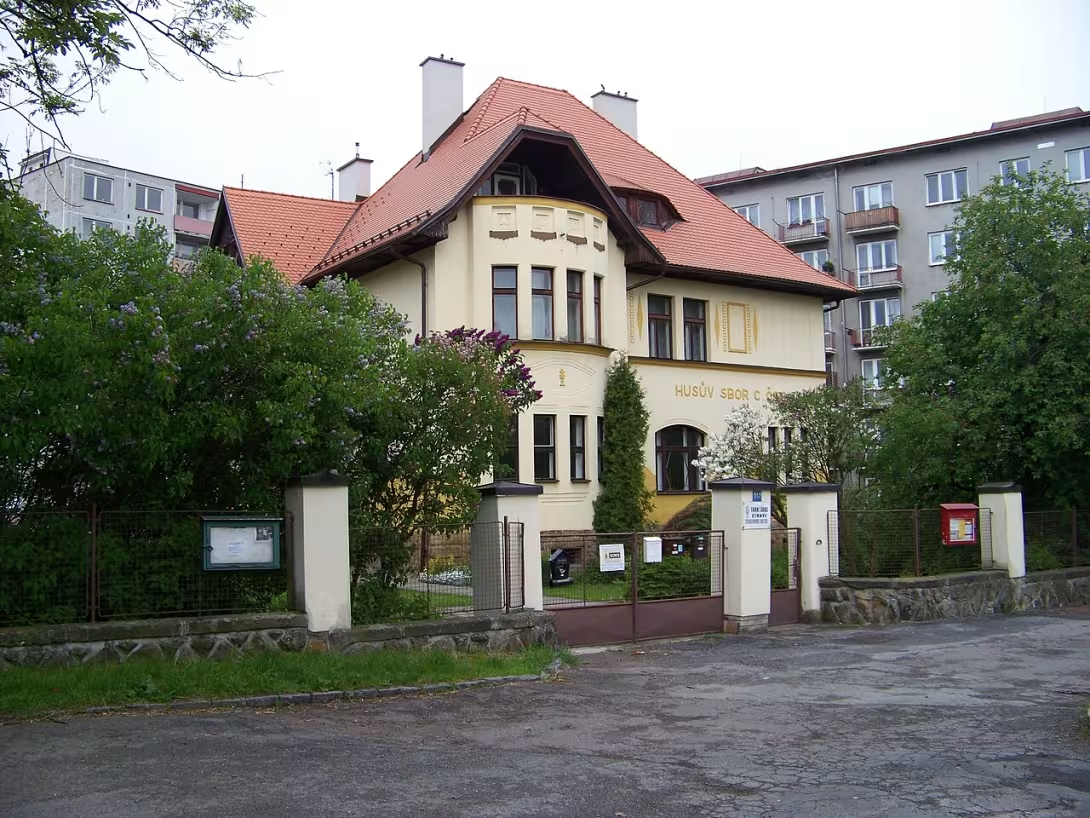
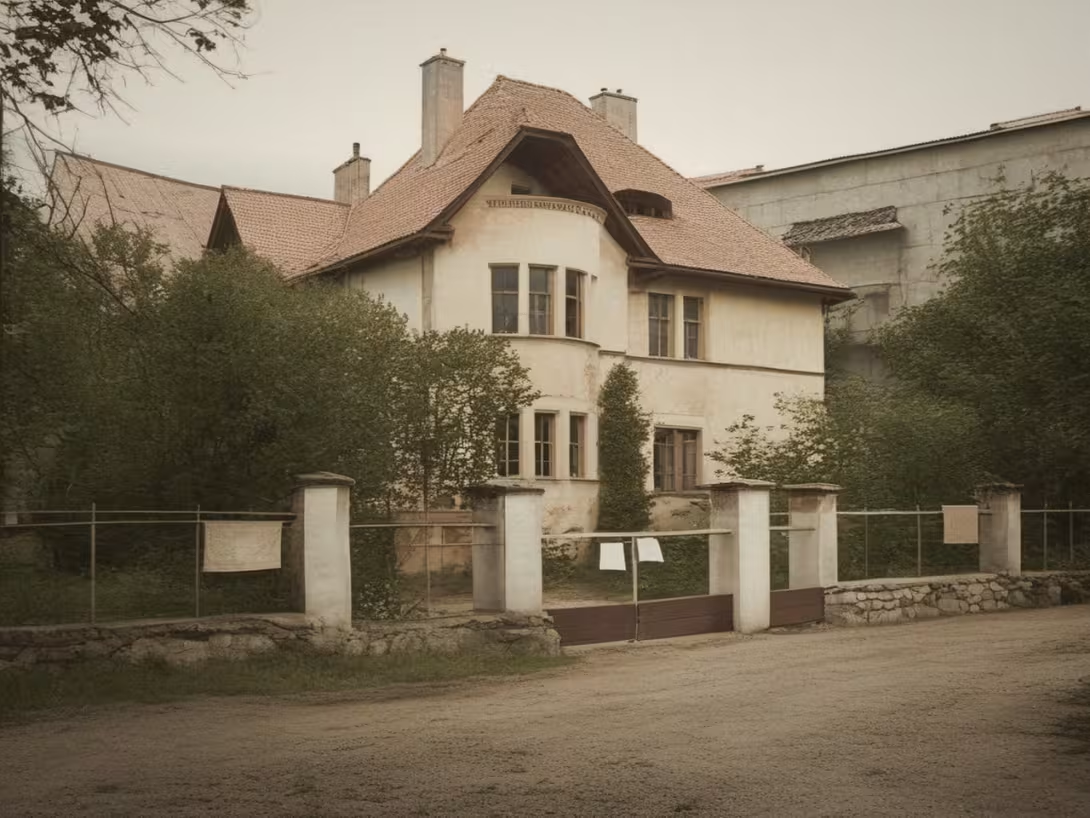
The historical appearance on the left is an AI-generated visualisation and serves as inspiration only.
Historical milestones
- 1908
- Application for construction and start of construction works.
- 1910
- The completion of the villa.
- 2018
- Listing to the list of cultural monuments of the Czech Republic.
Architectural development
The construction was carried out in the years 1908-1910 by the builder František Lasilem. The exterior combines a romantic plinth made of stone masonry with smooth plaster and wooden elements of the veranda or lounges. In 1947- 1948 the complex was supplemented with a wooden object with a hall.
Historical events
1912: Visit of the heir to the throne of Karl Franz Joseph with wife Zita. 1930: The suicide of owner Miroslav jumped after the stock market losses. 1947- 1948: Construction of wooden building with hall for the puppet scene Dawn.
Owners
Miroslav Vyskočil (1910-1930), Czechoslovak Hussite Church (since 1930).
Points of interest
- The villa is an important Art Nouveau building from 1908 to 1910, which was created according to the design of architect Alois Dryák. - In 1912, the heir to the Karel František Josef throne, later Austrian emperor, slept in the building with his wife Zita. - Since 1930, the villa has served the needs of the Czechoslovak Hussite Church, which established the Hussovy Choir. - The original owner of Miroslav Vyskočil committed suicide in May 1930 after suffering financial losses from stock exchange speculation. - The original floors, chandeliers, wall tiles and doors with cut glass have been preserved in the villa.
Guide
Show guide text
This text was created by artificial intelligence and has not been editorially reviewed. It may contain inaccuracies.
Welcome to Czech Třebová, where history intersects with every step you take here. Right now, you're standing in front of a building that tells its looks and history a story about ambition, luxury, but also about unexpected turns of fate. In front of you is Vyskočilova vila, a building that at the time of its creation represented the absolute peak of social status and architectural taste. Stop for a moment, take a breath and just feel the overall atmosphere of this place. Imagine what this neighborhood looked like over a century ago when this residence was one of the most important homes in the city.
Let us now return together in time more than a hundred years back to the beginning of the twentieth century. It is the year one thousand nine hundred and eight, and it is this year that applications were made for the construction of this house. At that time, Miroslav Vyskočil, a successful businessman who wanted to build a seat corresponding to his wealth and social position, worked here. The villa was not built randomly anywhere but near his family's mill, which made it not only a luxury house, but also a symbol of family prosperity and industrial success. Construction work, which began shortly after the application, lasted two years and in the year one thousand nine hundred and ten the construction was finally completed. At that time it was one of the most luxurious residences in Česká Třebová, a place where the local elite met and where each detail had its price and importance.
Now, please pay attention to the architecture itself. Look at the facade and see the building lines. You're facing a major Art Nouveau construction. The Art Nouveau was a symbol of modernity, elegance and desire for beauty, inspired by nature and smooth shapes. This project was the responsibility of recognised architects, Alois Dryák and František Plašil. It is their vision that this villa is ovated. Notice how a combination of functionality and aesthetics is manifested in architecture, which was typical for the time being. Even though we look at the building today through the eyes of a modern man, try to imagine the shock and admiration that the people of the city had to have when this building first appeared in their streets in the year one thousand nine hundred and ten. See the facade details, feel the rhythm of the windows and the overall balance of the object. It's an architecture designed to emit the owner's confidence.
But people and their life stories are connected to every building. Vyskočilova vila was not only a quiet home, but a place that hosted a truly significant personality. Now imagine the year one thousand nine hundred twelve. In this house, in these premises, a successor to the throne Karel František Josef, who later had the last Austrian emperor. He didn't come here alone, his wife Zita Bourbonsko-Parmská accompanied him. Imagine the incredible commotion that such a visit to Česká Třebová caused. The arrival of the future monarch with his wife at the merchant's private villa shows how high the level represented this residence and how strong ties Miroslav Vyskočil had to maintain at that time. It was the height of the glory of this house, the moment when the private space of the trader became for a short time the centre of European aristocracy.
However, history seldom works in a straight line. As we know from many life stories, after a great rise often falls. Not even Miroslav jumped this bill. There was a financial decline that changed the fate of the villa forever. The luxury residence that was created for rich life and social banquets changed its owner. The building was won by the Czechoslovak Hussite Church. This moment was a turning point not only in property, but also in spiritual and functional terms. The villa stopped being a private home for one family and became a place open to the community. It was adapted to the Hus Choir, which means that its interiors and the purpose of existence were redesigned to serve religion and the congregation of believers. Since the year one thousand nine hundred thirty, the villa has thus served the needs of this church, giving it a whole new dimension and importance within the city.
Perhaps now you will be interested in one question that floats over this place like a silent mystery. How did such an organically different presence unite in one building? On the one hand there was an unlimited luxury of a merchant and visits to Austrian emperors, on the other hand there was a place for a more modest spiritual search and community life of the Hussite Corps. It is fascinating to think about how the atmosphere in these walls was changing from privatized wealth to public faith. This transformation is basically a mirror to the history of the entire region and the whole country, where the old world of empires clashed with a new era of republics and social change.
The villa survived decades, testifying to two world wars and many regime changes. But its value only grew with time, not only the spiritual or social, but also the historical. This is why it was officially listed on the list of cultural monuments of the Czech Republic in the year two thousand and eighteen. With this recognition, the state has confirmed that Vyskočilova vila is not just an ordinary house, but an invaluable piece of our architectural and cultural heritage, which we must protect for future generations.
Now that you know the story of this house, I suggest you look around again. Feel the contrast between the original Art Nouveau elegance and the current use of the building. Try to imagine the steps of Emperor Karl and emperors Zita on the threshold here and imagine the silent prayers and songs of the Hussite choir that have been here for decades. This building is a bridge between two worlds.
Thank you for your attention and for stopping by this fascinating place for a moment. You can now calmly continue your journey along the Czech Třebová and discover other hidden corners and stories that this city offers. I wish you a pleasant rest of the day and an inspirational walk. Goodbye.
Tips for visitors
Best time to visit Jumping villa is in late afternoon or late evening, when the sun reflects on Art Nouveau facades and creates beautiful light effects.
You can also reach the location by public transport, verify the specific connections in the search engine.
Don't forget to bring your camera, because the Art Nouveau architecture of the villa is really photogenic. The best places for photography are in front of the villa, where there is a beautiful entrance portal, and in the garden where there is interesting details and ornaments.
If you have time, visit the historical center of Česká Třebová, where you will find many interesting monuments and historic buildings. You can also pass through the Třebovka River, which flows through the city.
For families with children it is possible to visit a nearby park where there is a playground and you can relax and sit on benches.
Frequently asked questions
Can the monument be visited?
Religious buildings are usually open mainly during services; at other times a visit is normally arranged with the parish or the operator. We have not verified specific times.
Where is the monument?
Location: Česká Třebová, Pardubický kraj. The map on this page shows the exact spot.
Why is the monument protected?
It is listed in the Central List of Cultural Monuments of the Czech Republic as a cultural monument (register no. 1999995389).
Businesses nearby
Do you run a restaurant, accommodation, shop, museum, rental, wellness or other visitor service near this monument? Show yourself directly to the people heading to it — this is how they will see you in the app and on the web:
Events nearby
Zdroj akcí: otevřená data měst a obcí ČR (Národní katalog otevřených dat) a kalendář akcí Národního památkového ústavu.
Nearby
The city of Česká Třebová, the river Trebovka, is nearby located the historical center of the city.
Accommodation nearby
Themed route
Thematic cruise route around the Vyskilov villa
1. Vyskočilova vila (villa) The main objective of our route is Vyskočilova vila itself, a historical object built in 1890. Its architecturally interesting facades and rich history make it necessary for those interested in the heritage of Česká Třebová.
2. Historical Center of the City After visiting the villa we will go to the historical centre of the city, which is located just a few minutes walk from the Vyskíčilov Villa. It is an ideal place for exploring old streets and architecturally interesting buildings that remind us of the rich history of Czech Třebová.
3. River Třebovka (natural attractions) Then we go to the Třebovka River, which surrounds the city and offers a quiet space for relaxation. It is an ideal place for a short break or for a moment walks in a pleasant environment.
4. City Česká Třebová (city centre) Eventually we will return to the city centre where we can look at other historical buildings and maybe visit some of the picturesque parks. The city offers diverse cultural activities and restaurants that complete our exploration of České Třebová.
This route will allow you not only to appreciate the beauty of the Vyskilova villa, but also to immerse yourself in the history and culture of the city of Česká Třebová.
Seasonal recommendations
Spring brings fresh energy and awakening nature around the villa, which complements the architecture of the monument. The fine sunlight highlights the facade details and creates a pleasant, optimistic atmosphere. Due to the variability of spring weather, we recommend choosing layered clothes. The best time to visit is in the morning when the coast is clear and there are not so many visitors around.
In the summer months the surrounding area of the villa is gardening rich and intense sun gives the construction a bright, rich look. In the main summer season, the number of people is the highest, so it is reasonable to arrive early in the morning to enjoy a quieter tour. Dress lightly and do not forget to protect yourself from direct sun and plenty of water for refreshment.
Autumn turns the atmosphere into nostalgic and calm, especially thanks to golden leaves and morning fog, which supply the place with mystery. Soft autumn light is ideal for photo lovers. Prepare warmer clothes and high-quality shoes in case of wet surface. Due to the smaller number of visitors, the best time for a tour in the afternoon.
Winter brings silence and a sense of stopping to the surroundings of the villa, which is underlined by short days and possible snow. The lighting is weaker and shadower in this period, which creates a very cozy but cold atmosphere. It is necessary to wear very warm clothes. Due to low traffic and shorter opening times in advent time we recommend to arrive early before it starts to get dark.
Visualizations and artistic views


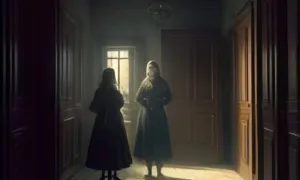
The visualisations are generated by artificial intelligence and serve as inspiration.
Photos from the area
Real photos taken near the monument


Zdroj a licence jsou uvedeny u každého snímku.
Tips from visitors
No tips yet. Be the first!
Log in and add your tip.
Sources and literature
Photos: ŠJů (cs:ŠJů) / CC BY-SA 3.0, rozlišení zvýšeno umělou inteligencí — Wikimedia Commons. The author and licence also appear when you hover over the image.
Faktickým podkladem tohoto textu byl článek na Wikipedii, jehož autory jsou přispěvatelé Wikipedie. Článek je dostupný pod licencí CC BY-SA 4.0.
Location on the map
Příběhy a pověsti
Legendy, pověsti a příběhy spjaté s touto památkou
Fotografie návštěvníků
Zatím žádné fotografie. Buďte první, kdo přidá fotografii z návštěvy!
Log in a přidejte svou fotografii nebo hodnoťte.
Za ověřenou návštěvu v aplikaci získáte víc bodů — poznáme podle GPS, že jste na místě.
Reviews and comments