



Sbratření (Česká Třebová) Memorial
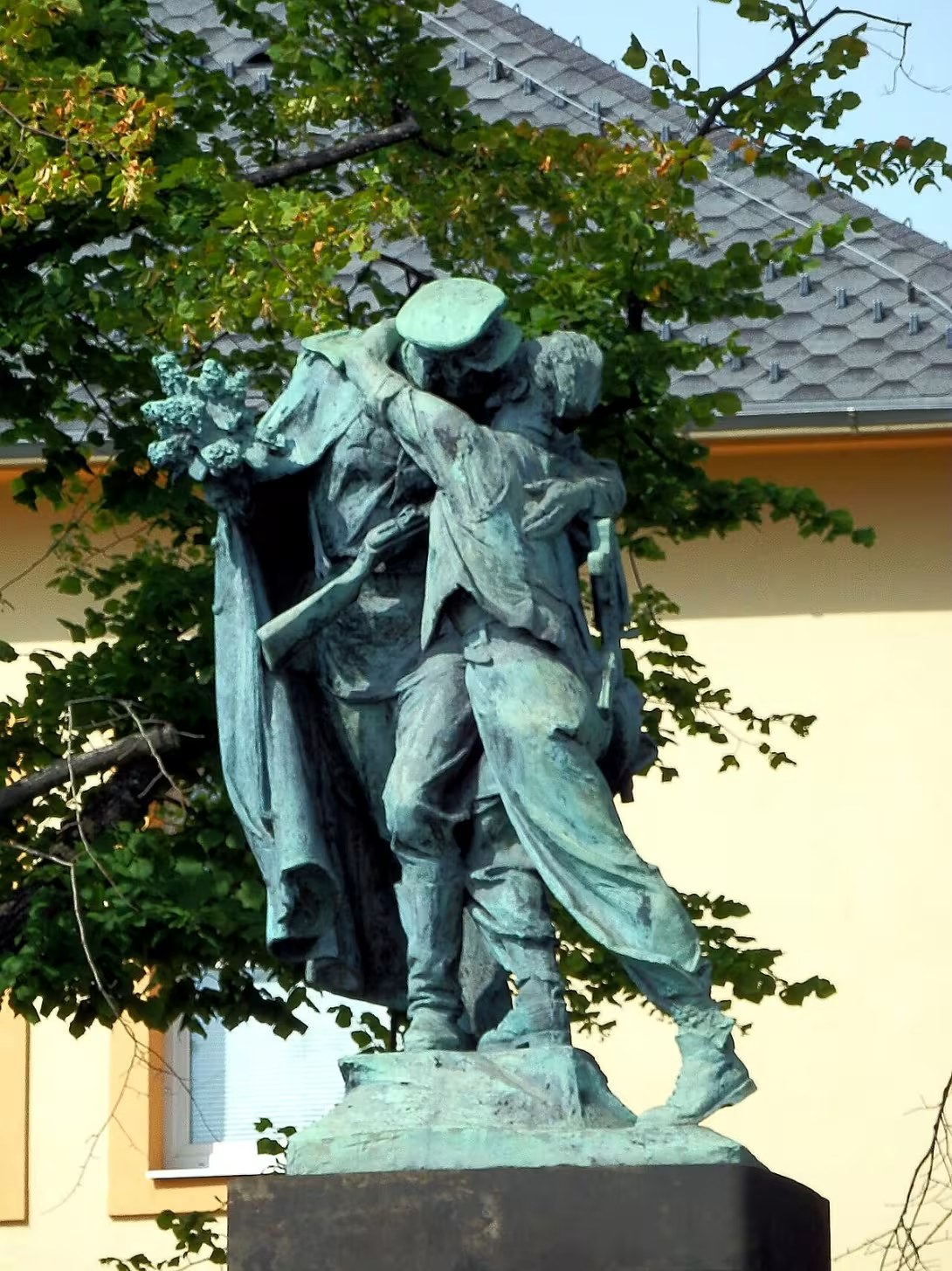
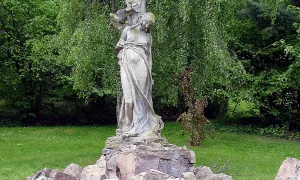
The statue of the Collector stands at Perner Square outside the station in České Třebová. It serves as a monument to the liberation of Czechoslovakia by the Red Army in 1945. The work of sculptor Karl Pokorný was created between 1947 and 1950 and commemorates the key events of the end of World War II. The original location on the main square in 1951 and the later transfer to Perner Square in 1996 underscore its permanent symbolic value. Since 1958, the sculpture has been protected as a cultural monument.
The work was inspired by a photograph of Karl Ludwig, who captured the first meeting of soldiers during the Prague uprising in May 1945. This image symbolized hope and recovery after the war, which was a major stimulus for Pokorný. The creation took place in the context of the post-war strengthening of relations between Czechoslovakia and the Soviet Union, which corresponded to the political atmosphere of the late 1940s and early 1950s.
The architectural sculpture represents a significant example of Soviet realism, then a common artistic direction. The monument not only celebrates the historic event, but also served as a propaganda tool in the past, which is evidenced by its depiction on postage stamps and banknotes in 1952 and 1953. A copy of the work can be found outside Česká Třebová, for example in Vrchlické orchards in Prague or Crimea.
Since 1951, when it was located in the main square, the statue has undergone several changes. In 1996 it moved to Perner Square and in 2009 it was moved again a few meters to avoid overshadowed new transport terminal. These adjustments demonstrate its adaptability and continued importance to the local community.
The brotherhood is now more than a monument; it is a testimony of events that shaped modern Czech identity. Due to its location near the railway station, it is easily accessible for visitors and tourists. It is a necessary stop for lovers of history and art.
Visiting the sculpture offers an opportunity to explore important chapters of Czech history. This monument tells the story of liberation and cooperation in difficult times, while witnessing the transformation of the surrounding environment. When walking through Česká Třebová, remember to visit this important work and suck its historical value.
Then and now
Drag the slider to compare how the landmark may have looked when it was built with the view today.
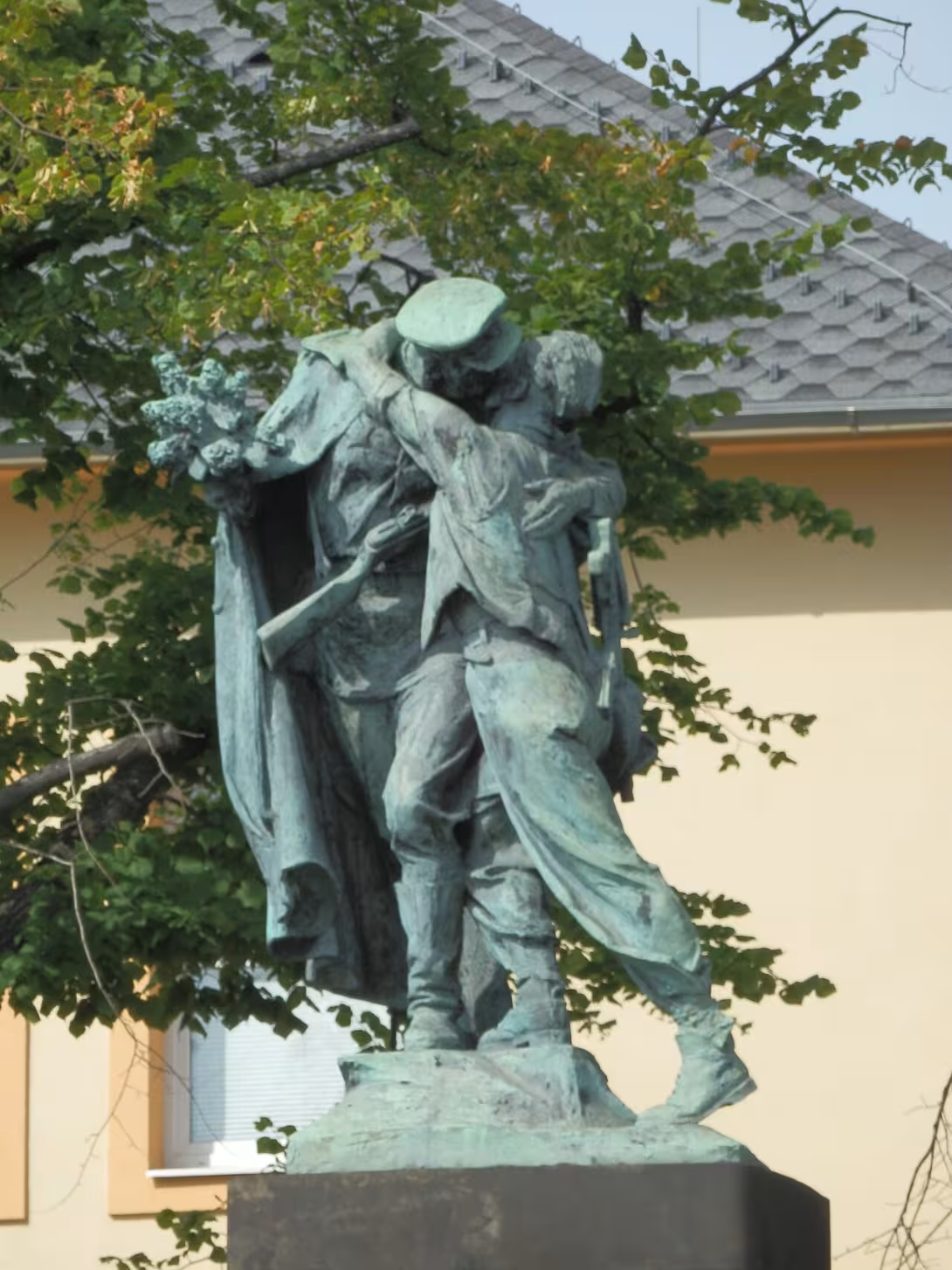

The historical appearance on the left is an AI-generated visualisation and serves as inspiration only.
Historical milestones
- 1951
- Location of sculptures on the main square in Česká Třebová.
- 1958
- Opening of monument protection of sculpture.
- 1996
- Moving the monument to Perner Square outside the station.
- 2009
- Replacement of the sculpture by several meters due to construction of the transport terminal.
Architectural development
The sculpture was created in 1947-1950. In 1996, it was moved to Perner Square. In 2009, the monument was slightly moved within the reconstruction of the square and construction of the transport terminal.
Historical events
In 1951 the sculpture was located in the main square. In 1958 it was declared a protected building. In 1996, the memorial was moved to Perner Square outside the station.
Points of interest
- The statue of the Collector stands on Perner Square in front of the station in České Třebová. - Memorial of the liberation of Czechoslovakia by the Red Army in 1945, the work of sculptor Karl Pokorný from 1947 to 1950. - Originally located in the main square in 1951, moved to Perner Square in 1996. Protected as a cultural monument since 1958. - The inspiration for the work was a photograph of Karl Ludwig from the Prague Uprising, symbolizing hope and recovery after the war.
Guide
Show guide text
This text was created by artificial intelligence and has not been editorially reviewed. It may contain inaccuracies.
Welcome to České Třebová, where history intersects with the daily movement of people and machines. Right now, you're standing in Perner Square, near the station, and there's a memorial in front of you that's called the Gathering. At first you may only perceive the silence of sculptures in the middle of the urban rush, but if you stop and look closely at it, you will see a materialized moment of strong emotion. It is a work that is not just to be a dry reminder of the date in the calendar, but rather a record of human encounter, hope and relief that came after long years of darkness.
Now let's look together at how this work came into being and why it actually stands here. The Memorial of the Collective is the work of sculptor Karl Pokorný. To understand its essence, we must return to shortly after the end of World War II. The author worked on this sculpture from 1947 to 1950. It was a time when the whole country tried to exhale and start to live again, but at the same time it tried not to forget those who contributed to its liberation. That is why the monument was created as a reminder of the liberation of Czechoslovakia by the Red Army in 1945. At that time, symbols were needed to express gratitude and belonging, and Karel Pokorný translated this need into plastic form.
Now pay attention to the work itself. You see a sculpture in front of you, which means a group of characters communicating in space. Look at how the characters are distributed and what relationship the author created between them. Notice the dynamics of their positions. The sculptor here did not work with cold symmetry, but sought the truth in the human gesture. Even though we don't know every detail of the material, we perceive the power of the composition to draw us into the situation that the figures are experiencing. It's the moment of connection where two people, perhaps from completely different worlds and cultures, meet at one point together. It is in this relationship of characters that the main idea of the whole work lies.
This particular scene, however, did not come from the imagination of a sculptor. Karel Pokorný sought inspiration in real life, and specifically in one very important photo. The author of this picture was Karel Ludwig, which was able to capture one of the most symbolic moments of the Prague uprising. His photograph captured the first meeting of soldiers, the moment when people who spoke in different languages understood without words through the common goal and joy of the end of the war. It is this authentic flash of humanity, this genuine emotion from the times of the uprising, that has become the cornerstone for the creation of the monument in České Třebová. So when you look at the figures in front of you, don't just think of them as statues, but as a tangible image from when the world was born again from debris.
Besides artistic value, this place has its own fascinating journey in time. You might find it interesting that the memorial wasn't always where it is right now. His history is basically a history of finding the right place in the city. For the first time, the sculpture was located in the main square in 1951. It was the center of the city, the most visible place where the monument was to serve as the main point of remembrance. A few years later, in 1958, the work was officially recognised and its monument protection initiated, which means that the state recognized its value for future generations.
However, with the advancing time and the change in the urban face of Česká Třebová, the monument has proved to have to change its position. In 1996 it was moved from the main square right here to Perner Square outside the station. This change of location gave the part a new context. The railway station is a symbol of roads, arrivals and exits, which in some sense corresponds to the topic of meeting soldiers who travelled to each other from different regions and countries. But the story of the transfers wasn't over. There have also been minor modifications. In 2009, the sculpture had to be relocated, only a few metres this time. The reason was the construction of a new transport terminal, which was to modernise the transport hub at this point. It's fascinating to think that even the heavy and solid mass of the monument has to move on sometimes to give way to the modern development of the city.
Stop by the memorial for a while and think about what "brotherhood" means to us. In today's hasty time, when people rush to trains, this group of characters acts as an anchor, forcing us to remember values such as peace, mutual understanding and common joy. The memorial teaches us that even in the worst times, there are moments worth preserving for eternity.
Now that you know the story of origin, the inspiration from the photograph of Karl Ludwig and the path that the monument has offended through the square of České Třebová, I suggest you slowly go around the whole sculpture. Try to perceive it from different angles, look for the details that the sculptor Karel Pokorný put into it during three years of his work. Feel the atmosphere of this place where history meets the present.
This concludes the brief chapter on the Memorial of the Gathering. I hope this view has helped you see more than just stone or metal figures in this work. Czech Třebová still has many other secrets and interesting places waiting for your discovery. I invite you to continue to explore the city, perceive its architecture and soak up the atmosphere of this beautiful region. I wish you a pleasant journey and don't forget to stop and look at the details that connect us to our ancestors. Goodbye and have a good trip.
Tips for visitors
The best time to visit the sights is in the spring or autumn season when the weather is favourable and light suitable for photography. Moreover, there are fewer people compared to winter frost or summer sun.
When visiting the sights you can take with you protective sunglasses for sun day, camera and warm clothes in winter months. Accessories such as a map or a booklet of memorials can be useful.
Photography can be done from all sides of the square where the memorial is located. The best light for photos usually takes the morning or evening when the sun is not directly above your head.
For families with children it can be an interesting experience to walk around the local park or visit the museum.
Frequently asked questions
Can the monument be visited?
This is a structure in a public space that can usually be seen from outside free of charge. We have not verified that this particular one is freely accessible.
Where is the monument?
Location: Česká Třebová. The map on this page shows the exact spot.
Why is the monument protected?
It is listed in the Central List of Cultural Monuments of the Czech Republic as a cultural monument (register no. 1000152797).
Businesses nearby
Do you run a restaurant, accommodation, shop, museum, rental, wellness or other visitor service near this monument? Show yourself directly to the people heading to it — this is how they will see you in the app and on the web:
Nearby
Památník se nachází na Pernerově náměstí v bezprostřední blízkosti nádraží v České Třebové.
Accommodation nearby
Themed route
Thematic cruise route: Collective Memorial
1. Památník Sbratření (Česká Třebová) - Typ: Historický památník - Proč stojí za návštěvu: Památník připomíná historicky významnou událost z roku 1945, kdy se do České Třebové dostali první sovětští vojáci. Je to symbol míru a osvobození od nacistické okupace.
2. Station Česká Třebová - Type: Historical station area - Why is it worth visiting: The railway station is an important part of local history and architecture. It is possible to see the old buildings and understand the importance of the railway for the development of the village.
3. Perner Square - Type: Public Square - Why is it worth a visit: The square is the center of local life and offers a beautiful view of the memorial of the Collector. It is an ideal place to relax and explore other historic buildings nearby.
4. Perner Street - Type: Historical aisle - Why is it worth a visit: The street leading to the monument is full of ancient houses and architecturally interesting buildings. It's an opportunity to explore local history through urban heritage.
5. City Park - Type: Urban greenery - Why is worth a visit: The park is an ideal place to relax and explore nature in the urban environment. It offers beautiful landscapes that are suitable for family rest or picnic.
This route offers visitors the opportunity to immerse themselves in the history and culture of České Třebová through key places in the centre of the village.
Seasonal recommendations
Spring: In the spring season, the atmosphere around the memorial of the Collector in Česká Třebová is especially beautiful when nature wakes up from its winter sleep. Trees and shrubs are beginning to bloom, which gives the surroundings a live shine of different colors. The sun illuminates the monument with long rays that highlight its architectural details and create attractive shadows. For a visit it is advisable to choose the period of noon when the sun most illuminates the monument, but at the same time it is recommended to wear a light coat or jacket for possible cooling. Visiting this historical object in the spring season is also ideal because of a less busy environment, because there are no major public events at this time.
Summer: For years, the surroundings of the Gathering monument are full of ripe leaves and thick greenery, adding a relaxing feeling to the atmosphere. The sun rays illuminate the memory of long shadows creating patterns on the surface and enhance its visual attractiveness. In this period it is advisable to visit the monument in the morning or in the evening when the temperature becomes more pleasant and the sun rays are less intense. It is recommended to wear light clothes that protect from the sun, such as a tie or scarf, and must not be lacking UV protection.
Autumn: In the autumn months, the surroundings of the Brotherhood monument turn into a magical flower of color when tree leaves acquire shades of orange, yellow and red. The sun illuminates the memory of a shorter beam, which creates fine and warm colors that give the place a melancholy yet comfortable character. Visiting this historic object is best in the early afternoon, when the weather is still warm and the sun's rays illuminate the monument from an optimal angle. It is advisable to prepare for cooler weather by wearing clothes that allow you to easily adjust to temperature changes.
Winter: In the winter months, the surrounding area of the Collector monument is covered with snow or ice, which gives the place a magical and peaceful atmosphere. The sun rays illuminate the memory with long shadows creating patterns on the snowy surface, which is nice to see in the morning or evening. Visiting this historical object is best at noon, when the sun illuminates the monument with long rays while the temperature becomes more pleasant. It is recommended to wear swollen clothes such as fur coats or blankets, and protective shoe fittings for the corridor on snow or ice.
Visualizations and artistic views


The visualisations are generated by artificial intelligence and serve as inspiration.
Photos from the area
Real photos taken near the monument


Zdroj a licence jsou uvedeny u každého snímku.
Tips from visitors
No tips yet. Be the first!
Log in and add your tip.
Sources and literature
Photos: Isolda11 / CC BY-SA 3.0 — Wikimedia Commons. The author and licence also appear when you hover over the image.
Faktickým podkladem tohoto textu byl článek na Wikipedii, jehož autory jsou přispěvatelé Wikipedie. Článek je dostupný pod licencí CC BY-SA 4.0.
Location on the map
Příběhy a pověsti
Legendy, pověsti a příběhy spjaté s touto památkou

Fotografie návštěvníků
Zatím žádné fotografie. Buďte první, kdo přidá fotografii z návštěvy!
Log in a přidejte svou fotografii nebo hodnoťte.
Za ověřenou návštěvu v aplikaci získáte víc bodů — poznáme podle GPS, že jste na místě.
Reviews and comments