



kostel svatého Jakuba Staršího (Česká Třebová) Church
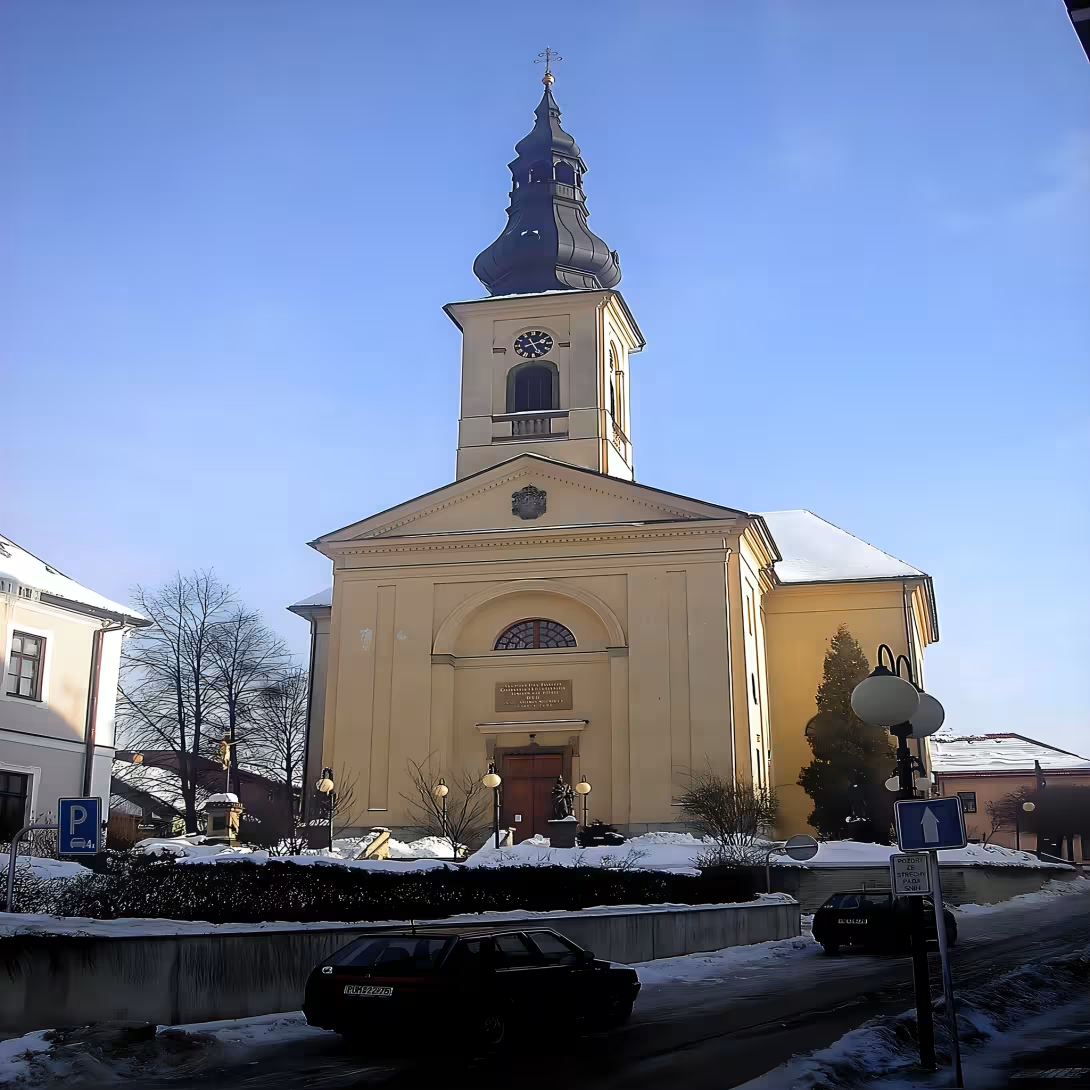
The Church of Saint James the Elder in Česká Třebová is a classicist-style parish church recognized as a cultural monument since May 6, 1964. Located in Pardubický kraj, this architectural gem stands on the site of previous churches destroyed by fires in 1745 and 1793. Its current structure was commissioned by Prince Alois of Lichtenstein after the last fire, with architect Josef Hardtmuth overseeing its construction. The church is notable for its prominent facade inscription commemorating its patronage.
The origins of this monument trace back to a series of fires that destroyed earlier churches on the site. The first wooden church dedicated to Saint Nicholas was established in 1335. Following a fire, a new stone church was constructed in 1636 and later connected to a parish house by a gallery. A chapel of the Sacred Heart of Jesus was added in 1708. However, another fire in 1745 destroyed these additions, and yet another blaze in 1793 razed the existing church. In response, representatives from Česká Třebová, led by Mayor Jan Kašpar, petitioned Prince Alois of Lichtenstein for a new construction. The foundation stone was laid on July 14, 1794, with Hardtmuth's plans guiding its creation.
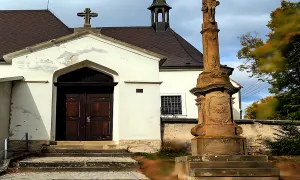
Architecturally, the Church of Saint James the Elder exemplifies classicism, reflecting Enlightenment ideals through symmetry and simplicity. Its design features a regular cross-shaped floor plan, with entrance doors set in the facade flanked by stone framing adorned with perls and garlands above. A commemorative plaque inscribed by Prince Alois himself sits prominently on the facade. The church's tower is positioned over the gable, topped with a bulbous belfry and lantern. Its walls are punctuated by semicircular, circular, and rectangular windows, along with two rectangular entrances on each side. Originally completed in 1798, the structure underwent several renovations, including significant repairs after a fire in 1884 that destroyed its roof, tower, and bells. A new belfry was constructed post-1913, deviating from Hardtmuth's original plans.
Throughout its history, the church has been under the stewardship of various figures, notably Prince Alois of Lichtenstein, who played a crucial role in its establishment and funding. The foundation stone ceremony included notable individuals such as František Riedera, Jakub Müller, Bernard Arzt, and Jan Kašpar, whose initials were carved into it. The church was solemnly consecrated on June 7, 1815, by Bishop Alois Josef Krakovský z Kolovrat.
Key events in the church's history include its foundation stone laying in 1794 and its consecration in 1815. These milestones underscore its significance within the community of Česká Třebová. The church grounds are adorned with several statues of saints, including Saint Barbara and Saint John Nepomucene, adding to its historical and cultural allure.
Today, the Church of Saint James the Elder stands as a testament to classical architecture and local history. Its facade has been restored in the late 20th century, and the roof now features copper cladding. The church's interior houses various artifacts from different periods, including wood carvings of the Holy Apostles saved from the original church, dating back to the early 18th century. Modern additions include three-manual electric-pneumatic tubular organs installed in the early 2000s.
Visitors are drawn to this monument not only for its architectural beauty but also for its rich historical narrative and cultural significance. The Church of Saint James the Elder offers a unique glimpse into the past, making it a worthwhile destination for those interested in history and architecture. Its preservation as a cultural monument ensures that future generations can appreciate its enduring legacy.
Then and now
Drag the slider to compare how the landmark may have looked when it was built with the view today.
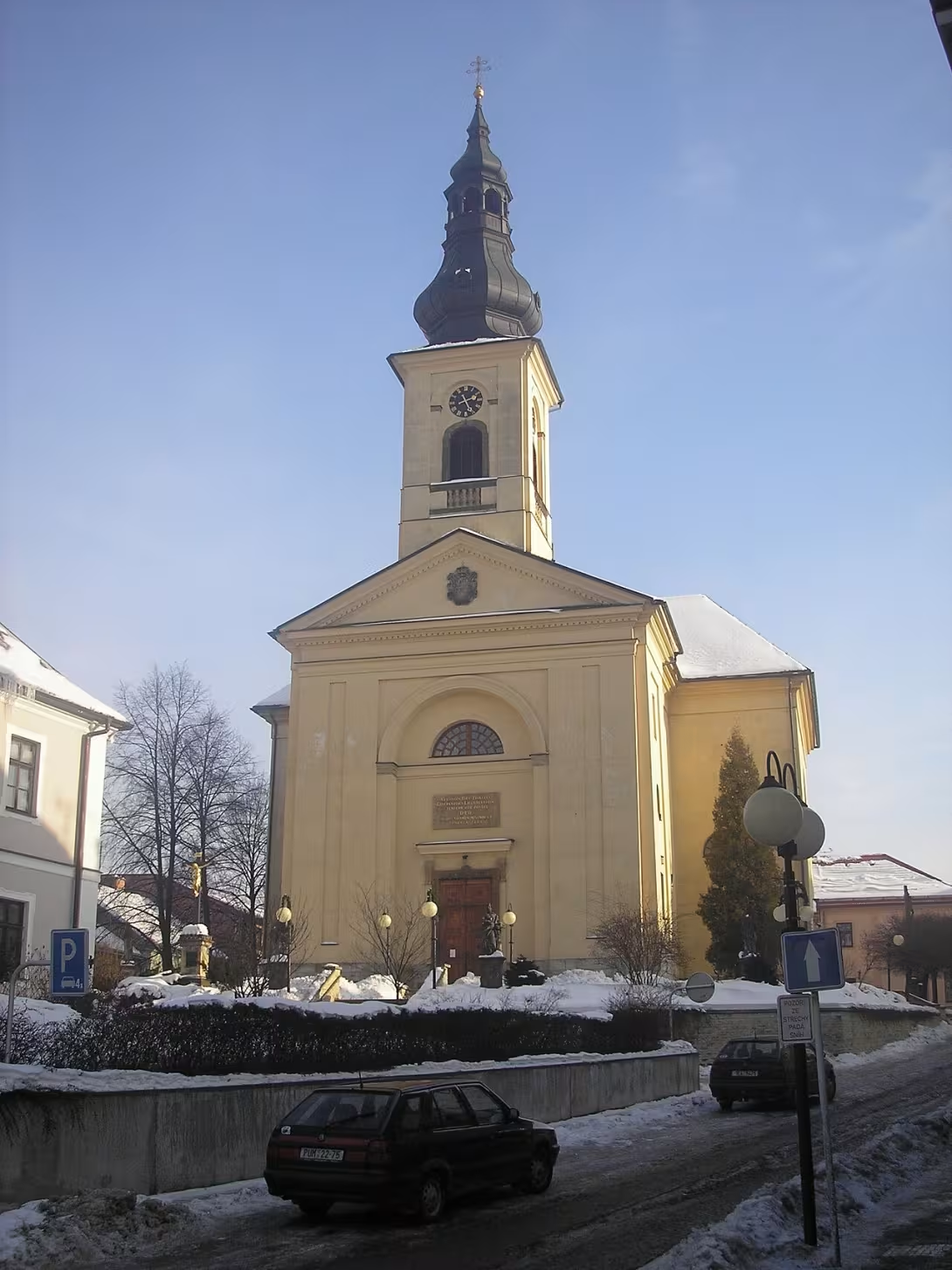

The historical appearance on the left is an AI-generated visualisation and serves as inspiration only.
Historical milestones
- 1794
- Foundation stone laid by Prince Alois of Lichtenstein.
- 1815
- Church consecrated by Bishop Alois Josef Krakovský z Kolovrat.
Architectural development
Construction began in 1794 and was completed in 1798. The church underwent several renovations, including a significant fire in 1884 that destroyed the roof, tower, and bells. A new, taller belfry was constructed post-1913 repairs, deviating from Hardtmuth's original plans. In the late 20th century, the facade was restored, and the roof was covered with copper.
Historical events
The foundation stone for the new church was laid on July 14, 1794, by Prince Alois of Lichtenstein.
The church was solemnly consecrated on June 7, 1815, by Bishop Alois Josef Krakovský z Kolovrat.
Points of interest
- Despite the church's classical style, its construction was repeatedly delayed due to financial constraints and political upheaval following the fires of 1745 and 1793.
- The original wooden church dedicated to Saint Nicholas in 1335 was reportedly built on a site believed by locals to be sacred, possibly linked to ancient pagan rituals.
- A legend suggests that during the foundation stone ceremony in 1794, an unexpected storm caused a dramatic pause in proceedings until the skies cleared, which participants interpreted as divine approval of their plans.
- The church's original bells were crafted from metal salvaged from the ruins of previous structures destroyed by fire, symbolizing resilience and continuity for the community.
- An intriguing architectural quirk is that the church's floor plan was slightly altered during construction to accommodate an ancient well discovered on-site, which was believed to have healing properties.
Guide
This guide is narrated by a synthetic voice generated by artificial intelligence.
Show guide text
This text was created by artificial intelligence and has not been editorially reviewed. It may contain inaccuracies.
The Church of Saint James the Elder is the parish church in České Třebové. It stands in the classical style and has been protected as a cultural monument since nineteen sixty-four.
A Christian church has stood here since thirteen thirty-five. It was a wooden church of Saint Nicholas. After a fire, it was replaced in sixteen thirty-six by a brick building, which was connected to the rectory by a footbridge. Around it grew a cemetery with an ossuary and a bell tower, and from seventeen hundred and eight also a chapel of the Sacred Heart of Jesus. These buildings burned down in seventeen forty-five. In seventeen ninety-three, lightning struck and fire destroyed the church itself.
That same year, representatives of the city led by the mayor, Prince Alois of Liechtenstein, requested a new building. The prince paid for it and entrusted the design to his court architect Joseph Hardtmuth. The foundation stone was laid on the fourteenth of July seventeen ninety-four. In the foundations, they placed a small box with a commemorative document and carved the initials of the contemporary leaders of the estate, the parish, and the city into the stone. The rough structure was completed in seventeen ninety-eight. A Latin plaque from eighteen hundred and one was then added to the facade, whose text was composed by the prince himself, and which presents him as the builder of the church. The church was consecrated on the seventh of June eighteen fifteen.
In eighteen eighty-four, the roof was repaired. During the work, a fire broke out and destroyed the roof, the tower with the clock, and the bells. The restored church was consecrated again in eighteen eighty-eight. In nineteen thirteen, the city asked Prince John the Second of Liechtenstein to repair the tower, which according to the council did not match Hardtmuth's plans. The new tower, however, ended up being taller than the plans anticipated. In nineteen forty-two, the bells were requisitioned. In the nineteen nineties, the church received a new facade and a copper roof.
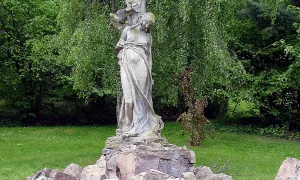
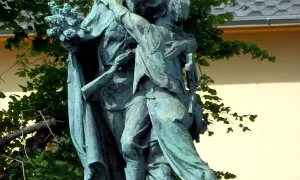
The building has the floor plan of a regular cross. The main entrance is framed by stone mullions with garlands. In the gable is the coat of arms of Liechtenstein, and above it rises the tower with an onion dome and a lantern. Around the church stand statues of Saint Barbara, Saint John of Nepomuk, Saint Wenceslaus, Saint Joseph, and Saint Catherine, as well as a sculptural group of Calvary.
The oldest pieces of furnishings are wooden statues of the apostles from the first half of the eighteenth century, saved from the original church. The statues on the main altar and the pulpit come from the workshop of the Brno sculptor Andreas Schweigel. The interior painting was done mainly in nineteen fourteen by the Prague painter Antonín Häusler. Between two thousand and one and two thousand and four, the Prostějov firm Vladimír Grygar built new three-manual organ. The city and many donors contributed significantly to its acquisition.
Tips for visitors
The best time to visit the Church of Saint James the Elder is during late spring or early autumn, when the weather is pleasant for walking around Česká Třebová and exploring its surroundings. During these months, you can enjoy the church's architecture without the crowds that tend to gather in peak tourist seasons like summer. Additionally, the lighting conditions are ideal for photography, capturing the intricate details of the classicist-style façade.
Public transportation options include buses that serve Česká Třebová; however, you should verify current routes and schedules through a travel app or website to ensure smooth transit. The town is accessible by car, making it convenient for those who prefer driving.
When visiting the church, consider bringing comfortable walking shoes as you may want to explore the surrounding areas of Česká Třebová. A camera or smartphone with a good camera will help capture the architectural beauty and historical significance of the site. Additionally, carrying a water bottle and some snacks can enhance your visit, especially if you plan on spending several hours exploring.
For photography enthusiasts, the best spots to capture the church are from the front and sides where natural light enhances its classicist features. Early morning or late afternoon provides softer lighting conditions that highlight the textures of the building.
Nearby attractions within a 30-minute drive include the Třebová Castle and the Museum of Glassmaking in Nový Bor. These sites offer additional cultural insights into the region's history and craftsmanship. For families with children, these places provide educational experiences that complement the historical visit to the church.
Frequently asked questions
Can the monument be visited?
Religious buildings are usually open mainly during services; at other times a visit is normally arranged with the parish or the operator. We have not verified specific times.
Where is the monument?
Location: Česká Třebová, Pardubický kraj. The map on this page shows the exact spot.
Why is the monument protected?
It is listed in the Central List of Cultural Monuments of the Czech Republic as a cultural monument (register no. 24759/6-3831).
Businesses nearby
Do you run a restaurant, accommodation, shop, museum, rental, wellness or other visitor service near this monument? Show yourself directly to the people heading to it — this is how they will see you in the app and on the web:
Events nearby
Zdroj akcí: otevřená data měst a obcí ČR (Národní katalog otevřených dat) a kalendář akcí Národního památkového ústavu.
Accommodation nearby
Themed route
Thematic Tour Itinerary: Česká Třebová
1. Kostel svatého Jakuba Staršího (Česká Třebová) - Church Begin your journey at the heart of Česká Třebová with the stunning Kostel svatého Jakuba Staršího. This church is a prime example of Gothic architecture, featuring intricate stone carvings and an impressive tower that offers panoramic views of the town. Its historical significance as one of the oldest structures in Česká Třebová makes it a must-visit for anyone interested in architectural history.
2. Náměstí Republiky - Town Square A short walk from the church, explore the vibrant Náměstí Republiky. This central square is surrounded by charming historical buildings and serves as a lively hub of local culture and commerce. It's an ideal spot to immerse yourself in the everyday life of Česká Třebová, with opportunities to enjoy traditional Czech pastries at nearby cafes or simply relax on one of the benches while observing the bustling activity around you.
3. Českotřebovské muzeum - Local Museum Just a few minutes' walk from the town square is the Českotřebovské muzeum. This museum offers insights into the rich history and cultural heritage of Česká Třebová, with exhibits ranging from local crafts to historical artifacts that tell the story of this region over centuries. It's a perfect place for those interested in deepening their understanding of the area’s past.
4. Památník padlým - War Memorial Conclude your tour at the solemn Památník padlým, located near the museum. This war memorial honors the soldiers who lost their lives during significant conflicts, serving as a poignant reminder of the region's turbulent history. It provides a moment for reflection and appreciation of peace, making it an essential stop on your thematic tour.
This itinerary offers a comprehensive exploration of Česká Třebová’s historical and cultural landmarks, providing visitors with both educational insights and memorable experiences.
Seasonal recommendations
Spring: Visiting the Church of Saint James the Elder during spring offers a unique experience as nature begins to awaken around Česká Třebová. The blooming flowers and fresh greenery create a vibrant backdrop for exploring this historic site, enhancing its architectural beauty with natural splendor. As daylight hours increase, visitors can enjoy longer periods of exploration in the pleasant weather. It's advisable to wear comfortable layers as temperatures may vary throughout the day. Early mornings or late afternoons are ideal times to visit when the church is less crowded, allowing for a more serene experience.
Summer: Summer at the Church of Saint James the Elder provides an opportunity to appreciate its architecture under clear skies and abundant sunlight. The warm weather makes it perfect for leisurely strolls around Česká Třebová’s historic center after visiting the church. However, this is also a peak tourist season, so expect larger crowds. Arriving early in the morning can help avoid the busiest times, ensuring a more peaceful visit. Light and breathable clothing is recommended to stay comfortable during warmer days.
Autumn: Autumn presents a picturesque setting for visiting the Church of Saint James the Elder, with its surrounding landscape draped in rich hues of reds, oranges, and yellows. The cooler temperatures make it an ideal time for walking tours around Česká Třebová without the summer heat. As daylight begins to wane earlier in the day, planning your visit during mid-morning or early afternoon is advisable to maximize natural light. Layers are recommended due to fluctuating temperatures.
Winter: Winter transforms the Church of Saint James the Elder into a serene and almost mystical site, with snow often blanketing Česká Třebová’s historic center, adding a magical touch to its architecture. The shorter days mean that visits should be planned earlier in the day when there is still natural light. Due to colder temperatures, visitors are advised to dress warmly in layers and wear comfortable footwear suitable for potentially icy conditions.
Visualizations and artistic views


The visualisations are generated by artificial intelligence and serve as inspiration.
Photos from the area
Real photos taken near the monument


Zdroj a licence jsou uvedeny u každého snímku.
Tips from visitors
No tips yet. Be the first!
Log in and add your tip.
Sources and literature
Photos: Krib at Czech Wikipedia / Public domain, rozlišení zvýšeno umělou inteligencí — Wikimedia Commons. The author and licence also appear when you hover over the image.
Faktickým podkladem tohoto textu byl článek na Wikipedii, jehož autory jsou přispěvatelé Wikipedie. Článek je dostupný pod licencí CC BY-SA 4.0.
Location on the map
Příběhy a pověsti
Legendy, pověsti a příběhy spjaté s touto památkou
Fotografie návštěvníků
Zatím žádné fotografie. Buďte první, kdo přidá fotografii z návštěvy!
Log in a přidejte svou fotografii nebo hodnoťte.
Za ověřenou návštěvu v aplikaci získáte víc bodů — poznáme podle GPS, že jste na místě.
Reviews and comments