



zájezdní hostinec v Ostrově nad Oslavou Inn
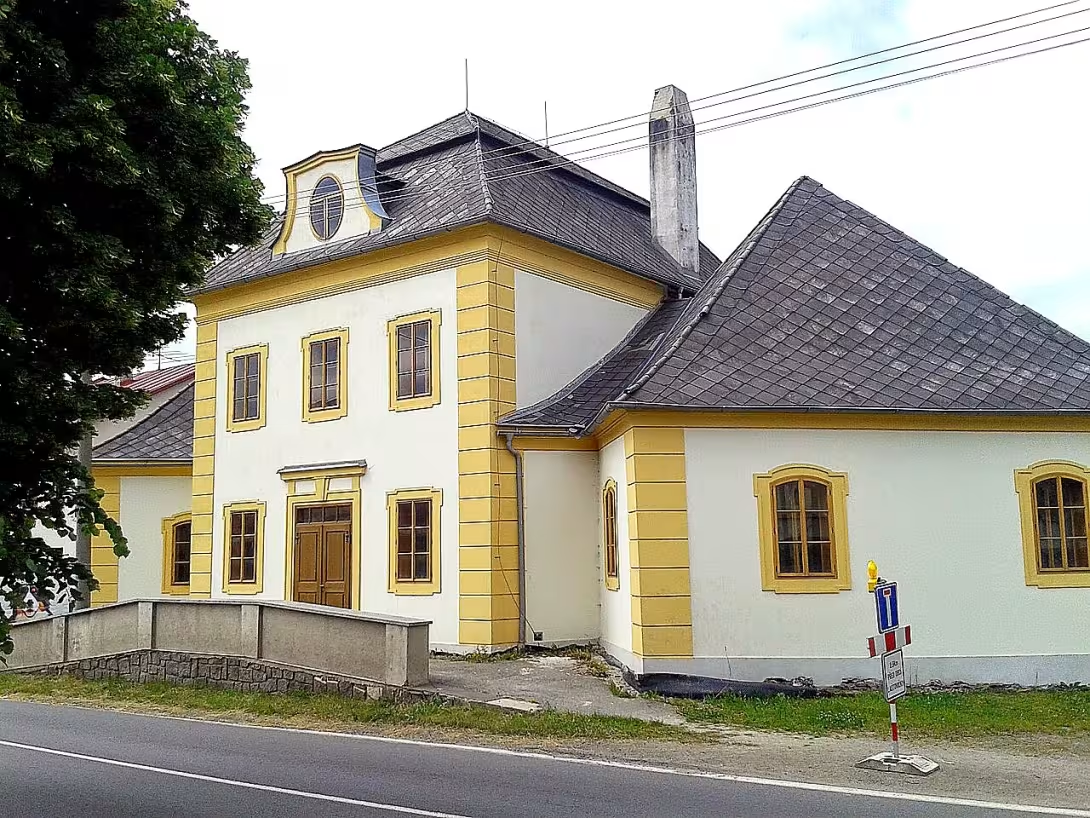
The road inn in Ostrov nad Záslavou is a baroque Gothic object built around 1720 by Abbot Václav Vejmlouva. It is located in the village Ostrov nad Oslavou and was designed by architect Jan Blažej Santini-Aichlem. This monument is protected as a cultural heritage and has a unique W-shaped ground plan referring to the initials of the abbot. The inn served the church dignitaries as a resting place and is now unavailable to the public.
The establishment of the inn was motivated by the purchase of the village of Ostrov in 1709 by Abbot Václav Vejmlouva. The abbot decided to build a monastery inn in the place of the former hotness, which was possible thanks to his prerogative. This representative building, reminiscent of the castle, was sold into private hands in 1771 due to the financial difficulties of the monastery.
The architecture of the inn is characteristic of the Baroque Gothic style. The W-shaped floor plan includes a three-storey entrance tract and a set of ground side wings on square surfaces. The top floor of the main building has a mansard roof with two chimneys, while the side wings have tent roofs. The windows are oblong and above the main entrance there is an oval window in the shield.
The inn underwent several changes to owners and dramatic events, such as the fire in 1819. It was repaired by the owner Václav Chromé, who made changes on economic objects. After nationalization in 1955 he served as offices and warehouses of the JZD Island, then he was rebuilt for cow and other purposes. In 1962 the inn regained its function of hospitality under the management of LSD Unity ŽDár nad Sázavou.
Key events in the history of the inn include its inclusion in the list of protected monuments in 1963 and extensive reconstruction completed in 2019. The reconstruction was financed by the owner from private funds with the support of the municipality, region and Ministry of Culture. In 2013, Sambucus was founded, which deals with the management and development of the inn area.
Today, the tourist inn is a protected cultural monument, even if it is not open to the public. Its historical and architectural significance makes this object interesting for those interested in Baroque Gothic and the history of the Tisteriac monastery in Ždar nad Sázavou. Visiting the area can provide another insight into the rich history of the area.
The road inn in Ostrov nad Záslavá is a reminder of the past, which enriches the region's cultural heritage with its architectural arts and historical events. Its reconstruction and protection ensure that future generations can appreciate this unique object, although access is limited. For those who want to explore the history and architecture of this area, the inn in the island of Ostrov is the necessary visiting material.
Historical milestones
- 1720
- Construction of the Cluster Inn according to the Jan Santini project.
- 1819
- The fire of the inn and the subsequent repair by the owner Václav Chromé.
- 1963
- Putting the inn on the list of protected monuments.
- 2019
- Completion of the general reconstruction of the main building and both wings.
Architectural development
Pudorys of buildings in shape W creates a three-storey entrance tract and a scythe-built ground side wing on square ground plans. The top floor of the main building has a Mansard roof with two high chimneys, side wings have tent roofs. Over the centuries, the complex has undergone many building modifications, post-arenas, insensitive interventions during the period of socialism and eventually extensive monument reconstruction completed in 2019.
Historical events
In 1709 Abbot Vejmlov bought the village. In 1819 an outbreak broke out in the Island of Zapor and the inn burned down. In 1955 he was born and later used by JZD. In 1993, the inn was acquired in restitution by the family of the last private owner.
Owners
Zdar nad Sazavou's civics cluster, private persons including Vaclav Chromy, LSD Unity Zdar nad Sazavou, family of the last private owners
Points of interest
- The guesthouse is a baroque Gothic building built around 1720 by Abbot Václav Vejmlouva. - It is located in the village of Ostrov nad Oslavou and was designed by architect Jan Blažej Santini-Aichlem. - The inn is protected as a cultural heritage and has a unique W-shaped floor plan, referring to the initials of the abbot. - The establishment of the inn was motivated by the purchase of the village of Ostrov in 1709 by Abbot Václav Vejmlouva. - The inn underwent several changes to owners and dramatic events, such as the fire in 1819.
Guide
Show guide text
This text was created by artificial intelligence and has not been editorially reviewed. It may contain inaccuracies.
Welcome to the Island of the Celebration. Right now, you're standing in front of a building that's likely to interest you right away. Stop for a moment, take a breath and just feel the space around you. In front of you is a building that at first sight resembles a representative summer castle rather than an ordinary inn. It is a place where the practical need for relaxation with the high art of architecture is combined and where every stone tells the story of ambition, faith and courage to create something truly unique.
Let us now look together at how this monument was created and why it is standing here in the first place. Let's move back three centuries in time to the beginning of the eighteenth century. It was a year of seven hundred and twenty, when the abbot of the Cisterciacia monastery in Zdar nad Sazava, a man named Václav Vejmlouva, decided to build this place. At that time, the roads were not as we know them today. The roads were hard and long, and therefore the tourist pubs were key points on the map of the empire. However, this particular inn was not intended for every bystander. He was to serve as a resting place for the church dignitaries who wandered between the monasteries and the bishops. So imagine the silence, peace and dignity that prevailed here at the time of its greatest glory, when people with great power were resting in their deep sleep.
Now pay attention to the architecture itself, because it is the most precious thing in it. If you look at the overall composition of the building, you'll notice something very special. This construction is carried out in the so-called Baroque Gothic style. It is a style that is absolutely unique to our country and its author was one of the most important architects of its time, Jan Blažej Santini Aichel. Santini was the master of geometry and light, and here he left his mark. Take a look at the building from the perspective, or imagine in your mind its layout. The building is a W-shaped building. It's not a coincidence or just an architectural experiment. This letter represents the initials of the Zdiri Abbot who had the building built. It's a fascinating detail of how the founder's personal identity became the basic building plan of the entire building. It is this shape that gives the inn its characteristic appearance of the summer residence and creates a space that surrounds and welcomes the visitor.
When you look around, feel the atmosphere of this place and think about the people who went through it. In addition to Abbot Vejmluva and Genius Santini, other names have been associated with this place. Among them was Lev Burian Berka z Dube a Lipe, for example, which recalls that this site has been linked over the centuries with the important personalities of the then company. But history is not only about fame and beauty, but also about trials. In a thousand and eight hundred and nineteen the inn was struck by disaster in the form of a devastating fire. The fire engulfed part of the building and threatened that this pearl would cease to exist in the Baroque Gothic. At that very moment Václav Chromé appeared, the owner who decided not to let the building collapse. Thanks to his efforts and repairs the inn could survive even this difficult period and remain visible to us today.
It's fascinating to see how access to this monument changed over time. For years, its value may have been overlooked, but in a thousand and nine hundred and sixty-three, this building was officially listed as a protected landmark. This was a crucial step which ensured that the inn would be treated as a cultural heritage. The peak of modern care was the overall reconstruction, which was completed in the year two thousand nineteen. It's how you see the main building and both its wings in such a maintained state. It is proof that even after 300 years we can appreciate the vision of one architect and the need of one abbot.
And now, one interesting thing that may interest you. Try to think again about the form W. In Santini's architecture, symbols and hidden signs often play a major role. The fact that the building in the form of the abbot's initials extends in the landscape can be seen as a symbol of the protection and care provided by the monastery to its passengers. It's basically a stone signature that survived centuries, fires and regime changes. It is a mystery how in such a relatively small object an architect could combine such a powerful personal symbol with such a strict and elegant geometry.
Now that you know the story of this place, I suggest you take a slow walk around the building. Feel the shadows touching the walls and the building changing depending on the angle you're looking at. Try to imagine the sound of horse hooves on the road and rustling of church robes that once formed the silence of this court. Look at the facade and see the harmony that Santini has put into the space.
This concludes our short journey through the history of the tourist inn in Ostrov nad Záslavou. I hope that this interpretation helped you see more than just the old walls and that you felt the spirit of the time when architecture was the way to express your identity and faith. Now the space is fully entrusted to you. Explore the surroundings, enjoy the peace of this place and be inspired by the genius of the Baroque Gothic style. I wish you a pleasant rest of the day and a pleasant continuation of your discovery of the beauty of our country. Goodbye.
Tips for visitors
The best time to visit the historic tourist inn in Ostrov nad Záslavou is in the morning, when the sun illuminates the baroque Gothic façade from the workshop of an important architect from the time of abbot Václav Vejpolovan around 1720. Take with you comfortable shoes to walk the villages and the camera, because the best light for capturing architectural details and the overall impact of the building is in the morning. To take pictures, choose the area near the nearby church of St. Jacob the Elder, from where there is a very nice view of the building. Within 30 minutes' drive you can visit the immediate surroundings in the village Ostrov nad Oslavou and close Zdár nad Sazavou, where the road from the monument is heading. Tips for families with children include a peaceful walk around the village connected with a tour of the historical building and the adjacent church, which captures small and large discoverers of old buildings.
Frequently asked questions
Can the monument be visited?
The building is in use (offices, a school, shops and the like). The interior is generally accessible only during operating hours and tours are not usually offered; we have not verified the details. You can see the exterior from the street.
Where is the monument?
Location: Ostrov nad Oslavou, Kraj Vysočina. The map on this page shows the exact spot.
Why is the monument protected?
It is listed in the Central List of Cultural Monuments of the Czech Republic as a cultural monument (register no. 1000135751).
Businesses nearby
Do you run a restaurant, accommodation, shop, museum, rental, wellness or other visitor service near this monument? Show yourself directly to the people heading to it — this is how they will see you in the app and on the web:
Events nearby
Zdroj akcí: otevřená data měst a obcí ČR (Národní katalog otevřených dat) a kalendář akcí Národního památkového ústavu.
Nearby
Objekt stojí v obci Ostrov nad Oslavou u silnice do Žďáru nad Sázavou, nedaleko kostela svatého Jakuba staršího.
Accommodation nearby
Themed route
Ostrov nad Oslavou - travel inn. The main destination of our trip, which stands in the village Ostrov nad Oslavou by the road leading to Zdar nad Sazavou. Why it is worth a visit: This historic building breathes old times and reminds us of the time when buyers and pilgrims traveled here on their long journeys.
Church of St. Jacob the Elder - sacral building. Why is it worth a visit: It is located in the immediate vicinity of our main destination and forms with it the historic heart of the entire village. It offers a quiet place to stop and admire traditional architecture.
Seasonal recommendations
Spring in the vicinity of the historic tourist inn in Ostrov nad Záslavou offers awakening nature, when surrounding meadows and water areas turn into fresh green shades. The sun rays penetrate early in the morning and create a fine mist over nearby ponds, which gives the ancient facade of the building a melancholy and peaceful character. In this period you will meet few tourists, so you can enjoy the undisturbed view of architectural details. Take with you fixed waterproof shoes for your spring visit, because the field roads in the area are drenched in tidal and spring rains. The best time for inspection and photography is in the morning, when soft light highlights the historical character of the site.
Summer brings a more lively atmosphere around the old inn to Ostrov nad Celebra full tourist season. The surrounding trees provide a welcome shade and the crown of leaflets are easy to shake in the warm wind in the midday heat, while the old walls of the building accumulate pleasant warmth. Since this is the main season of trips, we recommend you arrive immediately after the morning opening to avoid the afternoon crowds of hikers and cyclists passing through here. Put on light breathable clothes, but don't forget the headgear and sunglasses, as the space before the monument is exposed to direct sun during noon.
Autumn turns the landscape around the monument into a colorful palette of shades from yellow to brown, and morning fog often covers the whole area until morning hours. The atmosphere is very quiet and thoughtful, ideal for those who seek peace away from busy cities. With the coming end of the year, the days are significantly shortened, so it is necessary to plan a visit for the early afternoon before the sun sets. The practical advice for this rainy season is to wear a warmer, non-inflatable jacket and long pants, because a cool wind blowing from nearby ponds can make the outdoors uncomfortable.
Winter breathes into the tourist inn in the island above Celebration, with the old roof cover and surrounding courtyard covering the layer of snow. The lighting is muted in these months and early dimming gives the place a mysterious touch of old times. Since the winter is open for a shorter time and the operation is adapted to cold weather, check the operating time in advance. For your journey, unconditionally prepare your winter coat, warm gloves, hat and tight shoes with anti-slip soles, because the icy surface around the historic building requires great caution when walking.
Visualizations and artistic views


The visualisations are generated by artificial intelligence and serve as inspiration.
Photos from the area
Real photos taken near the monument


Zdroj a licence jsou uvedeny u každého snímku.
Tips from visitors
No tips yet. Be the first!
Log in and add your tip.
Sources and literature
Photos: Maxx / CC BY-SA 3.0 — Wikimedia Commons. The author and licence also appear when you hover over the image.
Faktickým podkladem tohoto textu byl článek na Wikipedii, jehož autory jsou přispěvatelé Wikipedie. Článek je dostupný pod licencí CC BY-SA 4.0.
Location on the map


Příběhy a pověsti
Legendy, pověsti a příběhy spjaté s touto památkou

Fotografie návštěvníků
Zatím žádné fotografie. Buďte první, kdo přidá fotografii z návštěvy!
Log in a přidejte svou fotografii nebo hodnoťte.
Za ověřenou návštěvu v aplikaci získáte víc bodů — poznáme podle GPS, že jste na místě.
Reviews and comments