






Základní škola (Hornická Čtvrť) School building
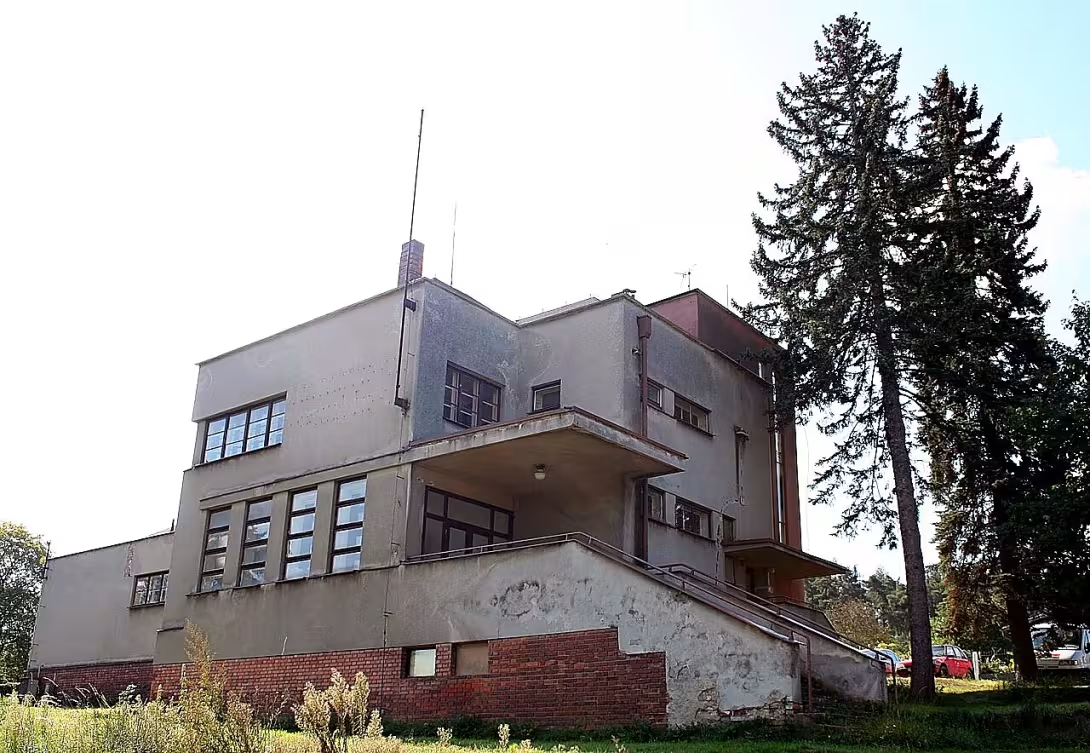
The primary school in the functional style in the Mining Quarter, Chvaletec in the district of Pardubice, is an important cultural monument of the Czech Republic. This building from 1930, the work of Pardubice architect Karel Řepa, was declared a protected cultural monument from 30 September 2009. Its unique architectural character, linked to the history of education and mining in the Iron Mountains, makes it attractive to visitors.
The creation of this building is closely linked to the economic development of the first republic, with modern architectural trends spreading in Czechoslovakia. The year 1930 brought the position of this important building, which originally served as a two-class school for the local population of Mining Quarter. The architecture of the building is an example of functionalism, a style characteristic of the first republic, where the architecture was promoted by functionality and simplicity of the form.
Architecturally, the school building is designed as a storey spatial structure with cubic mass, a right-hand cut-out corner and a valb roof. The dominant element is a semi-cylinder with two-arm staircase, which adds a unique look to the building. The ground wing with classes and high valb roof adds another dimension to the complex. The interior has preserved the original filling elements, built-in cabinets and staircases, which contributes to the authenticity of the building.
Since 1961, when the school was closed due to planned demolition due to the mining of manganese quarry, the building has been preserved in authentic condition. The deflection of the quarry eventually brought about the rescue of this cultural monument. Since 2019, its gradual restoration has taken place in order to create a association and a centre of mining history in the Iron Mountains.
Today, the building of the elementary school in a functional style is not only a monument to architecture, but also a witness to an important period of Czech history. Its unique design and authentic condition make it an ideal place for visitors interested in the architecture of the first republic and the history of education in the region. The reconstruction of the building aims to preserve its functional character and adapt it to new cultural purposes, making it an interesting destination for tourists and locals.
Visiting this monument offers not only a view of the architectural treasure, but also an opportunity to become acquainted with the history of the Mining Quarter and the surrounding Iron Mountains. Its importance as a cultural monument and potential for future use makes it not only an important part of the local cultural heritage, but also an inspiration for future generations.
Then and now
Drag the slider to compare how the landmark may have looked when it was built with the view today.
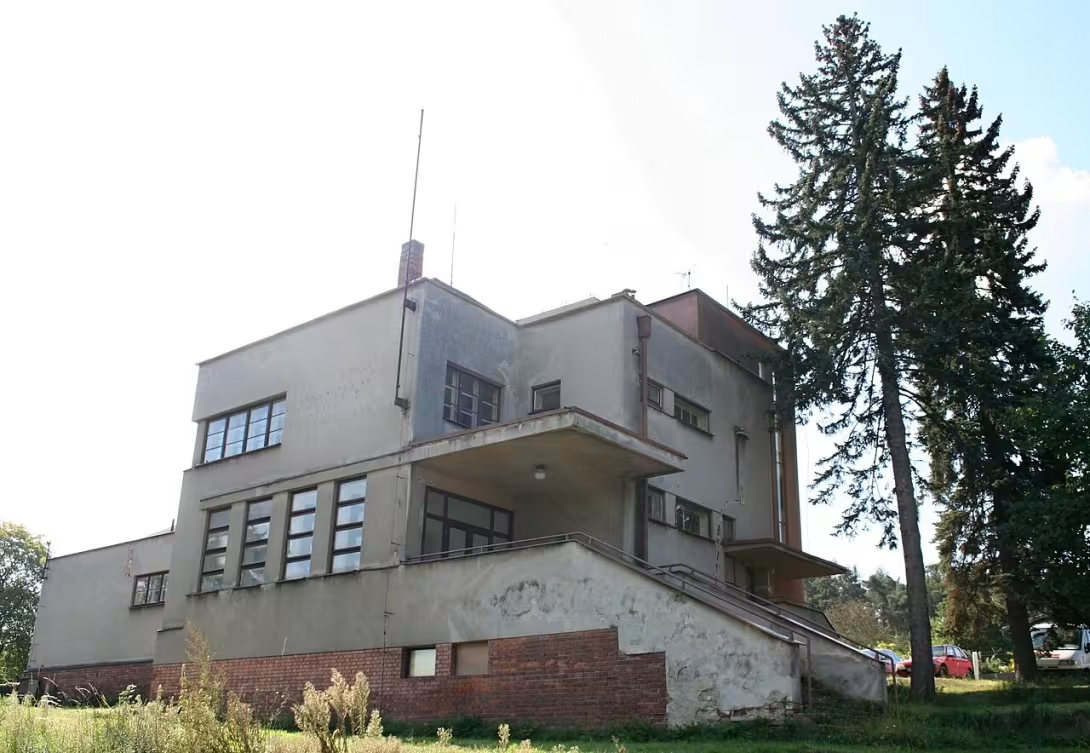
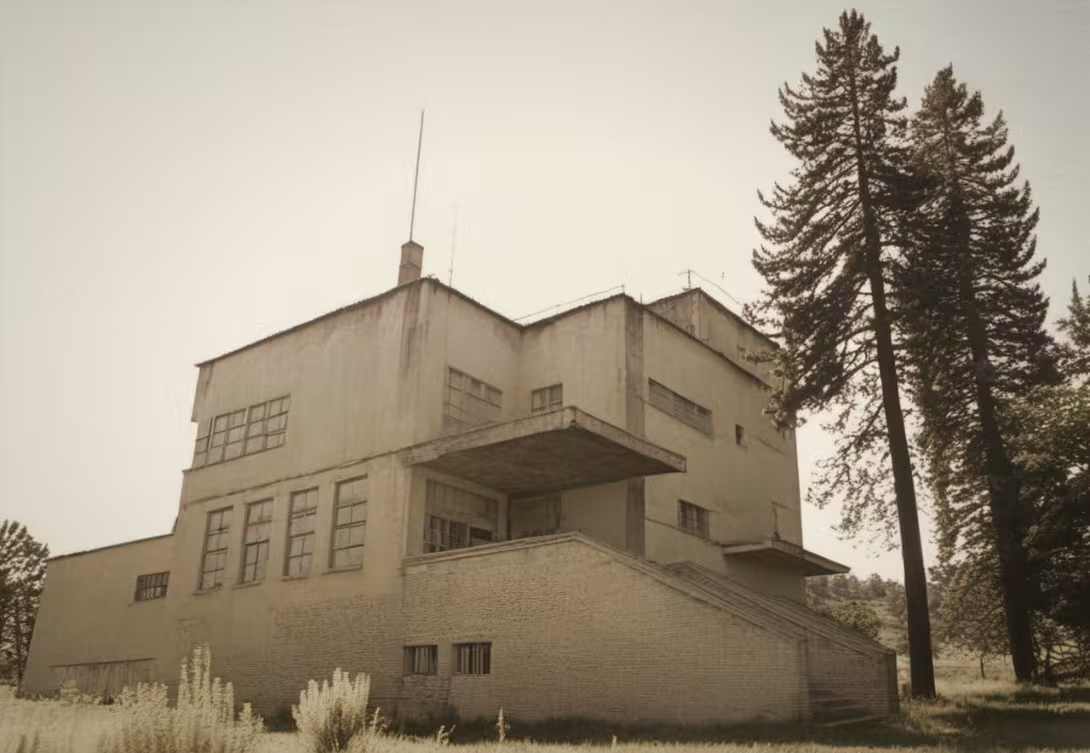
The historical appearance on the left is an AI-generated visualisation and serves as inspiration only.
Historical milestones
- 1930
- building a primary school
- 2009
- declaration as a real cultural monument
- 2019
- start phase renewal
Architectural development
The school was designed as a storey building with cubic mass and a valb roof, supplemented by a dominant half-cylinder and two-arm staircase. The interior has preserved the original filling elements, built-in cabinets and staircases, which contributes to authenticity. In recent years, reconstruction has been carried out to preserve the functionalist character and adaptation to new cultural purposes.
Historical events
1930 - construction of primary school; 30 september 2009 - the announcement of the monument; 2019 - start of building renewal.
Points of interest
- The primary school in the functional style in the Mining Quarter is an important cultural monument of the Czech Republic. - This building from 1930, the work of Pardubice architect Karel Řepa, was declared a protected cultural monument from 30 September 2009. - The architecture of the building is an example of functionalism, a style characteristic of the first republic. - Since 1961, the building has been preserved in authentic condition after school closure due to planned demolition due to the mining of manganese quarry which was eventually diverted. - Since 2019, its gradual renewal has taken place in order to create a association and a centre of mining history in the Iron Mountains.
Guide
Show guide text
This text was created by artificial intelligence and has not been editorially reviewed. It may contain inaccuracies.
Welcome to Mining Quarter. Right now, when you're standing right in front of this building, you're in a place where history touches everyday life and architecture meets the fate of the entire area. Look at this structure and try to perceive its presence. Although it is now a former school, its attitude towards the surrounding area is very strong. Do you feel the atmosphere of a place designed with a great sense of order and modern thinking? This building is not just a walled structure, it is a symbol of a certain era that has shaped our country.
Let's go back in time together and understand how this object came to be. Imagine the year one thousand nine hundred thirty. Our country, the First Republic, was experiencing a period of huge expansion, optimism and efforts to modernise everything that people around them were creating. In this context, this school was built as part of the wider development of the area. It was not just an ordinary building, but an author's work by an important Pardubice architect named Karel Řepa. It intended to create an area that will serve the education and development of young people in this specific environment. Originally, it was a small school, namely a two-class school, which made it the heart of the local community where generations met on a daily basis.
Now pay attention to the architecture itself, which you are now observing. What you see before you is an excellent and clean example of Czech functionalism. This style was revolutionary at the time. If you look at the overall composition of the building, you will notice that there is nothing unnecessary here. Funktionalism says that shape must come directly from function. No decorative ornaments that would only hinder the use of space, no unnecessary ornaments. Everything here is logical, material and pure. Notice the lines and geometric shapes that form the front of the building. Architect Karel Řepa tried to create an environment that is bright, clear and functional, which was absolutely crucial for the school environment. This architecture does not seem cumbersome, but rather light and rational, which precisely describes the spirit of the time. See how the building floats over its surroundings and uses its space harmoniously.
Although we do not know the names of specific teachers or children who sit here every day in the benches, we can imagine their stories through this architecture. The school was a living organism that worked until a thousand nine hundred sixty-one. Then her fate changed and the building was closed. Many similar buildings from that time died due to industrial development, but this one has unusual luck. It's fascinating how history can intertwine with natural and technical changes. This building was preserved due to the deflection of the quarry. It is a strange paradox that it is the changes in the surrounding terrain and mining activities that have helped to keep this piece of architecture whole and prevent its demise.
You might find one interesting thing that gives this building even more weight. Its importance for our culture was so high that since September 30, two thousand and nine, this school has been officially declared a real cultural monument of the Czech Republic. This means that its value is not only aesthetic, but it is part of our national heritage that we have an obligation to protect. If you think the building is going through some changes, you're right. Since the year two thousand nineteen, its gradual, phase renewal has been ongoing. So we are looking at the process in which history is awakening to life and how this functionalist brilliance returns to what Karel Řepa proposed. It's a fascinating view of how old monuments learn to live in the new century.
Now we leave you with your thoughts and your own eyes on this beautiful building. Do not forget to stop for the other details you will find here and note the constant work on restoring it. This neighborhood has many other stories waiting for its discoverers. Thank you for joining us on this short journey through time and for paying attention to this special place. We wish you a pleasant rest of the tour in this historic area.
Tips for visitors
The best time to visit a former elementary school in Mining Quarter is spring or autumn when vegetation is in the surrounding area in full blood and light changes so that it emphasizes architectural details of the building. These periods offer ideal conditions for understanding the historical context and aesthetics of functionalism.
Parking is possible to find near the city centre of Chvaletice, while public transport offers comfortable access to Mining Quarter. We recommend checking the current connection and parking possibilities before visiting to make your journey as pleasant as possible.
When planning a visit, take with you suitable shoes for walking on the ground and protective suit for winter if you visit in freezing months. Also remember the water and sun cream during a warmer period.
For photography it is best to wait until late afternoon when light becomes softer and shadow effects add depth to images. The best places for photography include the east side of the building, where the sun illuminates architectural elements.
In the vicinity of the Mining Quarter you can visit other historical buildings of the city of Chvaletice and explore the nature reservation with rich flora and fauna. These activities are ideal for families with children looking for a combination of culture and nature.
Businesses nearby
Do you run a restaurant, accommodation, shop, museum, rental, wellness or other visitor service near this monument? Show yourself directly to the people heading to it — this is how they will see you in the app and on the web:
Nearby
Hornická Čtvrť is located in the Iron Mountains Valley, near the former Manganese quarry and the Chrudimka River. Within a five-kilometer radius there are other historical buildings of the city of Chvaletice and a nature reserve with rich flora and fauna.
Accommodation nearby
Trips and activities nearby
Guided tours, tickets and activities nearby from GetYourGuide
Affiliate link: if you buy from the partner, we may receive a commission. The price for you does not change.
Search tours and activities →Themed route
1. Historical buildings of the city of Chvaletice (architecture) - Walk between old buildings will reveal the history of the local town. 2. Nature Reserve (nature) - Area with rich flora and fauna in the Iron Mountains Valley. 3. Former Manganese quarry (industrial monument) - A place resembling the mining past of this area. 4. River Chrudim (water flow) - Natural relaxation and a walk along the riverbed. 5. Základní škola (Hornická Čtvrť) (building) - The main destination in the village itself.
Seasonal recommendations
Spring brings freshness and soft light to the Mining District, which highlights the details of the historical development and the ongoing renovation of buildings. Nature is beginning to flourish again in the surroundings, creating an optimistic atmosphere around the building sites. The best morning for a visit is when the air is the cleanest. We recommend wearing layered clothes because morning cooling can be sudden.
Summer months are characterized by intense sun and long day, which gives the place a lively and lively touch. As the movement of people is the largest in the main summer season, it is best to arrive immediately after opening to avoid the biggest crowds and the highest heat. For a comfortable tour between historic streets, don't forget the headgear and plenty of water.
Autumn in this area offers a nostalgic atmosphere accompanied by golden shades and fog, which is often borne over roofs. The lighting is lower in this period and creates deep shadows, which gives the place mystery. It is advisable to wear firmer and waterproof shoes because of the wet surface of the pavement. The ideal time for visiting is around noon, when the light is most stable.
Winter brings peace to the quarter and short days, which mean the early onset of the clutter. The atmosphere is quiet and often cold at this time, which underlines the seriousness of the historical environment and ongoing reconstruction. In advent time, people's movement is limited, but it is necessary to count on shorter opening times. For a pleasant experience we recommend coming around noon and not forgetting very warm clothes and accessories against cold.
Visualizations and artistic views


The visualisations are generated by artificial intelligence and serve as inspiration.
Tips from visitors
No tips yet. Be the first!
Log in and add your tip.
Sources and literature
Fotografie: Canella23 / CC BY-SA 3.0 — Wikimedia Commons. The author and licence also appear when you hover over the image.
Faktickým podkladem tohoto textu byl článek na Wikipedii, jehož autory jsou přispěvatelé Wikipedie. Článek je dostupný pod licencí CC BY-SA 4.0.
Location on the map
Příběhy a pověsti
Legendy, pověsti a příběhy spjaté s touto památkou
Fotografie návštěvníků
Zatím žádné fotografie. Buďte první, kdo přidá fotografii z návštěvy!
Přihlaste se a přidejte svou fotografii nebo hodnoťte.
Za ověřenou návštěvu v aplikaci získáte víc bodů — poznáme podle GPS, že jste na místě.
Reviews and comments