



Zámecká kaple Morzinů Castle / castle chapel
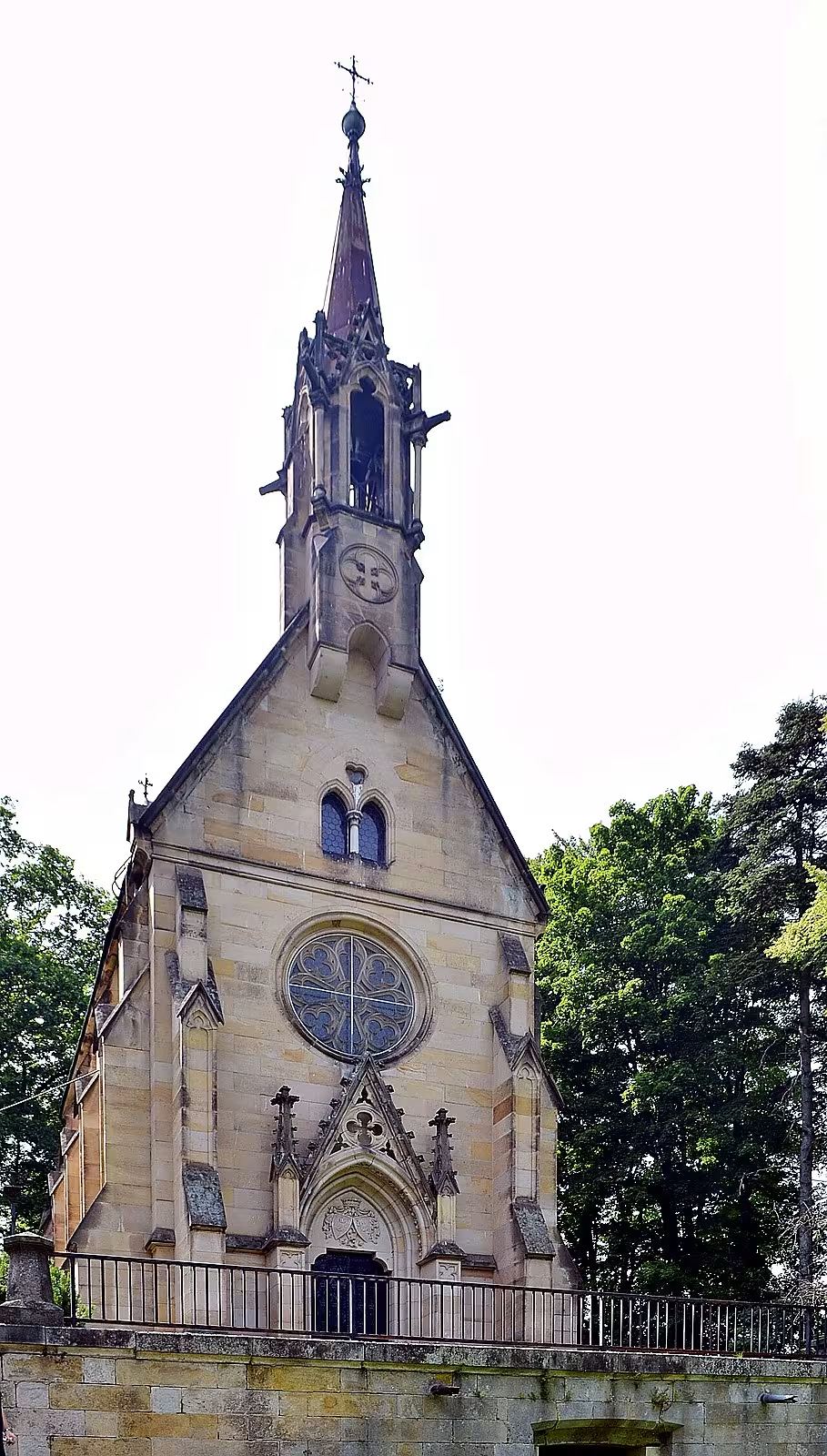
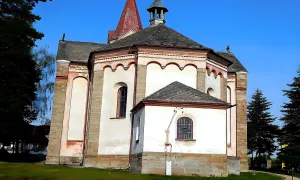
Zámecká kaple Morzinů in Vrchlabí is a neo-gothic building with a tomb, built in 1887-1891 for the Black-Morzine family. It is located in the western part of the city park and since 1947 serves as a prayer house of the Czechoslovak Church of Hussite. The building has been protected as a cultural monument of the Czech Republic since 2006.
The construction of the sanctuary on the hill above the western side of the park took place almost at the same time as the construction of the new church of St. Vavrnice in Vrchlaby Square. The chapel was built by Aloisie Černínová, born Morzin, according to the design of Smichov architect Stephen Tragl. The work was entrusted to local companies; The masons were taken over by the entrepreneur Edmund Zirm and the stone was provided by Eduard Wlačih. The building was originally dedicated to Saint James. This ceremony was performed on 20 October 1891 by the King's Hradec Bishop Josef Jan Hais. In the tomb under the altar, Count Heřman z Černínu rested, whose remains were stored in August of the same year.
The building stands on an elevated stone terrace with two access sides of staircases which equalises hilly terrain. The chapel has a rectangular plan with a polygonal presbytery on the west side. The eastern entrance consists of a profiled portal ending with a broken arch. In its tympanone is located a stone embossed coat of arms connecting two original birth marks of the Black-Morse branch. The lining is decorated with semicolons and two prism columns ended with fials. There is a circular rota and a triangular shield with two joined windows above the entrance portal. It culminates with a prism turret with an eight-sided needle, a poppy and a Latin cross. The sides of the chapel end with broken arches with a circle of four sheets and windows have vitrifying fillings with vegetative motifs.
The interior is a glass vault, while the presbytery separates from the ship the triumphant quarry arch. The floor is from a terrace with geometric motifs. The main furniture is a neo-gothic altar with a prismatic wooden mensa and a retable. In its central part there is a statue of Pieta in life size and three reliefs showing the Crucifixion, Birth and Ascension. The wooden carvings of the altar came from workshop c. K. of the yard carver J. Steiner of Meran and were created around 1890. In the chapel there is also a neo-gothic baptism of white marble, eight wooden benches from 1890 and an organ with five fields and tin whistles. In the interior are also stored tombstones of Count Vojtěch Czernin of Chudenice and his wife Joseph, born Thun.
The fate of the chapel was closely linked to the property of the Vrchlaby castle. The chateau was sold to the Nazi authorities of the Protectorate of Bohemia and Moravia, which established the district office of Landraf. After the restoration of Czechoslovak statehood, the chapel was thus subject to confiscation as German property according to the decrees of President Edvard Beneš. In 1947, the Czechoslovak Church of Hussite purchased a building and land from the Ministry of Agriculture for the sum of 58 115 then Czechoslovak crowns. Later, the land was taken from the church and returned to it only after 1989.
Under the terrace with chapel there is an entrance to the tomb, the floor plan of which corresponds to the construction itself. The space is cross-glazed with two rows of columns with plant motifs on the heads. There are catapults in the tomb that are in worse condition. The hall of the tomb has a flat ceiling and on the stone wall there is a text about the process of building the chapel.
The chapel is located west of the city park. A wooden suspension bridge leads to the construction, but it is currently closed. The object is an important monument that links the family history of nobility to the religious life of the region. Visiting this place offers insight into the architecture of history and history of the Vrchlabian estate.
Historical milestones
- 1887
- start construction of chapel
- 1891
- initiation of the chapel to Saint James
- 1947
- the chapel went to the administration of the Czechoslovak Church of Hussite
- 2006
- the chapel became a protected cultural monument
Architectural development
The construction took place in 1887-1891 in a pure neo-gothic style according to the design of architect Štěpán Tragl. The building has a rectangular plan with polygonal presbytery and is located on a stone terrace. The interior is decorated with a neo-gothic altar and stained glass with plant motifs.
Historical events
1887-1891: construction of the chapel; 1891: initiation of the chapel by Bishop Joseph Jan Hais; 1947: taking over the Chapel of the Hussite Church.
Owners
The Black-Morzine family; Czechoslovak Church of Hussite (since 1947).
Points of interest
- The construction was built in 1887-1891 for the Black-Morzine family. - Since 1947 it has served as a prayer house of the Czechoslovak Church of Hussite. - The building was originally dedicated to Saint James. - There is a life-sized Piety sculpture and wood carving from J. Steiner's workshop in the altar. - In the interior there is a baptizer made of white marble and wooden bench from 1890.
Guide
Show guide text
This text was created by artificial intelligence and has not been editorially reviewed. It may contain inaccuracies.
Welcome to Vrchlabí, a place where history meets nature and peace. Right now, you're facing one of the very special places in this city. The Zámecká kaple Morzinů stands before you. Notice you're not just standing in space, but you're on an elevated stone terrace. This location is not random, it gives the construction nobility and separates it from the surrounding activity while it also closely connects it to a nearby city park. Stop for a moment, take a breath and feel the atmosphere of this place. Imagine how people in period clothing came here over a century ago, as their steps on this rock sounded and how they felt about this building.
Let us now look together at how this chapel was created and who was behind it. We are at the end of the nineteenth century, namely in 1887, when its construction began. The whole project was carried out for a significant family of Cerníší-Morzins, who left a deep mark in this area. The architect who breathed life into this building was Štěpán Tragla. His job was to create a space that not only served for prayer, but also expressed the status and taste of owners. The building lasted several years and in 1891 the chapel was ceremonially dedicated to St. Jacob. At that time it was a place of deep faith and family belonging, which underlines the fact that the chapel contains the tomb of the original owners of the castle. So it is a place where the earth has joined the spirit and where the Black-Morzine family has found its last peace.
Now pay attention to the very form of the building. There's a neo-gothic building in front of you. Novogotics were very popular at the time because it returned to the values and aesthetics of the Middle Ages, but with the use of modern construction options. Look at the total line of the building, its vertical and the way it rises above the terrace. Feel the rhythm of her appearance and details that Štěpán Tragla has put into the project. Even though we are looking at an external construction today, its external form tells us of the inner peace and respect that persists in it. Look at the facade and think about how many generations of people have seen these walls.
With this place are also connected specific personalities that gave him a human dimension. These include Aloisie Černínová and Heřman z Černínu. Imagine them as people who have moved in these areas, who have sought solace here, or have quietly thought about the future of their family and their property. The name of Josef Jan Hais also belongs to the history of this place. Each of these people brought to the chapel a different story, a different feeling and a different view of the world. It is thanks to them that this chapel is not only a pile of stones and mortar, but a living witness to human destiny, love, sadness and hope.
Now I'm happy to show you something that is truly fascinating in this chapel. If we think about her fate, we'll find she's changed a lot over the years. Originally dedicated to Saint James, she went through a major change in 1947. In this year the chapel went to the administration of the Czechoslovak Church of Hussite and since then it has served as a prayer room for its believers. It is a fascinating transformation of one space, which took over a new role from the family tomb and private chapel of the noble family and opened up to a wider community of believers. This change shows how times changed, how political and social regimes were broken, but the building itself remained a fixed point in the stream of history.
When we think about the inner equipment that the chapel has in it, we can imagine the beauty of its altar. There is a statue of Piety in life size, which is a depiction of the Mother of God with a deceaded son in his arms. It's a picture of deep sadness, but also a great love that brings humility to the visitor. In addition to this emotional work, we can also find precise woodcuts that come from Master Steiner's workshop. This combination of art and belief creates space in the interior where one feels small but also part of something much larger.
You may be wondering why this building is so important today. Since 2006 the entire building has been protected as a cultural monument of the Czech Republic. That means the state has recognized its irreplaceable value for our history and culture. It's not just her looks, it's what she represents. It is a bridge between different ages, between the noble past and modern times, between the Catholic tradition and the Hussite prayer.
Let's stop for a moment in silence. Take a look again at this building, its location on the stone terrace and how harmonically it fits into the landscape of Vrchlabí. It's a place that teaches us patience and reminds us that even though the worlds around us change, there are values and places that persist. Zámecká kaple Morzinů is just like that.
Now that you know her story, her creator and the people who gave her life, I suggest you explore the space around her at your own pace. Take a walk on the terrace, see the proximity of the city park and let your thoughts float freely. You may feel the same peace as the people here were looking for a century ago.
Thank you for accompanying me on this short journey through time. I hope this interpretation has helped you see more than just architecture in this beautiful building, but the real story about people and their beliefs. I wish you a pleasant continuation in your discovery of Vrchlabí and its hidden treasures. Goodbye and see you in the next corner of our beautiful city.
Tips for visitors
Best time to visit The Morzine Castle Chapel is in the spring or autumn season, where it is quieter and nature offers the most beautiful views. The sunny days are ideal for exploring the neo-gothic details of the building.
When visiting the chapel, take a photo or a camera with you because the neo-gothic elements of the building are an ideal topic for photography. Don't forget to wear a protective coat or jacket as the weather can suddenly be variable.
Photography is best in the early morning or evening when light is mild and brings a chapel of romantic lighting. The best views of the building can be obtained from the park side or from the pavement leading around the castle.
In the surroundings it is recommended to visit Vrchlabská castle and city park where you can enjoy quiet walks. For families with children, it is suitable to visit the church of St. Vavrnice, which offers interesting history and beautiful interiors.
Frequently asked questions
Can the monument be visited?
Religious buildings are usually open mainly during services; at other times a visit is normally arranged with the parish or the operator. We have not verified specific times.
Where is the monument?
Location: Vrchlabí, Královéhradecký kraj. The map on this page shows the exact spot.
Why is the monument protected?
It is listed in the Central List of Cultural Monuments of the Czech Republic as a cultural monument (register no. 1672468951).
Businesses nearby
Do you run a restaurant, accommodation, shop, museum, rental, wellness or other visitor service near this monument? Show yourself directly to the people heading to it — this is how they will see you in the app and on the web:
Nearby
Vrchlabský zámek, městský park ve Vrchlabí a kostel svatého Vavřince.
Accommodation nearby
Themed route
1. Church of St. Lawrence (church) - Historical temple, which serves as a beautiful start for walking through the city. 2. City Park in Vrchlabí (park) - A pleasant green area that offers peace and shade along the way to the castle. 3. Vrchlaby lock (lock) - An impressive mansion with a rich history and interesting architecture. 4.Zámecká kaple Morzinů (chapel) - The main destination of the trip, which will capture its unique implementation.
Seasonal recommendations
Spring: During the spring season, the Morzine Castle Chapel is affected by the presence of flowering trees and shrubs, which provide space with live color shine. Sun rays penetrating through the leaf crown create colorful light effects on the walls of the chapel. In this period it is advisable to go to the chapel early in the morning when the temperature is pleasant and the crowds are not many. Recommended clothing should be easy, but with the possibility to add top clothing in case of a cool windshield.
Summer: Summer brings long days and warm sun, making the castle chapel of Morzins an ideal place for relaxation. The atmosphere is full of life, although more visitors may appear in the main summer season. It is advisable to visit the chapel earlier in the day to avoid the hottest hours and overcrowding. We recommend light clothing and a protective sun helmet to save from the strong sun.
Autumn: In autumn there are spectacular colours of leaves around the chapel that make a beautiful background. The sunlight penetrating between coloured leaves gives space to a melancholic atmosphere. In this period, a smaller attendance is expected, allowing a more relaxed tour of the chapel. Recommended clothing should be slightly warm with the possibility of adding top clothing on colder days.
Winter: Winter visit to the Morzin Castle Chapel offers a quiet and quiet environment where the surrounding area is covered with snow. Sun rays create a breathtaking contrast between the white ground and the color walls of the chapel. In this period the opening time is shorter, so it is advisable to visit it early in the morning or later in the day. We recommend warm clothes and protective equipment for legs such as blankets to prevent cold.
Visualizations and artistic views


The visualisations are generated by artificial intelligence and serve as inspiration.
Photos from the area
Real photos taken near the monument


Zdroj a licence jsou uvedeny u každého snímku.
Tips from visitors
No tips yet. Be the first!
Log in and add your tip.
Sources and literature
Photos: Keana / CC BY-SA 3.0 — Wikimedia Commons. The author and licence also appear when you hover over the image.
Faktickým podkladem tohoto textu byl článek na Wikipedii, jehož autory jsou přispěvatelé Wikipedie. Článek je dostupný pod licencí CC BY-SA 4.0.
Location on the map

Příběhy a pověsti
Legendy, pověsti a příběhy spjaté s touto památkou
Fotografie návštěvníků
Zatím žádné fotografie. Buďte první, kdo přidá fotografii z návštěvy!
Log in a přidejte svou fotografii nebo hodnoťte.
Za ověřenou návštěvu v aplikaci získáte víc bodů — poznáme podle GPS, že jste na místě.
Reviews and comments