



zámek Luka nad Jihlavou Chateau
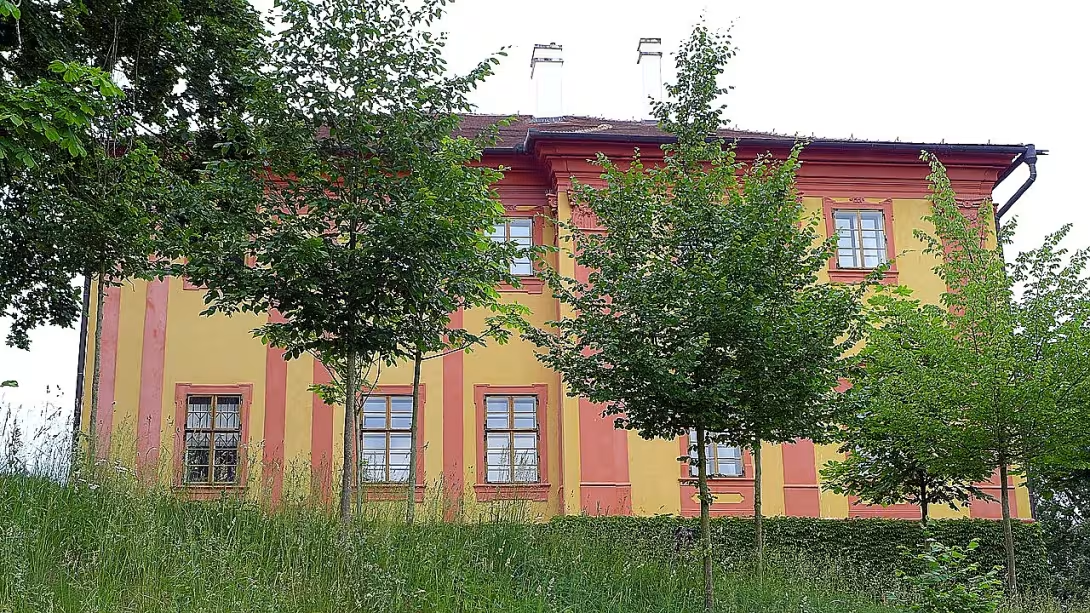
The chateau in Luky nad Jihlava in the district Jihlava presents an interesting study of building development. It is a two-storey chateau built on the right bank of the Jihlava River in Vysočina Region, protected since 1972 as a cultural monument of the Czech Republic.
The beginnings of the site go deep into the past - the first mention of the village dates back to the beginning of the 12th century, but the verified reports start only in the middle of the 14th century when Luka became the property of the Tribicky Benedict monastery. In 1584 the sons of Jan Zahradecký of Zahradec sold the village of Luka with a fortress and brewery rich in southern town Matthew Grün from Stürzenberk. Interestingly, the research showed that the older fort had nothing to do with today's chateau - probably lying on the left bank of Jihlava behind St. Bartholomew's Church. However, the remains of the brewery are under the current lock.
The chateau itself was established on the green meadow and it is possible to consider Matthew Grün as its founder. The construction started around the end of the 16th century and it was supposed to serve as a hunting lodge or military fortress. But the Thirty Years' War brought destruction - the chateau was destroyed and burned. The Collalts, who owned the estate, did not care much for it, and the construction disintegrated until the beginning of the 18th century.
The restoration began in 1711, when Jan Kryštor Říkovský of Dobrčice, the Regional Governor of Jihlava, bought the manor for nearly 45,000 Rhine gold. His initiative is confirmed by a coat of arms with a white stork visible above the window of the north facade. In 1730, the new owner František Antonín Gellhorn received permission to worship in the chateau chapel.
The most important reconstruction took place in 1739-1747 under Maximilian Oldřich from Kounice. The chateau turned into a two-storey three-track building of baroque style with mansards in the attic. The experienced builder Václav A. Petruzzi, stonemason Václav Winter, carpenter master Josef Reiter and stucco Giovanni Battista Ricca created a work with a column between side wings and winter garden (which was later removed). In 1747, the Mariánska Chapel was built.
From 1768, they owned Widmann Chateau until 1945. Their most important contribution was the establishment of an extensive chateau park in 1834 style. A park of 19 hectares has been preserved to this day. The railway from Jihlava to Brno also passed through the municipality for their reign, and the flow of the river had to be changed.
Then and now
Drag the slider to compare how the landmark may have looked when it was built with the view today.
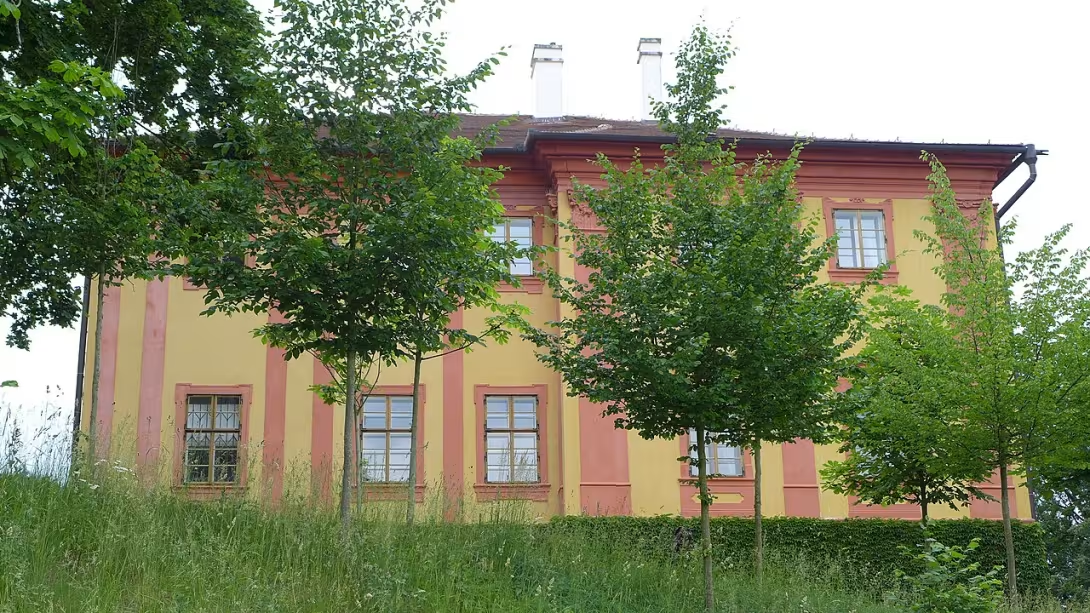

The historical appearance on the left is an AI-generated visualisation and serves as inspiration only.
Historical milestones
- 1739-1747
- Baroque reconstruction of the chateau for Maximilian Oldřich from Kounice.
Architectural development
Originally as a hunting chateau or military fortress built at the end of the 16th century, the chateau underwent reconstruction in Baroque style between 1739 and 1747. During this phase, the building was converted into a two-storey three-track structure with mansards, balcony and stucco decoration.
Points of interest
- The chateau in Luky nad Jihlava is protected as a cultural monument of the Czech Republic since 1972. - The first mention of the village dates back to the beginning of the 12th century, the verified reports begin in the middle of the 14th century, when Luka became the property of the Třebíč Benedict monastery. - Matouš Grün ze Stürzenberka purchased the village of Luka with a fortress and brewery in 1584, but the older fort had nothing to do with today's chateau. - The chateau was demolished and burned by the Swedes during the Thirty Years' War and later decayed before its restoration began in 1711 by Jan Kryštor Říkovský of Dobrčice. - The most important reconstruction took place in 1739-1747 under Maximilian Oldřich from Kounice, when the chateau turned into a two-storey three-track Baroque style building.
Guide
This guide is narrated by a synthetic voice generated by artificial intelligence.
Show guide text
This text was created by artificial intelligence and has not been editorially reviewed. It may contain inaccuracies.
The castle in Lukách nad Jihlavou is a two-storey Baroque structure on the right bank of the Jihlava River. The original castle was built at the end of the sixteenth century, and it acquired its present appearance in the eighteenth century. Since nineteen seventy-two, it has been protected as a cultural monument.
For a long time, it was believed that the castle was preceded by a fortified manor. It is mentioned in a bill of sale from fifteen eighty-four, in which the sons of Jan Zahrádecký ze Zahrádek sold Lukách to the wealthy Jihlava townsman Matouš Grün ze Stürzenberka. However, research has shown that the fortified manor is not connected to the castle. It most likely stood by the church of sv. Bartoloměje on the left bank of the river. Beneath the present castle, on the other hand, remains of a former brewery have been preserved.
The castle thus arose in a new location, on a gentle hillock near the original riverbed. Matouš Grün is considered its founder. It was apparently a hunting lodge or a military fortress. Karel Grün lost the estate because of his participation in the Estates' Revolt. At the end of the Thirty Years' War, when Lukách belonged to the Brtnická Collalts, the castle and brewery were destroyed and burned by the Swedes. The Collalts were seated in Brtnice and did not concern themselves much with Lukách, so the castle fell into disrepair until the beginning of the eighteenth century.
In seventeen eleven, the estate was purchased by the Jihlava district captain Jan Kryštof Říkovský z Dobrčic, who began its restoration. His coat of arms above the window of the northern façade commemorates this. On it is a white stork holding a golden stone in its raised right leg. This motif later became the symbol of Lukách nad Jihlavou.
The decisive renovation was a very costly reconstruction from seventeen thirty-nine to seventeen forty-seven under Maxmilián Oldřich z Kounic. The builder Václav Petruzzi, the stoneworker Václav Winter, the carpentry master Josef Reiter, and the stucco worker Giovanni Battista Ricca took part in it. A three-wing building with mansard roofs in the attic space was created. Between the side wings, a balcony with a colonnade was inserted, on which stood a winter garden. It was lost at the beginning of the twentieth century, and at the same time the stucco decoration of the main staircase was created.
In seventeen sixty-eight, the Widmanns purchased the estate and held it until nineteen forty-five. In eighteen thirty-four, they established an extensive castle park in the English style covering nineteen hectares, which has been preserved to this day. During their rule, a railway from Jihlava to Brno also passed through Lukách. Because of its construction, the course of the river was redirected, and thus a large open space was created in front of the castle.
Tips for visitors
The best time to visit is spring and autumn months when the landscape of Vysočina offers the most beautiful colours and Baroque architecture of the chateau stands out in a lighter light.
For a comfortable survey of the premises we recommend shoes suitable for the field. We recommend the photographers to focus on the details of the Baroque facade, ideally during the golden hour before sunset.
Families with children will appreciate the story of the history of the hunting chateau and the original Renaissance fortress, which may be a great impetus to familiarizing children with the history of the region.
Frequently asked questions
Can the monument be visited?
Some buildings of this kind are open for guided tours, others serve another purpose or are privately owned. We have not verified whether and when this monument is open – please ask the operator.
What are the opening hours and admission?
We have not verified the opening hours or admission. Current information is published by the operator.
Where is the monument?
Location: Nádražní 1, Luka nad Jihlavou, Kraj Vysočina. The map on this page shows the exact spot.
Why is the monument protected?
It is listed in the Central List of Cultural Monuments of the Czech Republic as a cultural monument (register no. 28411/7-4981).
For kids
About 326 years ago, when the world stopped and thought about what the future would bring, there was a magnificent chateau on the right bank of the Jihlava River. It was like when you accidentally drove a beautiful prince's chateau in your favorite book, but this one really happened! The chateau in Luka nad Jihlava is like a baroque queen carrying rich history and beautiful memories.
Businesses nearby
Do you run a restaurant, accommodation, shop, museum, rental, wellness or other visitor service near this monument? Show yourself directly to the people heading to it — this is how they will see you in the app and on the web:
Nearby
ITEX Show interactive overview of the surroundings - restaurants, accommodation, rentals and other places within a 15 km radius.
Data: OpenStreetMap contributors, 15 km radius.
‡ Historical monuments
- victims of World War I and II (3.9 km)
- sv Josef (7.5 km)
- victims of World War I (7.7 km)
- Church of St. Jacob the Greater in Jihlava (8.5 km)
- _ (8.6 km)
- Museum of Highlands (8.6 km - Masaryk Square 57)
- Soldiers Red Army (8.7 km)
- Gustav Mahler (8.8 km)
Restaurant and catering
- U Lojzy (3.8 km)
- U Milánka (4.0 km)
- U Pezna (4.5 km)
- Kredenc (4.9 km)
- Na Jelite (5.4 km)
- Hotel Knights (6.3 km)
- U Kachaby (7.1 km)
- McDonald's (8.4 km - Masaryk Square 68)
Accommodation
- Na Hradbás (8.1 km)
- Hotel Vivaldi (8.1 km)
- Guesthouse Jostovka (8.2 km)
- denafil (8.5 km)
- Gustav Mahler (8.6 km)
- Savorsky (8.6 km - Comenius 11)
- Grandhotel Garni (8.7 km - Husova 1)
- Pension Atrium (8.8 km)
› Rental and sports
- Swimming pool Luka nad Jihlavou (1.1 km)
- Cyklo Point (7.3 km)
- Decathlon (7.3 km - Brno 4971 / 74)
- KOLOFIX (7.7 km - Brtnický 2531)
- Hervis (8.1 km)
- Adidas (8.1 km)
- Sport 2000 (8.6 km - Masaryk Square 49)
- Pinecklub (8.6 km)
© Tourism and nature
- Petrovic mill (2.8 km)
- Big Beranov (4.4 km)
- Small Beranov (public transport) (6.0 km)
- Knights (bus) (6.3 km)
- Helenín (6.8 km)
- Krcupka (6.8 km)
- Helena Road (8.0 km)
- House Gustav Mahler (8.4 km)
Accommodation nearby
Trips and activities nearby
Guided tours, tickets and activities nearby from GetYourGuide
Affiliate link: if you buy from the partner, we may receive a commission. The price for you does not change.
Search tours and activities →Themed route
Travel Route zámek Luka nad Jihlavou
1. Chateau Luka nad Jihlavou * Type: * Historical landmark * Why is it worth visiting: * The chateau is a beautiful example of Baroque architecture with rich history. Its views of surrounding landscapes and interiors, such as palace halls and parking, offer visitors a view of the past.
2. Church of St. Bartholomew * Type: * Religious object * Why is it worth a visit: * This church is located in the centre of the village and attracts attention to its historical architecture. Its interior contains valuable artistic elements that reflect the rich spiritual tradition of the local community.
3. Square by the chateau * Type: * Public space * Why is it worth a visit: * The square is an ideal place to relax and relax after a visit to the chateau. Here you can enjoy quiet moments, prepare for the next part of the trip or see local shops.
4. Castle Park * Type: * Park zone * Why is it worth a visit: * Parkan is a beautiful natural garden that complements the historical character of the chateau. Its travels and seedlings offer ideal conditions for relaxing nature and beautiful photos.
5. Chateau courtyard * Type: * Historical area * Why is it worth visiting: * The tank is the centre of the chateau, where there are also other historical buildings and elements. It's a place full of the atmosphere of the past that complements the general impression of the chateau.
This route offers a compact view of the cultural and historical richness of the village Luka nad Jihlavou.
Seasonal recommendations
In spring zámek Luka nad Jihlavou comes to life together with the surrounding landscape. Future green and blooming trees around the flow create a fresh and optimistic atmosphere. The light is fine in this period and ideal for observing the details of the construction. We recommend wearing layered clothes because morning temperatures can still be cold. It's the perfect time for a quieter tour because you can avoid the biggest groups of visitors.
Summer months bring intense sun to the Highlands and full of growth vegetation. The chateau is surrounded by dense greenery, which provides a pleasant shade during hot days. The atmosphere is alive and full of energy. Due to the main summer season, prepare for a larger number of people, which is why it is best to arrive right after opening or late afternoon. Don't forget light summer clothes and plenty of fluids.
Autumn season turns the surroundings of the chateau into a varied palette of golden and brown shades. The foggy morning gives the historic place a mysterious and nostalgic mood. The light is low at this time and very photogenic. It is necessary to have a waterproof jacket and warmer clothing prepared because the weather is often variable. The best time to walk around is in the morning, when the fog slowly dissolves.
In winter, the chateau is covered in peace and quiet. If snow falls, the landscape looks fabulous and architecture stands out on white background. Days are short, which affects the overall impression of the visit. It is necessary to choose very warm clothes and quality shoes in case of frost. In advent time or during freezing days we recommend planning the visit in clear morning hours so that you don't miss the remaining daylight.
Visualizations and artistic views


The visualisations are generated by artificial intelligence and serve as inspiration.
Photos from the area
Real photos taken near the monument


Zdroj a licence jsou uvedeny u každého snímku.
Tips from visitors
No tips yet. Be the first!
Log in and add your tip.
Sources and literature
Photos: Koutne1 / CC BY-SA 4.0 — Wikimedia Commons. The author and licence also appear when you hover over the image.
Faktickým podkladem tohoto textu byl článek na Wikipedii, jehož autory jsou přispěvatelé Wikipedie. Článek je dostupný pod licencí CC BY-SA 4.0.
Location on the map



Příběhy a pověsti
Legendy, pověsti a příběhy spjaté s touto památkou
Fotografie návštěvníků
Zatím žádné fotografie. Buďte první, kdo přidá fotografii z návštěvy!
Log in a přidejte svou fotografii nebo hodnoťte.
Za ověřenou návštěvu v aplikaci získáte víc bodů — poznáme podle GPS, že jste na místě.
Reviews and comments