



železniční most v Bohušovicích nad Ohří Railway bridge
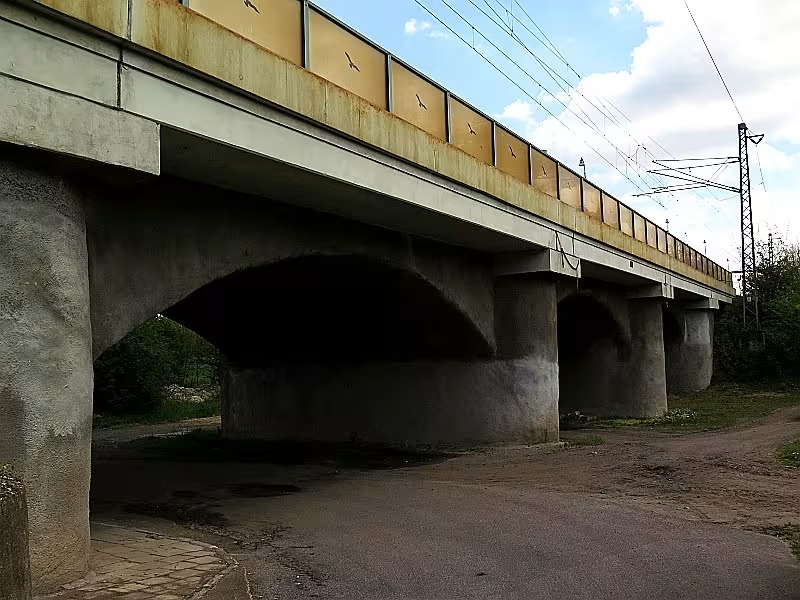
The railway bridge in Bohusovice nad Ohří is a remarkable Empire bridge built in 1848 by North State Railways. It is located southeast of the railway station Bohušovice nad Ohří in the district of Litomerice. The bridge is 165 metres long and has nine segment arches, of which five bridge the Ohři River. It is built from sandstone blocks that were imported to the site by the ships of the South Bohemian company Lanna.
The railway bridge in Bohusovice nad Ohří was established during the development of the railway network in the Habsburg monarchy. At that time, the main lines connecting Prague to Dresdo and Berlin were built. The bridge was built in 1848 and is a cultural monument of the Czech Republic. In 1924 his repair was made and the bridge was extended. During the period 2000- 2002 the bridge was reconstructed within the first speed corridor.
The bridge is built from sandstone blocks that were imported to the site by ships of the South Bohemian company Lanna. It is 165 metres long (including supports), has nine segment arcs with a brightness of 12,65 metres, of which five bridge the Ohři River, there are four pillars in the riverbed, another four arcs lead over local communications. Pillars are rectangular ground plan with rounded guide and flood sides. When repaired in 1924, these curvature was used to expand the bridge.
The railway bridge in Bohusovice nad Ohří is currently owned by the Railway Infrastructure Administration. The history of the bridge is linked to the development of the railway network in the Habsburg Monarchy. The bridge is a cultural monument of the Czech Republic and an important part of the railway network. Its history is linked to the development of railway transport in the 19th century. In 1924, the bridge was expanded. During the period 2000- 2002 the bridge was reconstructed within the first speed corridor.
The railway bridge in Bohusovice nad Ohří is a remarkable Empire bridge built in 1848. It is located southeast of the railway station Bohušovice nad Ohří in the district of Litomerice. The bridge is 165 metres long and has nine segment arches, of which five bridge the Ohři River. It is built from sandstone blocks that were imported to the site by the ships of the South Bohemian company Lanna.
Historical milestones
- 1848
- status of the bridge of North State Railways companies
- 1924
- repair and expansion of the bridge
- 2000-2002
- reconstruction within the 1st speed corridor
Architectural development
The original Empire construction of sandstone blocks with nine arches was expanded in 1924 using rounded pillars. Between 2000 and 2002, a comprehensive reconstruction took place for the needs of the express corridor.
Historical events
1848 - completion of bridge construction; 1924 - repair and extension of bridge; 2000- 2002 - reconstruction within the 1st speed corridor.
Owners
North State Railways (1848-), Czechoslovak State Railways (1918- 1993), Railway Infrastructure Administration (1993-)
Points of interest
The bridge is a remarkable Empire bridge built in 1848. - The bridge is 165 meters long and has nine segment arches. - The bridge is built from sandstone blocks. - The bridge is a cultural monument of the Czech Republic. - The bridge was built during the development of the railway network in the Habsburg monarchy.
Guide
Show guide text
This text was created by artificial intelligence and has not been editorially reviewed. It may contain inaccuracies.
Welcome to the beautiful landscape by the river Ohre. You're standing in front of one of the most impressive construction units in the whole area. Before your eyes, there is a mighty railway bridge, which, as a stone colossus, surpasses the flow of water and connects both shores. Feel the incredible power and stability this building emits. Look at the long, solid lines that stretch across the river, and imagine how powerful an impression this structure must have caused people more than centuries ago when it was first completed. It is a work that carries the weight of history and technological progress.
Let us now return together to a time when the world around you began to change faster than ever. It's a thousand and eight hundred and forty-eight. A time of great social change, a time of expansion of the railway network within the Habsburg monarchy. It was then, in this important period of industrial growth, that it was here, in Bohusovice nad Ohří, that a connection had to be established that would connect the distant regions. The construction was carried out at the time by North State Railways. It wasn't just an ordinary bridge, it was part of a huge project to change the way people, goods and information travel across the empire. At that time the railway was a symbol of the modern world and this bridge was a solid part of it.
Now pay attention to the architecture itself and to what you're seeing right in front of you right now. Notice his style. This bridge is built in an empirical spirit, which means that in its form we can seek order, peace and nobility. If you look at his body, you'll see it's built from massive sandstone blocks. These stone blocks are the foundation of its immense fortress. Each of them is proof of the craft at the time. The entire length of this work is 150 meters. If you look around the entire length of the bridge now, you will see nine segment arcs that are elegantly carrying the weight of the railway line across the river Ohře trough. These arches create a rhythm that leads your vision from one shore to the next and gives the whole building its distinctive appearance.
It's fascinating to think how this huge material got into place. Imagine the work and logistics in the middle of the nineteenth century. Sandstone blocks were not simply chosen, but were transported to this place by ships. All this was provided by Lanna, which at that time played a very important role in providing materials for large construction projects. It's extremely interesting to imagine the floating costs that were going here, down the river, to create this permanent element of the landscape. Every stone you see now has passed through the water path before it became part of this monumental structure.
This bridge is not just a relic of the ancient past, but still a living and functional element of our infrastructure. Serves today on track zero-nine naked. However, in order to continue to fulfil his role and safely carry modern trains, he had to undergo repairs and modifications. In a thousand and nine hundred twenty-four, the bridge was repaired and expanded to meet the growing needs of transport, which has been constantly changing over the years. And even in recent times, he was cared for with great care. At the turn of thousands of years, namely between a thousand and two thousand and two thousand and two thousand years, a major reconstruction took place. This work was not random, it was part of the construction of the first speed corridor. This clearly shows that this old stone colossus is still an important and necessary part of the modern movement of people and costs in our country.
You may now wonder who designed these stone shapes and who was thinking about them at night in the 1980s. Although this bridge is recognised as a cultural monument to our country, the names of architects who worked over it have not been preserved until today. But a certain mystery remains hidden in his silent stones. It is the work of unknown masters who have created something so permanent that it has survived for centuries and a half, while retaining its beauty and functionality. It's a monument built by the hands of people whose names fit in, but their work remains visible to anyone who stops.
Now we leave you with your own thoughts and views of this amazing sandstone whole. Look at it from different angles, see its weight, its texture, and the history that lies in it. Feel the connection between the nature of the river and the human art that meets here in the form of a bridge. Thank you for coming to this place and paying attention to this history. We wish you a nice walk around the Ohre River and other pleasant discovery of our historical treasures. Goodbye.
Tips for visitors
For the best visual experience we recommend a visit when the sun shines directly on the sandstone blocks of the bridge, which will highlight its historical beauty. For photography is ideal position at the flow of the river Ohře, from where the entire length of the building can be captured.
Please check the current timetables and connections in electronic search engines.
Bring with you comfortable shoes suitable for walking in nature and plenty of drinking water. It is suitable for families with children to be around the river where you can move freely.
Close to the castle is Hazmburk or the monument zone of Litoměřice, which offers a great combination of history and nature within one day.
It is interesting for lovers of history to observe the details of sandstone masonry, which dates back to the mid-nineteenth century.
Frequently asked questions
Can the monument be visited?
This is a structure in a public space that can usually be seen from outside free of charge. We have not verified that this particular one is freely accessible.
Where is the monument?
Location: Bohušovice nad Ohří, Ústecký kraj. The map on this page shows the exact spot.
Why is the monument protected?
It is listed in the Central List of Cultural Monuments of the Czech Republic as a cultural monument (register no. 1000138083).
Businesses nearby
Do you run a restaurant, accommodation, shop, museum, rental, wellness or other visitor service near this monument? Show yourself directly to the people heading to it — this is how they will see you in the app and on the web:
Events nearby




Zdroj akcí: otevřená data měst a obcí ČR (Národní katalog otevřených dat) a kalendář akcí Národního památkového ústavu.
Nearby
Železniční stanice Bohušovice nad Ohří, řeka Ohře, památková zóna města Litoměřice (cca 5 km), hrad Hazmburk (cca 8 km).
Accommodation nearby
Trips and activities nearby
Guided tours, tickets and activities nearby from GetYourGuide
Affiliate link: if you buy from the partner, we may receive a commission. The price for you does not change.
Search tours and activities →Themed route
Thematic cruise route from Bohusovice nad Ohří
1. Railway bridge in Bohusovice nad Ohří (bridge) This historic railway bridge is an architectural pearl that connects both sides of the Ohře River. Its 19th century design attracts attention from its unique design and technical innovation of the time. It is the starting point of our trip where you can enjoy the view of the river and understand the history of the railway in the region.
2. Railway station Bohušovice nad Ohří (station) After exploring the bridge, move to the neighbouring railway station, which is not only a transport hub, but also a place with a rich historical background. Here you can look at ancient wall paintings and architectural elements that show the past of this place.
3. Monumental zone of Litomerice (approx. 5 km) Short author or bus transport followed by a visit to the monument zone in Litoměřice. This historic city offers a view of Baroque and Renaissance architecture, with a rich history dating back to the Middle Ages. It is an ideal place for those who want to immerse themselves in the history of the region.
4. Hazmburk Castle (approx. 8 km) The final point of our route is Hazmburk Castle, which stands out with its historical architecture and panoramic views of surrounding landscapes. The castle was an important defensive fortress in the past and today it is open to visitors who want to discover its historical chambers and stories.
This route offers a combination of architectural monuments and historical sites that are not only important for the region, but also provide engaging experiences for every visitor.
Seasonal recommendations
Flowers and trees begin to bloom, which adds a colorful atmosphere to the surroundings of the monument. It is advisable to visit at dawn or in the evening when there are fewer people, and clothes should be mild because the temperature is gradually increasing.
Summer: Summer brings full sunlight, which highlights the historical architecture of the bridge. Nature is in full power and its surroundings are full of green. The best time to visit is in the morning or late afternoon when you avoid crowds. It is advisable to carry sunglasses and sun protection.
Autumn: In autumn the atmosphere at the bridge becomes quieter when the leaves swell in different colors. The sun becomes warmer and stays longer above the sky, allowing long walks on the bridge. Clothes should be slightly warm because temperatures are falling, and the best time is a trip in semi-morning light.
Winter: Winter visit brings a quiet atmosphere with the possibility to watch the snow landscape around the bridge. Lighting can be strange if the moon or stars appear in the sky. It is important to have warm clothes and suitable shoes for cold soil. The best time is a trip during daylight, because the monument closes early.
Visualizations and artistic views


The visualisations are generated by artificial intelligence and serve as inspiration.
Photos from the area
Real photos taken near the monument


Zdroj a licence jsou uvedeny u každého snímku.
Tips from visitors
No tips yet. Be the first!
Log in and add your tip.
Sources and literature
Photos: Sovicka169 / CC BY-SA 4.0 — Wikimedia Commons. The author and licence also appear when you hover over the image.
Faktickým podkladem tohoto textu byl článek na Wikipedii, jehož autory jsou přispěvatelé Wikipedie. Článek je dostupný pod licencí CC BY-SA 4.0.
Location on the map

Příběhy a pověsti
Legendy, pověsti a příběhy spjaté s touto památkou

Fotografie návštěvníků
Zatím žádné fotografie. Buďte první, kdo přidá fotografii z návštěvy!
Log in a přidejte svou fotografii nebo hodnoťte.
Za ověřenou návštěvu v aplikaci získáte víc bodů — poznáme podle GPS, že jste na místě.
Reviews and comments