



železniční viadukt Pošná Railway bridge
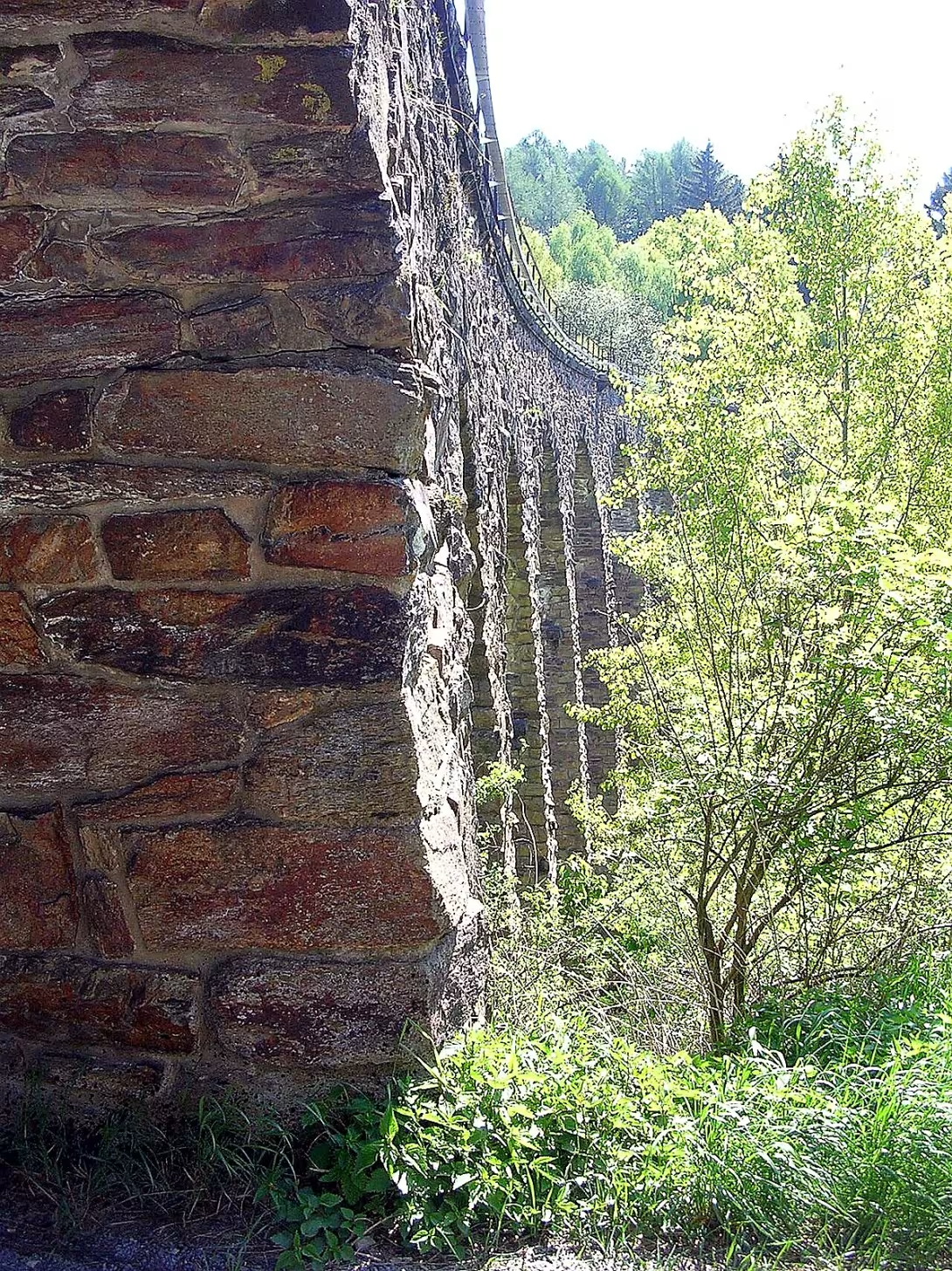
The railway viaduct near Pošné is a stone building from the years 1886-1888 which surpasses the valley of Novohradský creek on the track Horní Cerkra - Tábor. This technically important bridge in the Pelhřimov district is one of the three viaducts on the fifth section of the transverse track. It represents a proof of the development of railway infrastructure in the Czech countries at the end of the 19th century.
The construction took place between 1886 and 1888 in the construction of the line between Upper Cerkví and Tábor. The implementation of the fifth section of the transverse, including the Leskovice - Pacov route, was ensured by E. Ronchetti & Rentmeister. At that time, Austria-Hungary intensively developed the railway network and commonly used stone structures to overcome difficult terrain.
The bridge consists of eleven semicircular arches encircled on four-sided conical pillars of quarry stone. The entire object is built in a mild arch. The exception is the north side above the road where the vault is segment. The visual design of the building is completed by a parapet ledge made of barefoot sandstone blocks.
From the point of view of monument protection the object underwent a complex development. It was registered as a cultural monument in 1958-1987, although it was not registered. In 1988 there was an official entry in the list of cultural monuments of the Czech Republic, which was later cancelled due to procedural errors.
Viaduct is located in the railway kilometre 37,779 on the cadastral territory of the municipalities of Důl, Nová Ves and Pošná. In 2019, the construction underwent a repair that ensured its continued operation. Under the bridge leads a blue tourist route connecting the village of Důl and its part Nová Ves with Pacov.
This construction represents a valuable example of 19th century civil engineering, which still performs its original function after more than a hundred years. Visiting the place offers the opportunity to explore the technical monument in the authentic environment of the Noohradský creek valley.
Then and now
Drag the slider to compare how the landmark may have looked when it was built with the view today.
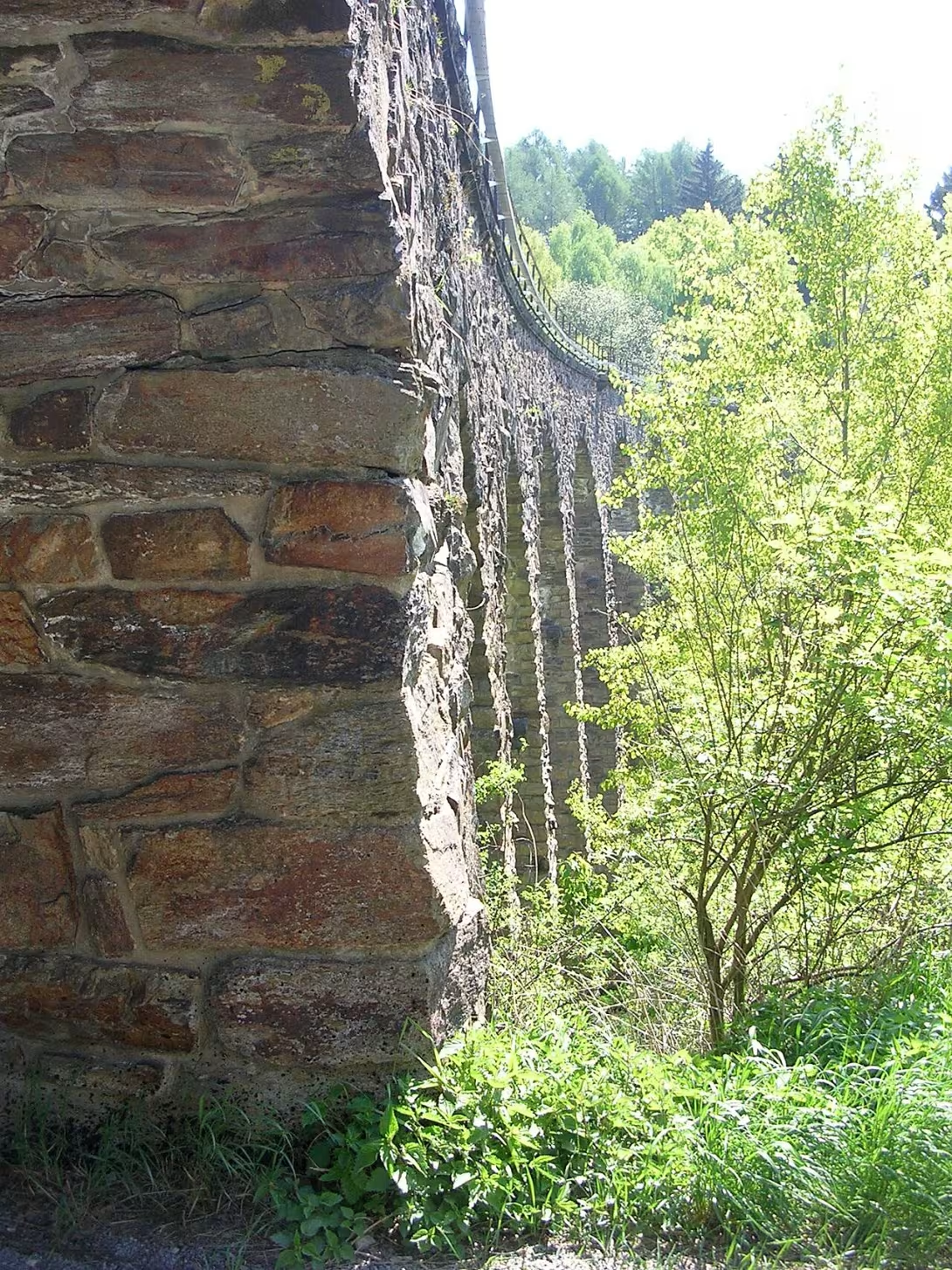
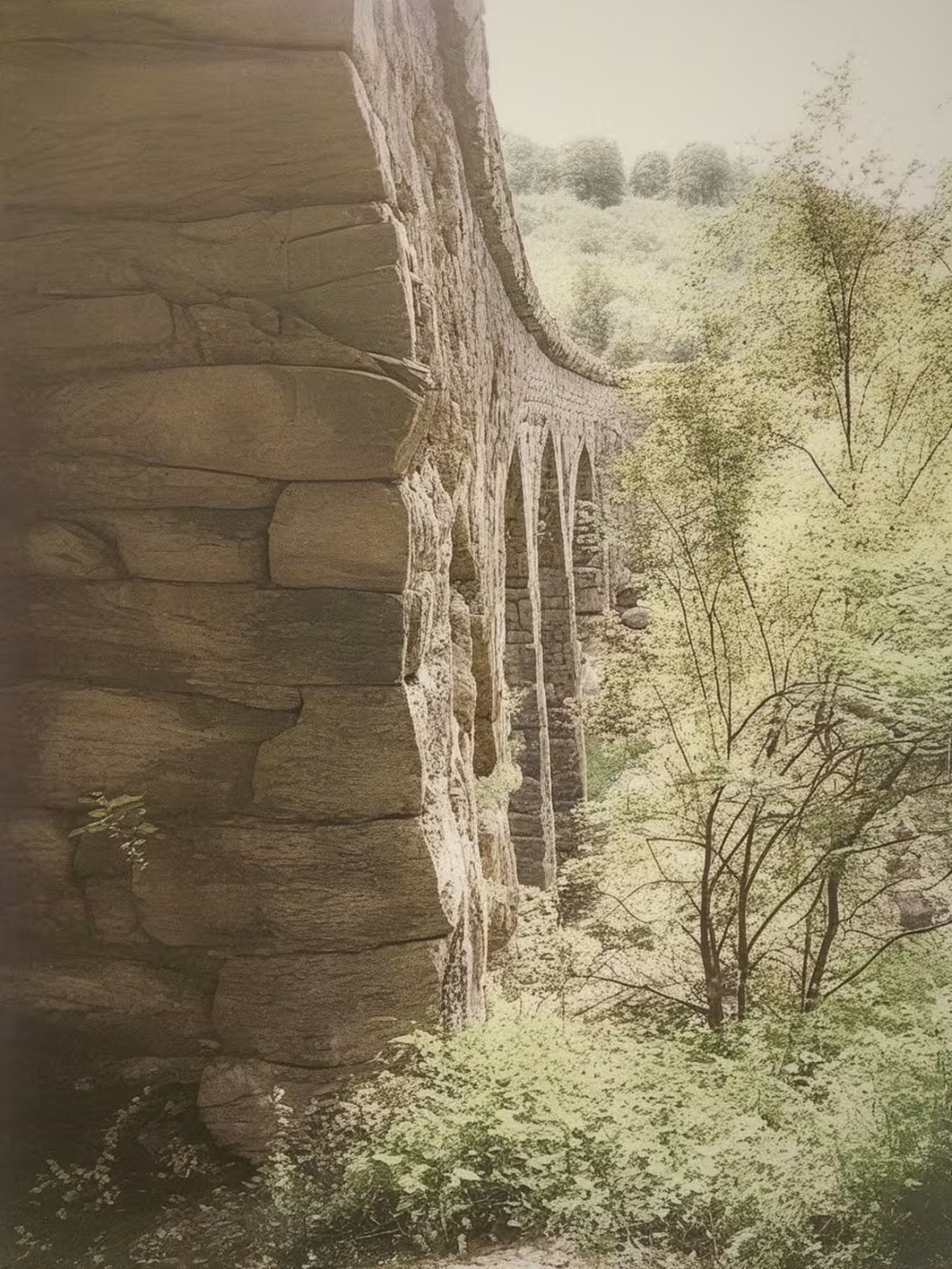
The historical appearance on the left is an AI-generated visualisation and serves as inspiration only.
Historical milestones
- 1888
- Completion of railway bridge construction.
- 1988
- Registration of the bridge as cultural monuments of the Czech Republic.
- 2019
- Repair of bridge structure.
Architectural development
The bridge is built in a slightly curved arch of quarry stone. The northern part above the road uses a segment arch while the rest consists of semi-circular arches. The parapet ledge is composed of barefoot sandstone blocks.
Historical events
In 1958-1987 the bridge was registered as a cultural monument, it was registered in 1988, but the registration was later cancelled due to procedural errors.
Points of interest
- The stone building from the years eighteen hundred eighty six to eighteen hundred eighty eight surpasses the valley of Novohradsky creek on the track between Horní Cerkví and Tábor. - The bridge consists of eleven half-circle arches encircled on four-sided conical pillars of quarry stone. - The object is built in a mild arch, the exception being the north side of the road above the segment vault. - The visual design of the construction is completed by a parapet ledge from barefoot sandstone blocks. - In the year two thousand nineteen, the construction went through a repair that ensured its continued operation.
Guide
Show guide text
This text was created by artificial intelligence and has not been editorially reviewed. It may contain inaccuracies.
Welcome to the railway viaduct Pošná, a unique stone construction, which with fame surpasses the valley of Novohradský creek. You are now facing a massive construction whose semicircular arches appear to be the embodiment of the courage and artistic skill that characterized the late nineteenth century. Look up at these unique arches, whose symmetry is enriched by conical pillars of quarry stone that have endured time and weather effects.
This bridge was built between 1886 and 1888, as part of the fifth section of the transverse track, which connected Upper Cerkva with Tábor. It was a time period when the railway network was rapidly expanding in the Czech Republic, which contributed to the country's communication and economy. E. Ronchetti & Rentmeister was responsible for implementing this project, which became a significant part of local infrastructure.
Architecture of the viaduct It is a real proof of technical progress at that time. Note the individual semicircular arcs whose shape and structure are not only aesthetically attractive but also functional. These arches get on four-sided conical pillars made of quarry stone, which deliver the whole structure of rugged and elegant. It's a masterpiece that illustrates the ability of the builders of that time.
Although no specific personalities associated with its creation are known, the viaduct represents the success of many anonymous workers and engineers whose work has left a permanent mark on the landscape. It is a monument not only to technical progress, but also to human efforts and achievements.
The interesting thing is that this bridge was officially registered as a cultural monument of the Czech Republic in 1988. This move underlines its historical and architectural value and reminds us how important it is to maintain such places for future generations.
Now let's look at the repairs made in 2019. These modifications ensure that the viaduct remains not only a monument to the past, but also a functional element of the current infrastructure. This is an example of how modern technology and respect for history can be combined to preserve the heritage.
Let's move closer and look at the details of the stone structure. Notice how each arch and pillar tells its own story about the skill and care of builders. The atmosphere of the place won't let them miss the sense of respect for the past.
Let this bridge be inspired, for each of us can find inspiration in its history and architecture for our own travels. If you have time, explore the area and enjoy the other natural beauty of this area.
Thank you for your visit to the railway viaduct Pošná. We hope your stay here was fruitful and inspiring. May the story of this place accompany you on other journeys.
Tips for visitors
The best time to visit is during the golden watch before sunset, when the warm light beautifully depicts the structure of the stone masonry viaduct. We recommend a spring or autumn period when vegetation in the valley of the creek is not so dense and allows a better view of the whole bridge construction. It is ideal for photographers to take a position in the valley under the bridge, from where its majestic arch architecture stands out in contrast to the surrounding nature. Don't forget to wear fixed shoes suitable for the field, as the surroundings of the creek can be soaked after rain. In the vicinity you can visit the village of Pošná, the town of Pacov or explore the picturesque valley of Novohradský and Kejtovský creek, which offer quiet places to relax in nature.
Frequently asked questions
Can the monument be visited?
This is a structure in a public space that can usually be seen from outside free of charge. We have not verified that this particular one is freely accessible.
Why is the monument protected?
It is listed in the Central List of Cultural Monuments of the Czech Republic as a cultural monument (register no. 1000138926).
Businesses nearby
Do you run a restaurant, accommodation, shop, museum, rental, wellness or other visitor service near this monument? Show yourself directly to the people heading to it — this is how they will see you in the app and on the web:
Nearby
V blízkosti se nachází obec Pošná, město Pacov a údolí Novohradského a Kejtovského potoka.
Accommodation nearby
Themed route
Thematic cruise route around the railway viaduct Pošná
1. Railway viaduct Soft (bridge) - Type: Historical construction - Why is it worth a visit: The Viaduct is an impressive example of railway architecture from the beginning of the 20th century, which connects the valley of Novohradský and Kejtovský creek. Its history and technical design make it an exceptional monument for railway lovers and architects.
2. Municipality - Type: Local municipality - Why is it worth a visit: The village offers the opportunity to explore local culture and history, with opportunities to meet older people who can share interesting anecdotes about the region. Besides, it's the perfect place to relax after visiting the viaduct.
3. City of Pacov - Type: Historical city - Why is it worth visiting: Pacov, located near Pošná, is famous for its history and architecture. The city centre with its streets offers opportunities for walking and exploring local shops and restaurants.
4. The Valley of the Neo Hrady Creek - Type: Natural environment - Why is it worth visiting: The valley is an ideal place for a short walk or picnic. Its natural beauty and peaceful character offer a shelter from modern life where you can enjoy views of the stream and surrounding landscape.
5. Keitovsky creek valley - Type: Natural environment - Why is it worth a visit: Like the Valley of Novohradsky, this valley offers opportunities for relaxation and entertainment in nature. Its quiet environment is suitable for family trips or meditation itself.
This route allows visitors to know the historical and natural beauty of the region around the railway viaduct Pošná.
Seasonal recommendations
Spring: During the spring season železniční viadukt Pošná lights up with sunlight, which particularly emphasizes its architectural beauty. Flowers around the bridge begin to bloom and bring freshness and colour to the surroundings. The atmosphere is calm, which allows a carefree view of the sights. We recommend visiting the viaduct in the early afternoon, when the sun is higher and shining directly on the bridge. Put on a suitable suit because the temperature can be medium, but in the morning and evening you can meet with cooler air.
Summer: In summer železniční viadukt Pošná is lit by bright sunlight, which increases its visual attractiveness. Nature is in full power and surrounds the bridge with thick greenery. The atmosphere is warm and lively, ideal for long walks along the waterfront. The best time to visit is in the early afternoon or evening to avoid the hottest hours of the day. We recommend clothes suitable for warm weather and do not miss sun protection.
Autumn: In autumn, the viaduct of the Poho Melancholic appearance takes place when the leaves of falling trees colour the surrounding area in various shades of yellow and red. The sun is less intense and shines longer, allowing long walks in pleasant sunlight. The atmosphere is calm with mild temperatures that are ideal for outdoor activities. The best time to visit is at noon when you look at the bridge in the sunlight and you can enjoy a mild temperature. We recommend clothes suitable for mild cold weather.
Winter: In winter železniční viadukt Pošná is lit by a weak sunlight, which creates a less dramatic atmosphere. Nature is shot by snow or ice and the bridge is transformed into a winter piece of art. The atmosphere is calm, with mild crowds of visitors. The best time to visit is at noon when the most sun and shine longer. We recommend clothes suitable for colder temperatures and wind protection.
Visualizations and artistic views


The visualisations are generated by artificial intelligence and serve as inspiration.
Photos from the area
Real photos taken near the monument


Zdroj a licence jsou uvedeny u každého snímku.
Tips from visitors
No tips yet. Be the first!
Log in and add your tip.
Sources and literature
Photos: cs:ŠJů / CC BY-SA 3.0 — Wikimedia Commons. The author and licence also appear when you hover over the image.
Faktickým podkladem tohoto textu byl článek na Wikipedii, jehož autory jsou přispěvatelé Wikipedie. Článek je dostupný pod licencí CC BY-SA 4.0.
Location on the map

Příběhy a pověsti
Legendy, pověsti a příběhy spjaté s touto památkou

Fotografie návštěvníků
Zatím žádné fotografie. Buďte první, kdo přidá fotografii z návštěvy!
Log in a přidejte svou fotografii nebo hodnoťte.
Za ověřenou návštěvu v aplikaci získáte víc bodů — poznáme podle GPS, že jste na místě.
Reviews and comments