



železniční viadukt v Uhříněvsi Railway bridge
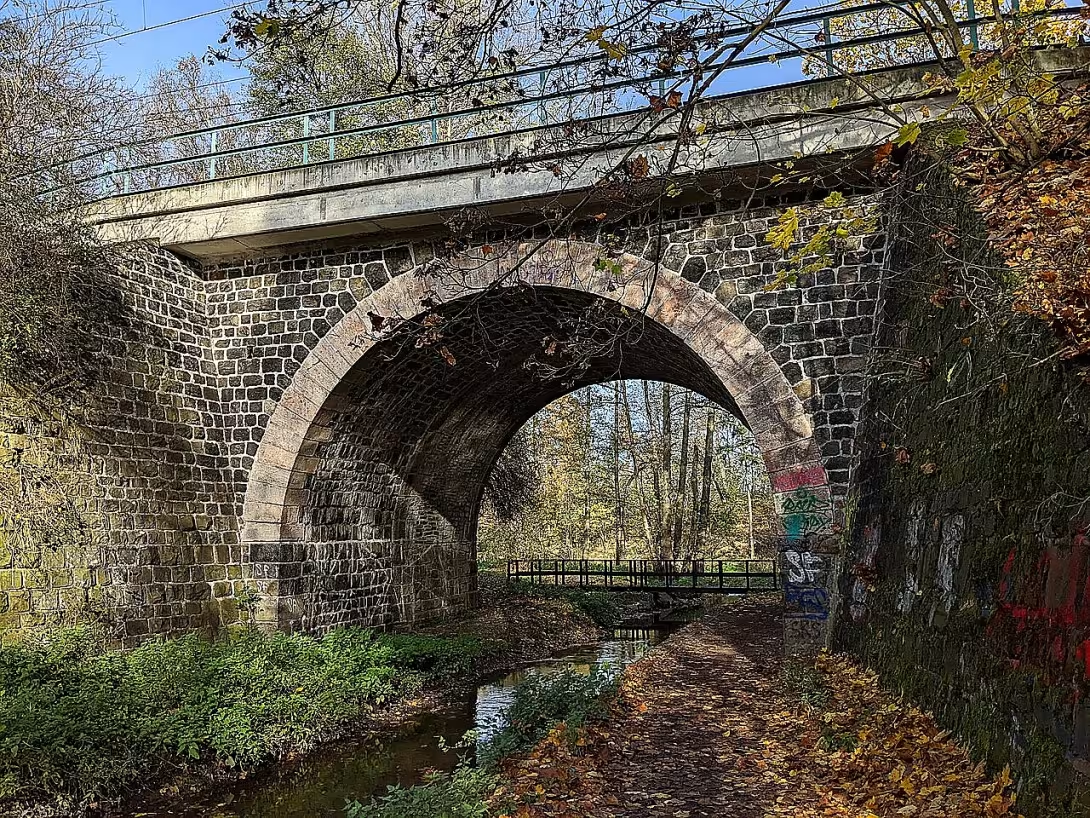
The railway viaduct in Uhraniv is a bridge built on the line Prague - České Budějovice, which crosses the Roman stream near the Vodice pond. Viaduct was built in 1872 as part of the Railway of emperor Franz Joseph from Prague to Vienna and since 2009 is protected as a real cultural monument of the Czech Republic.
The creation of the viaduct was linked to the development of the railway network in Austria-Hungary, which was key to economic and industrial growth. The Viaduct contributed to a better link between the region and the capital and other European destinations. This bridge was an essential part of the infrastructure development of the time.
The architecture of the viaduct is characterized by its building elements and materials. The original northern part is built of quarry stone, with corners decorated with sandstone blocks and arches composed of flat low blocks. The prune ledge above this section adds an elegant finish structure. The southern extension, which extended the original single-track line to a double-track line, is lined with blocks and arches of slivenec marble, which adds a viaduct of significant aesthetic value. This combination of materials and techniques points to a time when construction was influenced by both functionality and artistic expression.
The history of the viaduct includes key events such as its position in 1872 and the extension of the second track by the end of the 19th century. These changes were due to the growth of rail transport and the need to increase track capacity. Viaduct became not only a technical monument but also a cultural monument when in 2009 it was officially recognised as a real-estate cultural monument of the Czech Republic.
Today the viaduct is accessible and is worth visiting not only for its historical value but also for artistic representation. Its architecture reflects the time of its creation and is proof of the technological and aesthetic standards of the 19th century. The Viaduct is not only part of the railway infrastructure but also the cultural heritage of the region.
The importance of the viaduct lies in its historical and architectural legacy. This is a reminder of the time when railways have changed the way they travel and trade, and have become a key part of modernising society. Today the Viaduct is not only a monument to the past, but also a place that attracts visitors with its beauty and historical significance.
This monument offers a unique opportunity to explore the important period of Czech history and appreciate the artistic representation that stands behind recognition. Viaduct in UHřinev is therefore not only a technical success but also a cultural heritage that deserves attention and care.
Historical milestones
- 2009
- Viaduct was registered as a real-estate cultural monument of the Czech Republic.
Architectural development
The original northern part of the viaduct is made of quarry stone and sandstone blocks, with arches composed of flat low blocks. The southern extension extended the line to a two-track line and is lined with slivenecan marble.
Historical events
- 1872
- The position of the viaduct in building the railway of emperor Franz Joseph.
- 1890
- The extension of the viaduct to track two.
Points of interest
- The Viaduct was built in 1872 as part of the railway line between Prague and Vienna. - Since 2009 it has been protected as a real-estate cultural monument of the Czech Republic. - The architecture of the viaduct combines quarry stone, sandstone and slivenec marble. - The Viaduct was extended by the second track in the late 19th century due to the growth of rail transport. - The Viaduct represents an important historical and architectural legacy that reflects the modernisation of the company in the 19th century.
Guide
Show guide text
This text was created by artificial intelligence and has not been editorially reviewed. It may contain inaccuracies.
Welcome to this incredible stone work. You're standing in front of one of the most important building elements in the whole area. In front of your eyes now stands the mighty železniční viadukt v Uhříněvsi. It is a monumental structure that soothes with confidence and strength above the riverbank. You may have already noticed how this massive entity seems to be almost part of the landscape itself, although its human creation is quite obvious. It is a look that must immediately impress you with its unwavering stability and its enormous size. Feel this atmosphere of a place where human ingenuity, technical art and the untamed force of nature meet. This bridge is not just a simple path for trains, it is a living witness to many years of history, standing here and watching the changing world around it. Look at the length, the width, and how this whole harmoniously fits into the surrounding terrain. It is a work that was created with a clear purpose - to last centuries and serve people regardless of the time that passes.
Let us now move further into the past together and try to understand how this bridge came into being and why it is here. To fully understand its meaning, we must return together to the deep last century. 1872 was a crucial year for the creation of this building. That is when the construction started to be implemented, which had a major impact on the transport and integration of people throughout this part of the country. This viaduct was not only built as a local road, but it was an absolutely crucial point on the large railway track that connected our capital city of Prague to the capital of the then empire, namely Vienna. This entire route was known as the railway of emperor Franz Joseph. Imagine the era when the railroad became the greatest symbol of incredible progress and modern times. So this bridge was part of a huge and ambitious project that changed the face of the country and made it easier for people to travel faster and easier than ever. It was a period when the world began to accelerate and this viaduct was one of the engines of this motion.
Now pay attention to what you see right in front of you when you look at the structure and material of this building itself. The architecture of this viaduct is truly fascinating and shows the incredible championship of the then builders and stonemakers. Now if you look closer to the surface of these stone blocks, you will see a very rich and diverse mixture of materials that were used to create it. The main part of the whole construction consists of a solid and robust quarry stone, which gives the whole unquestionable stability and a sense of resilience. In its rough and strong structure, however, you can see other, finer types of stoneware. The sandstone is used here, which gives the surface a specific texture and colour, as well as a rare slivenec marble. This combination of different types of stone is not only a question of aesthetics, but it creates a very rich visual experience that changes depending on how light hits it at different hours of the day. Notice how these different materials intersect and create the unique character of this building. It's a fascinating example of how people at the time were able to combine pure functionality with beauty and durability. It is also important to know that this bridge has not always been as wide as you see it now. At the end of the nineteenth century, this work had to be expanded to add a second track. This adjustment was absolutely necessary due to increasing traffic and the needs of the time when rail transport became an increasingly important part of life.
Unfortunately, although we do not know the specific names of architects who designed this magnificent project, nor the names of individual masters who worked the stones, their work here is evident in every detail. Even though we do not have the names of the great personalities that would be directly associated with this place, you can still imagine thousands of people involved in its creation. Each stone carved, each clutch and each layer of material bears a trace of human labor, sweat and determination. It's a monumental monument to human efforts to overcome obstacles.
You may find one very important thing that makes this viaduct even more extraordinary and gives it a new level of importance. It's not just the old railway bridge, it's the protected treasure of our history. Since 2009 this viaduct has been officially registered as a real-estate cultural monument of the Czech Republic. This means that its value is not only practical or technical, but it is a high cultural value. It is part of our common heritage, which we have a duty to protect and preserve for all future generations. It's proof of how important these stone giants are to our history and our identity as a nation.
Now we're slowly saying goodbye. I hope this short tour has helped you better understand the depth and importance of this place and that you enjoyed a look at this amazing piece of history. Don't forget to look around you again, observe nature around the Greek creek and soak up the atmosphere of this place. I wish you a wonderful further journey and enjoy the rest of your day while researching the surroundings.
Tips for visitors
The best time to visit the railway viaduct in UHřinev is autumn or spring when nature is around in a special flower and light is ideal for photography. The view of the bridge from the Great Vodice pond offers a beautiful view.
You can use cars or public means of transport to access the viaduct.
When visiting, remember the quality camera or mobile phone with good cameras to capture the architectural beauty of the viaduct. Due to its historical importance, the bridge is an interesting photographic location.
There are natural and cultural monuments around the viaduct, which can be visited during the visit. Big Vodice pond is an ideal place for relaxation or picnic. For families with children, an interesting activity can be to explore the natural environment and observe wildlife.
Frequently asked questions
Can the monument be visited?
This is a structure in a public space that can usually be seen from outside free of charge. We have not verified that this particular one is freely accessible.
Where is the monument?
Location: Uhříněves. The map on this page shows the exact spot.
Why is the monument protected?
It is listed in the Central List of Cultural Monuments of the Czech Republic as a cultural monument (register no. 1129799183).
Businesses nearby
Do you run a restaurant, accommodation, shop, museum, rental, wellness or other visitor service near this monument? Show yourself directly to the people heading to it — this is how they will see you in the app and on the web:
Events nearby
Zdroj akcí: otevřená data měst a obcí ČR (Národní katalog otevřených dat) a kalendář akcí Národního památkového ústavu.
Nearby
Viadukt se nachází u rybníka Velká Vodice a je součástí přírodního a kulturního okolí obce Uhříněves.
Accommodation nearby
Trips and activities nearby
Guided tours, tickets and activities nearby from GetYourGuide
Affiliate link: if you buy from the partner, we may receive a commission. The price for you does not change.
Search tours and activities →Themed route
1. Pond Great Vodice, water surface. You can observe a calm surface here and start your journey in nature. 2. Natural and cultural surroundings of the village Uhříněves, landscape whole. This part will guide you through the local environment. 3. Railway viaduct in Uhřinev, technical monument. The main destination of the trip, which will impress you with its extensive structure.
Seasonal recommendations
Spring: In the spring period železniční viadukt v Uhříněvsi is decorated with flowers and new leaves, which adds a colorful atmosphere to the historical construction. Sunshine days take turns with rainy moments, so it is advisable to wear a combination of warm clothes and a cape. The best time to visit is in the morning or in the evening when the sun illuminates the viaduct with fine light, which increases its aesthetic value and the natural beauty of the surrounding forests are in full power.
Summer: For years, the viaduct is surrounded by dense trees that provide a cosy shade. The sunny days offer ideal conditions for a tour, but due to the warm noon sun it is recommended to visit in the morning or evening and wear light clothes. This time of year attracts more visitors, so avoid the main summer days for a calmer experience.
Autumn: In autumn months the viaduct is surrounded by colorful leaves falling trees, creating an attractive and melancholic atmosphere. Sunshine days are shorter, so avoid visiting in cold noon time and you better visit in the morning or early afternoon. Clothes should be warm because autumn air is cold and wet.
Winter: In winter, the viaduct turns into a cozy place with snow on the landscape. The sunny days are short, but the sun illuminates the snow with bright light, which increases the aesthetic value of the object. It is advisable to visit in the morning or evening and wear warm clothes with protective helmets against cold. Despite fewer visitors, it is important to be careful, because snow conditions can make the journey difficult.
Visualizations and artistic views

The visualisations are generated by artificial intelligence and serve as inspiration.
Photos from the area
Real photos taken near the monument


Zdroj a licence jsou uvedeny u každého snímku.
Tips from visitors
No tips yet. Be the first!
Log in and add your tip.
Sources and literature
Photos: MartinVeselka / CC BY-SA 4.0 — Wikimedia Commons. The author and licence also appear when you hover over the image.
Faktickým podkladem tohoto textu byl článek na Wikipedii, jehož autory jsou přispěvatelé Wikipedie. Článek je dostupný pod licencí CC BY-SA 4.0.
Location on the map


Příběhy a pověsti
Legendy, pověsti a příběhy spjaté s touto památkou
Fotografie návštěvníků
Zatím žádné fotografie. Buďte první, kdo přidá fotografii z návštěvy!
Log in a přidejte svou fotografii nebo hodnoťte.
Za ověřenou návštěvu v aplikaci získáte víc bodů — poznáme podle GPS, že jste na místě.
Reviews and comments