



Židovský hřbitov v Kostelci u Křížků Jewish cemetery
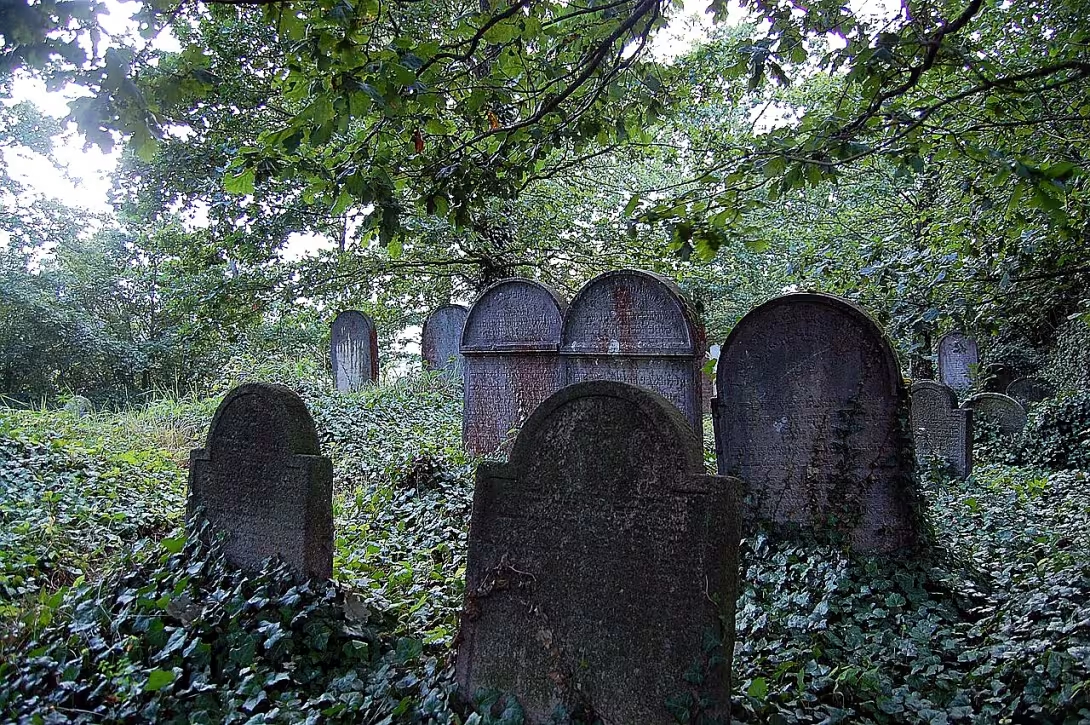
Židovský hřbitov v Kostelci u Křížků is an ancient Baroque monument on the western edge of the village, protected as a cultural monument of the Czech Republic since 2008. It was probably founded in the first half of the 18th century when there was a small but active Jewish community. Its importance lies in the preserved proof of historical Jewish life in the region, including an architecturally interesting site with original tombstones and a dilapidated ceremonial hall. The area is proof of how the Jewish village in Kostelec near the Crožky developed and neglected and how its monuments gradually became part of the cultural heritage.
The creation of the cemetery relates to the development of Baroque architecture in the Czech countries in the first half of the 18th century. At that time, the Jewish community in the region gradually settled, often around larger cities, but also in smaller municipalities like Kostelec u Křížků. The first mention of Jewish families in the village dates back to the end of the 17th century, when several families lived here. The cemetery was founded in 1702, probably used since the end of the 17th century, and served for burial until the 1930s. In the 1880s, its area was extended to 2510 square metres, most of which remained unused.
The cemetery is a typical example of baroque and classical architecture. It is surrounded by an uncompact stone wall that was used to protect graves. On the south side of the complex stands a decrepit ceremonial hall, originally used for religious ceremonies. The oldest preserved tombstone dates back to 1724, reflecting the period of its oldest years. In this context, the Baroque style manifests itself primarily in the shape of tombstones and their decorative elements, which were typical of the Jewish cemetery at the time.
Since 1995 the cemetery has been under the care of the Jewish village in Prague, which takes care of its reconstruction and maintenance work. The main gate is locked, but the entrance to the premises is possible by the southern gate. The owners and landlords thus ensure its preservation and accessibility to the public.
Key events in the history of the cemetery and its surroundings include the creation of the cemetery in 1702, the extension of its area in the 19th century and the demise of the last prayer house in 1846. In 1930, the Jewish community in Kostelec, near the Cross, no longer existed, suggesting its gradual extinction. The eastern part of the cemetery remained unused until the 19th century, when the area of the cemetery was expanded, indicating the gradual expansion of the area as needed.
Today Židovský hřbitov v Kostelci u Křížků is open to the public and is part of the cultural heritage. Its preserved tombstones and architectural elements represent a valuable historical document that reflects the life of the Jewish community in this area. For a visit it is advisable to use the southern goal, which allows access to the premises. The monument is worth visiting especially for its historical and architectural values that capture the life and culture of the Jewish village in the past.
This cemetery is a model of how Jewish heritage monuments in the Czech countries have been preserved and became part of the cultural heritage. His visit offers the opportunity to learn about history and architecture, which are an important part of the regional heritage.
Then and now
Drag the slider to compare how the landmark may have looked when it was built with the view today.
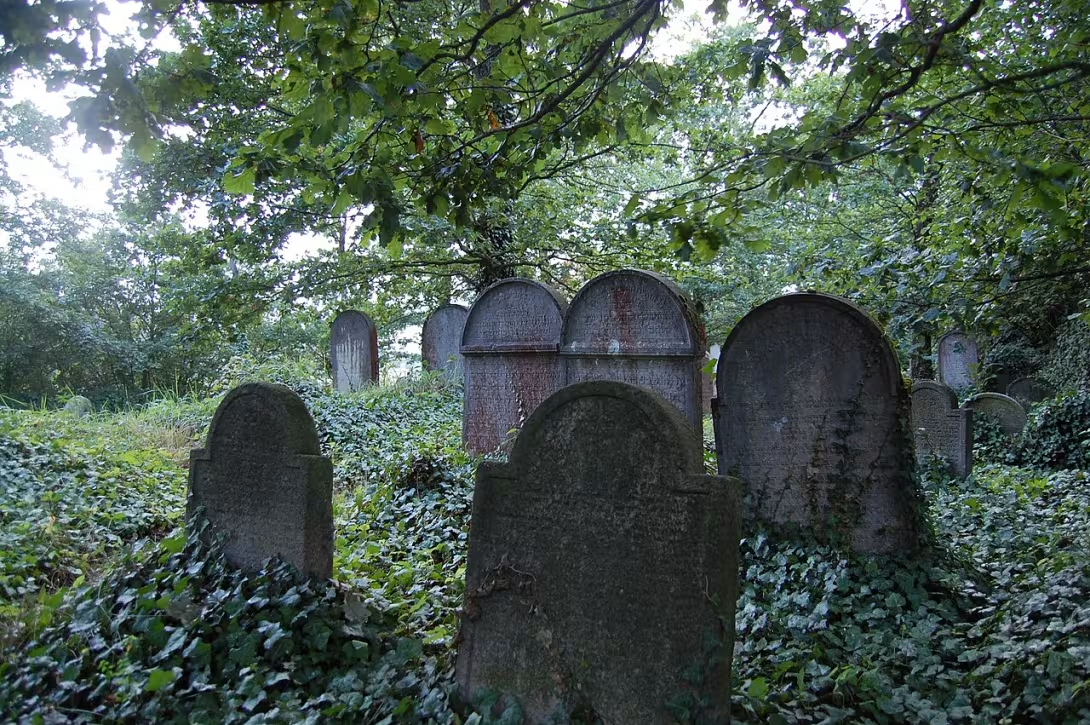

The historical appearance on the left is an AI-generated visualisation and serves as inspiration only.
Historical milestones
- around 1680-1690
- First mention of Jewish families in Kostelec near the Cross, beginning of settlement of the village
- 1702
- The establishment of a Jewish cemetery, probably used since the late 17th century
- 1724
- The oldest preserved tombstone in the cemetery, referring to its active use
- 1846
- The demise of the last ceremonial hall in the cemetery, the end of active religious life
- about 1880
- Extension of the cemetery area to the current 2510 m ², use of the eastern part
- 1930
- The disappearance of the Jewish community in Kostelec, the cemetery no longer used for funerals
Architectural development
The cemetery was built in Baroque style, later the classicist elements were added. The area is surrounded by stone walls made of stone, which was used to protect graves. The ceremonial hall was built in the 18th century and gradually decayed. In the 19th century the cemetery area was expanded, but most of the eastern part remained unused.
Historical events
- 1702
- Establishing a cemetery, probably used since the late 17th century
- 1846
- The demise of the last prayer house of the Jewish community in Kostelec near the Cross
- 1930
- The disappearance of the Jewish community from the village, the last mention of her life
- 2008
- Capture of the cemetery as cultural monuments of the Czech Republic
Owners
Jewish village in Prague (since 1995)
Points of interest
- The Jewish cemetery was founded probably in 1702, used since the end of the 17th century. - The eastern part of the cemetery was extended to 2510 square metres in the 1880s. The oldest preserved tombstone dates back to 1724. The ceremonial hall for religious ceremonies is decrepit and originally baroque. The Jewish village in Kostelec disappeared in 1930.
Guide
Show guide text
This text was created by artificial intelligence and has not been editorially reviewed. It may contain inaccuracies.
Welcome, dear visitors. You are standing in front of an old cemetery area that will charm you with its calm atmosphere and historical foundation. You're surrounded by a flat, slightly disorganized surface surrounded by a stone wall that reminds you of the old border. On the south side there is a slightly decrepit building that used to serve as a place for religious ceremonies. It's a place where centuries and memories meet.
Let's move on to the past. This cemetery was probably founded in the first half of the seventeenth century, but from the end of the sixteenth century, Jewish people could be buried here. In seventy-two, the oldest preserved tombstone was found in this place, which shows us that it was used here. In the 1880s, the cemetery was extended to an area of two thousand fifty square metres, most of which were used in the eastern part. That means the original part was filled long ago.
Now pay attention to the circumstances that enchant you. The stone wall is probably discompact, which can be proof that it was built at a time when there were not such strict rules for building fences. Notice how the tombstones are placed here. Some are tall and decorated, others are simpler, but all are proof that there are people who lived and worked here. On the south side, there is a decrepit ceremonial hall that used to serve religious ceremonies. Her condition is clear, but you can still see how she was built and what her original function was.
The interesting thing is, the oldest tombstone dates back to seventy-two. This shows us that the cemetery was already actively used here at the time. It was extended in the 1880s, which means that new generations of burying families could have been born here. In 86, the last ceremonial hall was destroyed, which means that religious life ended here. In the 1930s, the Jewish community in the village was eradicated, so the cemetery was no longer used for funerals.
The place you're just seeing is witnessing many stories. Here lies the people who lived here, worked and loved. It's a place where their memories meet our current feelings of peace and quiet. If you have time, explore this cemetery in more detail. Look at the individual tombstones, find out who sleeps here and what stories are connected to each of them. This cemetery is not only a historical monument, but also a place where we meet the past and present.
Thank you for your attention and we wish you a walk around this place to bring peace and memories of the past. Let yourself be inspired by his calm and old stories that lie here. Let your walk around this historic place do well and bring you some new knowledge and joy.
Tips for visitors
The visit is best in the period from April to October, when the weather is pleasant and the cemetery is well lit. In winter the place is quieter, but sunny days are less frequent.
In the summer months it is possible to observe flowers and green areas that bring life to the place. The period before and after the holidays when cultural events take place is also appropriate.
The location is available by car from the main road leading from Kostelka near the Cross. There are also cycling trails nearby that connect the cemetery with the surrounding forests.
It is recommended to identify the current connection in advance.
Take with you suitable clothes for weather, quiet shoes and possibly sun protection. It is also useful to have a small daily lunch or tea with you because there are no refreshments in the area. It is good for families with children to carry toys or books to read.
The best places for photography are around tombstones with historical motifs, especially those with carved motifs or texts. It is important to photograph at a time when the light is pleasant, i.e. in the morning or afternoon, when there are fewer shadows.
Photography is permitted, but it is necessary to respect other visitors and do not damage tombstones. It is also appropriate to keep the camera calm and not provoke visitors.
The local museum offers interesting information about the history of this area. There is also the possibility to walk through forest trails, which are suitable for families with children.
In the woods and field roads in the surrounding area you can enjoy walks, cycling trips or picnics. Forests offer a quiet environment and are ideal for families with children who can play and observe nature here.
The cemetery is suitable for short walks, especially for children who can see the tombstones and observe nature. There are forest trails nearby Radlík, which are safe and interesting for children. It is recommended to inform children in advance of the nature of the site in order to realise its historical significance.
Families with children should remember that the cemetery is not a place for long stays. It is recommended to find short but interesting moments for children. It is also convenient to bring small refreshments which children can easily use on a walk.
Frequently asked questions
Can the monument be visited?
Cemeteries and graves are usually accessible; please respect the dignity of the place. We have not verified the opening hours of this cemetery.
Where is the monument?
Location: Kostelec u Křížků, Středočeský kraj. The map on this page shows the exact spot.
Why is the monument protected?
It is listed in the Central List of Cultural Monuments of the Czech Republic as a cultural monument (register no. 1000154434).
Businesses nearby
Do you run a restaurant, accommodation, shop, museum, rental, wellness or other visitor service near this monument? Show yourself directly to the people heading to it — this is how they will see you in the app and on the web:
Events nearby
Zdroj akcí: otevřená data měst a obcí ČR (Národní katalog otevřených dat) a kalendář akcí Národního památkového ústavu.
Nearby
V okolí se nachází přírodní krajina s lesy a polními cestami. V blízkosti se nachází obec Radlík a historické sídliště, ale žádné další významné památky v rámci 5 km.
Accommodation nearby
Trips and activities nearby
Guided tours, tickets and activities nearby from GetYourGuide
Affiliate link: if you buy from the partner, we may receive a commission. The price for you does not change.
Search tours and activities →Themed route
A daily trip to the Jewish cemetery in Kostelec near Křížky * *
1.Židovský hřbitov v Kostelci u Křížků (approximately 0 km) It is worth visiting for its historical value and calm atmosphere. It is an old cemetery with the order of graves and memorable tombstones that tell about the history of the village.
2. Forest trail leading to Radlík (approximately 2 km from the cemetery) Walk the field road between the woods and the fields. Here you can take a careful look at the natural landscape and relax in a quiet place.
3. Historical settlement in Radlík * * (approximately 3 km from the cemetery) Interesting for old houses and preserved architecture. It's a place where you can learn about local traditions.
4. Tanks and surroundings of the Jewish cemetery * * (internal tour) Come and see the surroundings of the cemetery and its surroundings, where there is a small park and a quiet place to relax. Here you can also observe old trees and green areas that provide a place of comfort and silence.
Seasonal recommendations
Spring In the spring months Židovský hřbitov v Kostelci u Křížků awakens to life after winter peace. The sun illuminates the tombstones with a fine, scattered light that creates shadows on the stones with fine edges. Nature is awakening - spring flowers are blooming, birds are echoing in the woods and the air is saturated with moisture. The atmosphere is calm but not empty; The cemetery feels a fine transformation, as if a new hope is being remembered. In this period, the cemetery is often visited by families that remind their ancestors. I recommend visiting the cemetery in the first half of spring, when the temperature is pleasant and the crowds are still not disturbed. It's convenient to wear light, but headgear, because dust can accumulate on rocks. If you want to escape the crowds, go to the cemetery early in the morning or late in the afternoon.
Summer In the summer months, the Jewish cemetery will turn into a place that attracts not only historians but also tourists. The sun shines intensely here, the shadows are short, and the tombstones shine under bright celestial light. Nature is lush - trees are green, grass is high and air is full of insects. The atmosphere is lively, but also sometimes busy, because the cemetery is a popular destination for tourists. In the main summer season, there are groups of people who are looking at the memory. I recommend visiting the cemetery early in the morning, when it is still quiet, or in the late afternoon, when the crowds disperse. It is convenient to wear light but protective clothing because the sun here can be very strong. Don't forget enough water and a hat to protect yourself from direct sunlight.
Autumn Autumn at the Jewish cemetery in Kostelec near the Cross creates a unique atmosphere. Leaves on trees are colored in yellow, orange and red shades, which are reflected on the stones of tombstones. The sun shines lower, the shadows are longer and the light has a golden touch. The air is cold, but pleasant, and the cemetery feels quiet and quiet. Nature reminds us here that time is running out, which goes with the atmosphere of this place. In this period, the cemetery is visited by fewer crowds, allowing a peaceful walk. I recommend visiting the cemetery in September or early October when the weather is stable and nature is not yet completely covered with snow. It is convenient to wear a lighter jacket and hat to protect yourself from the cold wind. If you want to experience the most beautiful autumn colors, go to the cemetery in the morning when the light is the softest.
Winter The winter visit to the Jewish cemetery in Kostelec near the Cross is a unique experience. The snow blanket on the tombstones and around it creates a calm, cold atmosphere. The sun shines in a low angle, the shadows are long, and the light is pale, silver. Nature is covered with a white cloak that gives the place mysterious beauty. The air is cold and clean, and in the cemetery it feels quiet, which is interrupted only by the rustling of snow. In winter months, the cemetery is visited by fewer people, allowing for a peaceful walk. I recommend visiting the cemetery in December or January, when the snow cover is the most beautiful. It is advisable to wear warm clothes, hat and gloves to protect yourself from cold. If you want to experience the most beautiful winter scenery, go to the cemetery in the morning, when the light is the softest and snow blanket the most beautiful.
Visualizations and artistic views


The visualisations are generated by artificial intelligence and serve as inspiration.
Photos from the area
Real photos taken near the monument


Zdroj a licence jsou uvedeny u každého snímku.
Tips from visitors
No tips yet. Be the first!
Log in and add your tip.
Sources and literature
Photos: Radovan Zítko / CC BY-SA 3.0 — Wikimedia Commons. The author and licence also appear when you hover over the image.
Faktickým podkladem tohoto textu byl článek na Wikipedii, jehož autory jsou přispěvatelé Wikipedie. Článek je dostupný pod licencí CC BY-SA 4.0.
Location on the map
More monuments – Kostelec u Křížků
Show all in the municipality




Příběhy a pověsti
Legendy, pověsti a příběhy spjaté s touto památkou
Fotografie návštěvníků
Zatím žádné fotografie. Buďte první, kdo přidá fotografii z návštěvy!
Log in a přidejte svou fotografii nebo hodnoťte.
Za ověřenou návštěvu v aplikaci získáte víc bodů — poznáme podle GPS, že jste na místě.
Reviews and comments