



Židovský hřbitov ve Vamberku Jewish cemetery
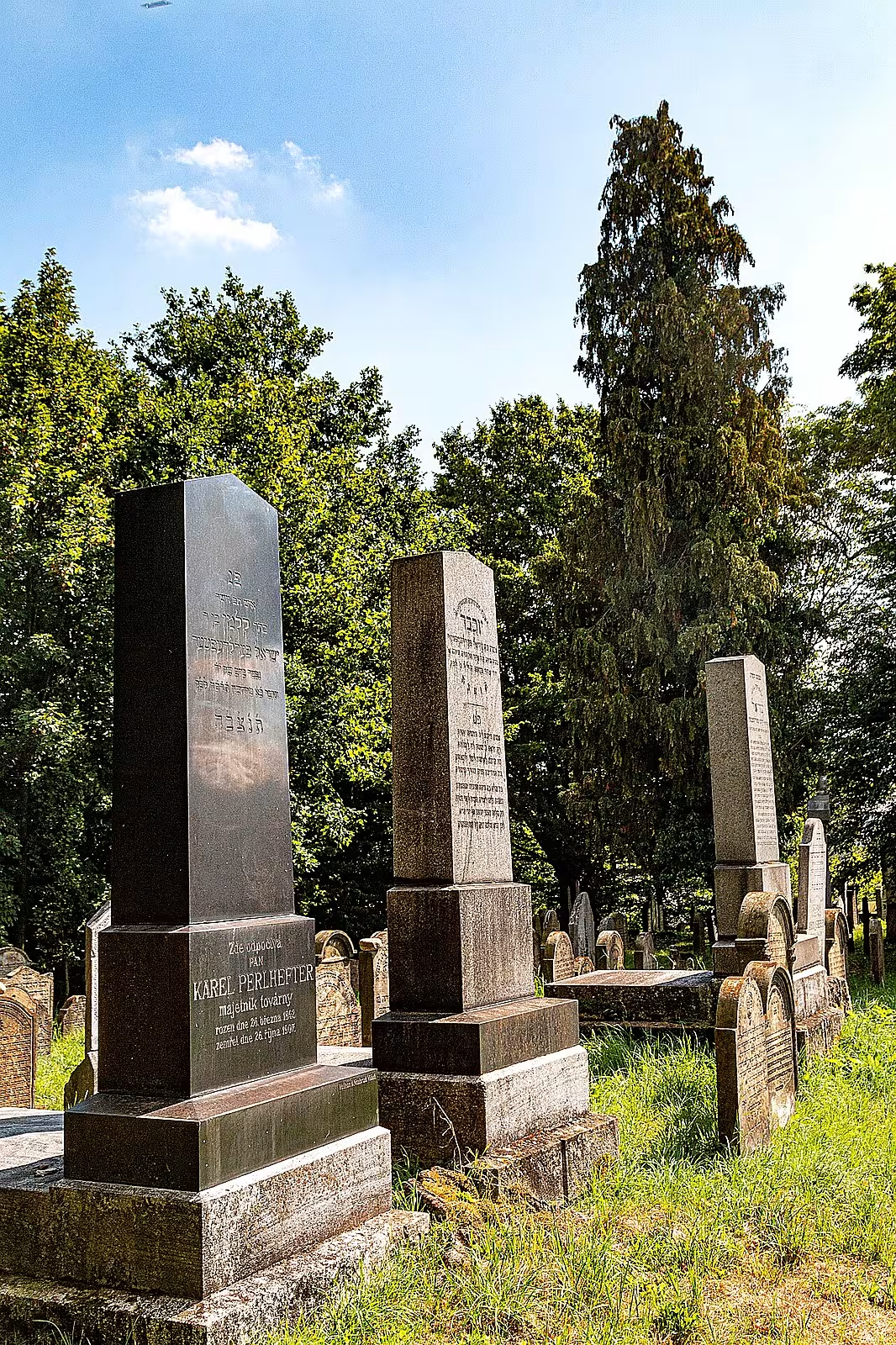
Židovský hřbitov ve Vamberku is an important historical monument located in the northern part of the village in Vrabcov Street. It was probably founded in the 17th century, the first written mention dates back to 1688. It belonged to the Jewish religious community in Doudleby nad Orlicí, where it served as a burial place for Jews from the vicinity of Doudleb and Rychnov nad Knežně until World War II. Its importance lies in preserving historical tombstone art and documentation of the life of the Jewish community in the region.
The cemetery was established in connection with urbanisation processes in the 17th century, when Baroque and classical style tendencies developed. The Jews were looking for solid places for their funerals, often close to city centers. Vamberk was, in this sense, a typical example where the Jewish community accumulated.
The architecture of the cemetery reflects Baroque and classical style. The area is irregular, divided by a stream, which in the past caused damage to the floods. The main part is surrounded by a wall which was extended between 1753 and 1806. In 1820, the Jewish community bought another plot of land, which was subsequently branded. The tombstones are made of stone and decorated with inscriptions in Hebrew, German and Czech. The oldest preserved tombstone dates back to 1700.
In the past, the cemetery was managed by the Jewish religious community in Doudleby nad Orlicí, later taken over by the Prague Jewish community. In the 20th century, the construction of the adjacent heating plant caused damage in particular. In the 1990s, repairs were carried out, including the repair of the wall and the setting of the destroyed tombstones, but the morgue remained damaged.
Today, the cemetery is freely accessible. The entrance is possible from the east wall through the passageway or the road. The administration of the cemetery is in the care of the Prague Jewish village, which ensures its maintenance. The main attractions are Baroque and Classicist tombstones with inscriptions from 1700 to 1940, which capture the life of the Jewish community in the region.
This cemetery is not only a historical monument, but also a demonstration of long-term efforts to preserve the Jewish heritage. His visit offers an opportunity to see the past of the region and understand how the Jewish community developed and how it manifested itself in architecture and funeral ceremonies. It's a place worth visiting for anyone interested in history and cultural heritage.
Historical milestones
- around 1688
- First written mention of the establishment of the Jewish cemetery in Vamberk
- 1700
- The oldest preserved tombstone in the cemetery
- 1753
- Enlargement of the wall in the cemetery
- 1806
- Further extension of the wall
- 1820
- Jewish village in Doudleby bought another plot to expand the cemetery
- around 1940
- Last preserved tombstones before Nazi occupation
- before 1945
- The cemetery served as a burial place for Jews from the vicinity of Doudleb and Rychnov over the Priest
- after 1945
- The beginning of the destruction of tombstones and the damage to the cemetery (due to the construction of the heating plant)
- end of the 20th century
- Reparations of the fenced wall and restoration of destroyed tombstones
Architectural development
The cemetery was created as a Baroque and later a classicist complex with irregular ground plan. It originated from the original land divided by a stream that caused damage to the floods. The materials for the construction included stone tombstones with inscriptions in Hebrew, German and Czech. In the 20th century, the damage was caused by the heating plant and subsequently repairs were carried out in the 1990s.
Historical events
- 1673
- Likely year of cemetery, previous written mention from 1688
- 1753
- First written mention of the expansion of the cemetery
- 1806
- Further expansion of the cemetery
- 1820
- Buy more parts of the property and wall fencing
Owners
Jewish religious community in Doudleby nad Orlicí (direct care from Prague Jewish community)
Points of interest
- It is located in the northern part of the village of Vrabcov Street. - The first written mention dates back to 1688. - The main part of the cemetery was covered in 1753 and 1806. The oldest preserved tombstone dates back to 1700. - In the 1990s, the damaged parts were repaired.
Guide
Show guide text
This text was created by artificial intelligence and has not been editorially reviewed. It may contain inaccuracies.
Welcome to a place that has a hard history and is also a quiet hiding place for the monument. You are standing in front of a Jewish cemetery in Vamberk - a place where past and silence meet, where people treated their loved ones over 300 years ago. Take a look at the surrounding area: a plot of the old wall that separates this space from normal life is situated in front of you. Notice how the shadows of the trees with stone monuments take place here, reflecting the history of the people who came here with respect and respect.
Let's see how this cemetery came into being. The first written mention of it dates back to 1688, but probably was founded five years earlier, in 1673. It was intended for Jews from the surroundings, especially from Doudleb nad Orlicí and Rychnov nad Priest. By the time they treated their deceased here, this cemetery was one of the few places where they could have peace and privacy. Over the years, however, the needs grew - in 1753 and then again in 1806, the fenced wall was expanded to receive more tombstones. In 1820, the Jewish village in Doudleby then bought another land, which was also built. This shows how important he was to the community.
Now pay attention to what you see before you. The cemetery is surrounded by a wall that separates this space from the outside world. The oldest preserved tombstone has been standing here since 1700, which is proof that they have been treating their deceased since the beginning. The stone slabs you find here are witnessing the lives of people who came here with respect and respect. Some of them are damaged, but they still emit a certain atmosphere that attracts you. See how they are arranged - mostly by date of death, but also by family relations.
The key stories of this place are linked to the people who were buried here. The Jewish community in Vamberk and its surroundings was part of the wider Jewish life in Bohemia, which was rich in traditions and customs. Even though we don't know the names of many of those who came here, we can imagine what it was like for their families. Every tombstone is like a little story-- someone was buried here as a child, someone as an adult, and each of them had their own life. These stories are part of the history of Vamberk and the whole region.
The interesting thing is that in the 1990s, the damaged parts of the cemetery were repaired. This showed that even after a long time of oblivion they still cared about this place. The repairs helped preserve the memory for future generations. Note how old and new elements take turns - this is proof that monuments can be restored and preserved.
The last thing we want to stress is that this cemetery is a place of peace and respect. It's where the past and the present meet. If you have the chance, stay here for a while and breathe in the atmosphere. You can imagine what it was like for people who came here with respect and respect.
If you like this cemetery, it is certainly worth looking into other parts of Vamberk. The city has a rich history that is reflected in other monuments. If you're going on another journey, don't forget to take some of the peace and respect you've taken here. Thank you for stopping by this place and bringing him your attention. When I see you on the next road.
Tips for visitors
It is convenient to visit a monument between May and September, when the weather is pleasant and nature in the surroundings is in full strength. The cemetery is quieter in winter, but the possibilities for photography are more limited due to snow and frost. It is also recommended to visit in the morning when light is softer and visitors are less numerous.
The monument is located in the village Vamberk, which is a small residence. In the vicinity of Vamberk there is also the possibility to use public transport, but you can find out the exact connection in advance on local information or in the search engine.
It is advisable to bring comfortable clothes to visit, because the terrain can sometimes be steep and wet. We also recommend bringing a guide or a small map guide, as some parts of the cemetery may be difficult to access. It is useful for photography to have enough batteries and memory cards. It is also convenient to take a small water bottle, because there are only small water streams in the area that may not always be available.
The middle part of the cemetery with the oldest tombstones, which are often located in the centre and are well visible.
The edge of the cemetery, where there are often smaller but interesting tombstones and monuments.
Preview places where monuments or commemorative plates are found, which are often located on the height.
It is best to photograph in the morning or afternoon hours when light is softer and less shadows. Avoid the middle day, when it can be too sunny and shadows marked. In winter, photography is more difficult due to reduced light and snow.
Historical town of Rychnov nad Knežnou
In the vicinity there is an important historical city that offers many sights. The most important one is the castle of Rychnov with its rich history and the church of St. John Nepomuk, which is famous for its architectural details and historical monuments.
Natural landscape with forests and water streams
The surrounding area is a beautiful natural landscape with dense forests and small water flows. It is ideal for walking and exploring nature. Some sections are also suitable for families with children who can enjoy a pleasant surroundings.
For families with children it is advisable to visit the cemetery in the morning when there are fewer visitors and children can better see the surroundings. Near Vamberk is a natural landscape with forests where children can play and explore nature. It is also recommended to visit the historical town of Rychnov nad Knežnou, where there are interesting exhibitions and possibilities for various activities for children.
Frequently asked questions
Can the monument be visited?
Cemeteries and graves are usually accessible; please respect the dignity of the place. We have not verified the opening hours of this cemetery.
Where is the monument?
Location: Vamberk, Královéhradecký kraj. The map on this page shows the exact spot.
Why is the monument protected?
It is listed in the Central List of Cultural Monuments of the Czech Republic as a cultural monument (register no. 1000158083).
Businesses nearby
Do you run a restaurant, accommodation, shop, museum, rental, wellness or other visitor service near this monument? Show yourself directly to the people heading to it — this is how they will see you in the app and on the web:
Events nearby
Zdroj akcí: otevřená data měst a obcí ČR (Národní katalog otevřených dat) a kalendář akcí Národního památkového ústavu.
Nearby
V okolí se nachází přírodní krajina s lesy a malými vodními toky. V blízkosti se nachází také historické město Rychnov nad Kněžnou, kde se nachází další významné památky, jako je hrad Rychnov a kostel sv. Jana Nepomuckého.
Accommodation nearby
Themed route
Day trip in the vicinity of the Jewish cemetery in Vamberk
1.Židovský hřbitov ve Vamberku It is worth visiting as a quiet place of monuments and historical monuments where people from the local Jewish community are buried. The tombstones here keep track of the past and remind us of important personalities.
2. Name - Natural surroundings of forests and streams * * Approximately 5 km from Vamberka decays forest landscape with small water flows. It is an ideal place to walk and relax where you can enjoy the peace and natural beauty.
3. Name - Historical center of Rychnova nad Knežnou * * The nearest major city is approximately 15 km away. Here it is worth visiting the castle of Rychnov with its rich history and the church of St. John Nepomuk, which is an architectural monument.
Route order: - Vamberk - Jewish cemetery (first post) - Forests and streams (walk around) - Speedy over the Priest (last station)
Seasonal recommendations
Spring
Vamberk in spring offers wonders of natural beauty. The air is full of air flowers and the first green leaves that surround the Jewish cemetery. The light is softer, the sun returns and creates pleasant shadows that give the place a peaceful atmosphere. At this time the cemetery is less visited, allowing comfortable walks without crowds. It is recommended to come in the morning when the temperature is pleasant and nature is still full of silence.
Summer
In the main summer season Vamberk is a living place, but also the Jewish cemetery becomes a popular place for visitors. The sun shines bright, but temperatures may be high, so it is advisable to wear light clothes with long sleeves and dresses. The best time to visit is early morning, when there are fewer people and it is pleasant cold weather. At this time it is also possible to use the shadow surfaces that occur around the cemetery.
Autumn
Autumn brings a magical atmosphere where leaves turn orange and red. The light is warmer and long, which creates pleasant conditions for walking. At this time the cemetery is less visited, but the atmosphere is special and offers a sense of quiet and quiet. It is recommended to visit in late afternoon hours when the temperature is pleasant and nature is full of colour sheets.
Winter
In winter Vamberk is covered with snow and the Jewish cemetery offers a completely different view. The light is weaker, but it creates a magical effect on the snow. At this time it is advisable to wear warm clothes that protect against cold. The best time to visit is in the morning when snow is less frequent and you can enjoy a quiet environment. It is also important to check opening times that may be shorter in winter.
Visualizations and artistic views


The visualisations are generated by artificial intelligence and serve as inspiration.
Photos from the area
Real photos taken near the monument


Zdroj a licence jsou uvedeny u každého snímku.
Tips from visitors
No tips yet. Be the first!
Log in and add your tip.
Sources and literature
Photos: Petr1888 / CC BY-SA 4.0 — Wikimedia Commons. The author and licence also appear when you hover over the image.
Faktickým podkladem tohoto textu byl článek na Wikipedii, jehož autory jsou přispěvatelé Wikipedie. Článek je dostupný pod licencí CC BY-SA 4.0.
Location on the map

Příběhy a pověsti
Legendy, pověsti a příběhy spjaté s touto památkou
Fotografie návštěvníků
Zatím žádné fotografie. Buďte první, kdo přidá fotografii z návštěvy!
Log in a přidejte svou fotografii nebo hodnoťte.
Za ověřenou návštěvu v aplikaci získáte víc bodů — poznáme podle GPS, že jste na místě.
Reviews and comments