



Zkamenělý zámek Hillfort
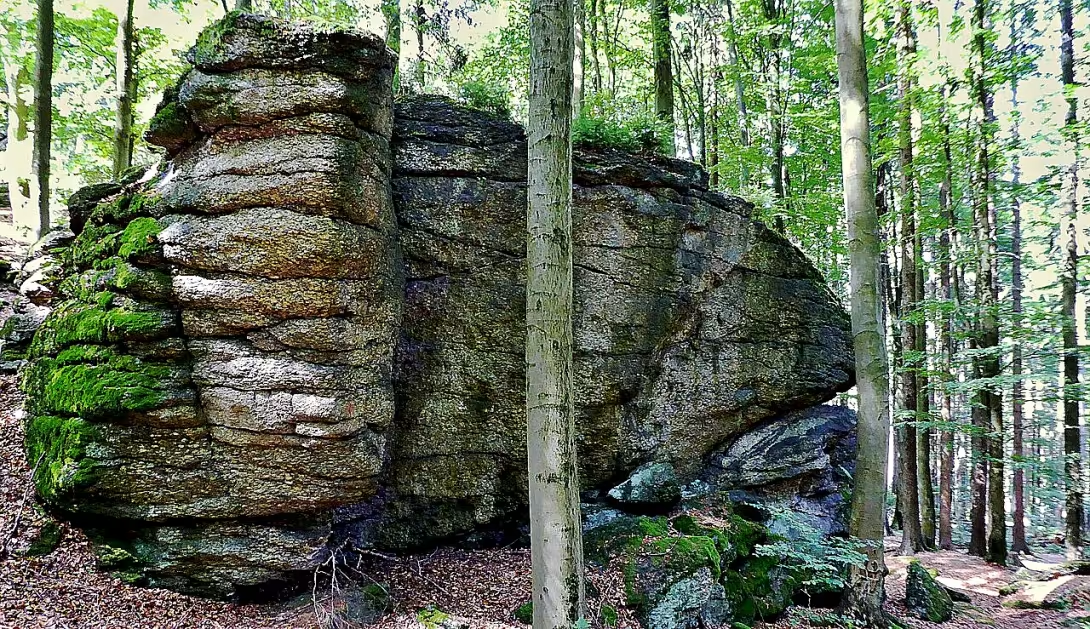
Zkamenělý zámek, also known as Old Karlstejn, is an archaeological site near the village of Svratka in the district of Ždár nad Sázavou. The locality was already inhabited in Neolithic and in the later Middle Ages there were smaller castles. The building is protected as a cultural monument and is located in the territory of natural monuments.
The oldest traces on top of the hill come from neolithic, specifically from the Sharean degree of culture with linear ceramics. The presence of minerals or the existence of a link between Bohemia and Moravia could contribute to the presence of people in the mountainous landscape. The first fortification of the spleen-paying culture was probably created in the period of Halštátský and there was a fort in the early Middle Ages. In the second half of the thirteenth century, a smaller castle was built on the site, which disappeared at the latest at the beginning of the fourteenth century. There were no written reports of this supreme medieval object.
The dominant place is a rock cabin made of rulees. A small fort was approximately 55 × 85 metres. The inner space of approx. 15 × 50 metres defined rocks and a pair of ditches on the northeast and southeast sides. The gate was probably located in the south, where the internal line is cut. Between these notches lie a narrow space with the character of the wall. The low rock wall is preserved on the inside of the second ditch. Another shallow moat lies near the stalk of rock formations on the west side.
The core of the later castle consisted of a space enclosed by rock blocks whose original form changed as a result of the crash. The construction was mainly wooden, one of the objects stood right on top of the highest rock formation. The more accessible south and east side protected the wall and double moat.
The location was discovered before 1789. In 1868 František Zákrejs visited her, who published her description and plan. In 1887, 1889 and 1890 the site was explored by Karel Václav Adámek. His findings, most of which come from the turn of the thirteenth and fourteenth centuries, are stored in the Chrudim Museum. Primordial objects include seceromite, stone spikes and fragments of smudges. From a culture with linear ceramics come shards with volute motif, a fraction of hoof wedge and fine vessels decorated with cut lines. The settlement of the spleen-paying culture is evidenced by ceramic fragments with a mixture of mica or pebbles, one of which shows large holes.
The name Old Karlstejn started to be used after the construction of the castle Karlstejn. Karel Václav Adámek believed that fortifications served as an occasional shelter for the surrounding population, probably until the Thirty Years' War.
Today the place is covered with forest. There is a blue marked tourist route from České Křižánky to the castle Karlstejn across the top of the fossilized castle.
This archaeological monument offers a unique insight into the settlement of the area from neolithic to medieval. It is a suitable destination for visitors who are interested in the history of fortifications in natural terrain.
Historical milestones
- Neolithic settlement with linear ceramics.
- A finding of seceromite and stone spikes from the time of the Hallatites.
- [13.14]
- The existence of a castle in the late Middle Ages.
Architectural development
The locality was already settled in neolithic, later during the period of the Hallatians and early Middle Ages. In the second half of the thirteenth century, a castle was built, which disappeared at the beginning of the fourteenth century.
Historical events
- 1789
- The location has been discovered.
- 1868
- František Zákrejs visited the site and published its plan and description.
- [1887, 1889, 1890]
- Karel Václav Adámek examined the location and its findings are stored in the Chrudim Museum.
Points of interest
- The locality was already inhabited in neolithic and in the later Middle Ages there were smaller castles. - The dominant place is a rock cabin made of rulees. The building was mostly wooden. - The findings include seceromite, stone spikes and slug fragments. - The name Old Karlstejn started to be used after the construction of the castle Karlstejn.
Guide
Show guide text
This text was created by artificial intelligence and has not been editorially reviewed. It may contain inaccuracies.
Welcome to the place where time seems to be stopped in stone. You're standing in front of one of the most interesting places in this area, an archaeological site that carries deep traces of human endeavor. Perhaps when you look around you now, you will not see tall stone walls, massive gates or the decorative towers you would expect to see in the concept of a castle. Instead, you are surrounded by untamed nature and fascinating rock shapes. Look right in front of you, where the main shape of this place is erected. What you see is a rock cabin that was created by nature from rocks called roubles. These layered stones that you see here form the very foundation and skeleton of this entire site. Feel the weight and durability of these rocks, which have been here for an extremely long time and which for our ancestors were not only home but also protection.
Let us now move together in time deep into the past. This rock was not just an empty place in the landscape. Even in Neolithic, that is, in a very long time when people began to settle down and change the world around them, they found refuge here. Imagine the first people to come here. They weren't just pilgrims, they were people who left traces of pottery. If you were to dive into the ground today, you would find fragments of vessels decorated with fine, linear patterns that are so typical for this time. These lines on the clay are like scriptures that tell us the story of their everyday life, their art and their connection to this country.
Now pay attention to the next period that has left its mark. When time moved on to the period of the Hallatians, this place still played an important role. Here, in these rock corners, people used their tools and weapons. During the archaeological work here were found objects that allow us to better understand these people. We see here seceromites and stone spikes, which were absolutely necessary at the time for survival, for hunting and for work. Every such find is like a key that opens the door to the world of people who lived thousands of years ago, but who felt the same need for security as we do today.
Now, if you look at the very structure of the place, you might think how people were able to use what nature offered them. Even if the name of the place suggests a lock, we must realize that the architecture of this place was mostly wooden. In the late Middle Ages there were smaller castles. It was not a luxury palace, but rather a practical and functional shelter. Imagine the wooden structures that were embedded directly into these rock cabins. When the neighborhood was in danger, people here could find protection. The rocks from the rula served as an impenetrable wall and the wooden buildings provided space for life. It is a fascinating combination of a natural rock cabin and human craft that has interconnected here in the past.
However, in order to learn as much about this place as we know today, we must remind ourselves of the people who have advocated its discovery and understanding. The history of this place is not only about ancient settlers, but also about scientists and researchers looking for clues. Names such as Karel Václav Adámek or František Zákrejs are very important in relation to this place. It is because of their efforts, their patience in viewing every fragment and every layer of earth that we can stand here today and perceive this space as something more than just a pile of stones. They saw a story worth telling.
Now I want to invite you to the little secret this place holds. Perhaps the name Old Karlstejn seems very noble and historically rooted. But did you know that this name started to be used much later? Before the medieval castle was built here, this place did not have such a famous name. There is a strange contrast between what the place is called today and what it really was in ancient times. It's like instead of trying to create a great castle, it's like a quiet, natural hiding place that only keeps its size in its name. This variability, this shift from neolithic settlers to Hallatian craftsmen to medieval inhabitants, is what makes this location so special.
Now that you've come through the different layers of time, I suggest you slowly move on and continue your tour. Let yourself be drifted by the atmosphere of this place, which is protected as a cultural monument and located within the natural monument. Feel the harmony between human history and the wild nature that rules here. Look at the surrounding landscape, feel the silence and try to imagine all the people who stood before you and looked into the same mountains as you are right now. Thank you for choosing to explore this story with us. I wish you a wonderful journey and many other interesting discoveries around Svratka.
Tips for visitors
For the best experiences we recommend a visit in early spring or autumn times, when the forest is quieter and light through the trees creates beautiful shadows. For photography are ideal moments around sunrise or sunset, when light best highlights the structure of the rock cabin.
You can reach the location by car and public transport.
Since you are in a natural park with a forest environment, remember to bring comfortable shoes suitable for hiking, water and small refreshments. There are no services in the location itself.
For families with children there are ideal walks along nearby tourist routes. Discovering the natural environment within the natural park can be an interesting adventure for younger visitors.
Frequently asked questions
Can the monument be visited?
This is an archaeological site. Often there is little to see on the ground and the land may be private. We have not verified access.
Where is the monument?
Location: Svratka, Kraj Vysočina. The map on this page shows the exact spot.
Why is the monument protected?
It is listed in the Central List of Cultural Monuments of the Czech Republic as a cultural monument (register no. 1000130139).
Businesses nearby
Do you run a restaurant, accommodation, shop, museum, rental, wellness or other visitor service near this monument? Show yourself directly to the people heading to it — this is how they will see you in the app and on the web:
Events nearby
Zdroj akcí: otevřená data měst a obcí ČR (Národní katalog otevřených dat) a kalendář akcí Národního památkového ústavu.
Nearby
Na lokalitu vedou turistické trasy, a nachází se v přírodním parku s lesním prostředím.
Accommodation nearby
Themed route
1. Tourist routes (Type: Path) - They lead visitors from around to the main monument. 2. Natural park (Type: Nature) - It offers a pleasant environment for walking in the countryside. 3. Forest Environment (Type: Nature) - It surrounds the site and provides peace and shade. 4. Zkamenělý zámek (Type: Archaeological site) - The main destination of a trip with unique traces of the past.
Seasonal recommendations
Spring: In the spring season, the Stone Castle creates a vivid and fresh impression when flowering shrubs and trees begin to open their leaves. The sun illuminates the ruins in a new way, adding both color and depth to the image. At this time the visit of the place can be very comfortable because the crowds are not increasing. It is recommended to visit at noon when the sun is at its highest and open spaces offer a pleasant temperature. It is advisable to carry light clothes but also something to protect against cold wind or rain.
Summer: In summer Zkamenělý zámek is full of life and sunlight. The sun lights up ruins for a long time, allowing long visits without worrying about the early end of the day. The atmosphere is full of heat and glow, but also a large number of tourists may appear, especially in the main summer months. It is advisable to come early in the morning or later in the day to avoid the biggest crowds. Remember the sun protection - the water boxes and the hat are basic.
Autumn: In the autumn months, the fossilized locks acquire a unique, melancholic atmosphere. Leaves of trees are colored and fall on rocks, creating beautiful texture and color. The sun is shorter and brighter, which can cause romantic and peaceful visits. The crowds are decreasing, allowing for a more comfortable walk. Clothes are recommended with regard to colder temperature and the possibility of rain - a mild jacket and blanket are a good choice.
Winter: In winter months, fossilized locks of quiet and quiet character are acquired. The sun only lights up the ruins for a short time, creating dramatic contours and shadows. The temperature is cold and therefore it is advisable to visit the place with warm clothes - fur jacket and protective gloves are necessary. Although the crowds are minimal, it is important to note that some roads may be difficult to access due to snow or ice conditions.
Visualizations and artistic views


The visualisations are generated by artificial intelligence and serve as inspiration.
Photos from the area
Real photos taken near the monument


Zdroj a licence jsou uvedeny u každého snímku.
Tips from visitors
No tips yet. Be the first!
Log in and add your tip.
Sources and literature
Photos: Josef Kreuz (PEPan) / CC BY-SA 4.0 — Wikimedia Commons. The author and licence also appear when you hover over the image.
Faktickým podkladem tohoto textu byl článek na Wikipedii, jehož autory jsou přispěvatelé Wikipedie. Článek je dostupný pod licencí CC BY-SA 4.0.
Location on the map

Příběhy a pověsti
Legendy, pověsti a příběhy spjaté s touto památkou
Fotografie návštěvníků
Zatím žádné fotografie. Buďte první, kdo přidá fotografii z návštěvy!
Log in a přidejte svou fotografii nebo hodnoťte.
Za ověřenou návštěvu v aplikaci získáte víc bodů — poznáme podle GPS, že jste na místě.
Reviews and comments