



Zvolská homole Hillfort
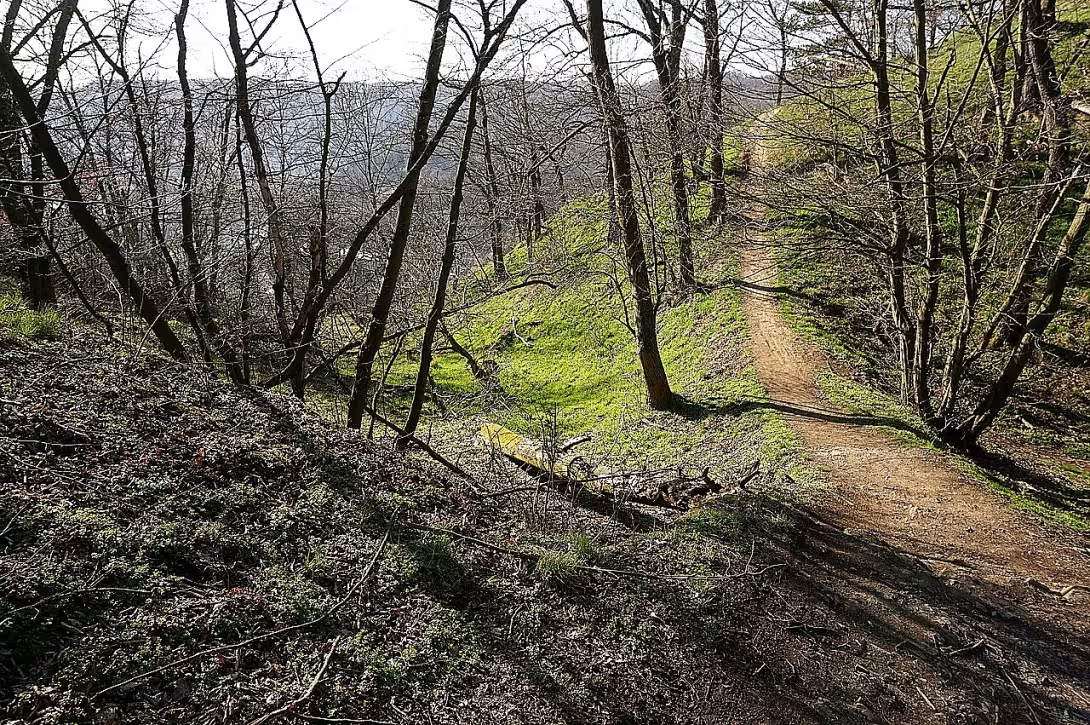
Zvolská homole is an archaeological site and remains of a extinct medieval castle. Located on the island over the right bank of the Vltava, northwest of the village Zvole in the Praha- west district. The location is protected as a cultural monument. It is particularly remarkable that there have been no written reports of the existence of the headquarters.
Archaeological research from 2004 showed that the island was already inhabited at a late age of eneolite. Further settlement and probable fortification occurred during the Bronze Age. In the High Middle Ages, during the development of castle architecture and colonization of the landscape, a castle was built on site. The precise circumstances of its creation, the founders or owners remain unknown as historical sources of the building remain silent.
The building form of the castle was based on the natural terrain of the island, which is separated from the surrounding area by a broken moat in the rock. On its inner side there is a designed wall. A significant element is the homoloid body which rises above the moat and is considered to be a possible remnant of the extinct tower. If this interpretation corresponds to reality, the castle could belong to a type of bergfrit construction, the remaining installation was probably wooden.
The location lies on the territory of the natural reserve Zvolská homole, directly above the Jarovsky tunnel. The location is freely accessible, although there is no tourist route.
Zvolská homole represents a valuable proof of the long-term settlement of the landscape from prehistoric to high Middle Ages. The visit offers the opportunity to familiarise yourself with the terrain remains of the fortification, the history of which is only indicative of archaeological findings and the form of the terrain itself.
Historical milestones
- about 3,000 bc
- First documented settlement of the location at late eneolithic time
- around 1500 bc
- The settlement and likely fortification of the site in the Bronze Age
- around 1300
- Construction of the medieval castle in the period of the high Middle Ages
- 2004
- Archaeological research confirming the prehistoric settlement and existence of the castle
Architectural development
The site has undergone prehistoric settlement and subsequent medieval fortification. The medieval castle was probably of the bergfrit type with wooden construction. The fortification formed a broken moat in the rock and a raised wall.
Historical events
2004: Archaeological research confirming the late eneolithic settlement.
Points of interest
There were no written reports of the residence. - Archaeological research from the year two thousand four showed that the island was already inhabited by the late eneolithic era. - The castle was built in the Middle Ages, but the exact circumstances of its creation, the founders or owners remain unknown. - A significant element is the homoloid section above the moat, which is considered to be a possible remnant of the extinct tower. - The location lies directly above the Jarov tunnel and although it is freely accessible, there is no tourist route.
Guide
Show guide text
This text was created by artificial intelligence and has not been editorially reviewed. It may contain inaccuracies.
Welcome, you are standing in front of the Zvolské homola, a place where a wide field covered with green grass and scattered bushes stretches over the right bank of the Vltava. The view here reveals slightly rippled slopes, on which are visible mild heights and deepening, which suggest ancient human activity. The air is fresh and slightly scented by forest scents, while the sun hits stone surfaces and creates a game of light and shadow. When you look around, you see only traces, but these marks are the key to understanding the thousands of years of history that took place under this landscape screen.
Let's move on to when people first left their tracks. Around 3,000 years earlier, the first primordial settlement, belonging to the late age of the eneolithic, settled on this island. People lived in simple shelters at the time, using local stones and wood to extract water and fish from the river Vltava. Two thousand years later, about fifteen hundred years before the century, further development appeared here - probably a fortification that protected the settlers from the enemy and allowed agriculture to flourish. This age belongs to the bronze era, when trade routes were expanding and people began to produce bronze tools, which brought higher levels of technology and social organisation.
In the period of the High Middle Ages, about a thousand and three hundred, a castle appeared here. The precise circumstances of its creation remain covered with mystery because no written sources have been preserved to describe the founder or purpose of the construction. Yet archaeologists proved that a solid complex was built here, which served as a defensive point and as a seat of the local aristocratic class. The castle was probably built in a strategically advantageous place where it was possible to control the passage along the Vltava and protect the surrounding area. Even though we do not see tall towers or stone walls today, the remains of foundations and ground excavations remind us that there once stood a powerful castle complex.
In the year two thousand and four there was extensive archaeological research which confirmed the existence of prehistoric settlement and medieval castle. During excavations, scientists discovered ceramic fragments, stone tools and remnants of wooden structures belonging to the age of eneolithic and bronze. At the same time they found stone foundations that can be assigned to a later castle. These findings provide important evidence of how the site evolved and what layers of human activity were alternating. Although there have been no written records, the physical evidence on the ground is clear - Zvolská homole has been an important point on the map of human activity for centuries.
Now pay attention to what you can directly observe. There are slightly elevated edges on the surface of the island, which suggest outlines of old fortifications. In some places you can see slightly elevated stone blocks that could serve as part of the foundation of the walls or as support points for wooden structures. There are several deep areas near the river that are likely to serve as warehouses or residential areas. Pay attention also to the inequalities in the terrain - these inequalities often reveal the old trench systems that were part of the defensive measures. Although no remnants of walls or towers are preserved, you can imagine how these structures were complementary to each other and formed a coherent defense unit.
As for the personalities associated with this place, history has yet to reveal names or specific stories. There are no chronicles or family records that indicate who was the founder of the castle, who was managing it or what events took place here. Yet you can imagine that there have been people who have had to face the daily challenges - the defense against intruders, the management of agricultural land, the trafficking of surrounding settlements and the maintenance of relations with higher powers. This unknown chapter adds a special charm to the place, stimulating the imagination of anyone who goes here.
The interesting thing that may interest you is the absence of written reports of the existence of the residence here. No chronicles, no documents, no references in period springs - everything we know about the site comes from stone, clay and ceramics, which archaeologists carefully interpret. This fact underlines how important it is to preserve and study physical remains, because without them this part of history would remain completely unknown. Moreover, the fact that research from the year two thousand and four has brought new knowledge shows that even after years something new can be discovered if we look at the site with an open mind and modern methods.
Finally, I invite you to enjoy this unique location in peace and with respect for its historical importance. Walk slowly through the sharpness, feel the atmosphere that persists for millennia, and be inspired by the story of the people who lived and worked here. Remember that Zvolská homole is protected as a cultural monument and part of the nature reserve, so it is important to maintain its natural state for future generations. Thank you for listening to this guide, and I wish you a pleasant time to explore the surrounding beauty. May the joy of knowledge and peace be with you in your heart.
Tips for visitors
The best time to visit is spring or autumn, when the vegetation is thinner and the terrain is better passable, while the light during the golden watch beautifully depicts the indentation of the field. You can reach the location by car or public transport to the village Zvole, where it leads to the location of the pedestrian road; Check the exact connection in the traffic search engine. Take your fixed shoes to the field, plenty of water and snacks, because there are no refreshments stands on the site itself.
Frequently asked questions
Can the monument be visited?
This is an archaeological site. Often there is little to see on the ground and the land may be private. We have not verified access.
Where is the monument?
Location: Zvole, Středočeský kraj. The map on this page shows the exact spot.
Why is the monument protected?
It is listed in the Central List of Cultural Monuments of the Czech Republic as a cultural monument (register no. 1000140314).
Businesses nearby
Do you run a restaurant, accommodation, shop, museum, rental, wellness or other visitor service near this monument? Show yourself directly to the people heading to it — this is how they will see you in the app and on the web:
Events nearby
Zdroj akcí: otevřená data měst a obcí ČR (Národní katalog otevřených dat) a kalendář akcí Národního památkového ústavu.
Nearby
Přírodní rezervace Zvolská homole, řeka Vltava, obec Zvole.
Accommodation nearby
Trips and activities nearby
Guided tours, tickets and activities nearby from GetYourGuide
Affiliate link: if you buy from the partner, we may receive a commission. The price for you does not change.
Search tours and activities →Themed route
1. Municipality of Zvole (village) Suitable starting point for the whole walk and orientation in the field.
2. Natural Reservation Zvolská homole (Protected Area) It offers a beautiful natural environment and leads visitors to the main destination.
3. Zvolská homole (archaeological site) The main monument to a trip where you can discover traces of ancient history.
4. River Vltava (water flow) Ideal place for relaxation and a peaceful ending of the journey by the water.
Seasonal recommendations
Spring: In spring, this place awakens into life. Young leaves start to green around the ruins and the air smells fresh. The light is soft and very pleasant in this period. I recommend you take several layers of clothing because the wounds can still be cold and the afternoon is warm. The road can be muddy because of the rain, so get ready for tough shoes. People here aren't as affectionate as they were in the summer, so you'll enjoy your peace.
Summer: It is very sunny in the summer months and the surrounding hills are densely green. The atmosphere is alive, but heat can be uncomfortable in the open. The best thing to do is to come first thing in the morning to avoid the biggest crowds and burning midday heat. Don't forget the sun cap and plenty of water. Long days allow you to observe the ruin until late evening.
Autumn: Autumn brings the colors of gold and brown, which perfectly contradict old stones. The morning mist gives the place a mysterious and a little sad mood. It's the perfect time for quiet contemplation. Put on a flat dress and don't forget to wear solid shoes because falling leaves can slide on the trails. The best time to visit is in the afternoon when the sun shines low and creates long shadows.
Winter: Winter makes this historic monument very raw and lonely. The landscape is often covered with snow or frost and the trees do not have leaves, which reveals the entire outline of the ruins. The atmosphere is quiet and intact. For short days and cold, I recommend a visit in the bright, sunny part of the day. The need is a very warm jacket, scarf and gloves, because there can be strong wind on the hills.
Visualizations and artistic views


The visualisations are generated by artificial intelligence and serve as inspiration.
Photos from the area
Real photos taken near the monument


Zdroj a licence jsou uvedeny u každého snímku.
Tips from visitors
No tips yet. Be the first!
Log in and add your tip.
Sources and literature
Photos: MartinVeselka / CC BY-SA 4.0 — Wikimedia Commons. The author and licence also appear when you hover over the image.
Faktickým podkladem tohoto textu byl článek na Wikipedii, jehož autory jsou přispěvatelé Wikipedie. Článek je dostupný pod licencí CC BY-SA 4.0.
Location on the map





Příběhy a pověsti
Legendy, pověsti a příběhy spjaté s touto památkou

Fotografie návštěvníků
Zatím žádné fotografie. Buďte první, kdo přidá fotografii z návštěvy!
Log in a přidejte svou fotografii nebo hodnoťte.
Za ověřenou návštěvu v aplikaci získáte víc bodů — poznáme podle GPS, že jste na místě.
Reviews and comments