



Zvonice (Podhradí) Belfry
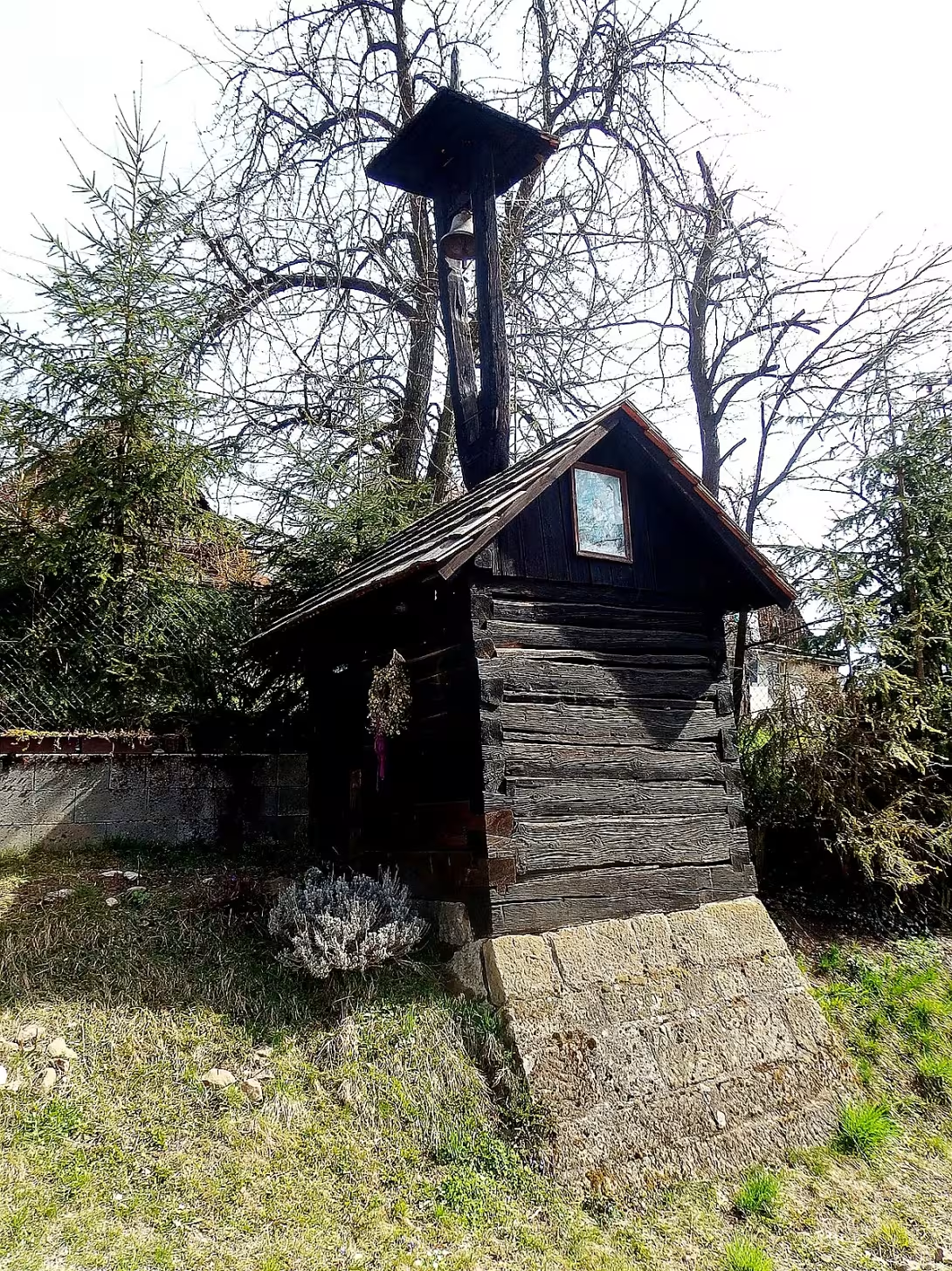
Roused bell tower in the village The Zlín district is a cultural monument of the Czech Republic from the 19th century. This building is a typical example of Luhačský Zálesí's folk architecture and serves for the reporting of dimmers.
There are no detailed reports on the specific circumstances of the 19th century building. However, it is demonstrated that it is a typical construction for the region.
It is a self-standing grafted wooden structure with a rectangular ground plan, mounted on a embossed base made of quarry stone. The construction was used by binding beams, treated with cutting from four sides with carefully raised faces and connected to the fish. There is a rectangular frame in the front wall with a single-wing door of the slatted structure, which is suspended on the cross curtains and equipped with simple petting. The entire building has a saddle roof covered with shingles. Through it comes a standing fork with a hanging bell, over which is also a shingles covered tent roof. The base dimensions are 2 × 2 metres and the total tower height is approximately 4,5 metres.
In terms of function, there was a significant change in 2020. The other bell was taken over by the bell with electric control in the chapel of St. Zdislava, so the grafted bell is now only announcing the divers.
The building is located in the centre of the village Podzrava by the road in the steep slope. It is recognized as a cultural monument of the Czech Republic and represents an authentic example of regional construction.
This compact construction is a valuable testament to the traditional craft and history of Luhačský Zálesí. Her visit allows to see preserved elements of 19th century rural architecture.
Historical milestones
- 19th century
- The creation of the bell tower as a typical construction of Luhačský Zálesí folk architecture.
- 2020
- Change the function of the bell tower to the announcing only of the dials after moving the other bell to the chapel of St. Zdislava.
Architectural development
The construction is carried out from the machined beam connected to the fish. It has a saddle roof covered with shingles and a base made of quarry stone. In the front wall there is a rectangular frame with one-wing doors.
Historical events
- 2020
- The other bell was taken over by an electric bell in the chapel of St. Zdislava.
Points of interest
- It is a grafted 19th century building and a cultural monument of the Czech Republic. - It represents a typical example of folk architecture from Luhačský Zálesí. - The construction has a base of 2 × 2 metres and a total height of approximately 4,5 metres. - Since 2020, it has been used exclusively to report dieheads. - It's got a saddle roof covered with shingles and it's based on quarry stone.
Guide
Show guide text
This text was created by artificial intelligence and has not been editorially reviewed. It may contain inaccuracies.
Welcome to the Zlín district, right in the heart of the village Podrány. You're standing in front of something very special, although at first glance, you may find yourself looking at a small, simple wooden structure. Stop for a moment, put your things down and embark on the observation of this small but extremely important monument. In front of your eyes, there's a small, grafted bell tower. Feel the silent presence of this object standing firmly on its stone base and fitting into the surrounding environment. It's a symbol of the past that still resists time and tells us the story of people's lives in this area.
This building is not just a random wooden house. It is an authentic and rare example of folk architecture, which is so typical of the Luhačský Zálesí region. If we could now return in time to the nineteenth century, we would see how people in this area were building their buildings from what nature itself offered them. This bell tower was created during this period, at a time when the community was strongly connected with the rhythm of work, nature and religious life. It was not a building for rich nobles, but the work of people who understood wood and stone and who could create something lasting from simple materials. It is proof of their art and their need to have a place in the village that will serve everyone.
Now let's look at what you see right in front of you and pay attention to the details. Notice how the whole structure is made out of wood. It is a grafted structure, which means that the beams are placed one on the other, creating this characteristic, layered texture, which is so typical of folk construction. However, this wooden part is not located directly on the ground. In order to protect it and to keep the building stable, it stands on the rhombus base. This stone provides the whole tower with strength and protects the wood from moisture. If you look at the total size, you realize how compact and striking this building is. Its foundation is a square with a side of two meters and the whole tower is held up to about four and a half meters. Above this whole structure is a saddle roof, which is completely natural for this type of folk building and helps to draw water away from wooden walls. Feel the simplicity and the incredible functionality this little object carries.
Now pay attention to why this tower was even built and what role it played in the lives of the people who lived here before us. The bell tower wasn't just a village decoration. Her main task was very serious and deeply emotional for the people at the time. It was used to report the death certificates. Imagine living in a village at a time when there was no phone or any other quick way to spread an important message. It was the sound of the bell the only way to inform the entire village of the departure of someone from their neighbors. When this specific sound sounded, people knew that it had to stop, in the spirit of revenge and come out on the last path of their neighbor. It was a sound that connected the entire community in a moment of sadness and respect.
In the history of this building, however, there has been one major shift which is important for understanding its current state. By the year two thousand twenty bell bells were full of wider functions, but after moving the other bells to the nearby chapel of St. Zdislava, her role changed. Since then, it has been used exclusively for this original, silent and very serious purpose - to report dieheads. This brought her original, very specific role back to the forefront and preserved her deepest essence.
You may now wonder if this little wooden tower is really important enough for the whole country to take care of it. The answer is yes. This bell tower is registered as a cultural monument of the Czech Republic. This means that its value for our history and for our culture is recognised at the highest level. It is a rare representative of the People's Construction of Luhačský Zálesí, which allows us to understand how people lived in the nineteenth century and what values were important to them. It's a little piece of history that reminds us of our roots.
I hope that this short journey in time and this brief talk has helped you better understand this little but extremely important piece of history that is standing before you. Now that you know what this building represents, how it was built and what it meant to the locals, I want you to walk around again. Discover the beauty of the village Podrár, feel its calm and enjoy the atmosphere of this place. Thank you for your attention and I wish you a wonderful rest of the day while further exploring the surroundings.
Tips for visitors
The best time to visit is early morning or late afternoon, when soft light best excels on the wood walls of the grafted bell tower and highlights the details of folk architecture from the nineteenth century.
The location is available by car and by public transport; Check the current connection in the search engine. Since the building is located in a steep slope by the road, we recommend that you be more careful when arriving.
For visitors, especially families with children, we recommend fixed-footed shoes that ensure stability in hilly terrain. For children, a visit can be an interesting example of traditional construction.
For the best photos we recommend angles that capture the bell bell in contrast to the surrounding nature. In the vicinity you can visit Luhačská Zálesí, where the monument is located.
Frequently asked questions
Can the monument be visited?
This is a structure in a public space that can usually be seen from outside free of charge. We have not verified that this particular one is freely accessible.
Where is the monument?
Location: Zlínský kraj. The map on this page shows the exact spot.
Why is the monument protected?
It is listed in the Central List of Cultural Monuments of the Czech Republic as a cultural monument (register no. 1000132536).
Businesses nearby
Do you run a restaurant, accommodation, shop, museum, rental, wellness or other visitor service near this monument? Show yourself directly to the people heading to it — this is how they will see you in the app and on the web:
Events nearby
Zdroj akcí: otevřená data měst a obcí ČR (Národní katalog otevřených dat) a kalendář akcí Národního památkového ústavu.
Nearby
Lokalita se nachází v Luhačovském Zálesí u silnice v příkrém svahu.
Accommodation nearby
Themed route
Zvonice (Podhradí) Type: Historical building, tower Why is it worth a visit: This monument stands in a steep slope along the road and offers a unique view of the landscape of Luhačský Zálesí. Its location in the field creates a dramatic contrast between the stone structure and surrounding greenery.
A steep slope by the road Type: Natural environment, terrain Why is it worth a visit: Access to the bell tower leads through this characteristic slope, which is part of the immediate surroundings of the monument. The walk here allows you to appreciate the specific geomorphology of the place and a quiet environment outside busy traffic.
Luhačský Zalezí Type: Local landscape, area Why is worth a visit: The whole route takes place in this specific area that defines the atmosphere of the trip. Observation of the surrounding landscape from the position of bell tower and slope allows you to see the typical form of this part of the region.
Road surroundings Type: Transport infrastructure, access route Why is it worth a visit: The road forms the main access axis to the monument and also frames the view of the bell tower. It is a point where historical architecture meets with modern movement around the landscape.
The route is designed to focus exclusively on the main objective and its immediate surroundings, as stated in the base. It starts at the side of the road where the entrance point to the steep slope is located. The entrance to the bell tower itself, which dominates this place. From the top of the tower or from the surrounding slope you can admire the vast Luhačský Zálesí. The entire section is short and focused on detailed examination of this particular location without the need to travel to further points.
Seasonal recommendations
In spring the tower surrounds the waking green and fresh air. The light is fine, which from the top creates a pleasant picture of the surrounding landscape. We recommend to dress in layers because the weather is very variable during this period. The best thing is to arrive in the morning, when there is relative peace at the monument.
The summer months bring bright sun and rich colours of thick leaves. The atmosphere is full of energy and the days are longest in a year. Due to the large crowds in the high season, select a visit right after opening to avoid queues. Don't forget light, breathable clothes and plenty of fluids.
In autumn, the surroundings of the bell tower turn into golden tones and morning fog gives the place a mysterious mood. The lighting is most suitable in late afternoon to capture the details of the construction. Practical choice is waterproof shoes and lighter jacket to protect against cold wind.
In winter, the tower is very peaceful in the snowy landscape. The air is freezing and the days are short, which creates a cozy atmosphere. Hot gloves, hats and solid winter shoes are essential.
Visualizations and artistic views


The visualisations are generated by artificial intelligence and serve as inspiration.
Tips from visitors
No tips yet. Be the first!
Log in and add your tip.
Sources and literature
Photos: Palickap / CC BY-SA 4.0 — Wikimedia Commons. The author and licence also appear when you hover over the image.
Faktickým podkladem tohoto textu byl článek na Wikipedii, jehož autory jsou přispěvatelé Wikipedie. Článek je dostupný pod licencí CC BY-SA 4.0.
Location on the map
More monuments – Zlínský kraj
Show all in the region
Příběhy a pověsti
Legendy, pověsti a příběhy spjaté s touto památkou
Fotografie návštěvníků
Zatím žádné fotografie. Buďte první, kdo přidá fotografii z návštěvy!
Log in a přidejte svou fotografii nebo hodnoťte.
Za ověřenou návštěvu v aplikaci získáte víc bodů — poznáme podle GPS, že jste na místě.
Reviews and comments