



Zvonice (Vyskeř) Belfry
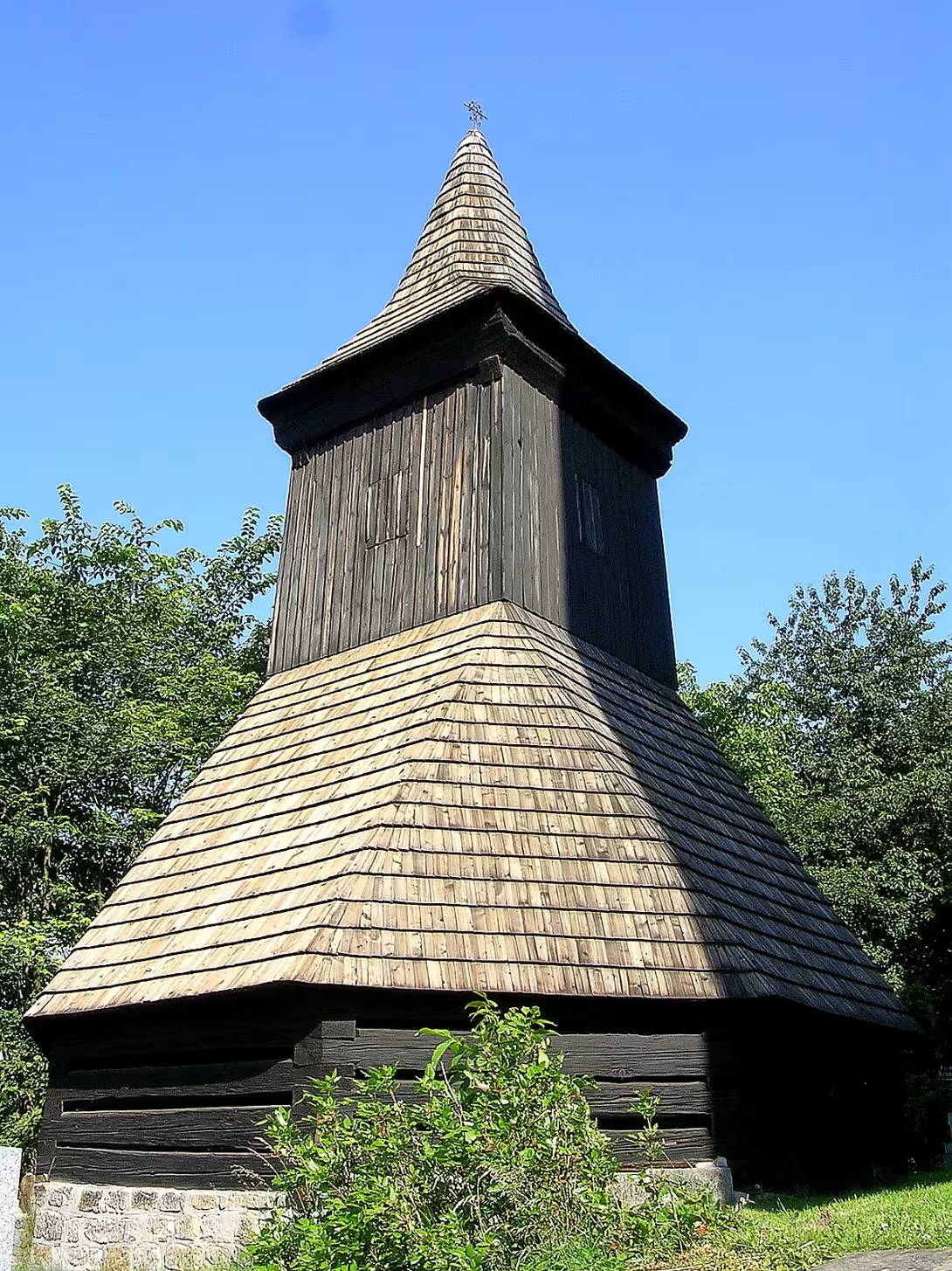
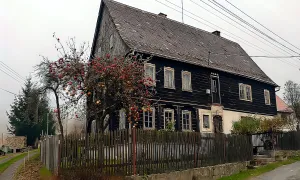
The wooden bell tower in Vyskéř in Semily district is a free standing Baroque building from 1750. It is protected as a cultural monument registered in the central list of cultural monuments of the Czech Republic. This building is located close to the Church of the Assumption of the Virgin Mary and forms an important sacral dominant feature of the whole village in the landscape of the Czech Paradise.
In the middle of the eighteenth century, Czech countries experienced the period of the highest Baroque, which was also strongly reflected in the sacral architecture of rural areas. The construction from 1750 replaced the older bell tower from 1504 or the beginning of the sixteenth century. Around 1750, the design of the bell tower was reinforced to hang the second bell, which was related to the fact that the historic bell of Maria was hung there.
Architecturally, it is a free-standing tiered structure on the ground plan of the octagonal, which stands on the masonry stone suspect. The lower part of the monument is grafted and connected by shingles roof. It narrows down to a vertically-crafted stinger prism. Stenary construction is bravely suspended inside by the Ondří cross and each oak stinger is supported by a pair of oblique braces. Inside this construction is built a separate bell floor with bell stool. In the formwork of the bell floor are placed bell windows covered by wooden window. The whole building is finished with a thin broken shingles needle roof.
Over the centuries this monument has undergone a number of building modifications and reconstruction. In 1830, the original shingles were replaced with vertical plates. Significant reconstruction took place in 1940. The shingles were replaced and some stener beams were replaced and the construction was suspected. Later maintenance included covering coating carried out in 2000 and replacement of damaged base beams in 2001.
In the bell tower was originally the bell Václav from 1617 with a diameter of 75 cm and a weight of 227 kg, which was broken by the bell tower Martin Schrötter II. This bell broke in 1850 and then passed through the spill. During World War II he was reclaimed and taken to a collection site in Prague in 1942. From there he returned after the end of the war and was hanged on June 18, 1945 in the tower of the neighbouring church. The second bell was made by Maria in 1723. It had a diameter of 83 cm and a weight of 314 kg and around 1750 it was hung from the church tower into a wooden bell tower. But this bell has met a different fate. In 1916 during the First World War he was married, torn to pieces and taken away for war purposes. Construction of this type was not only for religious purposes, but also as an important element of the community for reporting danger or death.
Today this monument stands in the village Vyskeř in the immediate vicinity of the Church of the Assumption of the Virgin Mary and represents a valuable example of historical folk and sacral architecture. Her visit offers a view of traditional carpentry craft and development of rural buildings in the region.
Historical milestones
- 1504
- The original bell bell was built and later replaced by a new building.
- 1750
- The construction of the new bell tower and the reinforcement of the structure for the second bell is completed.
- 1830
- Renovated with shingles cover replacement with vertical plates.
- 1940
- There was an exchange of shingles and stingers and a suspicion of construction.
- 2001
- Replaced damaged base beams of the bell tower.
Architectural development
The construction from 1750 replaced the old bell tower and was further strengthened around 1750. In 1830 the vertical plate coating replaced the original shingles. Another significant reconstruction took place in 1940, when shingles and some stener beams were replaced and the whole building was suspected. The later adjustments from 2000 and 2001 included protective coating and replacement of damaged base beams.
Historical events
In 1750 a new bell tower was built and the construction was reinforced for the second bell. During the year 1830 a reconstruction took place where shingles was replaced by vertical plates. The bell Václav was recited for war purposes in 1942 and returned to the church tower after the end of the war in 1945.
Points of interest
- The wooden bell tower in Vyskéř is a free-standing Baroque building from 1750, which replaced the older bell tower from 1504. - Around 1750, the construction was reinforced because of the hanging of the second bell and the historic bell of Maria was hung there. - The building stands on a brick suspect, its lower part is grafted and inside the construction there is a separate bell floor. - In 1830, the shingles were replaced by boards and a significant reconstruction took place in 1940 when shingles and beams changed. - The bell tower was hidden by Václav bell from 1617, which after the war confirmation and return ended in the tower of the neighboring church, while the second bell of Maria was broken and taken away for war purposes in 1916.
Guide
Show guide text
This text was created by artificial intelligence and has not been editorially reviewed. It may contain inaccuracies.
Welcome to this lovely place. You are standing in front of an ancient wooden bell tower located close to the Church of the Assumption of the Virgin Mary on the cadastral territory of Vyskeř in Semily district. In front of your eyes is a free-standing Baroque building, which has been standing in this sacred place for many centuries, forming an inherent dominion of the surrounding countryside. Take a moment of your breath, look around you and let history breathe upon you, which is literally tangible here.
Let's move forward in time and look at how this remarkable building was created. The original bell bell has been standing here since 15400. However, this older predecessor, after centuries of loyal service, was no longer sufficient for the needs of the latter, and therefore had to give in to a new piece. Seventeen hundred and fifty were finished building a brand-new bell tower, which you see here today. At the time, its creators had to intensify the whole supporting structure, because the plan was to hang the second bell here.
Now pay attention to the architecture itself and the details you have right in front of you. It is a free-standing tiered structure that is built on an octagonal plan. When you look at the lower parts, notice the solid stone suspect on which this building rests. It is then followed by the grafted lower part. Over the centuries, this monument has undergone several necessary repairs that have ensured that we can admire it even today. For example, in the year eighteen... in the year eighteen hundred thirty, there was a major reconstruction, in which the original shingles were replaced by vertical plates. Other important work took place in nineteen hundred and forty, when workers exchanged not only shingles, but also steners beams and made a new suspicion of the whole building. The last major maintenance took place at the very beginning of the new millennium, in the year two thousand and one, when damaged base beams were replaced to protect the bell tower for future generations. Although the names of architects did not remain in history, their craft um speaks for everything.
There are also interesting stories and people associated with this place. Let us at least appoint Mr Martin Schrötter second among the historical figures who have entered the chronicles of this region. When you're standing at the bell tower, remember that around the year seventeen hundred and fifty here, a rare historical bell called Maria was hung. It has been ringing for centuries, announcing the joyful and sad events of the locals.
The interesting thing is that this building had to bear a great deal of weight and therefore required the said reinforcement of the construction. The wood from which the bell tower is built remembers generations of ancestors and resists many winds and storms. Each beam carries a story of craftsmen who came here with fangs and axes to finish the work.
Thank you for coming to this monument and devoted your time to its knowledge. I believe the sight of this ancient bell tower has brought peace to your soul and enriched your journey. I wish you a beautiful rest of the day and a happy journey to explore other places of interest. Goodbye.
Tips for visitors
Best time to visit the bell tower in Vyskeři is autumn or spring when the surrounding nature presents itself in its most beautiful form. These seasons offer ideal conditions for walking and photography in the picturesque environment of the Czech Paradise.
For those travelling by public transport, it is advisable to look at the current connection in the search engine, as Vyskeř is available from different locations.
When visiting, bring suitable shoes and clothes for outdoor activities. Photographers should bring their equipment as the bell tower offers a beautiful view of the surrounding landscape elements, especially in the weather with bright and sunny skies.
Photography is best in the early morning or in the evening when light is softer. The most beautiful views of the bell tower can be captured by the Church of the Assumption of the Virgin Mary, which is nearby.
It is possible to visit the Church of the Assumption of the Virgin Mary, another historical monument with a rich architecture. For families with children it may be interesting to explore the natural beauty of the surrounding area and possibly the organisation of some outdoor events.
Frequently asked questions
Can the monument be visited?
This is a structure in a public space that can usually be seen from outside free of charge. We have not verified that this particular one is freely accessible.
Where is the monument?
Location: Vyskeř. The map on this page shows the exact spot.
Why is the monument protected?
It is listed in the Central List of Cultural Monuments of the Czech Republic as a cultural monument (register no. 1000143525).
Businesses nearby
Do you run a restaurant, accommodation, shop, museum, rental, wellness or other visitor service near this monument? Show yourself directly to the people heading to it — this is how they will see you in the app and on the web:
Events nearby

Zdroj akcí: otevřená data měst a obcí ČR (Národní katalog otevřených dat) a kalendář akcí Národního památkového ústavu.
Nearby
Zvonice stojí v obci Vyskeř v bezprostřední blízkosti kostela Nanebevzetí Panny Marie v malebné krajině Českého ráje.
Accommodation nearby
Trips and activities nearby
Guided tours, tickets and activities nearby from GetYourGuide
Affiliate link: if you buy from the partner, we may receive a commission. The price for you does not change.
Search tours and activities →Themed route
Thematic cruise route: Zvonice (Vyskeř) and surroundings
1. Bells - Type: Architectural monument - Why is it worth visiting: This bell tower, built in 1870, is one of the most significant elements of the local panorama. Its unique architecture and historical meanings attract visitors who enjoy a view of the surrounding landscape of the Czech Paradise.
2. Church of the Assumption of the Virgin Mary - Type: Religious monument - Why is it worth a visit: The church, built in the 18th century, is a key part of the local spiritual life and architectural wealth of the village Vyskeř. Its interior offers wonderful artistic elements and provides a calm atmosphere for meditation and relaxation.
3. Church tank - Type: Historical area - Why is it worth a visit: The reservoir in front of the church is an ideal place to relax and enjoy a quiet moment. Here you can appreciate the history and tradition of the village while looking at the picturesque landscapes of the Czech Paradise.
4. Park spaces around the church - Type: Natural space - Why is it worth a visit: Parks and greenery around the church provide an opportunity to walk in a quiet and stupid atmosphere. They are ideal for relaxation, picnic or simply for enjoying the beauty of nature.
5. Church Tower - Type: Architectural element - Why is it worth visiting: The tower offers a unique perspective on the village and surrounding landscape. It is an ideal place for photographing and enjoying the views every visitor can appreciate.
This route offers a compact impression of the cultural and historical wealth of the village Vyskeř, focusing on key architectural elements and the natural beauty of the surrounding area.
Seasonal recommendations
Spring: In the spring season the surrounding nature of Zvonice in Vyskěř is full of life and colors. The trees are beginning to frown, the green meadows extend beneath their feet and the flowers celebrate their triumph over the cold. The sun illuminates the memory with a pleasant heat, which creates an ideal atmosphere for walking. It is recommended to visit more slowly to enjoy changes in the landscape and views from different angles. Dress appropriately according to temperature - short gloves and braces can be useful if the weather is cold.
Summer: In the summer, the Bell Bells in Vysktor gets its greatest shine. The sun rays illuminate the stone structure and surrounding landscape, making the outside inspections impressive. Nature is in full bloom with a wealth of colors and smells that give visitors a sense of peace and relaxation. Summer can also be a time of higher number of tourists, therefore it is advisable to visit in the early morning hours or later on the day when the crowd decreases. Don't forget the sun protection - short gloves and sunglasses are a good design.
Autumn: In the autumn months, Zvonice in Vyskr melancholic charm takes place when tree leaves turn into golden and red shades. The sun is already less intense and the sky often brings the first clouds and rain storms. This atmosphere creates a unique mood that is suitable for quiet moments near the monument. Wear more layers - a cape or umbrella can be useful in case of sudden weather. Visiting the autumn bell tower is particularly interesting when sunlight or the first snow falls on the landscape.
Winter: In the winter, the Bell Bell in Vyskteli grows a quiet and quiet atmosphere. Snow-covered trees and stone glaciers provide the landscape with magical charm, which is an ideal background for photography or relaxation. The sunlight illuminates the memory more gently, creating romantic moods. It may be cold to visit Zvonice during winter, so it is important to dress with warm clothes and pants, perhaps even with a protective layer against water. Visiting the memory in a quiet winter morning can be convenient because there are usually fewer visitors and the temperature is milder.
Visualizations and artistic views

The visualisations are generated by artificial intelligence and serve as inspiration.
Photos from the area
Real photos taken near the monument


Zdroj a licence jsou uvedeny u každého snímku.
Tips from visitors
No tips yet. Be the first!
Log in and add your tip.
Sources and literature
Photos: User:ŠJů / CC BY-SA 3.0 — Wikimedia Commons. The author and licence also appear when you hover over the image.
Faktickým podkladem tohoto textu byl článek na Wikipedii, jehož autory jsou přispěvatelé Wikipedie. Článek je dostupný pod licencí CC BY-SA 4.0.
Location on the map

Příběhy a pověsti
Legendy, pověsti a příběhy spjaté s touto památkou
Fotografie návštěvníků
Zatím žádné fotografie. Buďte první, kdo přidá fotografii z návštěvy!
Log in a přidejte svou fotografii nebo hodnoťte.
Za ověřenou návštěvu v aplikaci získáte víc bodů — poznáme podle GPS, že jste na místě.
Reviews and comments