



Bernartice Chateau
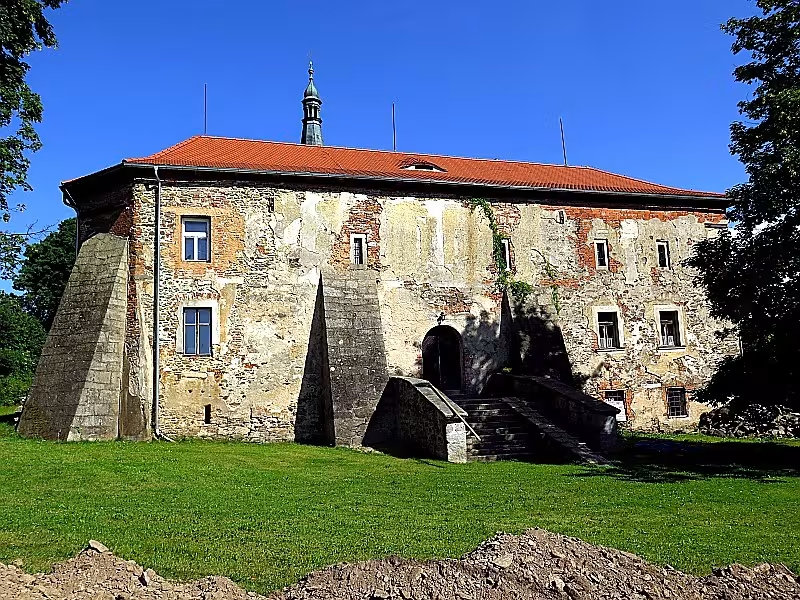
Bernartice is a protected cultural monument in the Pilsen region, located in almost half a millennium of the same location as the head of the small estate centre. Although the monumental form faced many changes, its buildings did not disappear - they are a testament to the fate of several powerful noble families and their property.
The first written mention of the Bernartic fortress dates back to 1413, when it appeared in the inventory of the property of the deceased John of Bernartic. It was inherited by various nobles - first Beneda z Volfštejna and Martin z Ostroměře, then Martin's son John. Since 1459, the fortress belonged to the Knights' House Purkartů z Hořešovic, which apparently also brought an initiative to build a late Gothic fortress, which can still be traced to parts of the original masonry today.
The fate of the fortress broke at the beginning of the Renaissance age. Merklínští z Merklína, which acquired the manor around 1553 or 1544, rebuilt it in accordance with the period taste. The last of them was Purkart Merklín, who died in 1626 and left behind an indebted farm. He soon after his death took Kocové z Dobrše, and although the fort was to be mentioned once more in the historical records - in 1639 when Divish Koc bought it - it was supposed to be the last moment of her fame as the control center of the estate.
After Koc the owners of the village quickly took turns and the fort gradually lost its original function. The ultimate transformation came in 1732 when Löwensteinové bought the village and joined it to its Boran estate. From that moment on, the fort was no longer a seat of the manor, but its buildings turned into accommodation for the administrator of the adjoining court and granary for the storage of grain. Only in the twentieth century - more precisely from its second half - part of the building began to be used as a private holiday home.
A fortress from the Gothic palace is built with a wall whose original wall is preserved in the southwest wing. During the Renaissance adjustments, three more wings were added around the courtyard with subtile polygonal towers in the corners. Dendrochronological dating of the ceilings on the ground floor of the south wing revealed that the trees were cut down to build them between 1584 and 1587. The masonry covered a simple block of sgraffiti, and the entire complex surrounded an arched moat, visible until the end of the eighteenth century.
A description of the fortress from the end of the 16th or the beginning of the seventeenth century was captured by a painter in a painting which was later preserved in a mountain chateau. It depicts a three-wing building with a bastion and a wall with key shooting points. Despite changes in the interior, which does not carry any significant architectural details, Bernartice retains importance as one of the significant Renaissance buildings of the southwest Bohemia.
Then and now
Drag the slider to compare how the landmark may have looked when it was built with the view today.
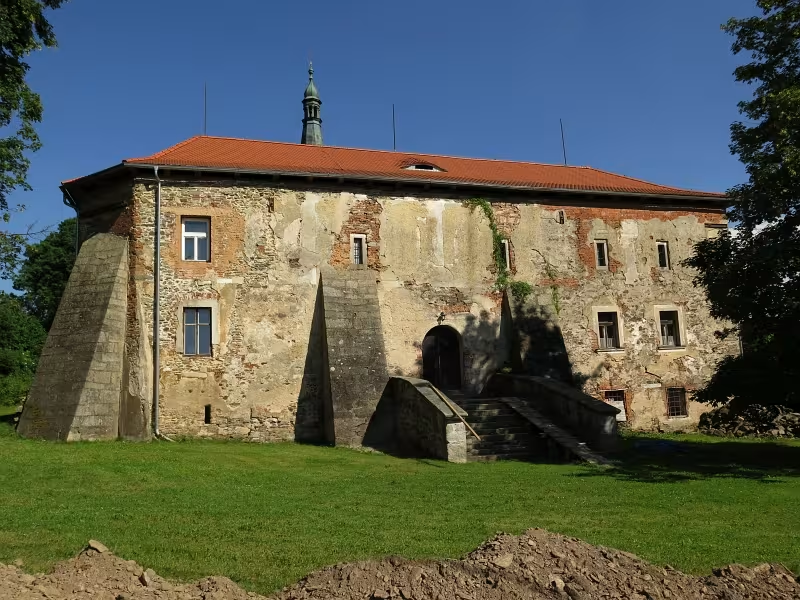
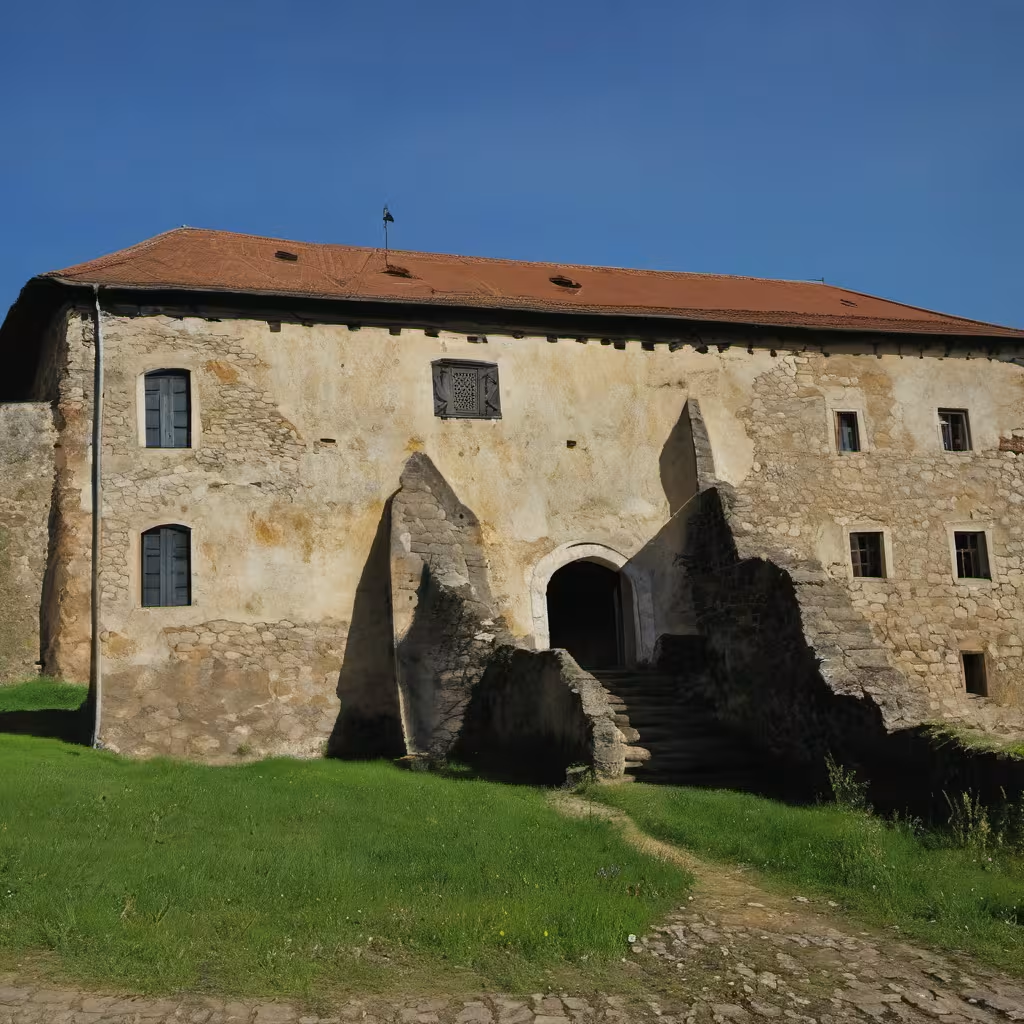
The historical appearance on the left is an AI-generated visualisation and serves as inspiration only.
Historical milestones
- 1413
- First written mention of the fort in the inventory of Jan from Bernartice
- 1459
- The fortress belongs to the Knights' House Purkartů z Hořešovic
- Around 1550
- Merklínští z Merklína obtains the manor and reconstructs the fort
- 1584-1587
- Construction of wooden ceilings on the ground floor of the south wing
- 1639
- Divis Koc buys a fortress, the last moments of her fame as the center of the estate
- 1732
- Löwensteinové buys a village and turns buildings into accommodation and granaries
Architectural development
The Bernartic fortress began as a Gothic palace with a fenced courtyard wall. During the sixteenth century it was remodeled, which included the addition of three wings around a small courtyard and polygonal towers. The wood used for the ceilings was cut down between 1584 and 1587.
Historical events
- 1413
- First written mention of the fort.
- 1584
- Dendrochronological dating of timber ceilings in the south wing shows 1584-1587 for renaissance reconstruction.
Owners
1413: Jan z Bernartic; followed by Beneda z Volfštejna, Martin z Ostroměře; since 1459 Purkartů z Hořešovic; in 1553 or 1544 Merklínští z Merklína; 1626: Merklín Purkart; subsequently Kocové z Dobrše; 1639: Diviš Koc z Dobrše; 1732: Löwensteinové.
Points of interest
- Bernartice are a protected cultural monument in the Pilsen region. - The first written mention of the Bernartic fortress dates back to 1413, when it appeared in the inventory of the property of the deceased John of Bernartic. - Since 1459, the fortress belonged to the Knights' House Purkartů z Hořešovic, who brought an initiative to build a late Gothic fortress. - Dendrochronological dating of the ceilings in the south wing revealed that the trees were cut down to their construction between 1584 and 1587. - Despite changes, Bernartice maintains its importance as one of the major Renaissance buildings in the southwest of Bohemia.
Guide
This guide is narrated by a synthetic voice generated by artificial intelligence.
Show guide text
This text was created by artificial intelligence and has not been editorially reviewed. It may contain inaccuracies.
Bernartice is a fortified house, sometimes also referred to as a castle, in the village of the same name near Stráž on the Tachov district. From at least the fourteenth century it was the seat of a small estate and in the second half of the sixteenth century it underwent a Renaissance reconstruction. The building is protected as a cultural monument.
The first written mention comes from the year 1413, from an inventory of the property of Jan from Bernartice who died at that time. After him the fortified house was inherited by Beneda from Volfštejn and Martin from Ostroměře. Martin's son Jan resided there as late as 1431. From 1459 the village with the fortified house belonged to the knightly family of the Purkarths from Hořešovic. They probably built the late Gothic fortified house, which has been partly preserved within the later masonry.
In 1553, according to another source already in 1544, Bernartice was acquired by the Merklíns from Merklín. The last of them there was Purkart Merklínský, who died in 1626. The indebted estate was then purchased by the Kocs from Dobrše. According to Miloslav Bělohlávek, it was only in 1639 that Diviš Koc from Dobrše bought the estate and at that time the fortified house is mentioned for the last time. The subsequent owners changed quickly. The fortified house definitely ceased to serve as a seat of authority in 1732 when the village was purchased by the Löwensteins and attached to their Borská estate. The buildings then served to accommodate the manager of the court and as granaries. From the middle of the twentieth century part of the building served as an occasional private recreation residence.
The core of the structure is a Gothic palace with a fortification wall of the courtyard. Its masonry has been preserved in the southwestern wing and the former rampart forms the courtyard walls of the northeastern and southeastern wings. During the Renaissance reconstruction three more wings were added around the small courtyard. In their northern and southern corners stood slender polygonal towers. The reconstruction was helped to be dated by the wood of the ceiling beams in the ground floor of the southern wing, because the trees for them were felled between 1584 and 1587. The plaster was decorated with simple ashlar sgraffito and the entire building was surrounded by a brick moat, visible until the end of the eighteenth century.
The appearance of the fortified house before 1634 was captured by a painter in a painting which is stored at the castle in Horšovský Týn. The fortified house is depicted in it as a three winged building with a bastion and with a fortification wall with keyhole loopholes.
The interior has been modified many times and valuable architectural details have not been preserved in it. Nevertheless Bernartice belongs to the significant Renaissance residences of southwestern Bohemia.
Tips for visitors
The best time to visit the fortress Bernartice is in the spring or autumn season when the natural beauty surrounding are in its full glory and fewer people. The sunny day provides ideal conditions for walking around historical walls.
Transport by public transport is also an option; Details of current connections can be found through route search.
When visiting, it is recommended to bring protective clothing because the climate may be cold in the winter months. It is also advisable to bring drinking water and perhaps some sweetener for longer walks.
The best times for photography are in the morning or in the evening when the light is softer. The most prominent places for the photograph include the east side of the fort and surrounding meadows, especially in the sunny afternoon.
In the vicinity of Bernartic there is a village called the Guard, which can be visited for a short walk. For families with children, this is an appropriate way to enjoy the outdoor environment and natural landscape in peace.
Frequently asked questions
Can the monument be visited?
Some buildings of this kind are open for guided tours, others serve another purpose or are privately owned. We have not verified whether and when this monument is open – please ask the operator.
What are the opening hours and admission?
We have not verified the opening hours or admission. Current information is published by the operator. Official website: http://www.tvrz-bernartice.cz/
Where is the monument?
Location: Bernartice č.p. 1, Stráž, Plzeňský kraj. The map on this page shows the exact spot.
Why is the monument protected?
It is listed in the Central List of Cultural Monuments of the Czech Republic as a cultural monument (register no. 44330/4-4542).
For kids
Imagine going back to the time when the Bernartic Chateau was on top of its glory. This would be like walking into a fairy tale.
It was a place where the nobles lived and big balls and tournaments were held. The best riders from all over the region came from here. But it wasn't just about fun. The chateau was also a fortress that protected people from dangerous armies.
Businesses nearby
Do you run a restaurant, accommodation, shop, museum, rental, wellness or other visitor service near this monument? Show yourself directly to the people heading to it — this is how they will see you in the app and on the web:
Events nearby

Zdroj akcí: otevřená data měst a obcí ČR (Národní katalog otevřených dat) a kalendář akcí Národního památkového ústavu.
Nearby
Obec Stráž v okrese Tachov.
Accommodation nearby
Themed route
Chateau in Bernartice Type: Entry space. A place where you can admire the architecture of the building and its overall appearance.
Interiors and exposures Type: Internal spaces. A tour of the rooms and exhibitions that tell the story of this estate.
Chateau park Type: Natural site. Ideal space for a quiet walk in the immediate vicinity of the main building.
Seasonal recommendations
Spring In spring, the chateau wakes up along with the surrounding countryside. The light is fine in this period and the color of the plants is getting fresh and bright. The atmosphere is full of expectations and calm. It is advisable for visitors to choose layered clothes because morning temperatures may still be low. It is the perfect time for those who want to escape the largest groups of people and enjoy the silence in the blooming nature.
Summer Summer months bring intense sunlight to Bernartic and rich, dense green vegetation around the walls. The days are very long, which allows for walking until late evenings. Due to the increased number of visitors in the main summer season, we recommend to come right after opening to avoid the biggest crowds and heat. Don't forget the protective headgear and plenty of fluids.
Autumn The autumn season offers a unique view of the changing colour of leaves and is often accompanied by a foggy morning clock that gives the memory a mysterious mood. The golden light of the autumn sun is best for shooting details of architecture. It is good to have waterproof shoes and a warmer layer of clothing with you, because humidity and cold can quickly appear around the chateau.
Winter In winter, the chateau is very quiet and melancholy. The gray sky and possible snow create a little bit of a little bit of a nice atmosphere. Due to shorter daylight and possible limited hours of operation, it is necessary to plan a visit in advance. The need is very warm clothes and solid shoes in case the roads around the sights are slippery.
Visualizations and artistic views


The visualisations are generated by artificial intelligence and serve as inspiration.
Photos from the area
Real photos taken near the monument

Zdroj a licence jsou uvedeny u každého snímku.
Atmosphere of the place
This atmospheric visualisation of the place and period was generated by artificial intelligence. It is not real footage of the location.
Tips from visitors
No tips yet. Be the first!
Log in and add your tip.
Sources and literature
Photos: Sovicka169 / CC BY-SA 4.0 — Wikimedia Commons. The author and licence also appear when you hover over the image.
Faktickým podkladem tohoto textu byl článek na Wikipedii, jehož autory jsou přispěvatelé Wikipedie. Článek je dostupný pod licencí CC BY-SA 4.0.
Location on the map
More monuments – Bernartice
Show all in the municipality

Příběhy a pověsti
Legendy, pověsti a příběhy spjaté s touto památkou
Fotografie návštěvníků
Zatím žádné fotografie. Buďte první, kdo přidá fotografii z návštěvy!
Log in a přidejte svou fotografii nebo hodnoťte.
Za ověřenou návštěvu v aplikaci získáte víc bodů — poznáme podle GPS, že jste na místě.
Reviews and comments