






Blahoslavova 16 House
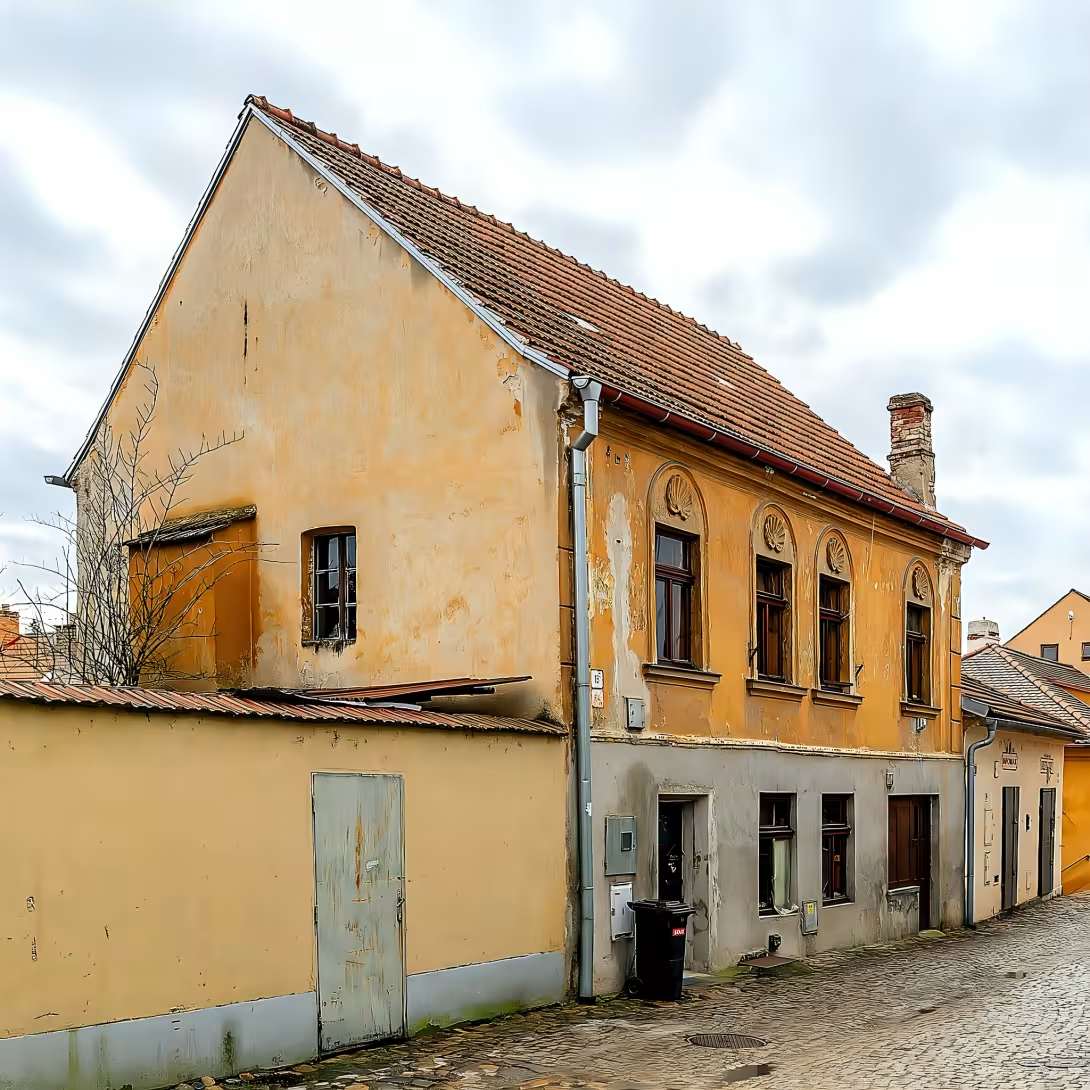
The Jewish house at Blahславova 64 / 16 in the Třebíč district Zámostí is one of valuable examples of Jewish architectural tradition. It's probably from the first half of the 17th century. In the course of long history he went through the gradual adjustments that transformed his character. The first half of the 19th century marks the classic modifications that gave the facade its present face. He succumbed to other significant changes in the 1930s when windows, doors, ground-floor windows and plaster were replaced. In 2020, the house had a cultural monument. This was followed by extensive reconstruction from 2021 to 2025, after which it was ceremonially opened as an apartment house called Nathan Apartments.
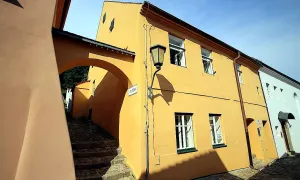
They build on an irregular, almost rectangular plan. The house is clocked and closed with a saddle roof. The street-oriented facade is a gutter. The ground floor offers a simple smooth surface with two windows and two inputs, one of which is accompanied by a window. The floor separates the characteristic cordon ledge from the ground floor and represents a more complex part with a more distinctive decoration. The Rustika combines four windows equipped with parapet mansions and shambles, decorated with stucco motifs. The special element consists of the strout facade on the east side where the narrow risalite with a counter roof exceeding two prevents is switched off.
The interior has retained an exceptional number of original elements. More vaulted structures are preserved, two black cuisine typical of Jewish buildings, wooden beam ceilings and ceiling stucco mirrors with frayed processing. The house has built-in cabinets and original doors with authentic fittings. Special attention should be paid to a window with a fixed central column that illuminates the stairway space with an original architectural solution. In the doorway of one of the black kitchens there is a mesuza, a traditional Jewish symbol.
The House presents a rare proof of Jewish material culture and architecture in Třebíči, which has managed not only to preserve but to adapt sensitively for current use. Apartments Nathan allow visitors to experience the continuity of history in an authentic historical environment.
Then and now
Drag the slider to compare how the landmark may have looked when it was built with the view today.
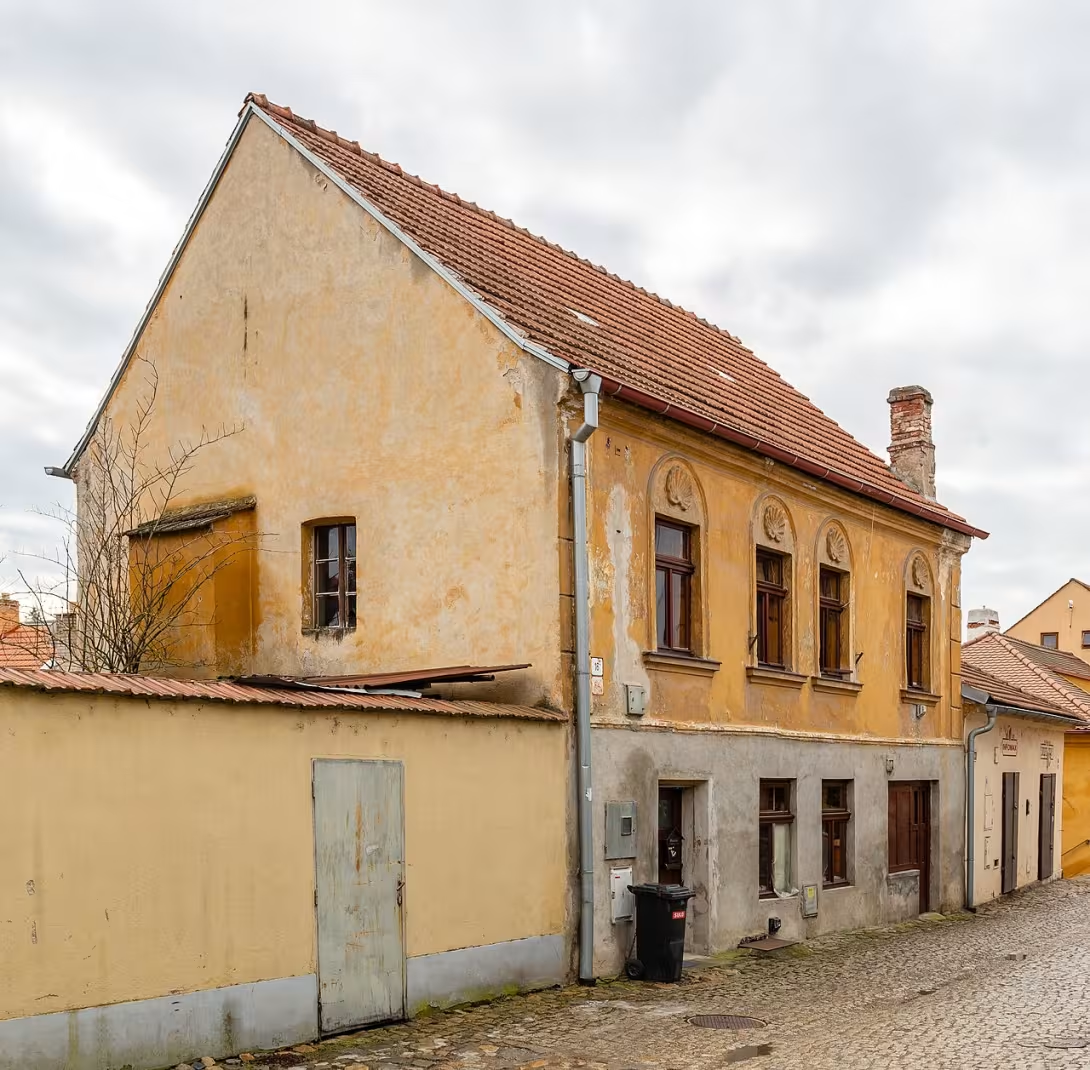

The historical appearance on the left is an AI-generated visualisation and serves as inspiration only.
Historical milestones
- 1636
- Likely year of house creation
- 20
- Declaration of the object for cultural monument
- 2025
- Festive opening as Nathan Apartments
Architectural development
The original building from the 17th century was adapted to classical style in the first half of the 19th century. Adjustments were made in the ground floor in the 1930s, including the installation of pantry windows and windows. In the years 2021- 2025 a comprehensive reconstruction took place.
Historical events
Declaration for the cultural monument in 2020; festive opening as Nathan Apartments in 2025.
Points of interest
- The building probably dates back to the first half of the 17th century. - Today's face of the facade is the result of the classic adjustments from the first half of the 19th century. - In the interior are preserved two black cuisine typical of Jewish buildings. - There is a mesuza in the doorway of one of the black kitchens, a traditional Jewish symbol. - After reconstruction in the years 2021 to 2025, the house was opened as apartment house of Apartments Nathan.
Guide
This guide is narrated by a synthetic voice generated by artificial intelligence.
Show guide text
This text was created by artificial intelligence and has not been editorially reviewed. It may contain inaccuracies.
Welcome to Třebíči, one of the most fascinating parts of the city, in the historic Jewish district of Zámostí. You're standing in front of the house with the number 16 in the street of Shraslav. Stop for a moment, take a breath and feel the atmosphere of this place. In front of you is a classic townhouse that is a silent but proud witness to centuries of history. When you look at it, you may only see one of many houses in a row, but every stone and every layer of plaster here tells their own story about the people who lived here, worked and dreamed.
Let us, together in spirit, return in time, deep into the past, to the very beginnings of this place. Imagine we're in the seventeenth century. It is year six hundred thirty-six. At that time there was no house like you see today. Instead, there was a garden that belonged to a man named Simon Hošek. It's fascinating to realize how the landscape of the city changed. Where today you feel the hardness of masonry and you see the defined lines of facade, once grew trees, herbs and maybe even fruits. It is at the site of this garden that it is likely that the foundation of the house that you are now facing is created. The creation of this building in the first half of the seventeenth century brings us to understand how the Jewish district gradually developed and how space within the narrow streets Zámostí was used very effectively.
Now pay attention to what you see right in front of you. Look at the front of the house. Although the foundations are much older, the face the house shows the world today comes from a much later time. In the first half of the nineteenth century, the object underwent major modifications in the spirit of classicism. Classicism was a style that sought a return to harmony, balance and purity. It is these modifications that have defined the present facade that you are now observing. Notice the moderate elegance, the absence of excessive ornaments and calmness radiating from the building. This style was not only a matter of fashion, but also reflected social changes and the desire for order and clarity. The house thus mutated over time from the simple construction of the seventeenth century into a representative city house of the nineteenth century.
If you're standing in the street of Shredislav, try to imagine life in the Jewish quarter centuries ago. Home was many, they were close together, formed a compact whole, which in many ways was a separate world in the world. Even though we don't know the specific names of all the residents who lived in this house, we know that these people were part of a living community that formed the identity of Třebíč. This house was not just a wall and a roof, it was a space for family life, for business and for maintaining traditions that passed down from generation to generation.
And this is where we come to the most mysterious and exciting thing that is hidden inside these walls. Although the house now serves a different purpose, details have been preserved in its interior, which are absolutely typical of Jewish buildings and rare. If you could take a peek inside, you would encounter two so-called black kitchens. Maybe you're wondering why they're called black. It wasn't because they were black, it was because they were cooking over open fire, which led to strong planting and blackening of walls. These kitchens were very specific in Jewish houses, often located in such a way as to minimise the risk of fire in densely built neighborhoods, while meeting the practical needs of the household.
Even deeper into tradition, one small but extremely important detail will lead us. There is a mesuza in the doorway of one of these black kitchens. Mesuza is a small rectangular object, inside which is a scroll with a text from the Torah. It is a deeply symbolic element that Jewish families attach to the right side of the front door of their houses. Mesuza reminds everyone who enters or leaves, the presence of God and the covenant between God and men. It's a silent testimony about the faith and spiritual life of people who once lived here. The fact that the mesuza survived in this house gives the building incredible value and connects us with the people who walked here hundreds of years ago.
This house has been through a new era in recent years. In the year two thousand twenty it was officially declared a cultural monument, which means that the state recognised its irreplaceable importance for the history and architecture of our region. But the monument doesn't have to be just a museum that we're just looking from the outside. This object has acquired a new life. In the year two thousand twenty-five it was festively opened as Nathan Apartments. It is a beautiful example of how historical substance can be preserved while giving it modern use. The house began again to host people, although today in a different context than in the seventeenth or nineteenth century.
When you look around for the last time, see this house as a bridge. It is a bridge between the garden of Simon Hošek and modern apartments, a bridge between the rough classicism and the deep Jewish tradition, a bridge between forgotten names of the past and visitors like you. It's a layered story about survival, adaptation and respect for history.
We now invite you to continue to explore the Jewish district Zámostí. Let yourself be guided by narrow streets, note the details on the facades of other houses and look for clues of the past that are hidden here at every step. We hope this short stop story helped you see more than what you can see at first sight. We wish you a pleasant continuation of the journey and many new discoveries in this magical corner of Třebíče. Goodbye.
Tips for visitors
The best time for a visit to Shrauslav 16 is in the spring or autumn season when the weather is pleasant and sunny. These months offer ideal lighting conditions for photography, especially in the morning or evening, when the classical architecture of the houses in the Jewish district of Zámostí is illuminated with beautiful colours.
Parking and transport: The place is available both by car and public transport. We recommend checking the current connection using an online search engine or local information sources. Parking facilities are located near the centre of Třebíče, where it is also possible to use public transport.
What to take with you: When visiting don't forget the protective sunglasses and plenty of water, especially in the summer months. The photographic device is also suitable for capturing architectural details of the houses or panoramic views of the Jewish quarter.
Photography: The best places for photography are located near the streets where it is possible to take pictures with an overall view of the Jewish quarter. Morning and evening light offers the best conditions to capture the atmosphere of the place.
What to visit in the area: The Jewish Quarter Zámostí is nearby, which is part of Třebíče and entered on the UNESCO World Heritage List. It is an ideal place to explore historical buildings and understand the cultural heritage of the area.
For kids
Imagine going back 390 years to a time when few people lived in the world and the country was even more wild than it is today. It was a time when people began to settle in small villages and build the first wooden houses.
This place where the castle of Congratulations stands today was once a great meadow where shepherds and dogs caught goats and sheep. Around 1636 more people started moving here and a small mansion was established, which later grew into a beautiful castle.
Businesses nearby
Do you run a restaurant, accommodation, shop, museum, rental, wellness or other visitor service near this monument? Show yourself directly to the people heading to it — this is how they will see you in the app and on the web:
Nearby
Židovská čtvrť Zámostí v Třebíči, zapsaná na seznamu světového dědictví UNESCO.
Accommodation nearby
Themed route
Thematic cruise route around the Jewish district Zámostí
1. Jewish District Zámostí - Type: Historical landmark, UNESCO World Heritage - Why is it worth visiting: It is the oldest and best preserved Jewish quarter in the Czech Republic. Visit it for a look at historical houses, synagogues and microbes, which represent a rich cultural and spiritual tradition.
2. Synagogue - Type: Religious object - Why is it worth a visit: The synagogue in Zámostí is the oldest preserved synagogue in the Czech Republic. It's a place where you can explore the wealth of Jewish religion's history and architecture.
3. Milky - Type: Historical object - Why is it worth visiting: Mikvé is the only public hoodie in the Czech Republic that has been preserved until today. It's a fascinating example of Jewish ritual and architecture.
4. The Zamostský Museum - Type: Museum - Why is it worth a visit: Here you will find exhibitions that illuminate the history of the Jewish community in Třebíči and their contribution to the region. It's an ideal place for a deeper understanding of the neighborhood's cultural heritage.
This route offers a view of the history, culture and architecture of the Jewish community in Třebíči. Visit the Jewish Quarter Zámostí for an unforgettable experience full of historical knowledge.
Seasonal recommendations
In spring, the surrounding area is dominated by the awakening nature and a fresh green shade of leaves, creating an optimistic atmosphere. We recommend to wear more layers of clothing because of variable high weather and schedule a visit to the morning when the light is the cleanest.
The summer months bring bright sun and rich colors of the landscape that highlight the details of the facade. It is advisable to arrive first thing in the morning to avoid the largest groups of visitors and heat. Remember light, breathable clothes and plenty of fluids.
Autumn is a period of golden colours and morning fog, which give the monument a mysterious and peaceful touch. Ideal is a visit in the afternoon when the sun paints the surroundings in warm tones. Practical recommendations are waterproof shoes and a warm sweater.
In winter the place is very quiet, especially if the landscape is covered with snow, which creates a contrasting and pure visual impression. In view of the shorter day and lower temperatures, select thermal clothing and check the opening times, which are usually limited during this period.
Visualizations and artistic views


The visualisations are generated by artificial intelligence and serve as inspiration.
Photos from the area
Real photos taken near the monument


Zdroj a licence jsou uvedeny u každého snímku.
Tips from visitors
No tips yet. Be the first!
Log in and add your tip.
Sources and literature
Photos: Michal Klajban / CC BY-SA 4.0, rozlišení zvýšeno umělou inteligencí — Wikimedia Commons. The author and licence also appear when you hover over the image.
Faktickým podkladem tohoto textu byl článek na Wikipedii, jehož autory jsou přispěvatelé Wikipedie. Článek je dostupný pod licencí CC BY-SA 4.0.
Location on the map
Příběhy a pověsti
Legendy, pověsti a příběhy spjaté s touto památkou
Fotografie návštěvníků
Zatím žádné fotografie. Buďte první, kdo přidá fotografii z návštěvy!
Log in a přidejte svou fotografii nebo hodnoťte.
Za ověřenou návštěvu v aplikaci získáte víc bodů — poznáme podle GPS, že jste na místě.
Reviews and comments