



Boží muka (Krukanice) Wayside shrine
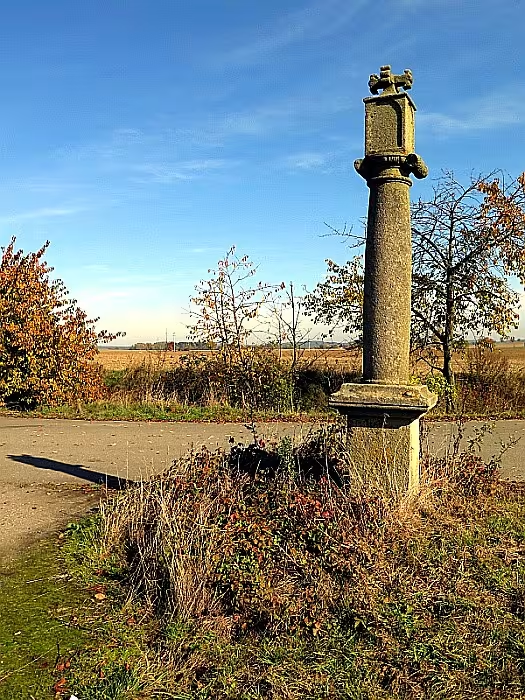
The Baroque torture of God in Krukanice, the village of Pernarec in the district of Pilsen-North, represents an important landscape element from the first half of the 18th century. This cultural monument, protected since 1964, stands by the road to Roznivic. It is currently in a state of emergency caused by a traffic accident in 2022.
The creation of this small sacral structure falls into the period of the high baroque. There was an intensive construction of small monuments in the Czech countries aimed at the spiritual connection of rural landscape. The specific circumstances of origin and the name of the donor are not known in the preserved sources.
The building was made of coarse grain sandstone and consisted of several architectural parts. The foundation consisted of a prismatic plinth with a square plate, which was concave-concave at the bottom and concave at the top. On the board was a smooth cylindrical column approximately 180 centimeters high. It was finished with a foot and a Yonian head with volutes, which decorated the motif of roses and pearls. The upper part was a chapel with shallow nobodies. One of them contained the relief of the crucified while the others were fitted with modern images of the saints. The whole building was closed by a concave-shaped chamber needle with a stone four-arm cross whose ends were decorated by lilies oriented towards the direction of the road.
The municipality of Pernarec provides the management of the monuments. On 30 November 2022, there was a car accident at night, in which God's torment was severely damaged. The impact broke the memory into several parts and separated the plate with a column and a chapel. Only a half-returned base remained in the original place. The damage to the building was calculated at CZK 20,000.
After the accident, smaller parts of the monument were deposed at the Pernarc Municipal Office. In December 2025, an earlier status check was carried out. The monuments were classified as extinct because the damage had not been rectified by then.
These divine torments represent a proof of Baroque little architecture, which has been building the nature of the landscape along the road to Roznivic for centuries. Despite the current emergency situation, the object remains an important historical testimony. His fate is a warning example of the vulnerability of monuments near transport roads. Visiting the site offers the possibility of considering the importance and protection of small sacral structures in the Czech rural area.
Historical milestones
- 1964
- A list of cultural monuments.
- 2022
- Severe damage to the sight in a car accident.
- 2025
- A confirmation of the emergency status by the monument office.
Architectural development
The original Baroque building was made of sandstone on a prism plinth. The head of the column was decorated with volutes with the motif of roses and pearl. The chapel contained the relief of the crucified and modern-day images of the saints.
Historical events
18 february 1964 declaration for cultural heritage; 30 november 2022 traffic accident and subsequent damage to the monument; december 2025 inspection of the monument office confirming the emergency situation.
Owners
Pernarc
Points of interest
- This monument dates back to the first half of the eighteenth century and has been protected since nineteen hundred and sixty-four. - The object was made of coarse sand and consisted of a prism plinth, a cylindrical column and a chapel with nobodies. In the year two thousand and twenty-two, God's torment was severely damaged in a car accident that caused them to be broken into several parts. - The damage on this historic building was calculated at 20,000 crowns. - In December of the year two thousand twenty-five, the monument was marked as decaying because there had been no repair of the damage until then.
Guide
Show guide text
This text was created by artificial intelligence and has not been editorially reviewed. It may contain inaccuracies.
Welcome to the Krukanice. You are standing right where time has stopped and where history meets the presence of this silent, stone witness. In front of your eyes is the wrath of God, which, despite its size, radiates special strength and peace. You may think it's just a piece of stone by the road, but if you stop and pay attention to it for a while, you'll realize how deeply involved this place is in this country's story. Please feel the atmosphere of this place, feel the silence around you, and let yourself be carried away by the imagination of what this place has experienced.
Now let's look together at how this object came into being. To understand its meaning, we need to go back far into the past, namely the first half of the eighteenth century. At that time, in the baroque era, building such torments of God was very common. They were not only religious symbols, but they also served as important landmarks for people who moved around. This monument was strategically located on the road leading to Roznivic to serve as a sign for any traveler or traveler who passed through here. Imagine those ancient times when people were on horseback or on foot on these roads and this place was a certain point for them in a constantly changing landscape.
Now pay attention to the construction itself and to what you're seeing right in front of you right now. This whole object is made of coarse grain sandstone. If you approach it closely, you can see its structure, its inequality, and the tangible matter that carries traces of time. The foundation of the whole structure is the prism plinth, which gives the whole stability and strength. On this plinth, there is a cylindrical column, whose smoothness contrasts with the roughness of the surrounding stone. If you lift your gaze even higher, you'll see the Yonian warhead. This detailed processing is a typical feature of Baroque architecture and gives the whole column elegance and grandeur. Above the column there is a chapel, which is made up of nobodies, i.e. those depths that can hide spiritual meaning within themselves. This whole building is finished by the chamberlain of the needles, which at the top concludes the stone cross, heading towards the sky. Each of these elements, from the base plinth to the cross itself, forms one whole, designed to last centuries.
Even though we don't know the names of the particular architects who created this piece, we can feel their efforts and their art in every cut into the sandstone. This monument is not only a dead object, it is a living proof of human efforts to keep something beautiful and eternal in the landscape. Its importance was so great that already in nineteen hundred and sixty-four it was included in the list of cultural monuments, thereby recognising its irreplaceable value for our heritage.
However, the history of this place is not only about beauty and duration, but also about fragility. Even such solid stone monuments can be vulnerable. In the year two thousand twenty-two something very sad happened. This divine torture was badly damaged in an accident caused by a vehicle. The stone wound was deep and left traces in the memory that can still be seen today. The situation further became clear in the year two thousand twenty-five when the landmark office confirmed that the object was in a state of emergency. It's a reminder of how easily we can lose parts of our history if we don't care about them. This event raises the question of how we will protect our past in this rapidly changing world, where modern transport meets ancient roads.
So arrest this moment, this view of the damaged but still standing monument. There's something fascinating and sad at the same time. You stand before something that has survived for hundreds of years, but which is now fighting for its next existence. It's a challenge to appreciate everything that's left of our past.
Thank you for stopping by and paying attention to God's torment in Krukanice. We hope that this brief insight into the past has helped you better understand this piece of our history. We wish you a pleasant continuation of your journey, whether you are going to Roznivic or in any other direction, whether you enjoy the beauty of the surrounding countryside and other secrets that the journey will bring. Goodbye.
Tips for visitors
The best time to visit is a sunny day during spring or autumn months, when the low sun beautifully depicts the structure of rough-grained sandstone and details of the Yonian warhead.
You can reach the monument on the road leading towards Zneňevice.
Take with you a high-quality camera with a lens for details to capture the capitals. The best light for shooting is in the morning when the front of the object is evenly lit.
In the immediate vicinity is the village of Pernarec, which offers a short walk around the surrounding landscape, which complements the historical nature of this Baroque monument.
Frequently asked questions
Can the monument be visited?
This is a structure in a public space that can usually be seen from outside free of charge. We have not verified that this particular one is freely accessible. According to the heritage register the structure is in poor condition – do not enter it and take care nearby.
Where is the monument?
Location: Krukanice. The map on this page shows the exact spot.
Why is the monument protected?
It is listed in the Central List of Cultural Monuments of the Czech Republic as a cultural monument (register no. 1000152396).
Businesses nearby
Do you run a restaurant, accommodation, shop, museum, rental, wellness or other visitor service near this monument? Show yourself directly to the people heading to it — this is how they will see you in the app and on the web:
Nearby
Obec Pernarec, silnice do Rozněvic.
Accommodation nearby
Trips and activities nearby
Guided tours, tickets and activities nearby from GetYourGuide
Affiliate link: if you buy from the partner, we may receive a commission. The price for you does not change.
Search tours and activities →Themed route
Thematic cruise route from Krukanice
1.Boží muka (Krukanice)
Type: Historical monument
Why is it worth a visit: This richly decorated statue is a reminder of past tragedies and has a significant history. It is an ideal place to understand the cultural heritage of the area.
2. Municipality of Krukanice
Type: Local centre
Why is it worth a visit: Explore picturesque streets with traditional houses and enjoy a quiet environment. Here you can find local shops where you can learn more about life in this part of the Czech Republic.
3. Municipality of Pernarc
Type: Local community
Why is it worth a visit: Visit this place for its idyllic character and enjoy a quiet moment in nature. It's a beautiful place to rest after exploring God's torment.
4. Roads to Roznivic
Type: Walk on open road
Why is it worth a visit: This road offers beautiful views and is ideal for a relaxing walk. It's an opportunity to enjoy the rural environment and stop for a while to enjoy your peace.
5. Return to Krukanice
Type: Final point
Why is it worth a visit: After exploring the surrounding areas, you will return to God's torment to remember your impressions and enjoy the peace in its nearby surroundings.
Seasonal recommendations
Spring: In the spring season, the surroundings of God's torment in Krukanice are particularly impressive because of the young leaves of trees and flowering bushes that add life force to the region. The sun illuminates the memory more gently than in the summer months, which allows a more detailed tour of architectural elements. Visitors should be prepared for suddenly changing weather and therefore it is advisable to carry light clothes that can be easily added or removed. The best time for a tour is in the early afternoon when sunlight is optimal and crowds are usually less.
Summer: The years are full of heat and life in Krukanice. The sun illuminates the memory strongly, making it an ideal place to photograph in the light afternoon. Due to high temperatures, it is advisable to choose cool clothes and have a drink with you to avoid sun fatigue. In addition, visitors can meet larger crowds during the summer days, so it is recommended to visit the memorial morning or late in the day.
Autumn: In the autumn season, the leaves of the colored gloss are acquired and the surroundings of God's torment are transformed into a magical still life. The sunlight is milder, allowing long walks without fatigue. Visitors should be prepared for colder weather and therefore it is advisable to wear more layers of clothing. The best place to visit the memory is in bright, sunny days, where the colour contrasts of the leaves are highlighted.
Winter: Winter brings peace and quiet to the surroundings of God's torment. The sun illuminates the memory with a weaker light, creating a melancholy atmosphere. Due to cold temperatures, it is important to equip yourself with warm clothes and protective items such as scarf or cap. Visitors should seek sunny moments when light is optimal for inspection and be aware of the possibility of suddenly changing weather.
Visualizations and artistic views

The visualisations are generated by artificial intelligence and serve as inspiration.
Photos from the area
Real photos taken near the monument

Zdroj a licence jsou uvedeny u každého snímku.
Tips from visitors
No tips yet. Be the first!
Log in and add your tip.
Sources and literature
Photos: Sovicka169 / CC BY-SA 4.0 — Wikimedia Commons. The author and licence also appear when you hover over the image.
Faktickým podkladem tohoto textu byl článek na Wikipedii, jehož autory jsou přispěvatelé Wikipedie. Článek je dostupný pod licencí CC BY-SA 4.0.
Location on the map




Příběhy a pověsti
Legendy, pověsti a příběhy spjaté s touto památkou
Fotografie návštěvníků
Zatím žádné fotografie. Buďte první, kdo přidá fotografii z návštěvy!
Log in a přidejte svou fotografii nebo hodnoťte.
Za ověřenou návštěvu v aplikaci získáte víc bodů — poznáme podle GPS, že jste na místě.
Reviews and comments