



Boží muka západně od Březnice na rozcestí Wayside shrine
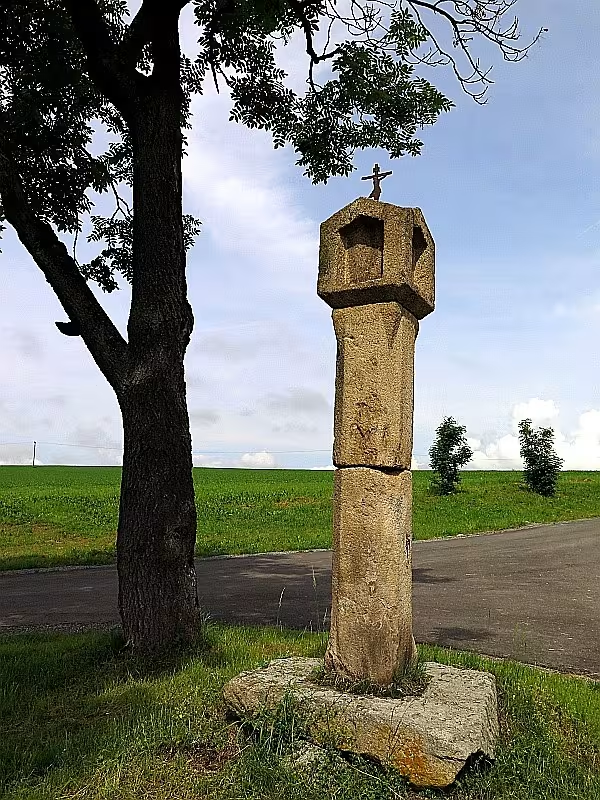
The stone torture of God at the village Březnice, located in a crossroads north of the village in the district of Tábor, represents a special cultural monument. Probably from the 17th century, this torture shows a fascinating mixture of Gothic sticks and Renaissance-Baroque superstructures. Their location in the landscape is not only historically interesting but also visually attractive.
God's torment was built as a memorable element at the crossroads. Their architecture combines gothic elements in the sling with Renaissance-Baroque details in the lantern superstructure, which reflects the stylistic transition of the time. This type of monument was used to celebrate and worship divine events or as a warning for passengers.
Although information about the owners or administrators of God's torment remains unclear, their existence shows the importance of this place to the local community. Torture served as both a visual and symbolic point of orientation in the landscape.
Today, God's torture is protected as a cultural monument, making it an important historical element of the region. Its preservation allows visitors to feel connected to the past and understand the cultural importance of similar objects.
Visiting God's Torture at Březnice offers a unique opportunity to explore the history and architecture of the region. Their location at the crossroads not only increases their importance, but also provides beautiful views of the surrounding region. This monument is a reminder of the past and of the historical wealth of the Březnice region.
Let us remember that every monument carries with it part of history and culture. Visiting these places allows us to better understand the past and appreciate the historical importance they have for the present. God's torture at Březnice is exactly where history becomes visible and accessible to each of us.
Architectural development
The origin of the tortures of God has a gothic shape, while the lantern superstructure with nothing has the character of Renaissance-Baroque.
Points of interest
- The stone torture of God at the village Březnice represents a special cultural monument.
- Probably from the 17th century and shows a mixture of Gothic sticks with Renaissance-Baroque superstructure.
- God's torment was built as a memorable element at the crossroads, used to celebrate and worship divine events or as a warning for passengers.
- It is protected as a cultural monument, which makes it an important historical element of the region.
- Visiting God's torture offers an opportunity to explore the history and architecture of the region with beautiful views of the surrounding region.
Guide
Show guide text
This text was created by artificial intelligence and has not been editorially reviewed. It may contain inaccuracies.
Welcome to the unique monument that we have suspected since ancient times - God's torment west of Březnice at a crossroads. You stand before this stone witness of the past, whose physical shapes seem to be thoughtful and full of deep meanings.
The God's torment that we see today is part of the rich history of the Březnice district in the Tábor district. Although specific data on its creation and creators remain unknown, we can assume that it was built as a monument to tragic events or to the protection of passengers. Such structures were often created in the Middle Ages and served as a warning and prayer places.
Look up at this stone work. Notice his robust architecture, which may seem simple to you, but full of symbolism. The stone shape of God's torture is designed to withstand time and natural elements. Even if we don't know the details of its creation, every element tells us about generations past that have been trying to preserve the memory of important moments.
Although we know nothing about the specific personalities associated with this divine torture, we can imagine that she witnessed many travelers and their fates. This monument reminds us how important it was for our ancestors to share experiences and keep memories.
The interesting thing is that although most details of this divine torture remain unknown, its existence itself represents a fascinating chapter in our history. Every stone has its own narrative, waiting to be revealed.
Let us now absorb the atmosphere of the place around God's torment and think about how history has happened here. This monument is part of the cultural heritage of our region and is worth exploring with respect and respect.
Thank you for your attention and we hope that this piece of history inspired you. If you want to explore more, feel free to look at other sights around Březnice. When we meet again, I wish you good travel and new discoveries!
Tips for visitors
The best time for a visit is morning or late afternoon hours, where soft light falls on the stone surface of God's torments, which highlight details of stone working.
We recommend to bring comfortable shoes suitable for the field, because it is an object located in the landscape by the road.
For the best photos we recommend to capture the memory in the context of the surrounding South Bohemian landscape, especially during the golden hours before sunset.
For families with children, the visit is suitable as a short stop during a walk, where the importance of historical torments in the Czech landscape can be explained to children.
Frequently asked questions
Can the monument be visited?
This is a structure in a public space that can usually be seen from outside free of charge. We have not verified that this particular one is freely accessible.
Where is the monument?
Location: Březnice, Jihočeský kraj. The map on this page shows the exact spot.
Why is the monument protected?
It is listed in the Central List of Cultural Monuments of the Czech Republic as a cultural monument (register no. 22270/3-4751).
Businesses nearby
Do you run a restaurant, accommodation, shop, museum, rental, wellness or other visitor service near this monument? Show yourself directly to the people heading to it — this is how they will see you in the app and on the web:
Nearby
ITEX Show interactive overview of the surroundings - restaurants, accommodation, rentals and other places within a 15 km radius.
Data: OpenStreetMap contributors, 15 km radius.
‡ Historical monuments
- Baroque sculpture Great Depot (3.3 km)
- Hradiště Hradec u Nuzic (4.5 km)
- Municipal Museum (5.6 km)
- Museum of Tourism (5.8 km)
- Master Jan Hus (6.7 km)
- 1914-1918 (9.7 km)
- 1914-1918 to the fallen soldiers of the Hidden (10.6 km)
- _ (11.7 km)
Restaurant and catering
- camera (4.8 km)
- Hermína (5.8 km)
- Dining room on Rose (5.8 km)
- Pizzeria Kontakt (6.5 km - Veselská 747)
- Hossovka Kacovská turret (7.4 km - Žizkova 562)
- Hostin u Hrdliččky (8.1 km)
- Lehna Na Kovarní (8.6 km)
- Neznašovské farmhouse (9.7 km - 15)
Accommodation
- Pštross vila (5.6 km - Valtrova 33)
- U Pichllou (5.6 km)
- Hotel Pansk (5.7 km)
- U Draka (5.9 km)
- Jupiter (5.9 km)
- Plzenka (7.1 km)
- Castle guesthouse (7.1 km)
- Pezion under churches (7.2 km)
› Rental and sports
- Mech Wall (4.6 km)
- JOLA (5.5 km)
- Swimming pool Beshynie (6.4 km)
- Sport hala (6.9 km)
- Cyclosport
- Kanoist Club Spark KKJ Týn nad Vltavou (7.3 km - Salt 422)
- Na Palubu (7.5 km)
- Strelnice (12.5 km)
© Tourism and nature
- Kopanins (for cross) (4.5 km)
- Jewish Mound (under Nuzice) (4.6 km)
- Jewish gutter (mouth) (4.6 km)
- Outlook Vojty Náprstka (5.3 km)
- Komárov (6.2 km)
- U Hutí (7.0 km)
- K Černýšovice (rozc.) (9.2 km)
- Radetice (9.5 km)
Accommodation nearby
Themed route
1. Breakdown Type: Crossing Why to visit: It serves as a starting point for access to the main monument.
Boží muka západně od Březnice na rozcestí Type: Sacral monument Why to visit: The main objective of the tour represents a historic stone building.
3. Ground floor of the monument Type: The immediate area Why to visit: A place for quietly observing details and a quiet stop.
Seasonal recommendations
Spring: In spring, this site is surrounded by fresh greenery and flowering field flowers. Light is soft and pleasant in this period, which gives the monument a gentle look. We recommend to come in the morning when the air is freshest. Due to the variable weather, we can use layered clothes and light jackets.
Summer: The summer season offers intense sunlight and rich vegetation that creates a shadow around the crossroads. The atmosphere is warm and alive. Due to higher temperatures and possible increased movement of people on rural roads, it is best to arrive early in the morning or just before sunset. Don't forget enough drinking water and headgear.
Autumn: Autumn brings to the surroundings melancholy tones and fascinating color changes in the landscape. The morning mist often settles right at the monument, creating a mystical and quiet atmosphere. It's the perfect time for photography. Due to the damp air and rain we recommend to wear a waterproof jacket and solid footwear suitable for the field.
Winter: In winter, God's torment in the landscape is very lonely and majestic, especially if everything is covered with snow. The atmosphere is quiet and freezing. Due to short days and low sun, plan to visit around noon. It is necessary to have very warm clothes, quality gloves and shoes with good grip in case of ice or snow.
Visualizations and artistic views


The visualisations are generated by artificial intelligence and serve as inspiration.
Photos from the area
Real photos taken near the monument


Zdroj a licence jsou uvedeny u každého snímku.
Tips from visitors
No tips yet. Be the first!
Log in and add your tip.
Sources and literature
Photos: Sovicka169 / CC BY-SA 4.0 — Wikimedia Commons. The author and licence also appear when you hover over the image.
Location on the map




Příběhy a pověsti
Legendy, pověsti a příběhy spjaté s touto památkou
Fotografie návštěvníků
Zatím žádné fotografie. Buďte první, kdo přidá fotografii z návštěvy!
Log in a přidejte svou fotografii nebo hodnoťte.
Za ověřenou návštěvu v aplikaci získáte víc bodů — poznáme podle GPS, že jste na místě.
Reviews and comments