



bývalý kostel sv. Maří Magdalény Vlastějovice Chapel
Objekt se nedochoval — na místě dnes nestojí. Následující text popisuje jeho historii, ne současnou návštěvu.
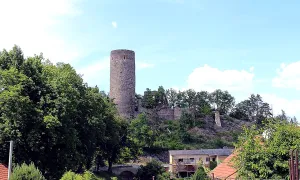
The Chapel of St. Mary Magdalene in Vlastějovice was once a notable Gothic chapel located northeast of the village, near Fiolník hill within forested areas. Originally constructed during Bohemia's rich cultural and architectural Gothic period, it served religious purposes and stood as a prominent landscape landmark. Despite its historical significance, the chapel was demolished at the end of the 20th century.
The chapel originated in the Gothic era when Bohemia was a significant cultural and political center in Central Europe. This period saw the flourishing of Gothic architecture across the region, characterized by intricate designs and religious significance. The Chapel of St. Mary Magdalene exemplified this style with its original construction featuring a defensive tower base.
Architecturally, the chapel was notable for its orientated structure, consisting of a single nave with a polygonal choir and a western porch. It featured latticed windows with sloped brick sills, typical of Gothic design. In the 17th century, significant modifications were made: a western vestibule and staircase tower were added, enhancing functionality and aesthetic appeal. The structure also included a loft supported by three cross vaults in its western section.
Throughout its history, the chapel underwent various changes in ownership and administration, reflecting broader historical shifts. Initially protected as a cultural monument, this status was revoked in 1976 by the Ministry of Culture of Czechoslovakia. Despite losing protection, it remained an important landmark until its eventual demolition.
The chapel's most notable events include its construction during the Gothic period and the modifications made in the 17th century. Its demolition at the end of the 20th century marked the end of its physical presence but not its historical significance. The site was once a prominent landscape feature, adding to its cultural value.
Today, the original structure no longer exists; however, the location remains part of the natural landscape near Vlastějovice village. While the chapel itself is gone, visiting the area offers an opportunity to reflect on its historical importance and appreciate the surrounding natural beauty. The site serves as a reminder of the region's rich architectural heritage and invites visitors to explore the history that once unfolded there.
Architectural development
Originally constructed in the Gothic style with a defensive tower base, the chapel underwent significant changes in the 17th century when a western porch and staircase were added. The structure featured latticed windows and a loft supported by three cross vaults. Despite its historical significance, it was demolished in the late 20th century.
Historical events
In the 17th century, a western porch and staircase tower were added to the chapel.
The chapel was demolished at the end of the 20th century.
Points of interest
- The chapel's original construction included a defensive tower base, hinting at its dual role as both a religious and protective structure during the Gothic period.
- Despite being designated a cultural monument initially, the Chapel of St. Mary Magdalene lost this protection in 1976 due to decisions by the Ministry of Culture of Czechoslovakia, reflecting shifting priorities or perspectives on heritage conservation.
- The chapel's architectural modifications in the 17th century, such as adding a western vestibule and staircase tower, demonstrate how structures were adapted over time to meet changing needs and tastes while maintaining their Gothic essence.
- Although demolished at the end of the 20th century, the site remains significant for its historical role and connection to Bohemia's rich cultural past, offering visitors a chance to engage with history through the landscape itself.
- The chapel was part of a broader tradition of Gothic architecture in Central Europe, characterized by intricate designs that combined religious significance with aesthetic appeal, as seen in its latticed windows and sloped brick sills.
Guide
This guide is narrated by a synthetic voice generated by artificial intelligence.
Show guide text
This text was created by artificial intelligence and has not been editorially reviewed. It may contain inaccuracies.
The Chapel of Saint Mary Magdalene, also referred to as a church, no longer stands today. It was located northeast of Vlastějovic in the Kutná Hora district, in forests near the Fiolník hill. It was protected as a cultural monument, but the Ministry of Culture revoked this protection on December thirteenth, nineteen seventy-six.
Originally it was a Gothic structure with a fortified settlement. It stood in places where iron ore was mined. In the seventeenth century, a western vestibule and an annex with stairs were added to it. In the western part of the nave, a spacious gallery, that is a raised platform, was created at that time. Following the Josephine reforms, the chapel was closed and began to decay. For a long time it stood as a ruin and was a striking landmark of the landscape. At the end of the twentieth century it was demolished and its foundations were destroyed by surface mining.
The chapel was oriented and had one nave, a polygonal choir and a western vestibule. Even before demolition, the masonry was preserved up to the crown. The façade was smoothly plastered and articulated by buttress pilasters. The windows of both the nave and choir were pointed and their slanting reveals were built from bricks.
Two windows illuminated the main nave and originally it was covered by two bays of cross vaults. The brick gallery in the western part was supported by three cross vaults. The triumphal arch between the nave and the choir no longer had a preserved decorative border, the so-called archivolt. Only a smooth, unarticulated reveal was visible on it. The shallow choir was vaulted with lunettes and light entered it through three windows.
The western vestibule probably had a flat ceiling. Inside there was a staircase that led to the gallery. From the south side, a small chamber with a barrel vault adjoined the vestibule.
Businesses nearby
Do you run a restaurant, accommodation, shop, museum, rental, wellness or other visitor service near this monument? Show yourself directly to the people heading to it — this is how they will see you in the app and on the web:
Visualizations and artistic views

The visualisations are generated by artificial intelligence and serve as inspiration.
Tips from visitors
No tips yet. Be the first!
Log in and add your tip.
Sources and literature
Faktickým podkladem tohoto textu byl článek na Wikipedii, jehož autory jsou přispěvatelé Wikipedie. Článek je dostupný pod licencí CC BY-SA 4.0.
Location on the map





Příběhy a pověsti
Legendy, pověsti a příběhy spjaté s touto památkou
Fotografie návštěvníků
Zatím žádné fotografie. Buďte první, kdo přidá fotografii z návštěvy!
Log in a přidejte svou fotografii nebo hodnoťte.
Za ověřenou návštěvu v aplikaci získáte víc bodů — poznáme podle GPS, že jste na místě.
Reviews and comments