






Čertův mlýn Water mill
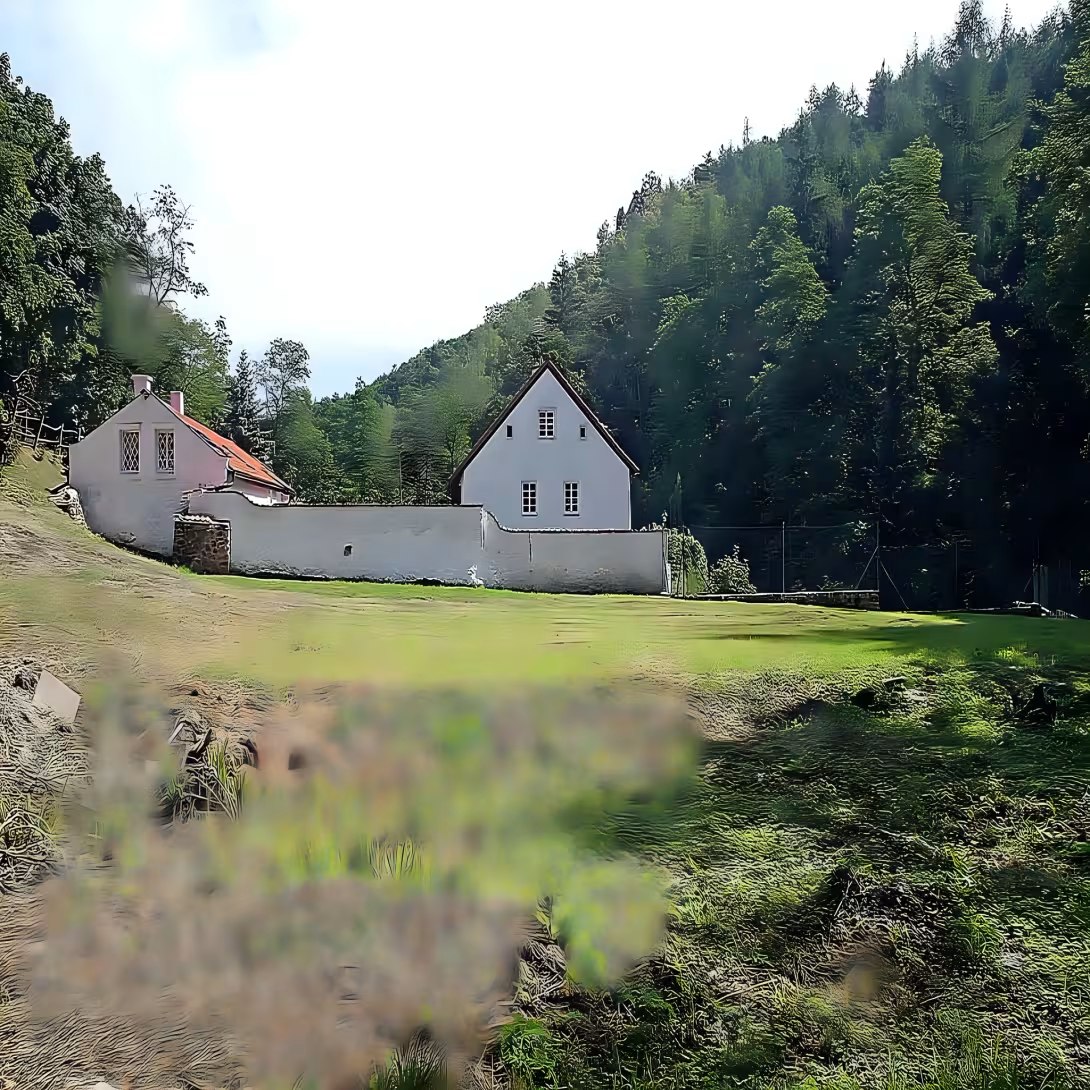
Čertův mlýn, also known as the Tuček Mill, is a baroque water mill on the Šárecký creek in Prague 6-Liboci. This monument from the turn of the 17th and 18th centuries kept the original available with an economic building and a fenced wall with a gate. Since 1958, it has been protected as a cultural monument.
It is located in the quiet valley of Šárecký, which today forms a green space on the outskirts of Prague. The mill served not only as a technical building but also as a cruise restaurant and instead of theatre performances. Its complex is an example of the 18th century rural architecture, which was developed on the then edge of the city.
It was originally built probably at the turn of the 17th and 18th centuries, when water mills in the surrounding area performed an important economic function. Liboc was then a rural village where mills processed grain. The 30-year war affected rural economic development, but mills remained key building elements of the local economy.
Architectural consists of a main residential building on a square plan and a ground floor economic section. Both objects connect the wall with the gate and gate, have a saddle roof and stone wall. The main building has a wooden stove to the yard, the economic part is elongated with a vaulted vault in the cellars. In the 1970s and 1980s, the reconstruction took place in which copies of baroque and classical bars were installed in the windows.
The ownership of the mill changed over time. In the 19th century, Kaiser's restaurant, abolished in 1945, worked here. In the 1970s, the complex was in a state of emergency, but at the turn of the 1970s and 1980s, the new owner, the artist, adapted it as a studio, retains its original character.
It is interesting to rent the property south of the mill of the singers of the National Theatre Emil Pollert and Antonín Fencl, who founded the Natural Theatre in Šárka here in 1913. The project was renewed after World War I, in 1919. The site became an important cultural centre.
Today the mill is open to the public and retains the original atmosphere. The surrounding area consists of the Sárecká valley with natural elements such as the Sárecký stream and green areas. There are other sights nearby such as LibocKá fortress or LibocKý park. The mill offers not only a view of history, but also a pleasant environment for walks.
It is an example of how historical construction combines cultural heritage with modern life. The visit allows you to get to know architecture from the turn of the 17th and 18th centuries, while getting to know important cultural events. For lovers of history and nature, this is a place worth visiting.
Historical milestones
- 17th-18th century
- The formation of a water mill on the Sárecký creek.
- 1913
- Opening of the opera theatre of the Natural Theatre in Šářka on rented land.
- 1958
- Registered as a cultural monument of the Czech Republic.
- 1970s-1980s
- Reconstruction of the mill by the new owner, who adapted it as a studio.
Architectural development
The main building is square, storey with wooden bunk to the yard. The ground-floor economic building has a vaulted vault in the cellars and is connected to the main building of the fenced wall. There is an arched gate in the eastern part of the wall and a smaller gate north of the main building. A reconstruction took place in the 1970s and 1980s, where copies of baroque and classical bars were taken into the windows.
Historical events
- turn of the 17th and 18th centuries
- Likely to create a water mill on the Sárecký creek.
- 1913
- The opening of the activities of the Natural Theatre in Šárka on the property rented from Kaiser's restaurant where the Opera Sold Bride was played.
- 1945
- Cancellation of Kaiser's cruise restaurant in the mill.
- 1970s
- The mill was in a state of emergency.
Points of interest
- The mill is also known as the Fat Mill.
- The area served not only as a mill, but also as a place for cruise restaurants and theatre performances.
- In the 1970s and 1980s, it underwent reconstruction, where copies of baroque and classical bars were installed in the windows.
- The ownership of the mill changed over time. Kaiser's restaurant worked here in the 19th century.
- South of the mill was rented land to the singers of the National Theatre, who founded the Natural Theatre in Šářka here in 1913.
Guide
Show guide text
This text was created by artificial intelligence and has not been editorially reviewed. It may contain inaccuracies.
Welcome to the Devil's Mill - a place where history meets secrets
You are standing in front of one of the most interesting monuments of Liboce, which in the past has turned from the mill to the place of meeting people. In front of you is a simple but distinctive building with an economic character, surrounded by an old wall. Notice how the river Šárecký is quietly waved behind the wall - its water once powered the mill wheels. The building looks like a solid place that has lasted for centuries, yet it hides stories that have been constantly changing.
Originally, this mill was probably built at the turn of the seventeenth and eighteenth centuries. Its first owners were probably grinding the grain and processing the grain to get flour from it. The mill was built right by the creek, which was at that time the easiest and most effective way to get energy for the mill stones. The water that flows to this day was once a vital force for this place.
Let's take a closer look at what's surrounding you now. The main building is single storey, but it has deep cellars with a vaulted vault - a typical construction that has been common in mills and other economic buildings in the past. Take a look at the wall with the gate - it is one of the few preserved elements that remind you that this place was once protected from the unknown. In the 1970s and 1980s the mill underwent reconstruction, in which it was adapted for other purposes. Note the windows with baroque and classicist bars - they are not original, but their copies give the place a special atmosphere.
Now pay attention to how this area was transformed. After the original mill purpose, Kaiser's cruise restaurant worked here in the first half of the twentieth century. This means that a place that once worked for people's needs has become a place where people have been reunited and socialized. After World War II, however, the restaurant disappeared and the mill waited for another fate.
One of the most interesting moments in the history of this place was the period when the Natural Theatre in Šářka was established on the rented land near the area. In 1913 the opera theatre started to work here, which was unique by being built directly into nature. Even if you don't see the theatre yourself, you can imagine what it must have been like - the audience sat in nature and listened to music while nature spread around them. This was the time when Liboc became a place of cultural activity.
The mill is also known as the Tuček Mill, which reminds that even such simple buildings had their owners and their stories. In the 1950s the mill was registered as a cultural monument of the Czech Republic, which means it was recognised as a place of historical value. This was a step that saved this area from extinction and allowed it to become a place that we can explore today.
Let's see what makes this mill so special. One of the biggest attractions is that there was not only grinding of grain, but also a theatre performance and people were meeting at a cruise restaurant. This means that this place was a place where different layers of society met - from workers who were grinding flour here to spectators who came here to listen to music. This is a unique combination that makes the Devil's Mill a place worth knowing.
Now imagine what it must have been like at the time of the restaurant. People came here for trips from Prague to relax and enjoy nature. The mill was a place where different cultures and interests met - from agricultural work to art. This is one of the reasons why this place is referred to as a place with a rich history.
In front of you is a place that has turned from a mill into a cultural center and then into studios. In the 1970s and 1980s the mill was reconstructed and adapted for new purposes. Today it is a place that resembles the past, but at the same time it has become a part of the present life. Note how different ages meet here - from mill operations to cultural events.
If you want to get to know this place in more detail, you can see its surroundings and imagine what it must have been like at the time of the restaurant or theatre. The mill is also a great place for photography - its simple architecture and natural surroundings create a unique atmosphere.
Before you leave us, we want to thank you for taking the time and attention to this place. Čertův mlýn is one of those places that reminds us of how history changes and how simple structures can become places with rich stories. If you liked what you saw here, you can move on to Liboci and discover other hidden pearls of this place.
When we meet again, maybe at some other interesting place. Today, however, we are going to say goodbye to this place, which has shown us how history can be transformed and what the simplest building can hide. Thank you for your attention and when I see you!
Tips for visitors
The best time to visit the Certova Mill is in spring or autumn when nature is around the most beautiful and temperatures are pleasant. In the summer there may be noise due to tourists and in the winter access may be limited due to the ice water on the creek. The mill is ideal for walks when it is morning or late afternoon when light is softer and photography excels.
Parking near Čertov Mill is not directly near the monument, but in the surrounding area it is possible to find free seats in the parking lot in Liboci. The location is also accessible by public transport; the current connection can be found in the traffic search engine. It is recommended to arrive on foot because it is not far from the stop.
When visiting, wear a comfortable shoe because the area is usually uneven and moist. It is also appropriate to take an umbrella with you because the valley can be damp. If you want to photograph, take a lens with a larger field of vision to capture the whole mill and surrounding nature.
The best places for photography are the front of the mill, where you can see its historical architecture, and the surroundings of the Sárecký creek, where nature is the most beautiful. It is recommended to take pictures with scattered light, for example early morning or before sunset, when the light is softer and the color is more vivid.
In 30 minutes you can visit the Liboc Fortress, which is another historical monument, or LibocKý Park, where you can relax and enjoy nature. It is also worth visiting the area of the Šárecký Theatre, which is a cultural centre with various performances and events.
For families with children, visit to Certova Mill is a great opportunity to explore nature and history. Children can see the old mill and have fun walking through the Šárecká valley. You can also talk about the history of the place and how important it was for the locals. There is enough space in the vicinity for games and exploring.
Businesses nearby
Do you run a restaurant, accommodation, shop, museum, rental, wellness or other visitor service near this monument? Show yourself directly to the people heading to it — this is how they will see you in the app and on the web:
Events nearby

Zdroj akcí: otevřená data měst a obcí ČR (Národní katalog otevřených dat) a kalendář akcí Národního památkového ústavu.
Nearby
V okolí se nachází Šárecké údolí s přírodními prvky jako Šárecký potok a zelené plochy. V blízkosti (do 5 km) jsou další památky jako Libocká tvrz, Libocký park nebo areál Šáreckého divadla.
Accommodation nearby
Trips and activities nearby
Guided tours, tickets and activities nearby from GetYourGuide
Affiliate link: if you buy from the partner, we may receive a commission. The price for you does not change.
Search tours and activities →Themed route
Thematic cruise route: Čertův mlýn and surroundings
1.Čertův mlýn Water Mill - An interesting historical building with legends of the Devil, located near the Sárecký creek. It is a unique example of a water mill in a natural environment that attracts both lovers of history and nature.
2. Liboc Fortress The ruin of the medieval fortress - Approximately 1 km from Čertov Mill is located this picturesque ruin with well preserved remnants of castle walls. It's a great goal for lovers of medieval history and the romantic atmosphere.
3. Liboc Park Green area with relaxation possibilities - After visiting the fortress you can relax in a quiet park overlooking the surrounding countryside. It's an ideal place for a picnic or a short rest while walking.
4. Sárecký Theatre Area Cultural facilities - About 3 km from Čertov Mill, this theatre offers various cultural events. If you like local culture, you can check the current program here.
The route is designed to be logical and allow a visit to all the mentioned places in approximately 2-3 hours.
Seasonal recommendations
In spring, the area of the mill wakes up along with nature. The trees start to green and the first flowers appear around the water. The light in this period is delicate and very pleasant to capture the beauty of the place on the pictures. I recommend arriving in the morning when the air is the purest. Dress well, because it is still cold in running water, even when the sun is shining.
In the summer months there is a rich green and warm sun. The overall mood is alive and the sound of the water acts in a refreshing way. Because of the larger number of people, it is best to arrive immediately after opening so that you enjoy the place in peace. Prepare light clothes, headgear and plenty of fluids because it can be hot in the morning.
Autumn brings gold colours and deep orange tones around the mill. The morning mist above the surface creates a mysterious and calm mood. It's an ideal time for walking in a colorful landscape. Bring a waterproof jacket and tight shoes, because the road can be slippery due to moisture and falling leaves.
Zimą makes the place very quiet and somewhat crude. You can see here the frost on the rocks or the snowy branches of trees. The light is weak and the days are short, so plan a visit around noon. The need is very warm clothes and high-quality shoes, because the frost at the water is usually severe.
Visualizations and artistic views


The visualisations are generated by artificial intelligence and serve as inspiration.
Photos from the area
Real photos taken near the monument


Zdroj a licence jsou uvedeny u každého snímku.
Tips from visitors
No tips yet. Be the first!
Log in and add your tip.
Sources and literature
Photos: Prazak / CC BY 2.5, rozlišení zvýšeno umělou inteligencí — Wikimedia Commons. The author and licence also appear when you hover over the image.
Faktickým podkladem tohoto textu byl článek na Wikipedii, jehož autory jsou přispěvatelé Wikipedie. Článek je dostupný pod licencí CC BY-SA 4.0.
Location on the map
More monuments – Liboc
Show all in the municipality
Příběhy a pověsti
Legendy, pověsti a příběhy spjaté s touto památkou
Fotografie návštěvníků
Zatím žádné fotografie. Buďte první, kdo přidá fotografii z návštěvy!
Log in a přidejte svou fotografii nebo hodnoťte.
Za ověřenou návštěvu v aplikaci získáte víc bodů — poznáme podle GPS, že jste na místě.
Reviews and comments