



Cyrilometodějský smírčí kříž II. Reconciliation cross
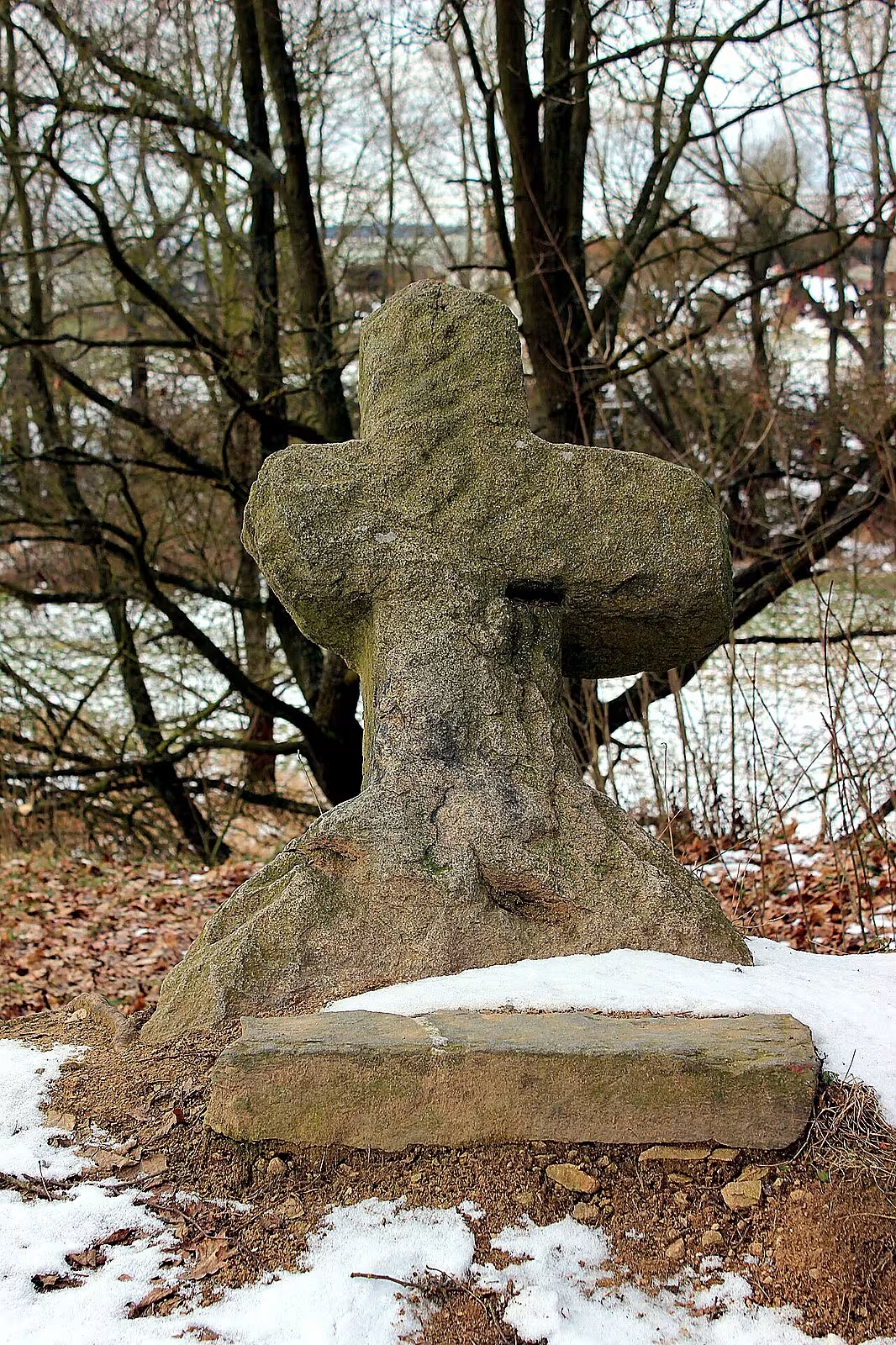
Cyrilometodějský smírčí kříž II., located in the village Bernartice, district Písek, Jihočeský kraj, is a cultural monument of the Czech Republic. This symbol of peace and settlement, dated up to the beginning of the 17th century, represents an important historical and cultural value. Its location near the city suggests the original function as a place to settle disputes or reconciliation.
The peace crosses were a common phenomenon in the Czech countries, serving as symbolic places to negotiate and calm conflicts. Cyrilometodějský smírčí kříž II., carved out of granite, has one arm almost whole missing, which can indicate its longevity and historical events that left traces on it. This monument is protected as a cultural monument under the Nature and Landscape Conservation Act.
Today, the cross of peace is in good condition, allowing visitors to appreciate its historical value. Its location near the city of Bernartice makes this object easily accessible and interesting for all who are interested in the history of the region. Visiting this peace-making cross offers a unique opportunity to connect with the past and understand the importance of such monuments for the local community.
Cyrilometodějský smírčí kříž II. is therefore not only a historical monument, but also a witness of the past and a symbol of peace and settlement. His visit brings a deep understanding of the importance of such objects in the context of Czech history and culture.
Points of interest
- Cyrilometodějský smírčí kříž II. is a cultural monument of the Czech Republic. - This symbol of peace and settlement comes from the beginning of the 17th century. - The peace crosses served as symbolic places to negotiate and calm conflicts. - The cross has one arm almost all missing, which could indicate its longevity and historical events. - This monument is protected as a cultural monument under the Nature and Landscape Conservation Act.
Guide
Show guide text
This text was created by artificial intelligence and has not been editorially reviewed. It may contain inaccuracies.
Welcome to the village Bernartice. You just stopped by something that requires more than a quick look. You are standing right in front of the historic sign bearing the name Cyrilometodějský smírčí kříž II. At first glance, you may think it's just a quiet object in the landscape, but believe me, this piece of history carries a deep story, even though its specific details remain hidden in the fog of time. Feel this moment, feel the calm that radiates this place. You are in South Bohemia, in a region where history constantly speaks through stones and monuments, and right here, near the city, you encounter something very rare.
Now take a closer look at this object. What is a peace cross, anyway? In our history, these monuments played a very specific and important role. It was not just a religious symbol, but rather an instrument that helped people in their daily lives. The peace crosses were formed as part of the settlement of disputes, as a permanent and visible sign that peace was found between the two parties. It could have been a solution to the legal conflict or an attempt to pay for the damage or punishment. So this cross is not just a work of art, but it is materialized in the form of a monument the moment when people decided to make peace instead of a lasting struggle. Although the exact date of its creation remains unknown, his presence here in Bernartice reminds us that the need for justice and peace is eternal in human society.
Now let's think about what you see right in front of you. Although time did not tell us the name of the architect or the exact year this cross was created, its existence is tangible evidence of the past. Feel his attitude in space, his weight and how he worked into the local environment. Look at his line and his structure. It is a cultural monument of the Czech Republic, which means that every edge and every detail you see here has its weight and value. Even if we don't know the specific materials used to make it, you can perceive its stability. See how light changes on its surface and how this object works throughout the whole area. He is a silent witness who stands here, close to human being, while retaining his own noble integrity.
Now, if we think about the people who were connected to this cross, we will encounter a fascinating void. History didn't give us names. We don't know the faces of those who sought this peace. We don't know the hands of a craftsman who put his work and his patience into the work. We don't even know the personalities who might have visited this place in the past. But it is in this ignorance that there is a great power. This cross is not only a monument to one particular event or to one particular person, but it is a monument to the human need to seek compensation. Everyone who built this cross, and everyone who went around it in the past, carried with him his own worries and his own desires for peace. Even though their names have been forgotten, their will is here, in this object, still alive and tangible.
The very name of this monument is the interesting thing that can accompany you in the next journey. The connection with the names Cyril and Methodius gives this place a deep spiritual and cultural dimension. These names in our countries are of great importance and remind us of the roots of our culture and faith. But there's one other thing that can make us curious. Notice the small but important digit two in the title. Why is it the Second Cross of Conciliation? Where did the first one come from? What happened to his trail in the landscape? This question does not have an immediate answer in our documents, and it is the greatest secrets that are often the most beautiful. This unsub encourages you to imagine what could have happened in this place.
Now I beg you, don't let yourself get tired just by looking. Feel the atmosphere of this place. You're in a place where history touches the present. Even though we don't have all the answers, we have this object that allows us to think about the past, about justice and peace. This cross is a bridge between the times they can no longer speak and the time you are in.
Thank you for taking the time to make this short stop at this important place. We hope that this moment at the Bernartice Peace Cross has been beneficial to you and that its atmosphere has enriched you. Please continue your journey and pay close attention to other details of this beautiful region. Any next step can lead you to other stories that are waiting to be discovered. I wish you a beautiful and inspiring walk.
Tips for visitors
The best time to visit the Cyril Methodology Cross II is in the summer months, especially from May to October. During these months the weather is usually favourable and allows long walks in the surrounding countryside. Visit the memory in the morning or in the evening when the light is less powerful and allows a better understanding of historical details.
You can check the current connection with the online traffic search engine.
When visiting the sights, it is advisable to take with you shoes suitable for walking along paths, protective sunglasses and plenty of drinking water. Thanks to your comfortable clothes, you will enjoy your walk without inconvenience.
The best place for photography is in front of the conciliation cross, especially at noon, when the sun illuminates the memory from the side. This light setting allows you to capture details and image depth.
In the vicinity of Bernartic you can visit other historical places such as ancient churches or locks nearby. These rooms can be reached by foot or car in 30 minutes and offer an interesting insight into regional history.
Frequently asked questions
Can the monument be visited?
This is a structure in a public space that can usually be seen from outside free of charge. We have not verified that this particular one is freely accessible.
Where is the monument?
Location: Bernartice, Jihočeský kraj. The map on this page shows the exact spot.
Why is the monument protected?
It is listed in the Central List of Cultural Monuments of the Czech Republic as a cultural monument (register no. 15267/3-2456).
Businesses nearby
Do you run a restaurant, accommodation, shop, museum, rental, wellness or other visitor service near this monument? Show yourself directly to the people heading to it — this is how they will see you in the app and on the web:
Nearby
➜ Zobrazit interaktivní přehled okolí – restaurace, ubytování, půjčovny a další místa v okruhu 15 km.
Data: OpenStreetMap contributors, okruh 15 km.
🏰 Historické památky
- 1914-1918 (6.7 km)
- 1945 (6.9 km)
- Pravěké mohylové pohřebiště (8.8 km)
- Karel Stehlik (9.7 km)
- Mezinárodní muzeum keramiky (9.7 km)
- Hasičské muzeum Bechyně (9.8 km)
- Muzeum turistiky (9.9 km)
- František Křižík (9.9 km)
🍽️ Restaurace a stravování
- Hospoda U Kyriánů (8.3 km)
- Pizzerie Giano (9.7 km)
- Kavárna Za oknem (9.8 km – nám. E. Beneše 1)
- Jídelna Na Růžku (9.8 km)
- U Kobyly (9.8 km)
- Kulturák (9.9 km)
- Hermína (10.2 km)
- Penzion Pod Skalou (10.3 km)
🏨 Ubytování
- Hotel Smrž (7.6 km – Sepekov 122)
- Mlýn na Prádle (7.7 km)
- Mlýn na Prádle (7.7 km – Prádlo 707)
- chata Červená nad Vltavou (8.0 km)
- Vltava (8.2 km – 126)
- Penzion U Jezu (9.3 km)
- U Draka (9.8 km)
- Jupiter (9.8 km)
🚲 Půjčovny a sport
- Koupaliště Bechyně (9.2 km)
- Sokolovna (9.5 km)
- CykloSport MARVAN (9.9 km – 5. května 290)
- JOLA (10.3 km)
- Koupaliště Milevsko (10.8 km)
- Mechová Stěna (11.0 km)
🥾 Turistika a příroda
- Tábor / Burkovák (5.3 km)
- Rozhledna Radětice (6.1 km)
- Studánka u sv. Anny (7.4 km)
- Dobronice u Bechyně (pod hradem) (9.3 km)
- Zvíkovec (9.5 km)
- U Hutí (10.0 km)
- Vyhlídka Vojty Náprstka (10.5 km)
- Kopaniny (u křížku) (11.1 km)
Accommodation nearby
Themed route
Thematic cruise route: Cyrilometodějský smírčí kříž II.
1. Main objective: Cyrilometodějský smírčí kříž II. Type: Historical monument Why is it worth a visit: This cross is an important historical monument, which resembles reconciliation between the Slavic apostles of Saint Methodius and Bishop Wiching. It is a key place to understand the cultural and religious history of the region.
2. Ambient interest: Municipality of Bernartice. Type: Urban area Why is it worth a visit: The village offers a clear opportunity to explore local culture and history. It is an ideal place for everyone involved to adopt the atmosphere of the village and its tradition.
3. Natural surroundings: Forest walks around Bernartic. Type: Nature Why is it worth a visit: Forests around the village offer beautiful opportunities to relax and explore. They are ideal for those who want to enjoy nature in peace and enjoy quiet surroundings.
4. Cultural interest: Historical houses in Bernartice. Type: Architectural interest Why is it worth visiting: These houses represent the architectural history of the village and provide insight into the life of past generations. It's a great place for those interested in history and construction.
5. Final point: Interactions with local residents. Type: Cultural meetings Why it is worth a visit: Meeting with locals allows a deeper understanding of life in the region and offers the opportunity to share experiences and stories. It's a great way to close a trip with personal memories.
This route offers a combination of historical, cultural and natural experiences that allow you to understand the heritage of the village Bernartice and its surroundings.
Seasonal recommendations
Spring brings fresh green to the surroundings of Bernartic and awakening nature, which contrasts beautifully with the stone structure of the peace cross. Light is usually soft and often variable in this period, which creates a poetic atmosphere ideal for peaceful contextions. Practically, the spring visit is advantageous by the fact that tourists are just starting to accumulate, so you can admire the memory without large crowds. Clothes should be laminated as temperatures can vary significantly during the day and occasional rains are common. The most appropriate time is the late afternoon, when the sun is no longer so sharp and the landscape becomes full of spring appearance.
Summer offers the longest days and brightest lighting, which reveals every detailed sculpture work on the cross. Nature around it is fully blooming and green, which gives the place live energy and fresh atmosphere. However, the main summer season brings with it more traffic, so it is recommended to come either very morning or late afternoon to avoid crowds and noise. Due to higher temperatures, it is necessary to wear light, breathable clothes, a hat and have enough drinking mode with you. The shadow is rare, so it is good to have sunglasses and possibly protective cream.
Autumn turns the surroundings of the monument into warm golden and red shades of falling leaves, creating a dramatic and visually rich background for photographs. The atmosphere is colder and often foggy, which gives the place a mysterious and thoughtful character. Tourism is falling significantly during this period, so the cross of peace can be visited in complete peace and privacy. Clothes should be robust and waterproof because autumn rains are common and temperatures are falling. The ideal time is the morning when the air is purest and light penetrates through the thin crowns of trees, creating playful shadows on a stone surface.
Winter will expose the structure of the cross and surrounding landscapes that lose leaves, thus highlighting the monumental nature of the monument. Snow, if attacked, covers the surrounding area with white carpet and increases contrast with dark stone, while short days and low sun create long shadows and cold, quiet atmosphere. Visiting is minimal during this period, allowing for a deep experience without interference. It is necessary to wear warm winter clothes, including gloves and hats, and shoes with good underslip, because the roads can be slippery from ice or mud.
Visualizations and artistic views


The visualisations are generated by artificial intelligence and serve as inspiration.
Photos from the area
Real photos taken near the monument


Zdroj a licence jsou uvedeny u každého snímku.
Tips from visitors
No tips yet. Be the first!
Log in and add your tip.
Sources and literature
Photos: Richenza / CC BY-SA 3.0 — Wikimedia Commons. The author and licence also appear when you hover over the image.
Location on the map

Příběhy a pověsti
Legendy, pověsti a příběhy spjaté s touto památkou
Fotografie návštěvníků
Zatím žádné fotografie. Buďte první, kdo přidá fotografii z návštěvy!
Log in a přidejte svou fotografii nebo hodnoťte.
Za ověřenou návštěvu v aplikaci získáte víc bodů — poznáme podle GPS, že jste na místě.
Reviews and comments