



Dojetřice Hillfort
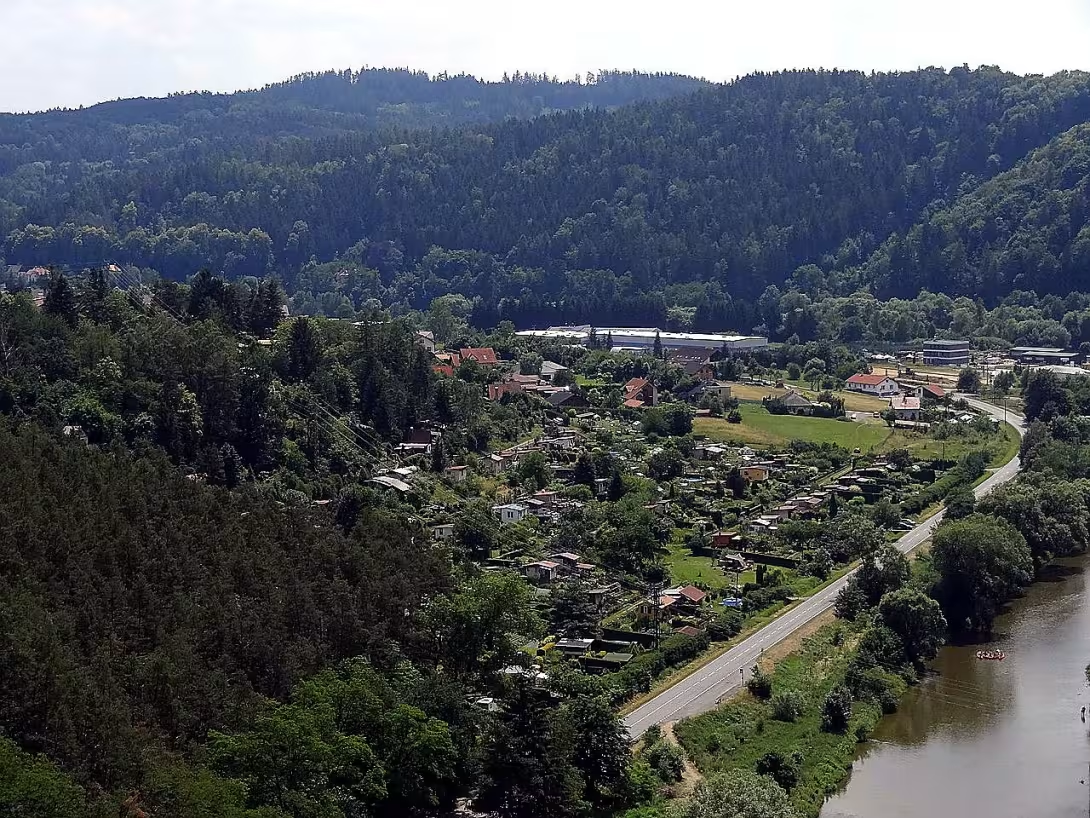
Dojetřice is an early medieval castle located in the district of Benešov in the Central Bohemian Region, east of the village Dojetřice and south-western part of the cadastral territory of the city Sázava. This monument is remarkable by its historical value as a cultural monument, inhabited at the turn of the eighth and ninth centuries. Its location in the Benesov hill above the left side of Sazava and the proximity of the important ford highlight its strategic significance in the early Middle Ages.
The castle Dojetřice was inhabited at the end of the eighth and the beginning of the ninth century, which related to the importance of the ford through Sazava and the possible extraction of limestone in a nearby quarry. This period was a time for Czechs to form Slavic settlements when the structure of the early Middle Ages was established. Although the details of the actual formation of the fort remain unclear due to the lack of archaeological research, the finding of ceramics and other artifacts suggests its settlement at this time.
The Dojetřice is presented as a two-piece castle with complex fortification. The accessible west side was protected by a straight wall which was preserved in the form of a wall of 295 meters long. This wall could serve not only as a defensive element, but also for the collection of cattle or the protection of a small spring which was a source of water. The southern part of the wall may be the original entrance to the fort. The second fortification line protected the acropolis, where preserved walls reach up to five meters of height. This element was key to defending the conclusion of the island.
The history of the castle is little documented, which makes its owners and administrators unknown. The only known violation of the fortifications was recorded in 1962 when forestry work damaged the inner wall. Local names for the location of the castle included Na Šance, V Šance or Na Dojetřická, which reflects its historical and cultural value in the region.
Today the remains of the castle Dojetřice are protected as a cultural monument. Although archaeological research has not been carried out, preserved fortifications and their location offer an interesting view of the early medieval period. This site is accessible to visitors and offers the opportunity to explore historical remains which are an important element of the cultural memory of the region.
Dojetřice reminds us of the importance of defence structures in the early Middle Ages and their role in forming Slavic settlements. Visiting this site is a valuable opportunity to explore part of our history, which has remained hidden beyond the surface of the hill above Sázavou for many centuries.
Then and now
Drag the slider to compare how the landmark may have looked when it was built with the view today.
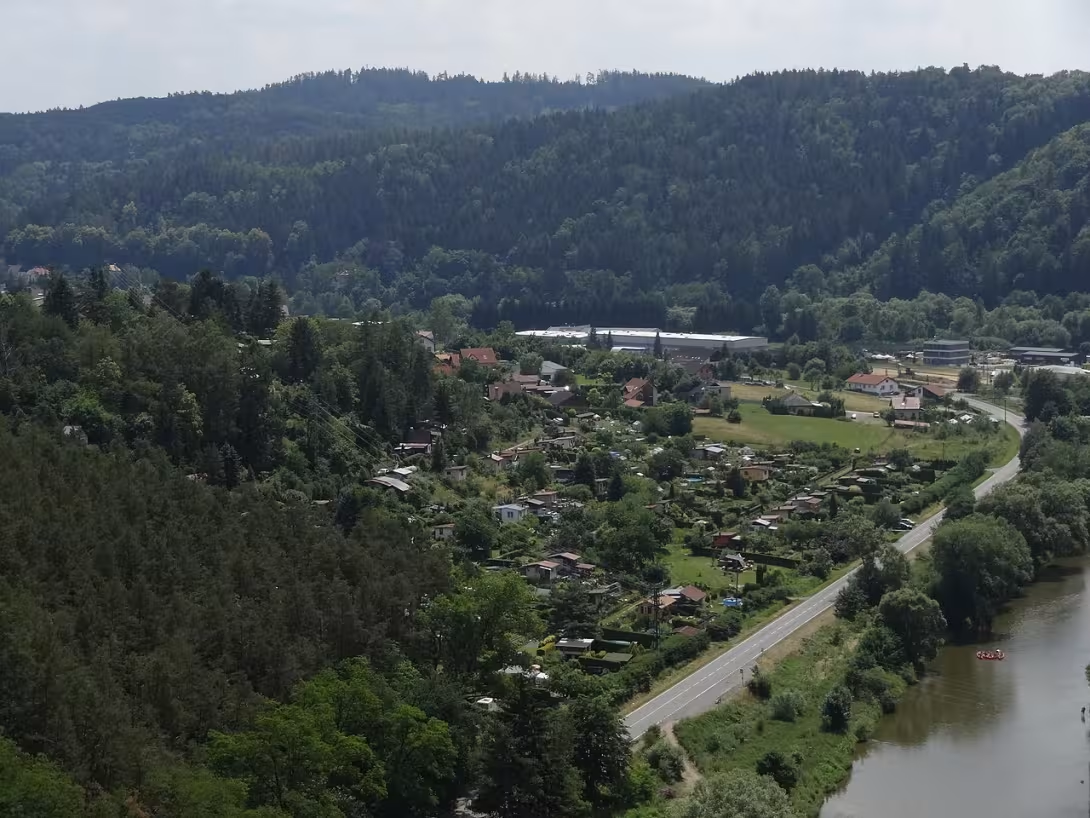

The historical appearance on the left is an AI-generated visualisation and serves as inspiration only.
Architectural development
The fort had a two-piece fortification. The accessible west side was protected by a straight wall, which survived as a wall of 295 meters long. The southern part of the wall could protect a small spring serving as a water source. The second line of fortifications defined the acropolis, where preserved walls reach up to five meters high.
Points of interest
- Dojetřice are an early medieval castle located in the district of Benešov in the Central Bohemian Region. - This monument is remarkable in its historical value as a cultural monument, inhabited at the turn of the eighth and ninth centuries. - The castle Dojetřice was inhabited at the end of the eighth and the beginning of the ninth century, which related to the importance of the ford through Sazava and the possible extraction of limestone in a nearby quarry. - Architecturally, Dojetřice is presented as a two-piece castle with complex fortification, where preserved walls reach up to five meters of height. - Today the remains of the castle Dojetřice are protected as a cultural monument.
Guide
Show guide text
This text was created by artificial intelligence and has not been editorially reviewed. It may contain inaccuracies.
Welcome to a place where time seems to stop and where every clue in the country tells a story older than our own memory. You are standing in front of the castle Dojetřice, a place that is not just an ordinary piece of landscape, but a living witness of ancient times. Look around you and feel the atmosphere of this place. You may feel the calm the surrounding nature brings in the southern part of the cadastral territory of the city Sázava, but beneath this calm lies deep history. Before your eyes, the terrain is spread, which was quite different over a thousand years ago. What you see today as the natural shapes of hills and slopes was once carefully shaped by the human hand for defence and survival purposes.
Let us now return together to the time when the world was formed as we know it today. Dojetřice is not only a pile of leftovers, but an early medieval fortress whose roots reach the turn of the eighth and ninth centuries. Imagine the era - a period of great people's movements, a time when the first groups of people who sought security and stability settled in these territories. At that time, there were no maps or fixed borders of states as we know them, but there were needs. The need to have a place to defend, a place to provide shelter for families and protection for their crops. This fort was chosen precisely to serve as a fixed point in the vast and constantly changing landscape of the Central Bohemian region. Although the exact date of its creation remains veiled by the fog of history, its importance to the people at that time was immense.
Now pay attention to what you see right in front of you and what's under your feet. Although we do not know the names of the particular architects who designed and built this castle, their work is still evident in the very structure of this place. Since this is an early medieval fortification, do not expect high stone ruins or decorative towers that you would know from later periods. The architecture of this castle was work with a element - with clay, stone and wood. If you look at the slope of the terrain and how the lines of the hills change, you can see the remains of the protection walls and ditches in these uneven areas. What today looks like the natural ripple of the earth was once a complex system of levees and defensive lines. Feel these shapes as a handprint of people who worked here over one thousand years ago to create a safe space for their lives. Any gravel in the ground and any change in terrain height can be traced back to where the wooden palisade once stood or where a deep moat was dug.
Looking at this place, one often asks who the people who lived here were. Unfortunately, history has given us no specific names. We know no kings, no warlords, or any powerful families to control this castle. This absence of names does not weaken Dojetřice, but gives them a special, almost mystical weight. We're not here to commemorate one particular hero, we're here to commemorate the entire people. Imagine the thousands of days that have passed here. Imagine the day-to-day rhythm of life - getting up in the morning, working in the field, caring for cattle and evening gatherings by the fire, when people were meeting safely in the castle after a busy day. These people were part of a wider society that was formed around today's Sazava and the entire Benesov district. They were people who had to deal with the harsh conditions of the time, but they also built the foundations of a culture that defines us today.
Here we come to one of the greatest mysteries of this place. Why here? Why did the people at the turn of the eighth and ninth centuries choose this particular place in the southern part of the cadastral territory of Sázava? What was it that offered them in this place that made them feel safe? Was it a strategic location to track the surrounding terrain? Or was it a place of spiritual significance? This question remains unanswered, and that is the fascination that Dojetřice emits. This monument is fascinating by its very existence as a cultural monument that has survived centuries and remains a reminder of the ancient era. It is a place where history cannot be read only from books, but where you must feel it in every wind and every view of the surrounding hills.
Keep looking, walk these routes and try to reconstruct the face of this place in spirit. Even though visible structures are now a shadow of the past, their presence is undeniable. Dojetřice is not just an archaeological site, it is sacred traces of human efforts for stability and home.
Now, I beg you, continue his recon. Take a walk around, feel the silence and try to hear the echoes of ancient life. Let yourself be inspired by what you see here, and by what you have to think. Thank you for choosing to visit this important cultural monument and for trying to understand its secret with us. We wish you a pleasant and inspiring rest of your trip to this historic place. We will say goodbye, but we believe that Dojetřice will leave you with a lasting quite impression.
Tips for visitors
For the best experience we recommend a visit in the period when nature is best-looking, for example in spring or autumn. For photography are the most suitable moments around the sunrise or sunset, when the light beautifully accentuates the shape of the castle, especially when viewed from elevated places on the rest of the structures.
You can reach the monument by car and public transport.
In the way, remember to take enough drinking water and comfortable shoes, which is necessary for movement in the uneven terrain of the castle.
For families with children a visit to the castle represents an interesting opportunity to discover history in nature, but it is necessary to ensure safety while moving around ruins.
In the immediate vicinity of the castle there are no other sights to visit.
Frequently asked questions
Can the monument be visited?
This is an archaeological site. Often there is little to see on the ground and the land may be private. We have not verified access.
Where is the monument?
Location: Sázava, Středočeský kraj. The map on this page shows the exact spot.
Why is the monument protected?
It is listed in the Central List of Cultural Monuments of the Czech Republic as a cultural monument (register no. 1000136354).
Businesses nearby
Do you run a restaurant, accommodation, shop, museum, rental, wellness or other visitor service near this monument? Show yourself directly to the people heading to it — this is how they will see you in the app and on the web:
Nearby
🏰 Historic sites (85)
- Boží muka v Dojetřicích 0.6 km
- Památník padlých 1.0 km
- Sázavský klášter 1.5 km +420 327 321 177 web
- Voskovec a Werich 1.5 km
- zabitý lesník 2.4 km
- Hrad Stříbrná Skalice 4.4 km
- Talmberk - zřícenina/ ruins 5.0 km
- Talmberk castle ruins 5.0 km
- zámek Ostředek 5.3 km
- Pirkenštejn 5.7 km
- Rataje 5.9 km
- Jubilejní pamětní kámen 6.4 km
- Hrad Čejchanov 6.5 km
- Český Šternberk 7.1 km
- Rotunda svatého Václava 7.9 km
- Muzeum života židovské obce Divišov 8.7 km +420 317 855 224
- Astronomické muzeum Vojtěcha Šafaříka 8.8 km +420 323 649 212
- Josef Jan Frič 8.9 km
- Lovecký zámeček Krásná hora 9.5 km
- Odranec 9.6 km
🍽️ Restaurants and dining (103)
- Za Vodou 1.1 km Klášterní 152 +420 327321599 web
- Chopsticks 1.1 km
- Pizza Nonno 1.3 km
- Pivnice U Stroma 1.7 km Sklářská 422
- Sázavská Kozlovna 1.8 km web
- Na Marjánce 3.1 km
- Na konci světa 4.9 km web
- U Čiháků 5.1 km
- Klub Lávka Chocerady 5.1 km
- U Kobzy 5.4 km
- Restaurace u Jindřicha 5.8 km
- Hospůdka u Pinců & Penzion 5.8 km
- Hotel Ostende 5.9 km
- Ostende 5.9 km
- Občerstvení Bayerka 5.9 km
- Uniq Hotel 6.8 km
- Pod Hradem 7.0 km
- Hradní kavárna Český Šternberk 7.0 km +420777685708 web
- Sázavský Kraken 7.2 km Parcela 89 +420 728 626 365 web
- Propast 7.3 km
🏨 Accommodation (34)
- U hrocha 0.7 km
- Sázava 0.9 km Benešovská 44 +420 773570007 web
- Pod Vrbou 1.6 km
- Sázavský ostrov 2.2 km
- Vaníček 5.0 km
- Klub Lávka Chocerady 5.0 km
- Pension Čtrnáctka 5.7 km
- Apartmán Kampelička 5.7 km
- Hotel U Zámku 5.9 km
- Ostende 5.9 km
- Penzion Jaro 6.0 km
- hotel Akademie Naháč 6.7 km +420 317 759 711 web
- Uniq Hotel 6.8 km
- Uniq 6.8 km
- Tábořiště u Karla 6.9 km
- Park Hotel 7.3 km
- Chata v klidném údolí 8.9 km Český Šternberk ev.29 +420 775 736 052 web
- Vodácké tábořiště 9.8 km
- Kemp u BOŘKA 10.3 km
- Tábořiště Vranice (YMCA) 10.7 km
🚲 Rentals and sport (13)
- Cykloservis a pneuservis 0.9 km +420 722286080 web
- Sportovní stáj Pyskočely 2.1 km
- Samba 4.9 km +420 604 904 737 web
- Samba 7.0 km +420 604 904 737 web
- Plochá dráha Divišov 8.7 km
- ČÁLEK 12.9 km
- SSK Kostelec nad Černými lesy 13.1 km
- CYKLOSERVIS JEVANY 13.1 km Sportovní 359 732365079 web
- KOLACALEK.CZ 13.2 km Kolínská 969 web
- Cyklo Ondráček 13.4 km
- Sokolovna 14.4 km
- Samba 14.4 km +420 604 904 737 web
- Dronte 14.5 km web
🥾 Hiking and nature (56)
- Skála 1.8 km
- Spálený vrch 2.0 km
- Bílč 2.5 km
- Na Babě 2.9 km
- Hradecký vrch 3.0 km
- Šramotův vrch 3.1 km
- Čapík 3.6 km
- Spálený kopec 3.7 km
- Hudečka 3.8 km
- Rulík 4.6 km
- Minirozhledna 4.8 km
- Kozly 5.3 km
- U Vápenky 5.7 km
- Krškov 6.2 km
- Červený vrch 6.6 km
- Na Stříbrné 7.0 km
- Břeský vrch 7.5 km
- Zahrada Hradec 7.7 km Hradec
- Vrchy 7.8 km
- Pecný 8.8 km
Accommodation nearby
Trips and activities nearby
Guided tours, tickets and activities nearby from GetYourGuide
Affiliate link: if you buy from the partner, we may receive a commission. The price for you does not change.
Search tours and activities →Themed route
1. Entry gate (input) - The beginning of a journey where you feel the atmosphere of an ancient fortification. 2. The walls (fortifications) - A walk around the perimeter of the castle reveals the way the place was protected in the past. 3. Central area (residential zone) - The space where the dwellings used to be and the normal life of the inhabitants was taking place. 4. Outlook (top) - The highest point of the complex, which offers a view of the surrounding landscape.
Seasonal recommendations
Spring: The milking fort in the spring season offers a unique experience where nature wakes up from its winter sleep. Green meadows and flowering bushes create a live variety of colours around historic ruins. Sunshine days can be an ideal time to visit, because temperatures are pleasant and rising solar views raise the atmosphere. Although it is possible to meet some early bird species that are returning from their spring migration, it is recommended to arrive at the post in late morning or evening to avoid the noon warm days. Spring is a period of relatively low traffic pressure, which means that you can walk through and discover a historical memory without obstacles to crowds.
Summer: In summer Dojetřice is a beautiful place to visit, thanks to long sunny days and warm evenings. The atmosphere becomes lively, especially in the main summer season, when there are more visitors eager to rest in nature. Although temperatures may be high, especially in the semi-deck, the views from the castle are unforgettable. It is recommended to visit early in the morning or late in the evening when the temperature is milder and fewer people. Don't forget the sun protection and plenty of drinking water, because the summer sun can be intense.
Autumn: Autumn brings a touching atmosphere with a colorful picture of leafy trees. This time of year is ideal for those looking for a quieter experience without a lot of crowd. The sunny days are warm and welcoming, allowing comfortable walks on historical ruins. In late autumn the probability of rainy days increases, so it is advisable to carry a protective coat or coat. Nature at this time offers a beautiful view of the transition leaves and cooler air increases the feeling of peace.
Winter: In winter, Dojetřice offers a different but equally fascinating atmosphere. The ruins of the fort are covered with snow and create a magical view, especially during freezing days. Hot clothing, including hat, gloves and shoes suitable for freezing surfaces, is essential. Despite potential hatches, the winter offers a peaceful experience with minimal traffic pressure and a unique opportunity for photography under unusual conditions.
Visualizations and artistic views


The visualisations are generated by artificial intelligence and serve as inspiration.
Photos from the area
Real photos taken near the monument

Zdroj a licence jsou uvedeny u každého snímku.
Tips from visitors
No tips yet. Be the first!
Log in and add your tip.
Sources and literature
Photos: MartinVeselka / CC BY-SA 4.0 — Wikimedia Commons. The author and licence also appear when you hover over the image.
Faktickým podkladem tohoto textu byl článek na Wikipedii, jehož autory jsou přispěvatelé Wikipedie. Článek je dostupný pod licencí CC BY-SA 4.0.
Location on the map






Příběhy a pověsti
Legendy, pověsti a příběhy spjaté s touto památkou
Fotografie návštěvníků
Zatím žádné fotografie. Buďte první, kdo přidá fotografii z návštěvy!
Log in a přidejte svou fotografii nebo hodnoťte.
Za ověřenou návštěvu v aplikaci získáte víc bodů — poznáme podle GPS, že jste na místě.
Reviews and comments