



sklářská huť František Glass factory
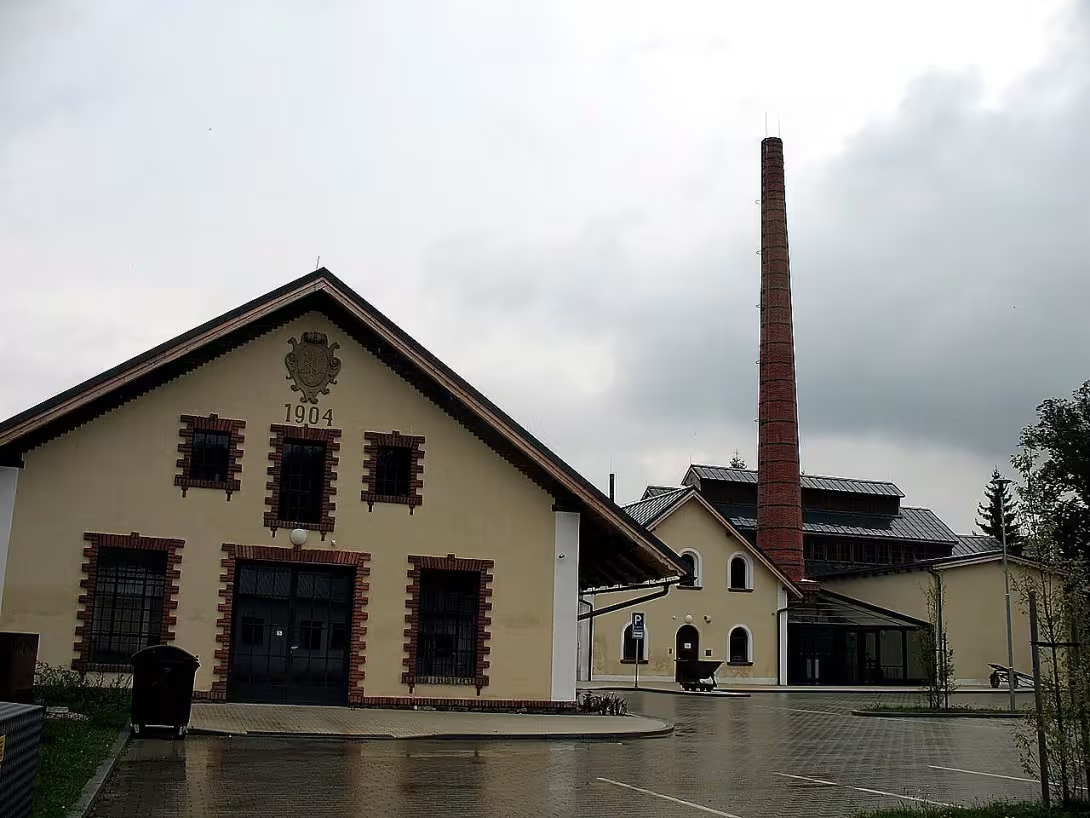
The foundry plant František, located in the village Sázava in the district of Benešov, is a historical monument to industrial heritage from the second half of the 19th century. This building of the glassworks, which now hosts the Centre of Glass Art, represents an important phenomenon of glassmaking in Central Bohemia and is a representative example of the industrial architecture of the time. Since 13 April 2010, the site has been a cultural monument, highlighting its historical and cultural value.
The history of the glass mill František dates back to 1835, when František and Antonia Kavalirová bought it. Originally, the first glass mill called Svatoprokopská was opened here, later known as Granny. This smelter became the center of local development and a settlement was created next to it. In 1882, their son Josef founded a second plant with a pelvic forest furnace, which was soon modernized by gauze technology to ensure higher quality products. This progress in technology reflected the broader trend of the industrial revolution and technological modernization of production in Central Europe.
Architectural sklářská huť František is characterized by its adaptation to new technologies. The original forest furnace was replaced in 1883 by a gauze furnace with a wood gasification generator, which was an advanced solution for that period. In 1947- 1948 the parabolic hall was built according to the plans of architect Václav Knobloch and in 1955 the building of the refinery with iron concrete construction was added. Administrative buildings were added three years later, indicating the gradual expansion and modernization of the premises.
The ownership of the smelter has undergone several changes. After František and Antonia Cavalier, their son Josef took the lead, who founded the second smelter. Over the course of the 20th century, there was a gradual cessation of operation of the smelter due to fuel depletion and technological progress. After World War II, the operation was restored to a limited extent, but the main focus shifted to learning and producing special products. In 2009 the site was returned with its historical honours by the foundation of the Glass Art Centre, the initiative of the Josef Viewegh Foundation.
Key events on the premises include filming the film "Now We" in 1939 and opening ceremony of the Glass Art Centre in 2009. These moments highlight the cultural and historical value of the site, which has become not only a monument to industrial heritage, but also a centre for artistic creation.
Today, sklářská huť František is open to the public and serves as the Glass Art Centre. The area offers visitors the opportunity to become acquainted with the history of regional glassmaking, to see rare specimens of the original machinery and to visit galleries. This monument is not only an important historical place, but also an inspiring centre of artistic creation.
The glass factory František represents an important part of the cultural and industrial heritage of the Czech Republic. Its history, architecture and current function as the Glass Art Centre makes it an essential destination for any curious tourist interested in industrial history and artistic creation. Visiting this complex offers a unique opportunity to explore the rich past and present of the Czech glass industry.
Historical milestones
- 1837
- Opening of the first Svatoprokopská glass plant.
- 1882
- The foundation of the second plant by Franz Joseph Cavalier.
- 1928
- End of original operation of the smelter.
- 2010
- Registration of the premises as cultural monuments.
Architectural development
In 1883, the original forest furnace was replaced by a gauze furnace with a wood gasification generator. In 1947- 1948 a parabolic hall was built and in 1955 the refinery building with a reinforced concrete structure was added. Administrative buildings were built in 1958.
Historical events
1882: The founding of the František Josef Cavalier. 1939: We're shooting the movie. 2009: Opening of the Glass Art Centre.
Owners
František and Antonia Cavalier (from 1835), Josef Kavalír (from 1882), Josef Viewegh Foundation (initiator of restoration in the 21st century)
Points of interest
- The glass plant František is a historical monument to industrial heritage from the second half of the 19th century. - The area has been declared a cultural monument since 13 April 2010, which highlights its historical and cultural value. - Originally here in 1835 František and Antonia Cavalir purchased the first glass mill called Svatoprokopská, later known as Granny. - Architect Václav Knobloch proposed the construction of a parabolic hall in 1947- 1948 and in 1955 a refinery with a reinforced concrete construction was built. - The campus hosted the film "Now Us" in 1939 and the opening ceremony of the Glass Art Center in 2009.
Guide
Show guide text
This text was created by artificial intelligence and has not been editorially reviewed. It may contain inaccuracies.
Welcome to the beautiful city of Sázava. Right now, at this moment, you're standing right in front of one of the most important points in this entire area, bearing the incredible power of the past and the trace of human effort. In front of your eyes is the premises of the glass mill František. At first glance you may find it a quiet and quiet place, but try to stop for a moment, close your eyes and soak up the atmosphere of this place. Imagine how there used to be constant pounding, machinery noise and, above all, incredible, fiery heat coming from deep furnaces. This place is not just a set of walls and roofs, it is a living witness to the time when glass formed the incredible power of human hands and unquenchable fire. Feel the presence of history that is imprinted in every stone and in every wall of this complex. It's a place where hard work connects to fine art.
In order to truly understand why this place is so special and why it deserves your attention, we must, together with you, go far into the past. The story of glass in this part of the country is not short and is very rich. Already in the year one thousand eight hundred thirty-seven, the first glass smelter was created here, which was then known as Svatoprokopská. But this was only the beginning of a long and fascinating journey. To get to what you see right in front of you, we need to look at the key moments that shaped this area. Already in the year one thousand eight hundred thirty-five, a major step took place when František and Antonia Cavalier bought their first glass mill. This was the cornerstone on which future prosperity and the bloom of the whole place were built. Later, in the year one thousand eight hundred and eighty-two, another important break occurred when Josef Kavalír founded the second smelter, which we all know today under the name František. This move was not just a simple business decision, but the beginning of a new era for the whole area, which brought new opportunities and new people.
Now pay attention to the construction itself and how this space around you works. The whole complex was designed by architect Václav Knobloch. Although today the complex appears to be a quiet place for art galleries, its architecture was originally intended for very difficult, noisy and challenging industrial work. When you look at buildings, realize that they were designed to withstand the extreme conditions that existed in them. Note the overall effect of these structures and their robust character. There was once a constant combustion process and glass production required a constant, precise supply of heat. Originally there was a pan-slinging plant, which was the method used at that time for expanding raw materials. However, this was not the final point of development. Over time, great modernization has come to ensure even higher quality of products. The transition to using gas-based technology at that time was a huge technological leap. This change made it possible to create glass products with much higher perfection and purity, which made this place a true pillar of quality, which was valued far beyond the borders of the region.
Behind every such construction, every successful product and every technological change, people are behind it. In this case it is primarily the Cavalier family whose names are firmly rooted in this place and whose legacy you still feel. František and Antonia Cavalier were the ones who bravely began to build the foundations of this glass heritage. They were people who believed in the power of glass and the power of work. Then came Josef Kavalír, who brought new visions and developed traffic to match the growing demands of the modern world. They were people who built an industrial face in this country. Their courage and determination are why we can stand here today and admire this heritage. Without their tireless work, this complex would not be what it is today, and history would have a completely different course.
You might find one interesting thing that connects the old to the new and shows how the world changes. This space has undergone an incredible transformation. At the end of the original operation in the year one thousand nine hundred twenty-eight, glass was no longer packed and heated as we used to. Instead of the site being destroyed, dismantled or forgotten, it gained a whole new and very rare meaning. Today this space is the seat of the Glass Art Center and serves as a gallery. It is a fascinating transition from heavy, noisy and hot industry to fine, quiet and beautiful art. This transition is so significant that since April 13th, two thousand and ten, the entire area is registered as a cultural monument. This entry only confirms the great historical and cultural value of this place. It is proof that even old industrial buildings can acquire a new soul and serve people in another, nobler sense, such as the protection of art and history.
Now I want to invite you to further explore. Walk around, see the details of the buildings and get carried away by the history that took place here. Whether you choose to enter the space of the gallery to see modern works, or just continue to walk around and perceive the atmosphere of this place, believe me, this place has something to offer you. Every corner of this complex tells its own story about work, about family, about technological progress and how human creativity changes in time. Thank you for spending this moment with me, and together we looked at the history of the glass mill František. I wish you a pleasant continuation of the tour and a beautiful day in Sazava.
Tips for visitors
The best time to visit the Glass Mound František is in the spring or autumn season when it is quieter and nature offers beautiful colors. The sunny days provide ideal light for photography of buildings and surrounding regions.
Access to the smelters is possible both by car and public transport.
When planning a visit, remember the appropriate suit, especially if you visit in colder months. Photography is best in the afternoon when the sun lights up the roofs and facades thaw.
There is a river Sázava in the vicinity of the Glass Mound František, which can be explored on beautiful walks. Children will also enjoy it, as it is possible to discover nature and historical elements in peace.
It is advisable for families with children to bring toys or books for outdoor reading. Children can also have fun by telling stories about smelters and their production.
Frequently asked questions
Can the monument be visited?
We have not verified whether this monument is accessible. Please ask the owner or operator, or the local municipal office.
Where is the monument?
Location: Sázava. The map on this page shows the exact spot.
Why is the monument protected?
It is listed in the Central List of Cultural Monuments of the Czech Republic as a cultural monument (register no. 1530591264).
Businesses nearby
Do you run a restaurant, accommodation, shop, museum, rental, wellness or other visitor service near this monument? Show yourself directly to the people heading to it — this is how they will see you in the app and on the web:
Nearby
Obec Sázava, řeka Sázava
Accommodation nearby
Trips and activities nearby
Guided tours, tickets and activities nearby from GetYourGuide
Affiliate link: if you buy from the partner, we may receive a commission. The price for you does not change.
Search tours and activities →Themed route
Thematic cruise route "Glass hut František" and surroundings
1. Glass smelter František (monument) - Type: Historical landmark - Why is it worth visiting: This glass mill is one of the oldest and best preserved industrial buildings in the Czech Republic. Visit it to learn about the history of the glassworks and see the original tools and technology used in the production of glass.
2. River Sázava (natural environment) - Type: Greek Valley - Why is it worth a visit: Shortly after visiting the František Mound, you will look at the river Sázava, which flows around the village gives the countryside a feel. It's an ideal place for a short look or a picnic at the water stream.
3. Municipality of Sázava (historical centre) - Type: City square - Why is it worth a visit: The village Sázava offers historic square with Baroque houses and church. It is a great opportunity to walk the streets where you can wait for the atmosphere of the old Czech city.
4. Autumn forests around Sazava (natural space) - Type: Forest area - Why is it worth visiting: If you like nature, looking into the surrounding forests is necessary. They are ideal for short walks and listening to the silence of nature, allowing you to relax your mind after visiting historical places.
This route offers a combination of cultural experience with nature and the history of the village Sázava.
Seasonal recommendations
Spring: In the spring season, the atmosphere around the glass plant František (others) in Sazava is particularly lively and full of hope. Nature awakens from its winter sleep, the trees begin to bloom, and the whole surrounding landscape frame is fertilized with pink colors of the first flowers. The light is gradually extending, increasing the attractiveness of the visit these months. Visitors are advised to wear clothes suitable for mild weather and bring a hat or sunglasses to protect themselves from the sun. It is a well-chosen time to visit in the semi-ships when light is brighter and less likely to snow.
Summer: For years sklářská huť František (others) in Sazava becomes a destination for lovers of warm days and natural beauties. Long days offer enough time to explore the surroundings, while sunny light decorates every stone in the landscape. In this period the atmosphere is full of vitality and cheerful visitors. It is recommended to wear light, sun-resistant clothes and have water supplies to protect against dehydration. The best time to visit is in the morning or in the evening when the temperature is lighter and shadows long.
Autumn: Autumn brings glass smelters František (others) in Sazava color palette of shades. Leaves turn green to pink, yellow and brown, making the surroundings even more attractive to visitors. Short days and colder weather bring a new atmosphere that is often associated with calm and reflectivity. Visitors are advised to wear warmer clothes and perhaps even blankets or plains for comfortable sitting outside if they enjoy a quiet moment. The best times to visit are a sunny afternoon, when the temperature is pleasant and the light is still bright enough.
Winter: The winter season offers glass smelters František (others) in Sazava a completely different experience where the surrounding area is covered with snow and light becomes more precious. The atmosphere is calm and quiet, which creates a sense of relief from summer stormy days. It is important for visitors to be well prepared for cold weather with warm clothes, shoes suitable for snow conditions and maybe even wind protection. The best times to visit are a sunny winter afternoon when the temperature is milder and light allows you to explore the beauty of the surroundings better.
Visualizations and artistic views

The visualisations are generated by artificial intelligence and serve as inspiration.
Photos from the area
Real photos taken near the monument


Zdroj a licence jsou uvedeny u každého snímku.
Tips from visitors
No tips yet. Be the first!
Log in and add your tip.
Sources and literature
Photos: Lukas panek / CC BY-SA 4.0 — Wikimedia Commons. The author and licence also appear when you hover over the image.
Faktickým podkladem tohoto textu byl článek na Wikipedii, jehož autory jsou přispěvatelé Wikipedie. Článek je dostupný pod licencí CC BY-SA 4.0.
Location on the map





Příběhy a pověsti
Legendy, pověsti a příběhy spjaté s touto památkou
Fotografie návštěvníků
Zatím žádné fotografie. Buďte první, kdo přidá fotografii z návštěvy!
Log in a přidejte svou fotografii nebo hodnoťte.
Za ověřenou návštěvu v aplikaci získáte víc bodů — poznáme podle GPS, že jste na místě.
Reviews and comments