






Dům čp. 115 House
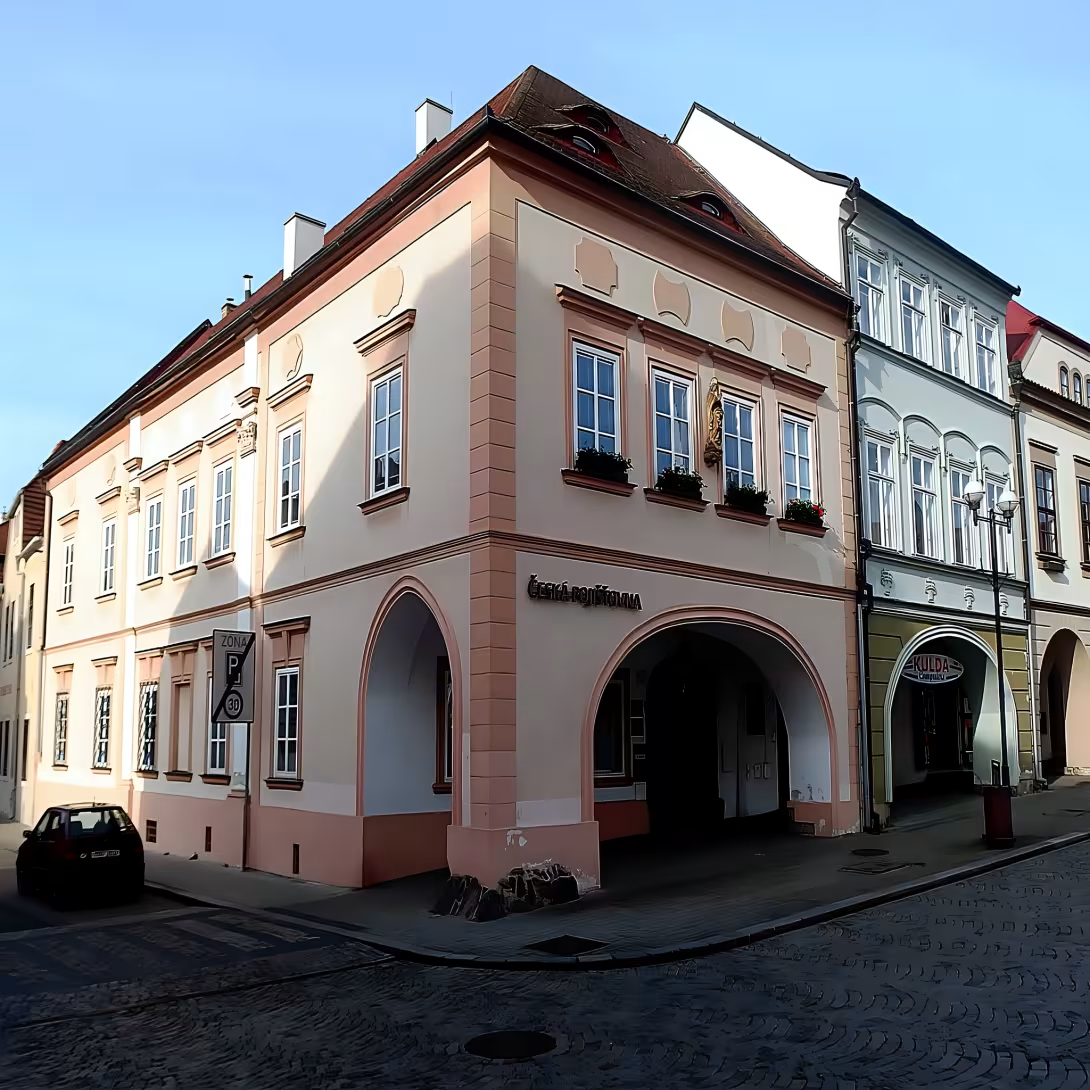
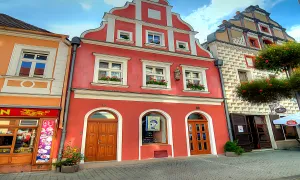
The House U Immaculata with the number descriptive 115 is a distinctive corner township building on the Peace Square in Kadani. Originally, the Gothic object stands on medieval foundations. It is remarkable, above all, the impressive archway that forms one of the dominant central square.
The history of the building is linked to several major changes. After the great city fire in 1498, the object was later Gothic and subsequently renaissance. Another significant reconstruction took place in the late 17th century, when the construction showed the consequences of a devastating 30-year war.
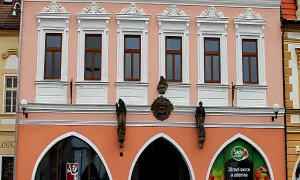
A rich home sign on the facade also belongs to the dominant arch. On the decorative stone pedestal with the head of the angel and gilded wings is a baroque sandstone statue of the Virgin Mary the Immaculate, probably dating from the mid-18th century. Plastika shows typical iconographic elements such as gold sun on dress, moon at feet and twelve gold stars around the head. This motive from John's Revelation was spread in Kadani thanks to the influence of the Franciscan Order and served as a symbol of the Catholic counterReformation in the 17th century.
Since the late 17th century, the object was the property of the Jankova family, which belonged to the local Catholic elite. Members of this family were active in public life. Josef Philipp Janka, for example, supported the establishment of the Kadani agricultural school in 1862. The family also owned the neighboring house No. 114. Here in 1887 Josef Janka founded a clock shop which was later operated by his son Paul until 1945. The main residence, however, remained the house U Immaculata, in whose possession Aloisia Janková and her children took turns. In 1920 Anna Janková planned reconstruction with engineer Hans Jungwirth. At that time, the building department of the municipal office highlighted the high historical value of the building.
In 1935, the last living co-owner of Marie Janková donated the building to the Association of Friends of the Museum in Kadani. On the second June of the same year, the main museum exhibition was ceremonially opened, which was housed in the house until 1972. Subsequently the exhibits were transferred to Kadaň Castle and after the museum was cancelled in 1975 to Chomutov. The critical moment in the history of the building was 16 March 1989, when the Municipal National Committee ordered demolition. However, it was not implemented as a result of the Velvet Revolution in November of the same year.
According to legend, the Kadani Catholic dean Leopold Andreas Roch, confidant of the Jankova family, visited the house regularly. Roch was an educated native, a leader of the Rosary Brotherhood and initiator of the elevation of the column of the Holy Trinity in the main square. It was built in 1752 and sanctified in 1755 by an assistant bishop of Prague by Antonín Vokoun.
Currently, the House of Immaculata is repaired and there is a cafe and fruit shop in its shell. The construction is a valuable testament to the development of the Kadani township from medieval to modern times. Visiting this building offers insight into the history of the city and its architectural wealth.
Then and now
Drag the slider to compare how the landmark may have looked when it was built with the view today.
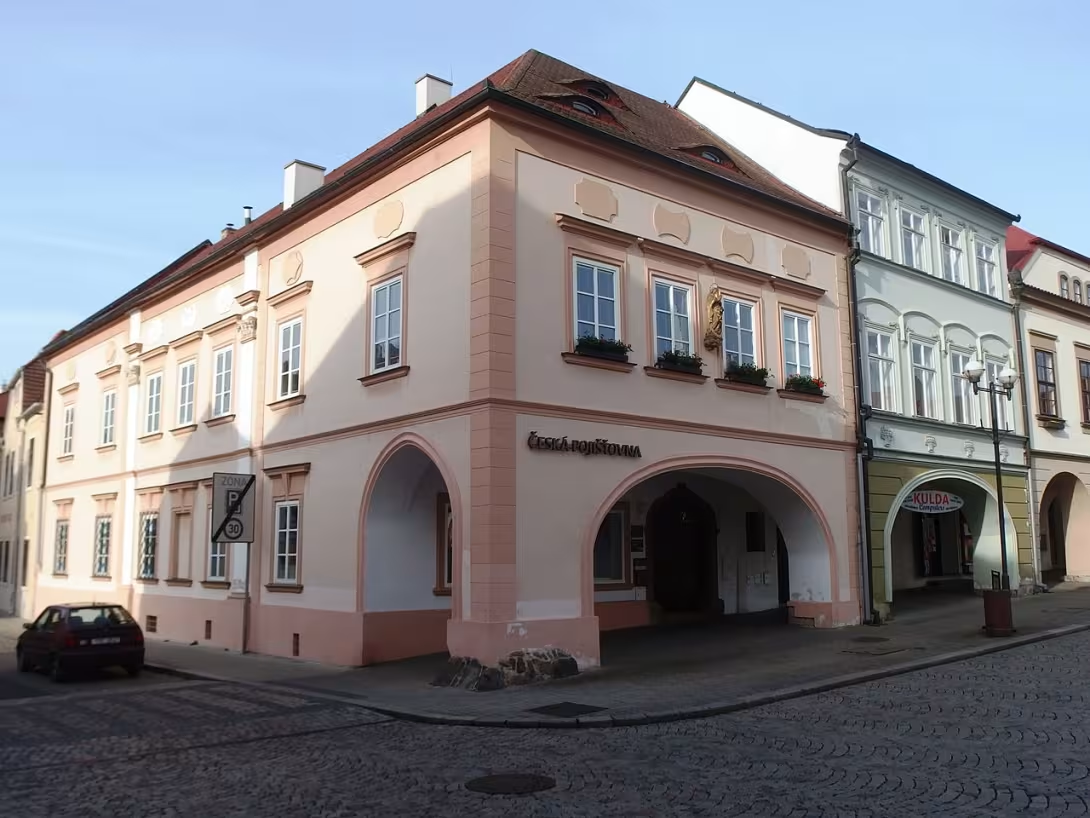
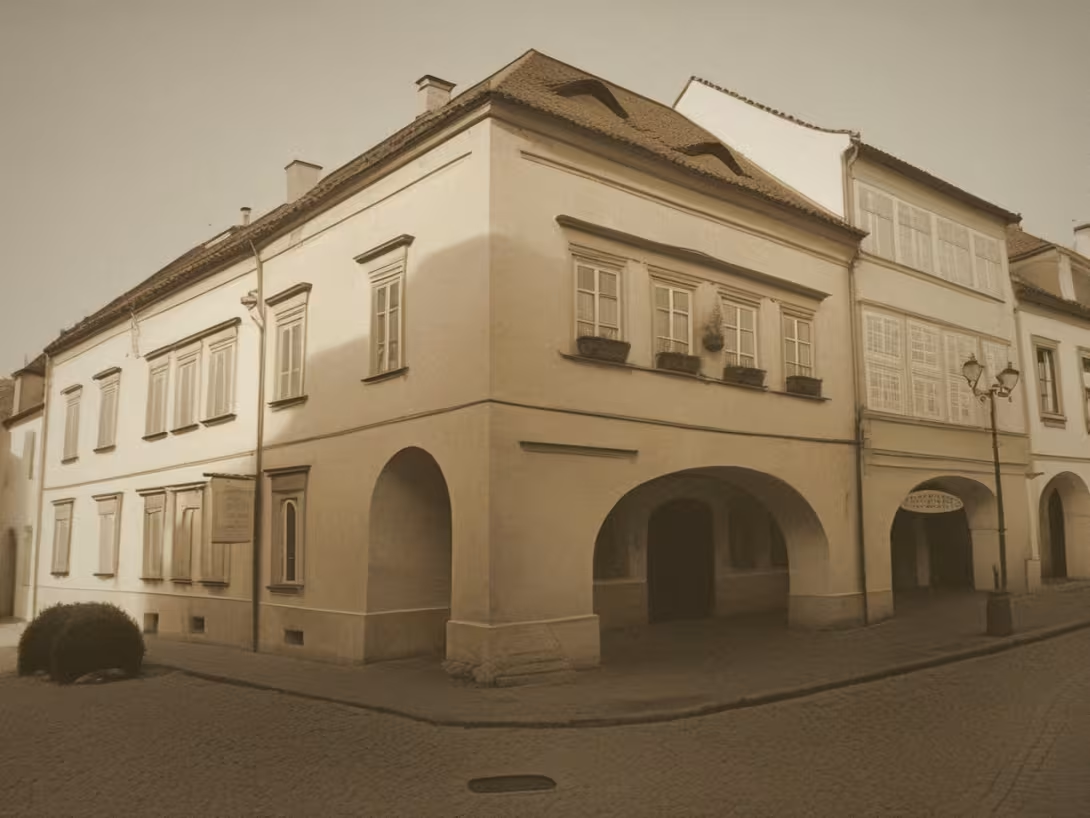
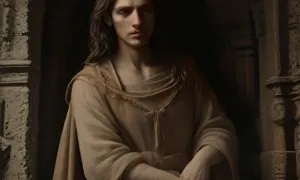
The historical appearance on the left is an AI-generated visualisation and serves as inspiration only.
Historical milestones
- 1498
- A great fire of the city and a subsequent late Gothic and Renaissance reconstruction.
- 1935
- Marie Janková dedicated the House of Friends of the Museum in Kadani and the exhibition was opened on 2nd June.
- 1972
- Transport of exhibits from the house to Kadaň Castle.
- 1989
- Cancellation ordered demolition of the house due to the velvet revolution.
Architectural development
Originally a Gothic house on medieval foundations with a distinctive arch. After 1498 it was later Gothic and renaissance, followed by further reconstruction. The facade is decorated with Baroque sandstone statue of the Virgin Mary from the middle of the 18th century.
Historical events
1498: Great fire of the city and subsequent reconstruction of the house. 1935: Opening of museum exhibition. 1989: Cancellation of planned demolition as a result of the velvet revolution.
Owners
The Janková family (from the end of the 17th century), Marie Janková (until 1935), the Association of Friends of the Museum in Kadani (since 1935).
Points of interest
- The building stands on medieval foundations and has an impressive arch. - After the fire in 1498, the building was rebuilt into a late Gothic and Renaissance style. - On the facade there is a Baroque sandstone statue of the Virgin Mary with rich decoration. - In 1935 the building was dedicated to the Association of Friends of the Museum in Kadani. The demolition of the building was ordered in 1989, but it did not occur thanks to the Velvet Revolution.
Guide
Show guide text
This text was created by artificial intelligence and has not been editorially reviewed. It may contain inaccuracies.
Welcome to Kadani, a city that breathes its history in every stone and every corner of its narrow streets. Right now, you're facing one of the most prominent buildings in the central square. In front of you is a house with the number one hundred and fifteen known to the locals and visitors as the house of Immaculata. The first impression of this building is very strong because it is a corner townhouse, which naturally attracts attention with its location and size. Feel this atmosphere of the old town where time has stopped and where this building welcomes you as a silent witness to the events that have taken place here for centuries.
When you look at this house, you only see what's above ground level, but the history of this place goes much deeper. This building is based on the foundations of the Middle Ages. Imagine how many layers of time are under your feet. These old foundations are like roots that hold the building and the entire neighborhood in its original form. However, the way to what the house looks like today was not easy. The history of this place is linked to dramatic events. The most significant of them was the great fire of the city in a thousand four hundred ninety-eight. The fire destroyed much of Kadana at the time, but it was from the ashes of this fire that a new form of the house came. There was a large reconstruction, thanks to which the building acquired elements of late Gothic and Renaissance style. Later, in the time of the Thirty Years' War, the house had to reface the instability and changes that brought about the conflicts of that time. Each of these editions left a trail in the house, making it a real history book written in stone.
Now, I ask you to pay full attention to the architecture you have in front of you. Look at this impressive Gothic arch. It is one of the most prominent dominant of the entire square. Notice how this arch forms the transition between the private space of the house and the public space of the city. In ancient times, the archways served not only to protect against rain or sun, but were the center of social and business life. This is where people met, negotiated, and watched in the streets. It's a space that gives stability to the building and opens it up.
Now please take a look above, at the facade of the house. Look for the baroque sandstone statue of the Virgin Mary. It is a very richly decorated work which is not only a religious symbol, but also an artistic jewel of the whole house. This is the statue that gave the building its poetic name at Immaculata. Feel the fineness of the details in the sandstone, which, even after centuries of weather influences, continues to tell about the champion of craftsmen who made it. This statue is like the guardian of a house that has been watching everyone who goes through it for a long time.
When a building looks like this, it's natural to ask who lived in it and who made it. Although the names of particular architects have been forgotten in time, we know of the people who left their prints. For years, this house has served as the seat of a very important Janko family. Among them we can mention Josef Philippe Janka, whose name is closely linked to this place. Leopold Andreas Roch is connected to the house. The Jankova family not only lived here, but also built the status of a house within the city.
But the strongest story is related to Maria Janko. It's a story of immense generosity and love for a hometown. In the year one thousand nine hundred thirty-five, Marie Janková decided not only to leave this family house for its loved ones, but to dedicate it to the Society of Friends of the Museum in Kadani. Imagine the moment when private space becomes a public treasure. The second June of the same year, a museum exhibition was opened in the house. The house became a home for monuments that told the stories of Kadana and its surroundings. People came here to learn more about their ancestors and the history of their city.
However, as with many historical monuments, the House of Immaculata had to go through a period of uncertainty. In the year one thousand nine hundred seventy-two there was a fundamental change when all the exhibits from the house were moved to Kadaň Castle. The house thus lost its museum function and remained empty, which in many cases is the beginning of decline. And then there was a moment that could be the end of this building. In the period before the late 1980s, the house was ordered to be demolished. Imagine that feeling of despair, when such architecture, such a landslide and such a statue of the Virgin Mary can only become a pile of rubble.
Here, however, one of the most beautiful connections with the modern history of our countries enters. In the year one thousand nine hundred and eighty-nine came the velvet revolution. With a new political system and a new view of cultural heritage, there has been a miracle. The ordered demolition of the house has been lifted. The House of Immaculata thus basically survived thanks to regime change and new awareness of the value of history. The fact that you stand before him today and you can admire him is the result of this historic twist. It's a reminder that even though everything seems to be lost, hope and change can save the most valuable.
Now that you know this whole dramatic and fascinating story, I suggest you take another look at the house, but with different eyes. Look at it and imagine people from the Renaissance era. Look at the statue of the Virgin Mary and think of Maria Janko and her decision to help the city. Feel the peace and quiet that is now in this place, and remember that this house is much more than just a building of stone and mortar. It's a living organism that survived fires, wars, and the threat of total destruction.
I wish you from visiting the house At Immaculata they took away a sense of respect for history and joy that such monuments still exist. Now invited to another walk on Kadaň Square. Explore the surrounding alleys, feel the rhythm of this city and let yourself follow the other traces of the past. Thank you for your attention and I wish you the rest of the day in our beautiful city. Goodbye.
Tips for visitors
The best time to visit Dom U Immaculata is in the summer months when the weather is favourable for walking and photography. This period offers ideal conditions for exploring historical details of the building and surrounding centre of Kadani.
Parking near the monument is possible, but due to a limited location we recommend the use of public transport. The location is well accessible by bus and tram, which makes it easier to travel from the centre of Kadani.
When visiting, bring sunscreen clothes, water-filled dishes and perhaps a map of the city. These things will help to maintain well-being while walking the historic streets.
For photography it is best to wait for the period before the full setting of the sun, when the light is softer and softer. Don't forget to look at the Gothic archway from different angles to capture the whole beauty of architecture.
In the vicinity of the monument you can visit Kadaň Castle and the Dean's Church of the Elevation of the Holy Cross. These places offer rich history and beautiful architecture, which will complement the impression of a visit from Dom U Immaculata.
Businesses nearby
Do you run a restaurant, accommodation, shop, museum, rental, wellness or other visitor service near this monument? Show yourself directly to the people heading to it — this is how they will see you in the app and on the web:
Nearby
Mírové náměstí v Kadani, Kadaňský hrad, děkanský kostel Povýšení sv. Kříže.
Accommodation nearby
Themed route
Thematic cruise route from Kadaňe
1.Dům čp. 115 (others) - Type: Historical residential houses - Why is it worth a visit: This house represents the architectural history of Kadaňe and its unique design from the 19th century is a fascinating example of local construction.
2. Peace Square - Type: Square - Why is it worth visiting: Central public space, which serves as a starting point for further exploring the city. It is a place full of history and culture, ideal for understanding the spirit of Kadaňe.
3. Kadaň Castle - Type: Castle - Why it is worth a visit: An excellent example of the historic castle, which offers a view of the city and surrounding landscape. His views are unforgettable and every corner is full of history.
4. The Dean's Church of the Elevation of the Holy Cross - Type: Church - Why is it worth visiting: This Gothic church is not only a spiritual centre, but also an architectural pearl with rich history and artistic elements that attract antiques lovers.
5. Return trip back to Dům čp. 115 - Type: End of route - Why is it worth a visit: After exploring historical monuments you can visit the house No. 115 again, this time with a new look at its meaning and location in the center of Kadaňe.
This route offers a comprehensive view of the history and culture of Kadaňe via key sites that reflect the rich heritage of the village.
Seasonal recommendations
In the spring, the surroundings awaken and nature around the city begins to grow again. Light is soft and pleasant in this period, which allows you to better observe the minor features of the building. I recommend wearing layered clothes because morning temperatures can still be low. It is a very good time for a quiet walk because the traffic is still in low condition.
In the summer months the area is very sunny and the days are long. The mood is full of life, but the heat can be unpleasant. For the sake of larger crowds, I suggest you come as early as possible in the morning to enjoy the tour in peace and shade. Dress lightly and don't forget enough fluids.
Autumn brings to the streets the colors of gold and brown shades that complement the house beautifully. Often, fog can appear in the alleys, creating a mysterious mood. It is advisable to carry a warmer jacket and shoes suitable for wet pavement. The best time to visit is in the morning when the light is still clear.
The winter is the most peaceful and the air is freezing. If there's snow outside, the historical environment is very cozy. For short days, it's best to arrive around noon so there's enough light. The necessity is very warm clothes and solid shoes. Please also consider that the visit period may be limited during this period.
Visualizations and artistic views


The visualisations are generated by artificial intelligence and serve as inspiration.
Photos from the area
Real photos taken near the monument


Zdroj a licence jsou uvedeny u každého snímku.
Tips from visitors
No tips yet. Be the first!
Log in and add your tip.
Sources and literature
Photos: Palickap / CC BY-SA 4.0, rozlišení zvýšeno umělou inteligencí — Wikimedia Commons. The author and licence also appear when you hover over the image.
Faktickým podkladem tohoto textu byl článek na Wikipedii, jehož autory jsou přispěvatelé Wikipedie. Článek je dostupný pod licencí CC BY-SA 4.0.
Location on the map
More monuments – Kadaň
Show all in the municipality
Příběhy a pověsti
Legendy, pověsti a příběhy spjaté s touto památkou
Fotografie návštěvníků
Zatím žádné fotografie. Buďte první, kdo přidá fotografii z návštěvy!
Log in a přidejte svou fotografii nebo hodnoťte.
Za ověřenou návštěvu v aplikaci získáte víc bodů — poznáme podle GPS, že jste na místě.
Reviews and comments