






Dům čp. 416 House
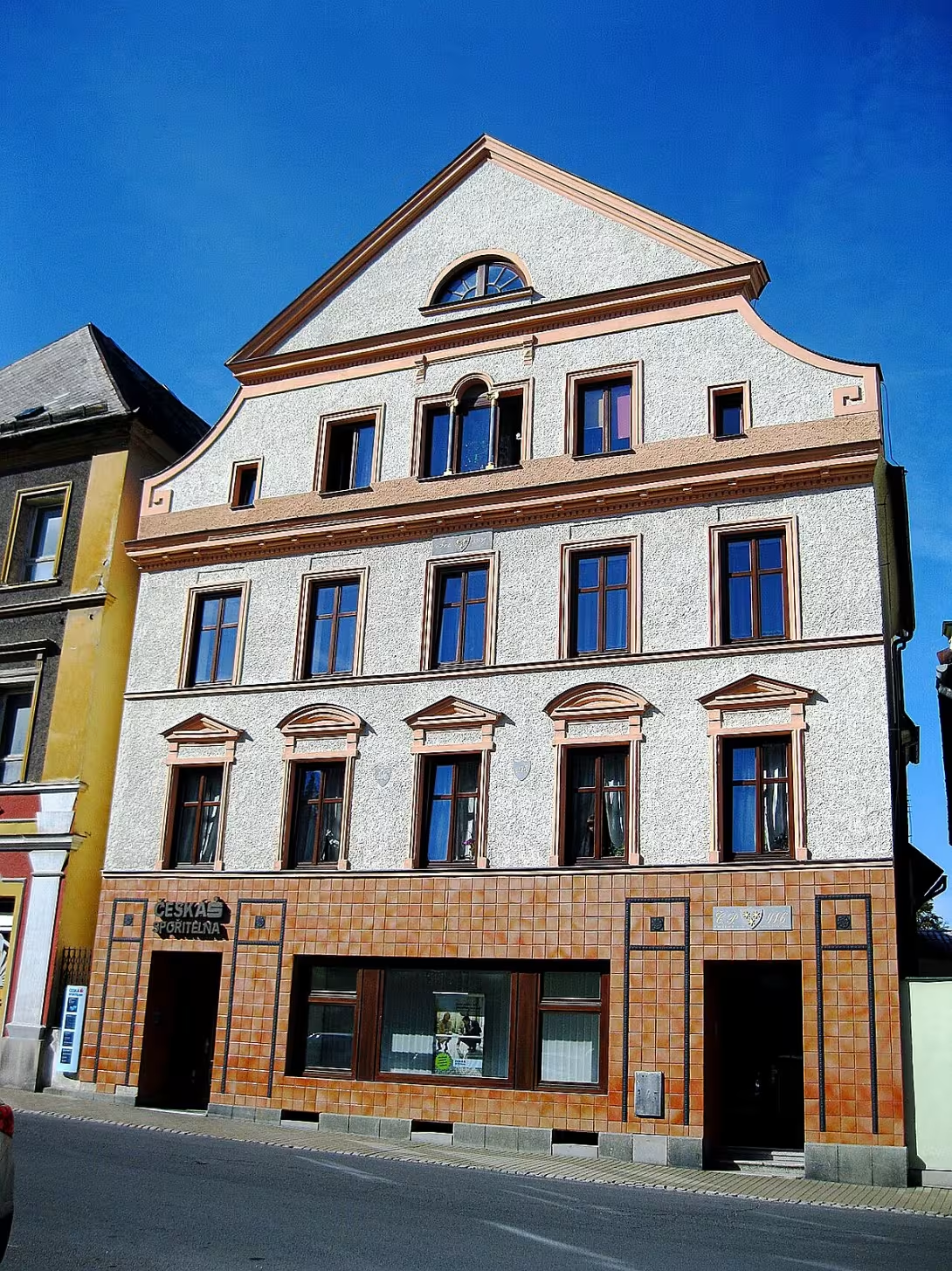
Dům čp. 416 in Javorník, the Jeseník district, is an empirical urban building with roots dating back to the Middle Ages and is protected as a cultural monument of the Czech Republic. It's part of the urban monument zone. This five-axis object is characterized by an atic floor and a long history dating back to the 14th century.
The monument was founded before 1373 when it was first mentioned as part of a medieval urban building. The development of cities and urban life took place in the Czech Republic at the time.
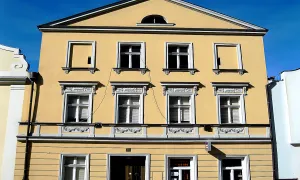
The current appearance of the house corresponds to the empirical style, it is a two-story, five-story, five-axis building made of bricks with a pane and a saddle roof. The inner spaces have flat ceilings. The street facade is divided by the cordon mansions above the ground floor and the first floor, closed by the main ledge. Above the second floor is an atic floor with simple volute wings and four windows (two larger and two smaller). The entire top of the facade consists of a triangular tympanone with an orbital ledge and a half-circle window. On the ground floor there is a display cabinet with rectangular entrances on its sides, while windows of the first floor are decorated with alternating triangular and segmented frontons.
In 1843, the merchant Meigonesche was based in the house, who ran his business here. A town savings bank was located on the ground floor before 1945. In 1932, repairs were carried out on the house, to which the Monument Office in Brno commented.
The history of the house is marked by several disasters. In 1428 it was damaged in the conquest of Javorníka husita. The reconstruction was followed by floods and fires in 1576 and 1603. A significant hit came in 1825, when 104 houses were destroyed in a large fire in Javorník, including this building. The later Empire redevelopment reflects the effects of Classicism from the first half of the 19th century.
Currently on the ground floor of the house, the branch of České spořitelna, a.s. The monument remains an important element of the urban monument zone Javorníka.
Dům čp. 416 represents a valuable example of the layered history of urban architecture and it is advisable to visit it during a walk through the historical centre Javorníka.
Historical milestones
- 1373
- First mention of the house as part of a medieval building
- 1428
- Damage to the house while conquering the city of Hussite
- 1843
- The owner's shop Meigonesche is located in the house
- 1932
- Repair of the house with an expression of the monument office in Brno
Architectural development
Originally a medieval building which was repeatedly rebuilt after fires in 1576, 1603 and 1825. The current empirical appearance shows a five-axis facade with cordon ledge and saddle roof. The house was repaired in 1932 under the supervision of the Brno Monument Office.
Historical events
1428: Damage to the house during the conquest of the city of Javorníka husita. 1825: The destruction of the house in a big fire that hit 104 houses in the city.
Owners
Meigonesche (1843)
Points of interest
- The history of the building dates back to the 14th century and is first mentioned before 1373. - In 1428, the house was damaged by Hussites in the Javorníka conquest. - The building was destroyed in a large fire in 1825, which hit 104 houses in total. - In 1843 a trader Meigonesche was resident and operated here. - On the ground floor there was previously a town savings bank and there is currently a branch of České spořitelna, a.s.
Guide
Show guide text
This text was created by artificial intelligence and has not been editorially reviewed. It may contain inaccuracies.
Welcome to Javorník. You are standing in front of the house No. 416, which is not only part of the town monument zone, but also a cultural monument of the Czech Republic. If you look at him, you'll probably find his calm but dignified silhouette first. In front of you is a two-story five-axis brick structure that boasts an empirical style. This architectural expression, which brought emphasis to Czech cities in the nineteenth century on symmetry, purity of lines and calm elegance, is evident at every step. It is not a random building, but an object with roots reaching deep into the Middle Ages, and it is this layered history that gives it the special weight that can be felt from a distance.
Let's move on to the story of the origin of this place. The history of this property is fascinating by its beginnings dating back to the 14th century. The first written mention of the house as part of the medieval building dates back to the year 1373. This means that there were buildings on this particular property before Javorník became what it is today. Imagine how people lived here over 600 years ago, how business was changing and how the city grew. This house witnessed many changes, conflicts and developments that shaped the face of this city.
Now pay attention to the facade itself, which is the result of reconstruction from the newer times. Even though the core of the building is old, what you see in front of you is the implementation of the Empire style. Look up to the roof line. Note the attics floor, which is decorated with volute wings. These spiral elements, reminiscent of tired leaves or stylized horns, are a characteristic feature of the Empire and add lightness and nobility to the building. Above them is a triangular tympanone that closes the composition and creates a harmonious whole. This combination of atics and tympanone is very characteristic of townhouses of this period and shows the efforts of owners to have a representative look, which corresponded to the then taste.
On the ground floor of the house there is a space for business. Although today it may seem to be ordinary business premises, historically it was the heart of the economic activity of this building. The business function was crucial to this house throughout its existence. In 1843, for example, the trader Meigonesche was resident and operated here. A name that sounds exotic refers to the European business network and international relations that the city of Javorník had at that time. Meigonesche was one of those who developed the economy and contributed to the prosperity of the city. His presence in this house shows that it was a place with an important trade tradition, where people from different corners met and traded various goods.
But the history of this house is not just a story of peaceful development. He also witnessed violent events that hit the whole city. In 1428, during Hussite wars, Javorníka was conquered. In this conflict, the house was damaged. Imagine the chaos and confusion that prevailed when the geese attacked the city. A home that was a haven for its inhabitants and a source of livelihood became the target of attacks and was destroyed or damaged. This event is proof of how fragile human civilization can be and how quickly the fate of individual buildings and communities can change. The damage from that time was probably repaired, but traces of it could remain in the city's memory and possibly in the very structure of the building, which was undergoing many reconstruction.
Another significant milestone in the history of this house was a big fire that broke out in 1825. This fire was so extensive, it hit a total of hundred and four houses in Javorník. Imagine how furious the fire was and how fast it spread over the wooden and brick buildings of the medieval and early modern city. Dům čp. 416 was destroyed in this fire. This means that the construction you see today is essentially a new building on the original property, built after this tragic incident. The fire was a huge test for the city, which required great effort and means to rebuild. The restoration of the house took place in view of the architectural trends at the time, and thus the current empirical form was created, which is now a cultural monument.
There was another important event in the twentieth century that ensured the preservation of this house for future generations. The house was repaired in 1932, in which he expressed his views in Brno. This intervention was crucial because it shows that the historical and cultural importance of this construction was already recognised at that time. Monuments tried to restore the house to preserve its historical character while still functional. This step was important for maintaining the authentic appearance of the house and for its further use. Without this intervention, it could happen that the house would gradually lose its original character and become a mere dwelling without historical value.
The architectural details you see today are the result of this meticulous restoration and the original empirical design. The brick facade is a symbol of strength and durability, but also elegance. Five-axis layout means that the house has five window axes, which creates a regular and harmonious rhythm on the facade. This rhythm is typical of townspeople 'houses and creates an impression of order and stability. The atic floor with volute wings and triangular tympanone is the crown of this building and attracts the view up. These elements are not only decorative, but also symbolic. Volumes can symbolize growth and development, while tympanone closes the composition and gives it closure and perfection.
The interesting thing is that the architects who designed or rebuilt this house are not known. This is common in many historical buildings, because at that time it was not customary to mention the names of architects on buildings. However, this does not mean that it is the work of ignorant craftsmen. On the contrary, the quality of the execution and compliance with the Empire style point to a high level of craft art. The house was built and rebuilt according to the most precise standards of its time, and that is why it was preserved in such good condition and why it is today protected as a cultural monument.
When you search this house, you can see how history intersects with the present. The bricks from which the house is built bear traces of centuries. Every brick has a story, every stone has a history. Dům čp. 416 is not only a building but also a book in which the history of Javorníka is written. From medieval beginnings, to Hussite wars, a great fire, to empirical reconstruction and modern recovery. Each stage
Tips for visitors
For the best experience we recommend a visit during the morning or late afternoon when the light is softer and better highlighted by historical details of the facade. Photography is ideal in a period of golden hour, when glitter on old walls is formed most remarkably.
You can easily get to the memory with your own vehicle or use public transport. Please check the current timetables and parking options within the city zone before travelling in internet search engines or local information portals.
Until the tour of the historical core we recommend to wear comfortable shoes suitable for walking on the city tiles. For families with children, walking around is interesting thanks to the authentic atmosphere of the old town, which can entertain children with its unusual form.
When visiting, do not only stay at the house itself, but also explore the wider area, which is the city monument zone Javorník. This area offers many other historical elements to observe.
Businesses nearby
Do you run a restaurant, accommodation, shop, museum, rental, wellness or other visitor service near this monument? Show yourself directly to the people heading to it — this is how they will see you in the app and on the web:
Nearby
City Monument Zone Javorník
Accommodation nearby
Themed route
House No. 416 - historical house - main destination of the trip, preserved Baroque residential house with original interiors and valuable building details.
The courtyard of the house - the outdoor area - represents a typical arrangement of the urban residence where you can admire stone columns and old stone tiles.
The tower of the house - an architectural element - provides a view of the entire city monument zone Javorník and allows you to see the historical context of the city.
Exposition of local history - exhibition space - in the house are located exposition documenting the development of Javorníka from the Middle Ages to the present, including original artifacts and photographs.
Park in front of the house - green area - quiet area with benches and old trees, ideal for relaxing after a tour and for the perception of the atmosphere of the historic city core.
Seasonal recommendations
In spring, the surrounding area is dominated by the awakening nature and a fresh green shade of leaves, creating an optimistic atmosphere. The soft spring light will highlight the facade details beautifully. We recommend wearing layered clothes because the weather in this area can be variable. The ideal time to visit is in the morning when the air is the cleanest.
The summer season brings an intense sun and a full bloom of surrounding gardens, giving the monument a lively and colorful look. Expect more visitors in the high season, so the best solution is very early arrival to avoid heat and crowds. Don't forget light, breathable clothes and plenty of fluids.
In autumn, the surroundings turn into golden and red tones, while morning fog gives the place a mysterious and melancholy touch. The lighting is softer at this time and the shadows are more. It is practical to choose waterproof shoes and to plan a visit for the afternoon when the temperature is more stable.
In winter the monument is often covered with snow, which creates a quiet and cozy atmosphere typical of mountain areas. Short days mean the building is best seen in the noon hours. It is necessary to wear warm winter clothes and to verify in advance the opening hours which are usually shortened during this period.
Visualizations and artistic views

The visualisations are generated by artificial intelligence and serve as inspiration.
Photos from the area
Real photos taken near the monument

Zdroj a licence jsou uvedeny u každého snímku.
Tips from visitors
No tips yet. Be the first!
Log in and add your tip.
Sources and literature
Fotografie: Lehotsky / CC BY-SA 3.0 — Wikimedia Commons. The author and licence also appear when you hover over the image.
Faktickým podkladem tohoto textu byl článek na Wikipedii, jehož autory jsou přispěvatelé Wikipedie. Článek je dostupný pod licencí CC BY-SA 4.0.
Location on the map
More monuments – Javorník
Show all in the municipality
Příběhy a pověsti
Legendy, pověsti a příběhy spjaté s touto památkou
Fotografie návštěvníků
Zatím žádné fotografie. Buďte první, kdo přidá fotografii z návštěvy!
Přihlaste se a přidejte svou fotografii nebo hodnoťte.
Za ověřenou návštěvu v aplikaci získáte víc bodů — poznáme podle GPS, že jste na místě.
Reviews and comments