



Dům Eduarda Červinky House
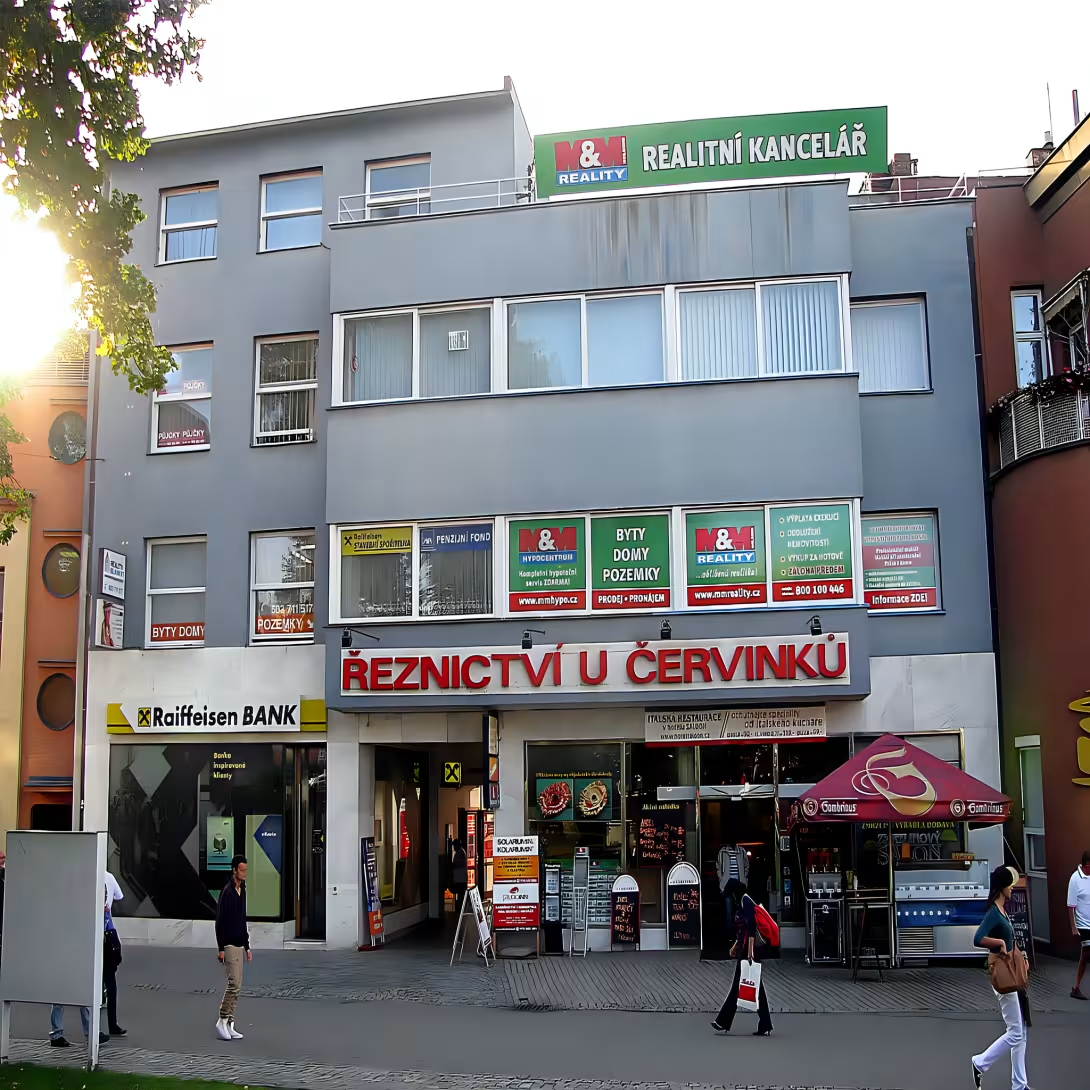
Dům Eduarda Červinky is a residential and office building with a business partner in the historical core of Zlína on Peace Square. This object in a progressive functionalist style was created in 1931. He confirmed his architectural value by entering the list of real cultural monuments in 2001.
On plot number 9 in the city centre, there was originally a simple single-storey house after Antonín Šmída with shingles roof. The butcher's concession was obtained here in 1899 by Karel Mikšík, later on in this activity Eduard Červinka. In 1921 Červinka received permission to operate a sausage and butcher workshop with electric motor drive. Since the original object was in bad condition in 1927, the prosperous grandeur in April 1931 made plans for a new construction. The project was approached by Brno architect Bohumir F. A. Cermák. He did not work in the construction department of Bata, which was less common in Zlín at the time.
The building is based on a reinforced concrete structure filled with brick walls. It has a three-storey body with an attic and a flat roof. The main facade is mass asymmetric and the facade refers to period functionalist tendencies. The most significant features are the belt sliding system of windows combined with so-called American sliding windows, receding floors or terraces. The stone parter contains glazed unloading and asymmetric passage. In the central part of the facade stands out an iron bay with belt windows, lined with heraclite. The attic forms the basis for an open terrace with metal railing. The original proposal was supplemented by advertising neons above the main entrance to the store and after its edges.
On the ground floor there were two commercial units separated by passage to the yard. The main part consisted of a generous area of butchery with a height of 3.55 metres, which included a section with tables and dining department. The rear wing served as an office, cold room, kitchen and pantry. The residential and administrative areas were located on the upper floors. In the first one there was a representative apartment of the family Cervicka, which also served as a workplace with two offices and waiting room. The floors led to a bright staircase with luxers. The upper floor was occupied by other apartments and there was a background in the attic including laundry and drying room.
The construction was carried out by Josef Jarcovák in 1931. In the second half of the 20th century, the building became part of the National Enterprise of the Spring. The housing units were gradually replaced by sales facilities and the original smokers turned into dumplings. In the 1990s, the house was replaced by several operations, from a beauty salon to a wine shop. Since 2003 the house has been using the U Červinky label and since 2009 the butchery has been operational again on the ground floor. At this time, the building was renovated, which included a third floor superstructure and a yard structure.
Today the house is registered as a cultural monument and is part of the urban monument zone. Although commercial areas perform their original function, most of the remaining premises were fundamentally redesigned, which changed the layout of the apartments. However, a large number of details such as balconies, stone tiles and window layout have been preserved. The building represents a good example of functionalism that corresponds to the surrounding development and is worth the tour as an important element of the historical core Zlína.
Historical milestones
- 1899
- Karel Mikšík obtained a butcher's concession tied to house 9.
- 1921
- Eduard Červinka has been authorised to set up a sausage and butcher shop.
- 1931
- Implementation of a new commercial and residential house in a progressive functionalist style.
- 2001
- Registration of the building on the list of real cultural monuments.
Architectural development
Originally there was a simple single-storey house after Antonín Šmída with shingles roof. In 1931 it was replaced by a three-storey building with a flat roof and a reinforced concrete structure filled with bricks. The facade combines stone tiles, heraclite and strip and American windows.
Historical events
1899: Obtaining a butcher's concession by Karel Mikšík; 1931: Construction of a new functionalist house; 2001: Entry into the list of real cultural monuments.
Owners
Karel Mikšík (from 1899), Eduard Červinka (from 1921)
Points of interest
- Dům Eduarda Červinky is a residential and office building with a business partner in the historical core of Zlína in Peace Square. - This building in a progressive functionalist style was established in 1931 and was included in the list of real cultural monuments in 2001. - Originally there was a simple single-storey house after Antonín Šmíd, which in 1927 was replaced by a new building according to the plans of architect Bohumir F. A. Cermák. - The building has a three-storey body with an attic and a flat roof, a mass-asymmetric main front facade and a characteristic belt sliding system of windows combined with American sliding windows. - In 2009 the butchery was restored to operation on the ground floor and the house was renovated, which included a third-floor superstructure and a yard extension.
Guide
Show guide text
This text was created by artificial intelligence and has not been editorially reviewed. It may contain inaccuracies.
Welcome to the heart of the city of Zlín and you have just stopped at Peace Square, where you will meet with history that defines the face of this place. You're standing right in front of a building that's not just an ordinary house, but a symbol of the transformation that the city went through during its greatest bloom. Before your eyes is the house of Eduardo Worvinka, a building that carries everything that was considered to be the pinnacle of progress and modern thinking in the 1930s. Feel the atmosphere of the place where the old craft connects to the new dynamic era of the city.
Let's go back in time together and understand what this place has experienced before it's become the way you see it right now. The history of this particular place at the heart of the city did not begin in the year one thousand nine hundred thirty-one as it might seem. He's much older. Already in the year one thousand eight hundred ninety-nine here began a story that was closely linked to traditional craft. That's when Karel Mikšík acquired the right to perform the butchery activity, which was firmly linked to this very house at number nine. It was a time when the city had not yet been so large and life was much slower in it, but it was here that the foundations of future wealth and expansion began to form.
Over time, however, people's needs have changed and the buildings themselves have changed. In the year one thousand nine hundred twenty-one there was another important moment when Eduard Červinka obtained permission to set up its own sausage and butcher shop. This was a signal that this place had enormous potential and that a much more intensive business life could take place here. Worm wasn't just a butcher, he was a man with great ambitions who understood that he needed something more than a simple workshop to succeed in the modern world. He needed a representative space that reflected his position and the growing importance of the city.
And so just in the year one thousand nine hundred thirty one happened the thing that fundamentally changed the appearance of the entire square. A new building has been built, which you are now observing. It wasn't just another house, it was a manifesto of a new age. Eduard Červinka did not ask for an ordinary object but for a modern combination of business and housing. This created a house that was intended not only for his business, but also for the life and work of many other people.
Now pay attention to what you see right in front of you. Look at the structure and try to perceive its unusual character. This object is an excellent example of what we call functionalism. This is the direction in architecture that does not seek unnecessary decorating, but focuses on making the building do its best and look clean and modern. The architect of this work was Bohumír F. A. Čermák, the man who was able to transfer these advanced ideas into the reality of Zlína.
Notice how this building is different from the older, traditional structures you might expect in the historical core. The key element that should interest you immediately is her asymmetric facade. If you try to find an exact central axis that divides the building into two identical halves, you will find that there is no such axis. And that's where her strength lies. The asymmetry gives the house movement, dynamics and a sense of modern energy. It's not a static, boring block, it's a living part of the city.
Look at the ground floor. That's where the most important business life takes place. These spaces were designed to serve as shops that attract people and create a busy heart square. There are other floors above them, which served as living spaces or offices. It is a fascinating example of how the best of urban life was combined in one building: work, business and private housing. The whole was designed with regard to the modern needs of the time when people began to move at a faster pace.
Looking at the building, you can imagine the character of Eduardo Worm. Imagine him as a visionary who in the year one thousand nine hundred thirty-one invested in the future expansion of his city. His decision to build such an advanced house in the heart of Zlín was bold. He didn't just want a building, he wanted a symbol. And he really created it. This house witnessed many generations of people who worked here, lived and walked by it.
There is one other thing I would like to stress to you. This building is not only a beautiful memorial object, but it also has official protection. In the year two thousand and one, this object was included in the list of real cultural monuments. This means that its value for our city and for the entire history of architecture has been recognised by state authority. It is a confirmation that what you see is an untouchable piece of our heritage that we must preserve for future generations.
You may now wonder how this place has changed since Karel Mikšík operated his small cutting concession here. Imagine the transformation from a simple, maybe wooden or stone object that served only one family to this monumental, modern building that dominates the entire square. It's a story about growth, ambition and how Zlín was turning from a small town into a modern industrial center.
Now that you know the story of this house, I suggest you continue your walk through the Square of Peace. Focus on other buildings in the area and try to find traces of the same era that left a trail here in the year one thousand nine hundred thirty-one. Every corner of this town has its own story waiting for you to uncover it. Thank you for stopping by and paying attention to this special place. We will brighten up another pleasant part of your journey with Zlína history.
Tips for visitors
The best time to visit Dům Eduarda Červinky is in the spring or autumn season when the city of Zlín is in full bloom and the temperature is not too extreme. This time of year offers ideal conditions for walking on historic streets and viewing architectural work.
The current connection should be verified in the online search engine.
When you visit, take your purse and rescue package with you if you plan a long walk. The house is located in the historical core of the city, so it is advisable to be prepared for different conditions.
Photography is best performed in the morning or evening when light is softer and shadow effects are more pronounced. The best places for photography include adjacent Square Peace where architectural details of the building can be captured.
In the surroundings you can visit Zlín Town Hall, located nearby and offers historic interior. For families with children it may be interesting to explore nearby parks or visit some of the cultural institutions that are located in the centre.
Frequently asked questions
Can the monument be visited?
This is a residential or farm building, not a museum with opening hours. Please view it from public space and respect the owners' privacy. We have no information about access to the interior.
Where is the monument?
Location: Zlín, Zlínský kraj. The map on this page shows the exact spot.
Why is the monument protected?
It is listed in the Central List of Cultural Monuments of the Czech Republic as a cultural monument (register no. 1000164338).
Businesses nearby
Do you run a restaurant, accommodation, shop, museum, rental, wellness or other visitor service near this monument? Show yourself directly to the people heading to it — this is how they will see you in the app and on the web:
Nearby
Budova se nachází v blízkém sousedství zlínské radnice v historickém jádru města.
Accommodation nearby
Trips and activities nearby
Guided tours, tickets and activities nearby from GetYourGuide
Affiliate link: if you buy from the partner, we may receive a commission. The price for you does not change.
Search tours and activities →Themed route
Travel Route in Zlín
1.Dům Eduarda Červinky
Type: Historical House
Why is worth a visit: This architecturally interesting object is part of the historical heart of the city Zlín. The house, located near Zlín Town Hall, represents the work of a famous architect and allows visitors to see the unique elements of modern architecture.
2. Zlín Town Hall
Type: Historical building, administrative building
Why is it worth a visit: Zlín Town Hall is one of the icons of the city and its architecture reflects the rich history of the village. Its location in the city centre allows a comfortable transition to other attractions such as Dům Eduarda Červinky.
3. Square of the Republic
Type: Public Square
Why is worth a visit: The Republic Square is the heart of the Zlín Centre, where many cultural and commercial buildings are located. It is an ideal place to relax after exploring architectural monuments and exploring the local atmosphere.
4. Church of St. Lawrence
Type: Religious object, church
Why is it worth a visit: This church is another important historical and architectural monument in the city. Its location near the Zlín centre encourages you to explore its rich history and unique buildings.
5. Antonín Macek Museum
Type: Museums
Why is it worth a visit: Even if it is not part of the surroundings of Dom Eduardo Cervica, it is one of the most important museums in Zlín. It offers exhibits about the life and work of Antonín Macek, which brings a deeper understanding of the cultural development of the city.
This route offers a view of the historical and architectural monuments Zlína and allows visitors to explore the wealth of the cultural heritage of the village.
Seasonal recommendations
Spring: In the spring season Dům Eduarda Červinky is lit by sunlight, which brings live color to green trees and flowering shrubs around the monument. The atmosphere is full of recovery and hope, making the visit peaceful and pleasant. Visitors should choose clothes suitable for mild temperatures with the possibility to approach the sun because the weather can be variable. The best time to visit is an early afternoon when the crowd load is minimal and nature in full bloom.
Summer: In summer Dům Eduarda Červinky becomes a popular place to visit thanks to warm sunshine and long days. Nature is in full bloom, which brings clear greenery and flowering shrubs. The atmosphere is vibrant and full of energy, but as a result there can also be a larger number of visitors. Visitors should come early in the morning or late in the afternoon to avoid the hottest hours and crowds. It is advisable to wear light clothes and prepare sun cream to protect against UV radiation.
Autumn: In autumn, Dům Eduarda Červinky offers visitors a view of a variable and colorful landscape where tree leaves turn into golden and red shades. The atmosphere is calm and slightly cold, creating ideal conditions for relaxed walks around the monument. Visitors should choose warmer clothes with the possibility to approach the sun because the weather can be variable. The best time to visit is an early afternoon when the temperature is mild and the crowd load is minimal.
Winter: The winter season brings the Dům Eduarda Červinky a quiet atmosphere with fewer visitors and beautiful snow landscapes if snow gets. Nature is calm, which allows you to enjoy a quiet and completely different form of monument. Visitors should be well prepared for cold temperatures with warmer clothing, including hat and gloves.
Visualizations and artistic views


The visualisations are generated by artificial intelligence and serve as inspiration.
Photos from the area
Real photos taken near the monument


Zdroj a licence jsou uvedeny u každého snímku.
Tips from visitors
No tips yet. Be the first!
Log in and add your tip.
Sources and literature
Photos: Pavel Langer / CC BY-SA 3.0, rozlišení zvýšeno umělou inteligencí — Wikimedia Commons. The author and licence also appear when you hover over the image.
Faktickým podkladem tohoto textu byl článek na Wikipedii, jehož autory jsou přispěvatelé Wikipedie. Článek je dostupný pod licencí CC BY-SA 4.0.
Location on the map

Příběhy a pověsti
Legendy, pověsti a příběhy spjaté s touto památkou
Fotografie návštěvníků
Zatím žádné fotografie. Buďte první, kdo přidá fotografii z návštěvy!
Log in a přidejte svou fotografii nebo hodnoťte.
Za ověřenou návštěvu v aplikaci získáte víc bodů — poznáme podle GPS, že jste na místě.
Reviews and comments