



dům Mona Lisa House
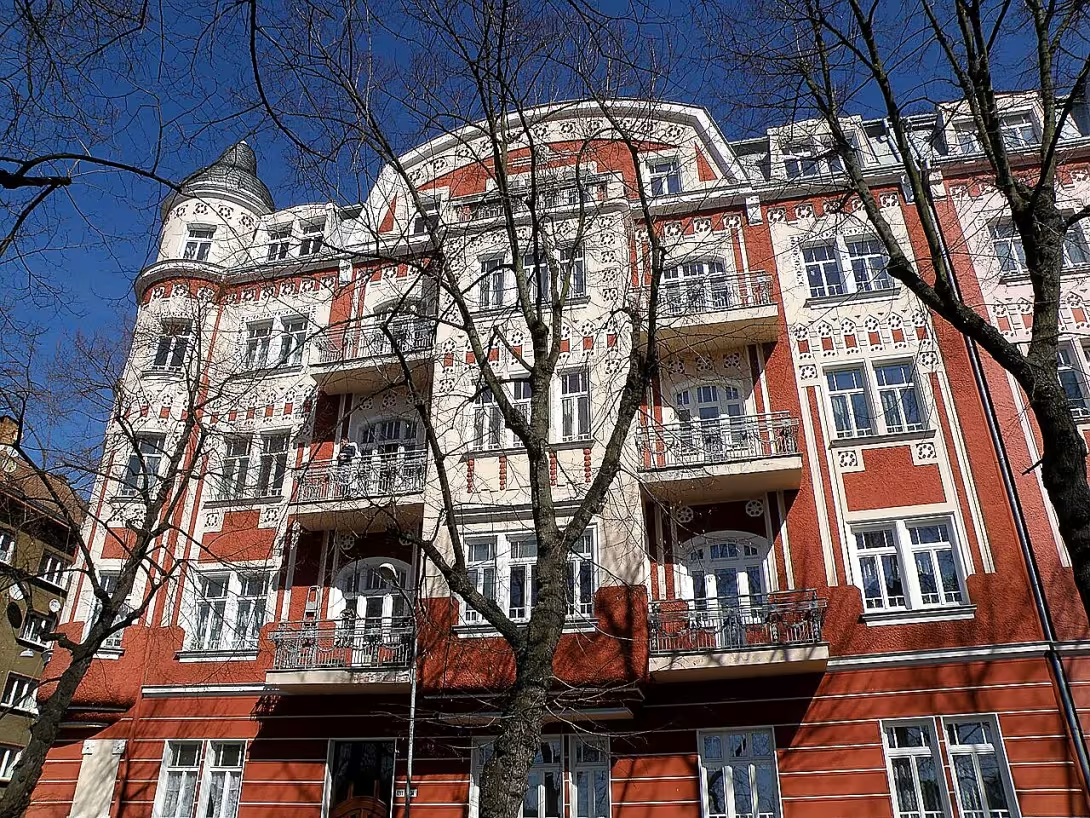
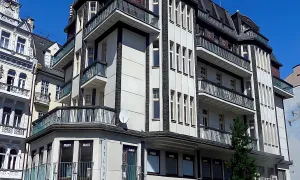
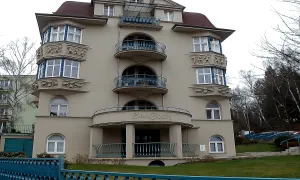
The Mona Lisa House is a four-storey corner apartment house built in the spirit of late Art Nouveau, located in the Karlovy Vary town monument zone on Jan Palach's waterfront. The building is important in its specific architectural form, rich geometrical decoration and mirror orientation towards the neighbouring building Am Lido.
The building was built in 1911-1912. Its builder was Karlovy Vary city builder Josef Waldert, who was probably also the author of both projects, including the neighbouring house. The house was set up as an apartment building for rental and its construction was completed in July 1912.
The architecture of the building uses elements of late Art Nouveau, which is manifested by geometric decoration and rough structure on tectonic articles. The building is four-storey and includes a basement part and a residential mansard. On the corner where the waterfront of Jan Palach and the street of Karel Čapka are met, a three-axis semi-circular bay ends with a circular tower with three windows and bell roof over a profiled ledge. The nine-axis entrance facade is oriented into Jan Palach's waterfront and the entrance is located in the third axis from the left. The front door is modern, glazed and with wooden corrugated frames. Sokl is made from rough plaster and contains rectangular cellar windows with smooth trim. The ground floor is broken down by the belt brass made of rough plaster with highlighted clutches. The windows are oblong, double wing at the bottom, with separated upper wing and other partitions. On both of the street facades there is a bay, which on the second to fourth floors on both sides contains balconies and is finished with a wide segment shield. The side facade is mirrored and has no entrance. The facades are richly decorated with stucco decoration, which includes women's heads in the lower forehead of the corner bay or in the mansard building, stylized flowers in squares, belts of convalines and pearls. The richly decorated balconies, together with garland and target moulds, are complemented by rich decorations.
Since 9 April 2001, the house has been declared a cultural monument under the register number SAR 50859 / 4-5235. Under the urban conservation programme Karlovy Vary for the period 2014- 2024, the building was listed as suitable in the list of real cultural monuments. The house is currently registered as a residential building owned by a community of unit owners.
One of the most significant architectural attractions is the relation to the neighbouring house Am Lido. Both buildings were built at the same time by Josef Waldert and their facades are designed as mirror oriented.
This object represents an important example of Art Nouveau architecture in Karlovy Vary. For visitors to the city it is an interesting topic of period construction and detailed craft.
Then and now
Drag the slider to compare how the landmark may have looked when it was built with the view today.
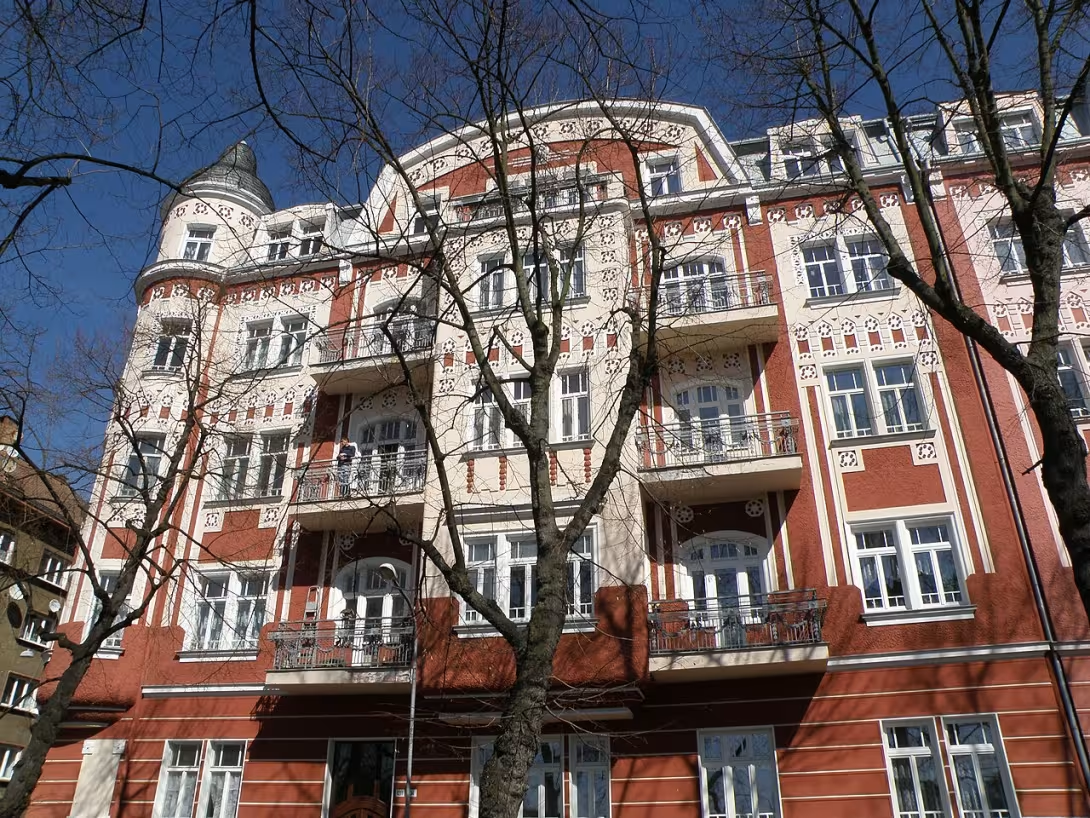
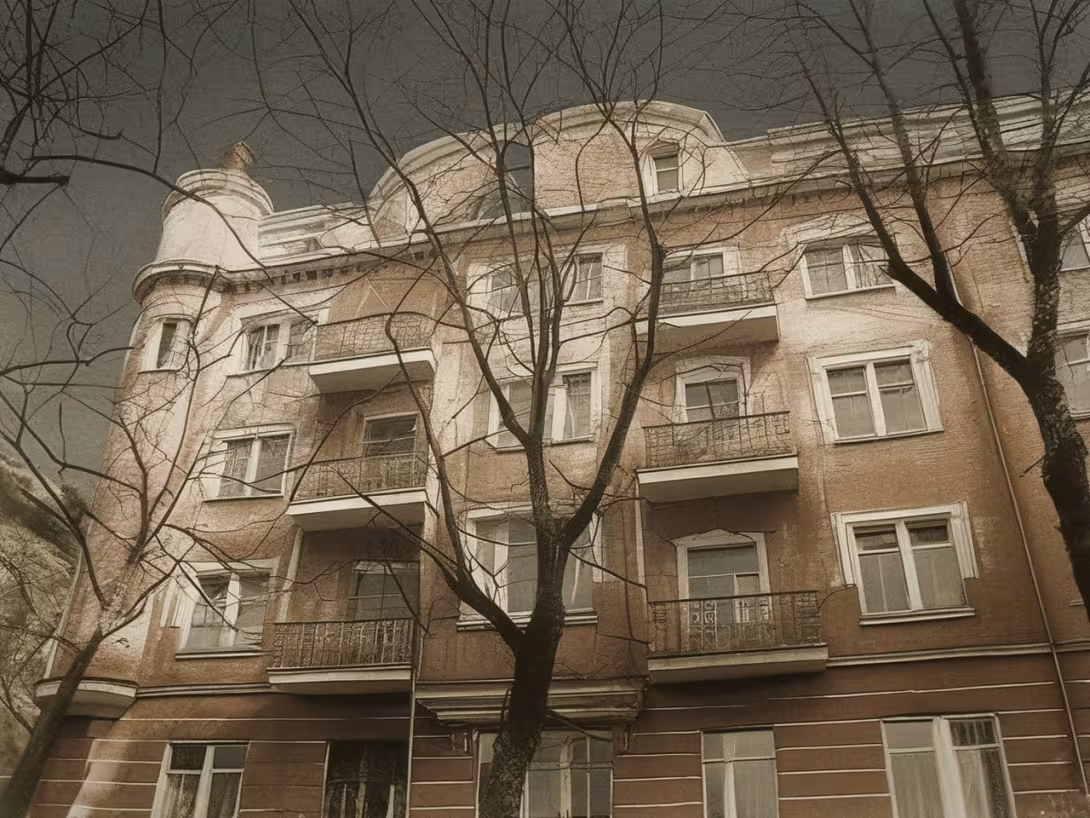
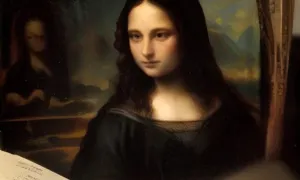
The historical appearance on the left is an AI-generated visualisation and serves as inspiration only.
Historical milestones
- 1912
- Completion of construction
- 2001
- Declaration of the building for a cultural monument
Architectural development
The building was built in 1911-1912 by Karlovy Vary builder Josef Waldert. The architecture uses elements of late Art Nouveau with geometric shapes and rough structure of plaster. The facade is richly decorated with stucco decoration, including women's heads and flower motifs.
Historical events
In 1912 the house was completed. In 2001 it was declared a cultural monument.
Owners
The Community of Unit Owners (as at 2021).
Points of interest
- The building is a four-story corner house built in the spirit of a late Art Nouveau. - On the corner there is a three-axis semi-circular bay ending with a circular tower with bell roof. - Stucco decoration of façades includes female heads, stylized flowers, convalines and pearls. - The house has been declared a cultural monument since 9 April 2001. - The object is important in its specific architectural form and rich geometric decoration.
Guide
Show guide text
This text was created by artificial intelligence and has not been editorially reviewed. It may contain inaccuracies.
Welcome to Karlovy Vary, where history meets the elegance of spa life at every step. Right now, you're standing on Jan Palach's waterfront and in front of you is a building that tells a story about the aesthetics and ambitions of the early twentieth century. Take a look at this four-story corner house called Mona Lisa. The first impression he gives is a sense of harmony and urban nobility. It is a building that perfectly complements the surrounding architecture by its location in the historical zone of the city, while it stands out in its specific form.
Let us now return together in time more than a century ago. It is the year of nine hundred and twelve, the period when old orders broke in Europe and a new, more modern vision of the world arose. It was this year that the construction of the Mona Lisa house was completed. Its creator was architect Josef Waldert, who inserted the spirit of late Art Nouveau into the project. At that time, it was not only the construction of the ordinary roof above the head, but the creation of an artwork in the city. The building was not designed as a one-time family residence, but was set up as a residential building for rental. So imagine how many different destinies, stories and conversations have taken place in these walls over the decades. There were perhaps rich visitors to the spa, local merchants or artists looking for inspiration in the Karlovy Vary environment.
I now ask you to pay full attention to the architecture itself. Look at the overall composition of the house. Notice the dominant role played by the corner of the building. This is where architect Josef Waldert placed the most significant element of the whole house. Look up at the corner where you'll see a three-axis half-circle bay. The arch is an element in architecture that expands the space of the rooms outwards while giving the facade a plastic, dynamic look. However, this bay is not usually completed. Follow the line of the building up to the top where the bay turns into a circular tower. This tower ends with an elegant bell roof, which resembles a fine arch and gives the whole house a touch of romance and lightness.
Now, when you get a little closer to the facade, start to perceive the details that make this house the real gem of the late Art Nouveau. Secese was a style that loved nature, organic shapes and geometric precision. That's what you see here. Note the rich geometrical decoration that rhythms the surface of the walls. But that's not all. Look carefully at the stucco decoration of the facade. If you look, you will discover fine details that are designed to create a sense of beauty and fragility. The architect has developed women's heads, which are a typical symbol of the Art Nouveau era, embodies the ideal of female beauty and mystery. Next to them you will see stylized flowers, which are confused by the facade as a real garden in stone. In particular, note the details of the paraphernalia and the pearl. These tiny elements show how much care Josef Waldert has given to each inch of its construction. It's a fascinating contrast between the mass of a four-storey house and the fineness of flower ornaments.
Although we do not know in historical records any specific personalities that would have been closely associated with Mona Lisa's house as its famous inhabitants, the very existence of the house as a rental building in the year nine hundred and twelve tells us about the time. Karlovy Vary was at the time a cosmopolitan centre where languages, cultures and social layers were mixed. This house was part of a mechanism that allowed people around the world to feel at home in our city, in an environment that was modern, luxurious and aesthetically polished.
You may be wondering why this house is so important today. The answer lies in recognising his value. After many decades, when the house served its inhabitants and witnessed changes in regimes and societies, the moment of official recognition came. On April 9th in the year two thousand one was declared a cultural monument by dům Mona Lisa. This means that the state has acknowledged that this building is not just an ordinary house, but an irreplaceable part of our cultural heritage. It's a reminder of the time when architecture tried to combine the functionality of living with pure art.
Stop now for a moment and just feel the atmosphere of this place. Imagine how nine hundred and twelve of this corner saw themselves on the waterfront, how carriages were left in the streets, and how people in elegant costumes were walking around these very stucco valleys that you see today. The house of Mona Lisa remains a silent but proud witness to the history of Karlovy Vary.
I hope you enjoyed this brief insight into the depths of architecture and history. Now I encourage you to look around again, feel the rhythm of the city and continue your journey along Jan Palach's waterfront. Every other house you pass can hide its own secret story, waiting to be discovered. I wish you a pleasant continued walk through our beautiful spa streets. Goodbye.
Tips for visitors
For the best visual experience we recommend visiting during the afternoon hours. Solar light in this period best highlights the rich geometrical and Art Nouveau details of the building, which are very visible from the waterfront. The corner location of the house offers excellent angles for photography.
Transport to the site is possible both by public means of transport and by own vehicles.
When visiting, it is recommended to wear comfortable shoes suitable for walking around the historical centre. For families with children, walking in this part of town is pleasant thanks to the proximity of the waterfront.
As part of a short walk around you can explore Jan Palach's waterfront, visit the Am Lido house or take a look at details within the Karlovy Vary town heritage zone.
Frequently asked questions
Can the monument be visited?
This is a residential or farm building, not a museum with opening hours. Please view it from public space and respect the owners' privacy. We have no information about access to the interior.
Where is the monument?
Location: Karlovy Vary, Karlovarský kraj. The map on this page shows the exact spot.
Why is the monument protected?
It is listed in the Central List of Cultural Monuments of the Czech Republic as a cultural monument (register no. 1000121936).
Businesses nearby
Do you run a restaurant, accommodation, shop, museum, rental, wellness or other visitor service near this monument? Show yourself directly to the people heading to it — this is how they will see you in the app and on the web:
Nearby
The Karlovy Vary Town Monument Zone, Jan Palach waterfront, Am Lido House.
Accommodation nearby
Trips and activities nearby
Guided tours, tickets and activities nearby from GetYourGuide
Affiliate link: if you buy from the partner, we may receive a commission. The price for you does not change.
Search tours and activities →Themed route
1. Karlovy Vary Town Monument Zone (Historical Region) - It offers the opportunity to admire the unique architecture and atmosphere of the whole centre. The 2nd waterfront of Jan Palach (Promenade) - An ideal place for a relaxing walk along the river. 3rd House Am Lido (Building) - Interesting architectural element in the immediate vicinity of water. 4. dům Mona Lisa (others) (Main monument) - Top of the route and main destination of the visit.
Seasonal recommendations
Spring: In the spring period, dům Mona Lisa in Karlovy Vary is transformed into a magnificent garden park, where various kinds of flowers and trees bloom into a new leaf dress. The sunny days bring a warm light that adorns the historic object with a delicate glow. At this time the opening time of the monument may sometimes be shorter due to the variable weather, so it is advisable to visit already in the early afternoon time. Although the first tourist crowds may appear here, they are usually still acceptable and allow a peaceful sightseeing visit.
Summer: During the summer season, the atmosphere around the house Mona Lisa in Karlovy Vary is full of life, when the city wakes up to its full strength. Sunshine days and warm nights attract tourists from all over the world, making this season the most visited. It is advisable to take an early morning tour in order to avoid long fronts and pushed crowds. It also makes it easier to visit alone, as warm weather can be exhausting in combination with large groups of tourists.
Autumn: In autumn, gardens around Mona Lisa's house turn into emerald and red pearls when leaves fall down and leave a beautiful picture in front of pilgrims. The sunny days are still warm, but the nights become gradually colder, creating a mild and calm atmosphere. It is advisable to visit a monument in the middle of the day when the weather is the sweetest, while avoiding closing hours, which may be too cold.
Winter: The winter visit to the Mona Lisa house in Karlovy Vary offers a unique atmosphere under the vaults of the snow blanket. Sundays can be dazzling, while nights become long and cold. This season the opening times are often shorter and the attendance is smaller, which allows for a calmer viewing experience. It is important to prepare warm clothes, including fur pockets and shoes suitable for freezing surfaces in order to enjoy the full potential of a winter view of the historical monument.
Visualizations and artistic views


The visualisations are generated by artificial intelligence and serve as inspiration.
Photos from the area
Real photos taken near the monument

Zdroj a licence jsou uvedeny u každého snímku.
Tips from visitors
No tips yet. Be the first!
Log in and add your tip.
Sources and literature
Photos: U.username / CC BY-SA 4.0 — Wikimedia Commons. The author and licence also appear when you hover over the image.
Faktickým podkladem tohoto textu byl článek na Wikipedii, jehož autory jsou přispěvatelé Wikipedie. Článek je dostupný pod licencí CC BY-SA 4.0.
Location on the map
More monuments – Karlovy Vary
Show all in the municipality
Příběhy a pověsti
Legendy, pověsti a příběhy spjaté s touto památkou
Fotografie návštěvníků
Zatím žádné fotografie. Buďte první, kdo přidá fotografii z návštěvy!
Log in a přidejte svou fotografii nebo hodnoťte.
Za ověřenou návštěvu v aplikaci získáte víc bodů — poznáme podle GPS, že jste na místě.
Reviews and comments