



Dům U Červeného orla (Celetná) House
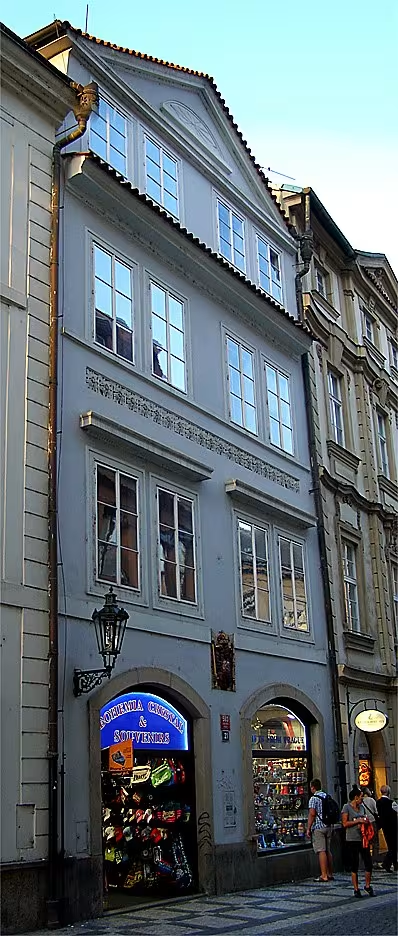
Dům U Červeného orla, located at Celetná ulice 21 in Prague's Old Town, is a historically significant building known for its role during the Czech national revival period. Originally built on medieval foundations, it has seen several architectural changes from Gothic to Baroque and finally to Neoclassical style by Jan Ripota in 1838. The house became famous through its café, which served as a cultural hub frequented by prominent figures of Czech culture.
The origins of Dům U Červeného orla date back to the early 15th century when it was first documented between 1404 and 1414 under Mikuláš Lunkovič's ownership. Initially, this structure stood on medieval foundations, reflecting its long-standing presence in Prague's architectural landscape. By 1641, the house belonged to řemeslník Heinrich Goldschmidt, marking a period when it underwent Baroque renovations before 1725. These changes were part of broader European trends during which Prague experienced significant cultural and architectural developments.
The most notable transformation occurred in 1838 with the Neoclassical renovation led by architect Jan Ripota. This change not only enhanced the building's aesthetic appeal but also aligned it with contemporary architectural movements that emphasized symmetry, proportion, and simplicity. The façade features four window axes, a main cornice, and a triangular pediment adorned with the Eye of God, reflecting its Neoclassical design elements.
Ownership transitioned to the Carmine family in 1844, who established the renowned café within. Josef Carmine, originally a prýmkař (a type of craftsman), and his descendants expanded their business by merging it with the neighboring U zlatého Václava, creating a significant restaurant operation. The last family member to manage this establishment was Bohdan (Theodor) Carmine, who handed over operations in 1927.
Dům U Červeného orla's café became a cultural landmark during the Czech national revival period. It served as a meeting place for notable figures such as Josef Kajetán Tyl and his theatrical companions from Divadlo U Kajetánů, as well as Magdaléna Forchheimová. The café was also frequented by Eleonora Šomková, who inspired the poet Karel Hynek Mácha. These associations underscored its role in fostering Czech cultural identity during a time of burgeoning nationalism.
Today, Dům U Červeného orla stands as a protected monument since 1958, reflecting its enduring historical and architectural significance. Visitors can explore its rich history and appreciate the Neoclassical elements that define its current form. The building's location in Prague's Old Town, a UNESCO World Heritage site, adds to its allure, offering insights into the city's vibrant cultural past.
Dům U Červeného orla is more than just an architectural relic; it is a testament to the dynamic history of Prague and the Czech national revival. Its café once served as a crucible for cultural exchange and intellectual discourse, making it a site worth visiting for those interested in exploring the intersections of architecture, history, and culture.
Then and now
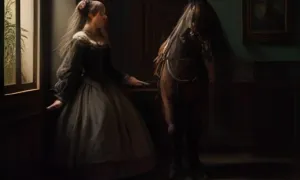
Drag the slider to compare how the landmark may have looked when it was built with the view today.
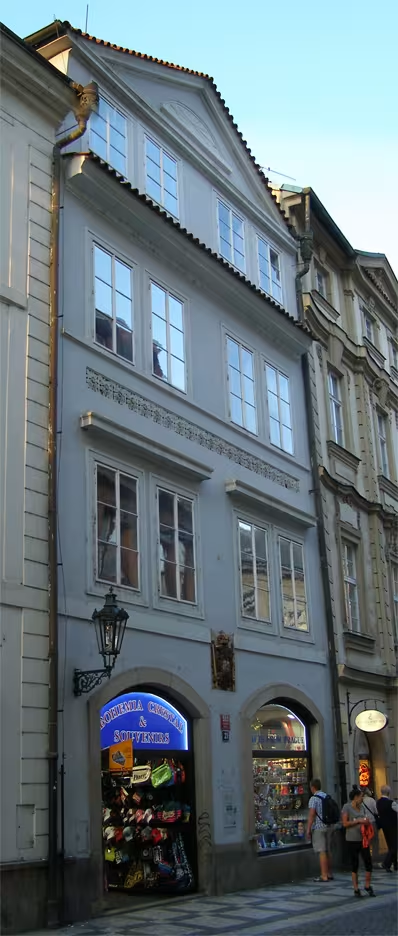

The historical appearance on the left is an AI-generated visualisation and serves as inspiration only.
Historical milestones
- 1404-1414
- First documented ownership by Mikuláš Lunkovič.
- 1641
- Owned by řemeslník Heinrich Goldschmidt.
- 1838
- Neoclassical renovation by Jan Ripota.
Architectural development
Dům U Červeného orla has evolved through several architectural phases. Initially a Gothic structure, it was transformed into Baroque style before 1725 and later underwent significant Neoclassical renovations by Jan Ripota in 1838. The building's façade features four window axes with a main cornice and triangular pediment adorned with the Eye of God.
Historical events
The house was first documented in the years 1404-1414.
Baroque renovation occurred before 1725.
Neoclassical transformation by Jan Ripota in 1838.
Owners
Mikuláš Lunkovič (1404–1414)
Heinrich Goldschmidt (1641)
Rodina Carmineových (1844–1952)
Points of interest
- The Dům U Červeného orla originally stood on medieval foundations dating back to the early 15th century, highlighting its long-standing presence in Prague's architectural history before undergoing several stylistic transformations.
- In 1641, řemeslník Heinrich Goldschmidt owned the building and initiated Baroque renovations that were part of a broader trend across Europe during that period, reflecting significant cultural shifts in architecture.
- The Neoclassical renovation by Jan Ripota in 1838 introduced distinctive design elements such as four window axes, a main cornice, and a triangular pediment featuring the Eye of God, aligning with contemporary architectural movements emphasizing symmetry and simplicity.
- Josef Carmine, originally a prýmkař, played a pivotal role in establishing the café within Dům U Červeného orla as a cultural hub by merging it with the neighboring U zlatého Václava to form a significant restaurant operation.
- The café at Dům U Červeného orla was not only a popular meeting place for figures like Josef Kajetán Tyl and Magdaléna Forchheimová but also served as an inspiration for poet Karel Hynek Mácha, who drew creative influence from Eleonora Šomková.
Guide
This guide is narrated by a synthetic voice generated by artificial intelligence.
Show guide text
This text was created by artificial intelligence and has not been editorially reviewed. It may contain inaccuracies.
The House of the Red Eagle on Celetná Street in Prague's Old Town was previously also called the House of the Stag in the Pot or Hartmann's Palace. It became famous for its café from the time of the Czech national revival. Since nineteen fifty-eight it has been a protected monument.
The house stands on the foundations of a medieval building, from which a pair of Gothic cellars has been preserved. It is first mentioned in writing in the years fourteen oh four to fourteen fourteen. At that time it was held by Mikuláš Lunkovič, who in fourteen oh seven acquired the neighbouring house as well. The sources, however, do not place both buildings on the street, but "on the placard makers' square". In sixteen forty-one the house was owned by a craftsman named Heinrich Goldschmidt. Before seventeen twenty-five an unnamed owner rebuilt it in the Baroque style. The house was then described as two-storied and well constructed.
A fundamental Classical renovation was carried out in eighteen thirty-eight by Jan Ripota. He raised the house by one storey and modified the facade. From eighteen forty-four it belonged to the Carmine family. Josef Carmine was a lace maker by original trade. The family ran a café called the House of the Dry and in eighteen eighty-two connected it with the neighbouring house, the House of the Golden Václav, into a large restaurant. The last family member to run it was Bohdan Carmine, also listed as Theodor. On the fourteenth of May nineteen twenty-seven he transferred the business to the then head waiters Karel and Julius Kirsch. The house remained with the Carmines until its expropriation in nineteen fifty-two.
The company of the Café of the Dry was described by Alois Jirásek in the chronicle Among Us. From the nineteen thirties onwards, Josef Kajetán Tyl would come here with his theatre amateurs after rehearsals. His later wife Magdaléna Forchheimová also came here, along with other actors from the Theatre U Kajetánů. It was right here that Eleonora Šomková was drinking hot chocolate when the poet Karel Hynek Mácha first saw her and addressed her.
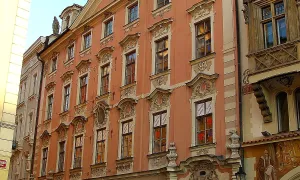
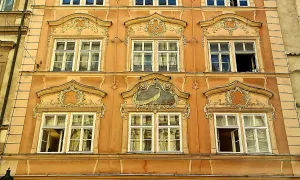
Today the house is three-storied. The facade onto Celetná Street has four window axes and a prominent main cornice with a triangular gable. In its tympanum is the Eye of God in a radiating halo in a semicircular field. The storeys have simple Classical articulation. The windows are framed by ribbon-shaped reveals, and in the recessed fields there is a strip of prefabricated decoration. The cornice between the second and third storeys is a remnant of the crown cornice of the original Baroque house. The ground floor received after the middle of the twentieth century two wide shop windows in stone frames, glazed with a segmental arch.
Tips for visitors
The best time to visit Dům U Červeného orla is during the late spring to early autumn months, when Prague's Old Town is particularly vibrant with cultural events and outdoor activities. The weather is pleasant for exploring the narrow streets and enjoying the architectural beauty of the area. Additionally, visiting in the morning can help avoid larger crowds that tend to gather later in the day.
Public transportation is highly recommended; you can easily reach the site using trams and buses that serve Prague's Old Town. For those driving, it's advisable to park at designated areas outside the city center and use public transport for the final leg of your journey.
When visiting Dům U Červeného orla, consider bringing comfortable walking shoes as you'll be exploring on foot. A camera is also recommended to capture the stunning architecture and vibrant street life. Since the area can get crowded, especially during peak tourist seasons, a small backpack with water and snacks might come in handy.
For photography enthusiasts, the best spots around Dům U Červeného orla include its front facade which is beautifully illuminated at night, offering excellent photo opportunities. The nearby Charles Bridge provides stunning views of Prague Castle and the Vltava River, especially during golden hour when the light is soft and warm.
Within a 30-minute walk from Dům U Červeného orla, visitors can explore several attractions including the Old Town Square with its iconic Astronomical Clock, Týn Church, and the Jewish Quarter. The area around Wenceslas Square also offers shopping opportunities and more historical sites to discover.
For families with children, Prague's Old Town is a wonderful place to visit due to its compact size and abundance of attractions. Children will enjoy exploring the Charles Bridge, visiting the historic Astronomical Clock, or enjoying ice cream at one of the many street vendors. The area also has several parks where kids can run around and play.
Frequently asked questions
Can the monument be visited?
This is a residential or farm building, not a museum with opening hours. Please view it from public space and respect the owners' privacy. We have no information about access to the interior.
Where is the monument?
Location: Praha 1, Hlavní město Praha. The map on this page shows the exact spot.
Why is the monument protected?
It is listed in the Central List of Cultural Monuments of the Czech Republic as a cultural monument (register no. 1000150678).
Businesses nearby
Do you run a restaurant, accommodation, shop, museum, rental, wellness or other visitor service near this monument? Show yourself directly to the people heading to it — this is how they will see you in the app and on the web:
Events nearby

Zdroj akcí: otevřená data měst a obcí ČR (Národní katalog otevřených dat) a kalendář akcí Národního památkového ústavu.
Nearby
Dům U Červeného orla is situated in Prague's Old Town, a UNESCO World Heritage site known for its rich history and architectural beauty. The area features numerous historical buildings, narrow streets, and vibrant cultural life.
Accommodation nearby
Trips and activities nearby
Guided tours, tickets and activities nearby from GetYourGuide
Affiliate link: if you buy from the partner, we may receive a commission. The price for you does not change.
Search tours and activities →Themed route
Old Town Square and its surroundings
1. Old Town Square (park) This historic square is the heart of Prague's Old Town and features a beautiful Astronomical Clock, street performers, and lively atmosphere. It's a great place to start your day and get a feel for the city's energy. 2. Týn Church (kostel) This stunning Gothic church is one of the most beautiful in Prague and features a unique blend of Gothic and Baroque styles. Its intricate stone carvings and stunning stained-glass windows make it a must-see. 3. Powder Gate (brána) This historic gate is one of the last remaining city gates in Prague and offers great views of the surrounding area. It's a great spot to take some photos and learn about the city's history. 4. Dům U Červeného orla (Celetná) (dům) This beautiful Renaissance house is one of the most iconic buildings in Prague's Old Town and features a stunning facade and ornate details. It's a great example of the city's rich architectural heritage.
Seasonal recommendations
Jaro: In the spring season, the House at U Červeného orla (Celetná) in Prague 1 is surrounded by greenery and flowers, creating a pleasant atmosphere. The specific feature of this time is also the spring lighting, which creates a delightful light. Practical tips: the ideal time to visit the house is in the morning or early afternoon to avoid crowds, and remember to dress warmly as it can still be chilly during the spring season.
Léto: Summer is the main tourist season for Prague, so the House at U Červeného orla (Celetná) in Prague 1 is very popular. The specific feature of this time is the summer lighting, which creates a pleasant light and warm atmosphere. Practical tips: the ideal time to visit the house is in the morning to avoid crowds, and don't forget to bring an umbrella as it often rains during the summer.
Podzim: In the autumn season, the House at U Červeného orla (Celetná) in Prague 1 is surrounded by greenery and flowers, creating a pleasant atmosphere. The specific feature of this time is also the autumn lighting, which creates a delightful light. Practical tips: the ideal time to visit the house is in the morning or early afternoon to avoid crowds, and remember to dress warmly as it can still be chilly during the autumn season.
Zima: In winter, the House at U Červeného orla (Celetná) in Prague 1 is enveloped by crisp air, creating a charming winter atmosphere. The specific feature of this time is also the winter lighting, which creates a delightful light.
Visualizations and artistic views


The visualisations are generated by artificial intelligence and serve as inspiration.
Photos from the area
Real photos taken near the monument


Zdroj a licence jsou uvedeny u každého snímku.
Tips from visitors
No tips yet. Be the first!
Log in and add your tip.
Sources and literature
Photos: Michal Kmínek / CC BY-SA 3.0 — Wikimedia Commons. The author and licence also appear when you hover over the image.
Faktickým podkladem tohoto textu byl článek na Wikipedii, jehož autory jsou přispěvatelé Wikipedie. Článek je dostupný pod licencí CC BY-SA 4.0.
Location on the map
Příběhy a pověsti
Legendy, pověsti a příběhy spjaté s touto památkou
Fotografie návštěvníků
Zatím žádné fotografie. Buďte první, kdo přidá fotografii z návštěvy!
Log in a přidejte svou fotografii nebo hodnoťte.
Za ověřenou návštěvu v aplikaci získáte víc bodů — poznáme podle GPS, že jste na místě.
Reviews and comments