



Dům U dvou praporečníků House
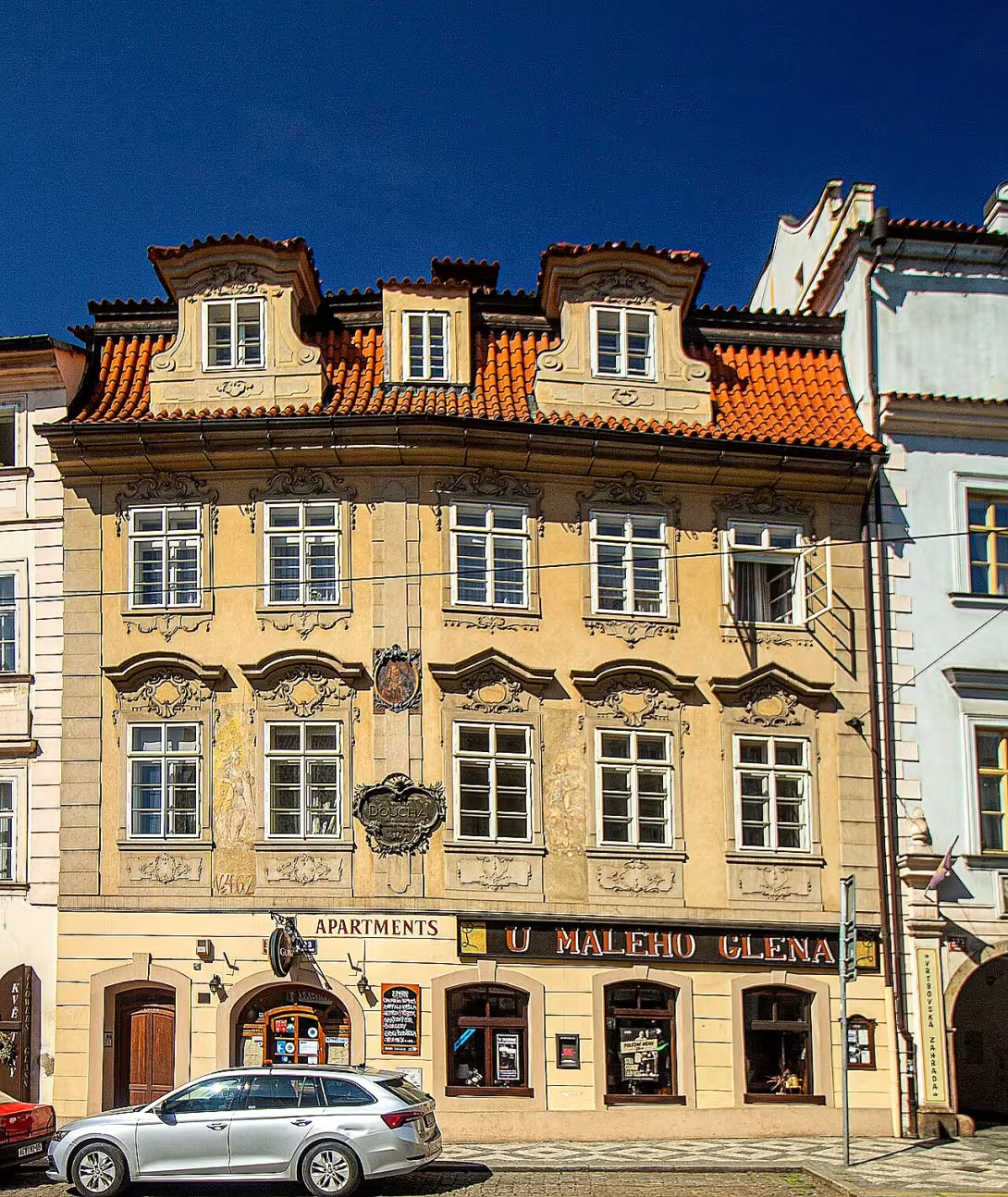
Town house In two flags, also known as Little Glen's or Two Fendrahres, there is a historical monument on the street of Karmelitské 23 in Prague 1, specifically in Malá Strana. This Baroque building was originally a combination of two medieval houses in 1624 and underwent several phases of reconstruction which gave it its current architectural character. Today it is protected as a cultural monument and belongs to the Prague Monument Reserve, listed in the UNESCO World Heritage List.
The house has a rich history. Its origin dates back to 1624, when two medieval houses in Renaissance style were connected. In the first half of the 18th century he underwent a late baroque treatment, which gave him a characteristic character, and the attic floor was added along with the stalls. In 1819 Karel Pollak performed minor modifications on the ground floor. The house is also known for the fact that on 31 August 1810 a priest and writer František Dobromysl Trnka, known under the pseudonym František Douch, was born here.
Architecturally, the house is fascinating. The original medieval cellars with renaissance stone vaults are part of its history, while the ground floor consists of two deeply-equipped spaces with valuable vaults. The Baroque staircase is built into a slippery yard wing. The Mansard roof with two symmetrically located shield skylights gives the building an elegant shape. The facade, despite its uniform high Baroque character from the period 1730-1740, is clearly folded and decorated with the painting of the Virgin Mary with Jesus. On the facade there is also a bronze plate with a sign about the birth of František Doucha.
The interior preserved Renaissance structures and vaults as well as a unique set of baroque and classical doors and windows. During the last reconstruction in 2005, rare classicist decorative paintings were discovered, including valuable Baroque fresco from the construction of St. Nicholas' church. The fresco of banners by which the house is named was restored during the work on the facade.
Today is the townhouse The two flags are protected as a cultural monument and belong to the Prague Monument Reserve. Its historical value, architectural elements and connections with important personalities such as František Doucha make it an interesting destination for visitors to Prague. When walking the Carmelite street, the house is not only a monument, but also a witness to the rich history of Mala Strana and the whole Prague centre.
Dům U dvou praporečníků represents a living example of how architecture changes with time and how different historical periods influence the appearance and function of buildings. It is a monument that bears traces of the past and remains part of a modern city. The visit offers a view of history and an inspiration to recognise the value of heritage conservation for future generations.
Historical milestones
- 1624
- Renaissance reconstruction connecting two medieval houses
- 1810
- Birth of priest and writer František Dobramysl Trnka
- 1958
- Writing the building into the list of cultural monuments
- 2005
- Reconstruction and finding of baroque fresco
Architectural development
The original medieval house was remodeled in 1624. In the first half of the 18th century he gained late Baroque form. There were modifications according to Karl Pollak in the 19th century.
Historical events
1624: Renaissance reconstruction, 1810: birth of František Dobromysl Trnka, 1958: declaration for cultural monument.
Points of interest
- Town house. It was originally a combination of two medieval houses in 1624. - On 31 August 1810 a priest and writer František Dobromysl Trnka, known as František Douch, was born here. - During the last reconstruction in 2005, rare classicist decorative paintings were discovered, including valuable Baroque fresco from the construction of St. Nicholas' church. - The House is protected as a cultural monument and belongs to the Prague Monument Reservation, listed in the UNESCO World Heritage List. - The facade has a painting of the Virgin Mary with a Jesus and a bronze plate with a sign of the birth of František Doucha.
Guide
Show guide text
This text was created by artificial intelligence and has not been editorially reviewed. It may contain inaccuracies.
Welcome to the heart of one of the oldest and most beautiful neighborhoods in this city. You're standing right where time stops and where every stone cube tells a story older than our own memory. Do you feel the strange atmosphere that still persists in these narrow streets of Little Party? It's a mixture of peace, nobility and the constant whisper of history. In front of your eyes is a building that is not just an ordinary house, but a living witness for centuries. Dům U dvou praporečníků. It may seem like a single whole at first glance, but if you look at it more carefully, you start to see layers of time coming together like strings in a fabric.
Let's take a closer look at the surface. This house was created in a very unusual way. It wasn't built at once as one new building, but it was created by combining two old medieval houses. Imagine that year, 1624, when these two separate beings decided to become one in all. It was a period when the world was changing around, when the old ways of life clashed with new visions, and when architecture began to turn into an art of power and beauty. It was this year, at the time of the Renaissance reconstruction, that this house began to form into what we can now feel in its foundations. These medieval roots are the solid foundation on which other, richer layers were then built.
Now pay attention to the facade right in front of you. When you raise your eyes, you are immediately approached by her baroque nature. The Baroque is not just about decorating, it's about motion, about emotions and how architecture can control the space around it. The facade of the house is very characteristic and its most important element is the painting of the Virgin Mary. This painting gives the building a spiritual dimension and makes it something more than just a common townhouse. It's like the bond between the earthly that we see and the invisible that we seek in history and faith. Feel the harmony of colors and shapes that try to capture the viewer and draw his view to the sky.
If we could look inside, we would find that this house is like a book with many chapters. Each chapter has a different style. In fact, there are rare Renaissance vaults within it that resemble the initial connection process from 1624. But right next to them you will find baroque and classicist elements. It is a fascinating mix where the elegance of the Renaissance meets the dramatic drama of the Baroque and later with the calm of classicism. This diversity is proof that the house has never remained calm, but it has constantly evolved along with the people who lived in it and who have remodeled it. Even though we see his external face today, this inner richness is what gives the whole place its true depth.
But monuments aren't just about stones and paintings. They're mostly about people whose lives took place in these walls. And one of them was really special. In this house, in 1810, a man was born who had many faces in the future. František Dobromysl Trnka. He was a priest, but he was also a writer, a man who could express through the word what he could not say directly in his time. You may know him under his other name, under the pseudonym of Franz Douch. Imagine the little boy who was born here, and know that it was in these streets that his spirit and his thoughts formed. This house was his home, where his journey began between people and books.
It's fascinating to see how this house cared for its own dignity over the centuries. In 1958 he was included in the list of cultural monuments, which gave him fame but also great responsibility. And that responsibility led us to one of the most interesting events in the recent history of this place. Before constantly changing times, in 2005, there was a thorough reconstruction. And what happened to her? In this work process, secrets have been revealed that have been hidden from human sight for decades. Rare baroque frescos and decorative elements were found in classical style. Imagine the joy and wonder of architects and historians when they found these hidden treasures beneath the layers of the old plaster. It was as if the house had decided to speak again and show its true face, which even its own people had forgotten.
So this house is a constant process. It's a combination of two houses, it's a clash of renaissance, baroque, and classicism, it's a place of birth for an important man, and it's still a place that can surprise these days. If you look at his facade now, try not only to imagine what you see, but also what was hidden beneath the surface. Feel the power of history emanating from this place.
I hope this short stop has helped you better understand what's behind this beautiful front. Malá Strana has many other secrets waiting for you to discover them. So continue walking through these historic streets, look up, pay attention to the details and let the city's atmosphere drift. Thank you for spending this moment with us. We wish you a beautiful and inspiring journey further.
Tips for visitors
The best time to visit is in the morning or late afternoon when there are fewer people on the streets of the Little Party and the Baroque facade of the house looks best in soft light.
The location is available by car and by public transport; Check the current connection in the search engine.
We recommend you take a photographic machine with you to capture details of Renaissance and Baroque reconstructions. The best light for façade images is shortly before sunset.
Within a short walk in the surroundings we recommend visiting Karmelitska Street and close church of St. Nicholas, which are within walking distance.
For families with children the visit is suitable, but we recommend to count on the narrow streets of Mala Strana which can be challenging for carts.
Frequently asked questions
Can the monument be visited?
This is a residential or farm building, not a museum with opening hours. Please view it from public space and respect the owners' privacy. We have no information about access to the interior.
Where is the monument?
Location: Malá Strana, Hlavní město Praha. The map on this page shows the exact spot.
Why is the monument protected?
It is listed in the Central List of Cultural Monuments of the Czech Republic as a cultural monument (register no. 1000151454).
Businesses nearby
Do you run a restaurant, accommodation, shop, museum, rental, wellness or other visitor service near this monument? Show yourself directly to the people heading to it — this is how they will see you in the app and on the web:
Events nearby

Zdroj akcí: otevřená data měst a obcí ČR (Národní katalog otevřených dat) a kalendář akcí Národního památkového ústavu.
Nearby
Karmelitská ulice, Malá Strana a blízký kostel svatého Mikuláše.
Accommodation nearby
Trips and activities nearby
Guided tours, tickets and activities nearby from GetYourGuide
Affiliate link: if you buy from the partner, we may receive a commission. The price for you does not change.
Search tours and activities →Themed route
Thematic cruise route to the Little Party
1.Dům U dvou praporečníků - Type: Historical House - Why is it worth visiting: This Baroque house is one of the oldest buildings on the Lesser Side. Its architecture and history attract lovers of old monuments.
2. Carmelite Street - Type: Historical aisle - Why is it worth visiting: Carmelite Street is one of the most beautiful and oldest streets on the Lesser Side. You can enjoy the views of Baroque houses and quiet surroundings while walking.
3. Church of St. Nicholas - Type: Church - Why is it worth a visit: This church is famous for its Baroque architecture and beautiful interior. It's an important place to understand the history and culture of the region.
4.Malá Strana - Type: Historical part of town - Why it is worth a visit: A general view of the Little Party from a high location offers a unique view of Prague. It is an ideal place to relax and explore panoramic views.
5. Ambient Alleys - Type: Walk - Why is it worth a visit: Exploring other small streets around the main road offers an overview of the life and history of the inhabitants of this part of Prague. It is the ideal way to immerse yourself in the atmosphere of old Prague.
This route allows you to explore not only the main destination, but also the surrounding historical sites on the Lesser Side.
Seasonal recommendations
Spring: In spring, Malá Strana awakens to life and the surrounding gardens begin to bloom, which gives the historic house a fresh look. The light is soft and pleasant in this period. I recommend wearing layered clothes because the weather can be variable. It is best to visit the place in the morning when the air is still fresh and people are just starting to move on the streets.
Summer: Summer moons bring intense sun and lively, hot atmosphere in narrow alleys. Due to high temperatures and large crowds, it is best to arrive at the memorial very early in the morning. Dress lightly and comfortably so you don't mind the heat. If you want peace, avoid the main noon time when there are most people here.
Autumn: Autumn season is characterized by golden colours of leaves and fog, which creates a nostalgic and calm mood. The sun shines low, highlighting the construction details. It is advisable to wear stronger shoes and warmer jacket. The ideal time to walk is in the afternoon when the colors of nature seem most impressive.
Winter: In winter, the days are short and there is a quiet, mysterious atmosphere. In advent time it is pleasant in the surroundings, even if it is cold. It is necessary to wear very warm clothes, including hats and scarves.
Visualizations and artistic views


The visualisations are generated by artificial intelligence and serve as inspiration.
Photos from the area
Real photos taken near the monument


Zdroj a licence jsou uvedeny u každého snímku.
Tips from visitors
No tips yet. Be the first!
Log in and add your tip.
Sources and literature
Photos: VitVit / CC BY-SA 4.0 — Wikimedia Commons. The author and licence also appear when you hover over the image.
Faktickým podkladem tohoto textu byl článek na Wikipedii, jehož autory jsou přispěvatelé Wikipedie. Článek je dostupný pod licencí CC BY-SA 4.0.
Location on the map

Příběhy a pověsti
Legendy, pověsti a příběhy spjaté s touto památkou
Fotografie návštěvníků
Zatím žádné fotografie. Buďte první, kdo přidá fotografii z návštěvy!
Log in a přidejte svou fotografii nebo hodnoťte.
Za ověřenou návštěvu v aplikaci získáte víc bodů — poznáme podle GPS, že jste na místě.
Reviews and comments