



Klárov Street
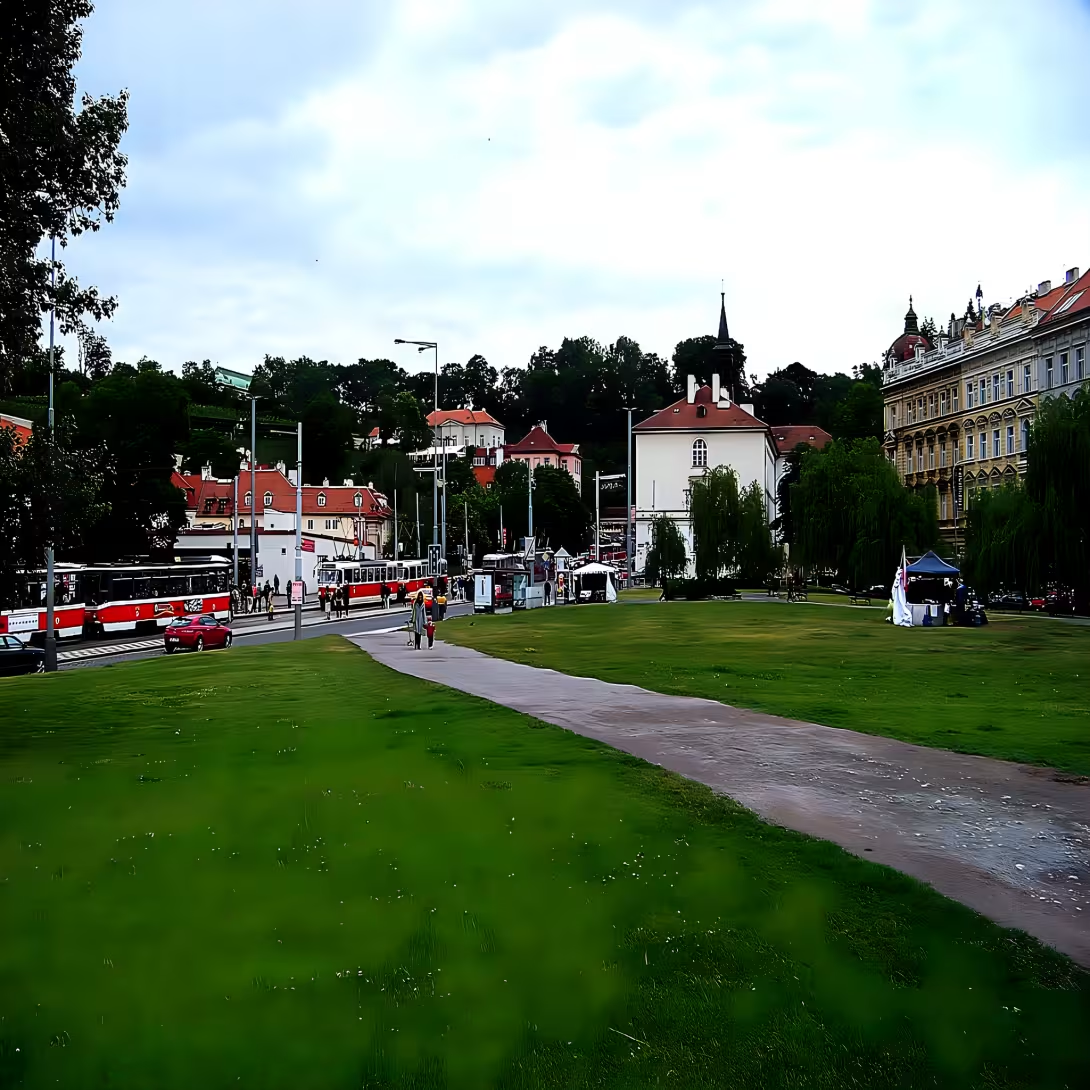
Klárov is a public area on Prague's Lesser Side. It serves as one of the busiest hubs in this part of town. The location is a remarkable history of the extinct medieval settlement, a unique underground technological centre of the metro and a concentration of monuments dedicated to resistance and airmen.
The space is located in a place where originally stood a medieval settlement called Fishermen, Sand or On Sands. The name came from the sediments that were applied by the Brusnice stream. It flowed here to Vltava and today it still flows in these places, but already in the pipes. The current name Klárov dates back to 1922. It is named in honor of Professor and linguist Alois Klar, who established a blind institution here in 1807.
From the point of view of urbanistic form, in 1922 a large modification of the space and the prefixes of the bridge were considered. The competition was won by architects Josef Štěpánek and Bohuslav Fuchs. Although the city of Praha ordered several elaborations of their project, the implementation itself did not take place. Since 2017, new adaptations to the area and transport solutions have been being prepared.
Klárov is now a complex traffic junction. There are four tram lines, bus lines and Malostranská Metro Station. The area is connected by communication from Holešovice, Malá Strana and Hradčán through the Manes Bridge to Josefov and Old Town. There are several parks between transport elements. The southeast part with monuments of the victims of the second resistance and Czechoslovak RAF airmen is lined with weeping willows. The northwest part consists of the Holubek park, along the metro exit there is a park with a fountain at the Waldstein Riding Hall and south of the Mánes Bridge lies the Cihelná park.
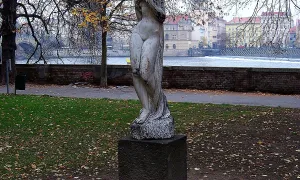
Underground history is a key attraction. In the 1950s, Klárov Metro Station was built here, which was intended to serve as a military cover for members of the government. Due to too much depth, however, it was not later used in line A and replaced by Malostranská Station. The original station Klárov today serves as a technological centre of the A route. There are also monuments within the public space, including the memorial of the 2nd Resistance from Vladimir Preclík and the works of British sculptor Colin Spofforth with winged lion. There is also a commemorative record of Marie Charousková, who was shot by Soviet occupants on 26 August 1968.
The Czech Geological Service currently resides in the building of the original Klár Institute of Blind Persons. There is also the Museum of Slivovice Rudolf Jelínek in the house of Slavka Budínová, Kunsthalle Praha, Valdštejnská Riding Hall and the raven house no. 554, which served as a tolls of the extinct Rudolf's footbridge.
Klárov presents a fascinating layer of Prague history from medieval settlement to social institutions to modern transport infrastructure. It is a place where the daily dynamics of the city meet with a silent reminder of historical tragedies and heroics. Visiting this area offers insight into the urban development of the Small Party.
Then and now
Drag the slider to compare how the landmark may have looked when it was built with the view today.
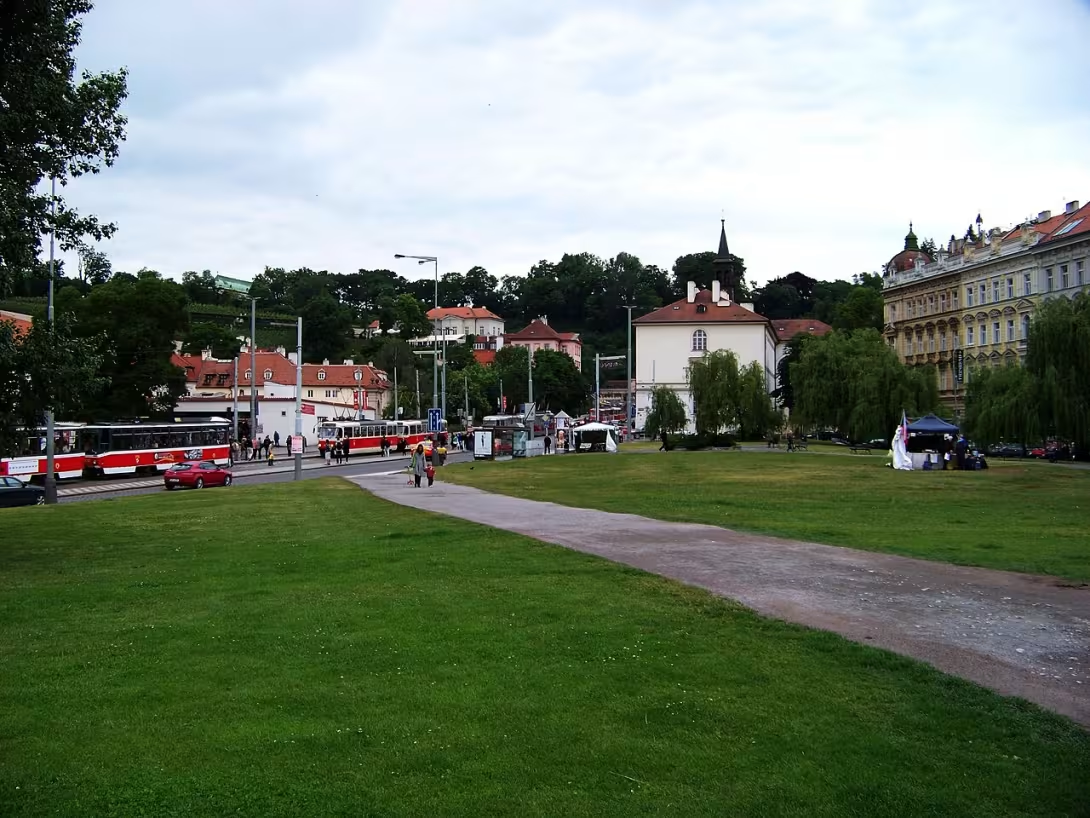

The historical appearance on the left is an AI-generated visualisation and serves as inspiration only.
Historical milestones
- 1807
- Establishing an Institute for Blind Professor Alois Klár.
- 1922
- Consideration of a large modification of the premises and the publication of an urban competition.
- 2017
- Start of preparations for modifications of the premises and transport solutions.
Architectural development
The space has evolved from the medieval settlement of the Fisherman to a modern transport hub. In the past there were architectural contests for its form which won Josef Štěpánek and Bohuslav Fuchs, but their projects were not implemented. The current appearance consists of a combination of transport routes and urban greenery.
Historical events
In 1807 Klara Institute of Blind Men was established here. In 1922, an extensive urban reconstruction of space was considered. Since 2017, the planned modifications to transport solutions have been under way.
Points of interest
- The site was originally made up of a medieval settlement called Fishermen, Sands or Sands. - The name Klárov from 1922 resembles Alois Klar, who founded the blind institute here in 1807. - In the 1950s, a subway station was built here to serve as a military shelter for the government. - The original metro station Klárov was not used within line A and today it serves as a technological centre. - There is a raked house in the area, which in the past served as a tolls of Rudolph's footbridge.
Guide
This guide is narrated by a synthetic voice generated by artificial intelligence.
Show guide text
This text was created by artificial intelligence and has not been editorially reviewed. It may contain inaccuracies.
Welcome to Klárov. You are standing in one of the most important public areas of Prague's Small Party. If you look around you, you'll probably feel a slight disturbance in a city that never stops. This space is not just an ordinary square, but a key transport hub that connects various parts of the historical centre. The area in front of you is opened, which serves as a crossroads of many tram and bus lines while providing access to Malostranská Metro exit. Although there is a place full of life and movement, it also hides quiet corners. Notice the smaller park modifications that line this area. A number of willow willows, whose branches move gently in the wind and provide a slightly melancholy but relaxing atmosphere, deserve special attention. These trees form a green frame that separates intense traffic flows from walkways and rest zones.
To understand why this place has such a character, we need to go back a few centuries. Today we see a modern transport hub, but originally a medieval settlement in this area. People knew her under the names of Fisherman, Sand, or Sand. It was a place where fishermen lived and where sand was collected, necessary building material for buildings in nearby churches and homes. This is where the cranice stream flowed, which supplied the place with live water and formed a natural boundary between the parts of the settlement. These watercourses and fishing traditions have shaped a place for centuries until it began to change with the development of the city.
The name you know today, Klárov, however, has a different origin and is associated with a particular person. In 1922, when considering the extensive modification of this area and the publication of the urban competition, it was decided to name the place after the language speaker Aloisi Klárovi. This step was not random. Alois Klár was an important figure who decided to establish an institute for the blind in 1807. It was one of the first such institutions in Czech countries and its creation laid the basis for the long-term history of this place as a centre of care and education. So when you walk through this space, you have the opportunity to perceive the legacy of a person who has devoted himself to those who could not see the beauty that you admire here today.
Let's move on to the architectural and urban elements you see here today. Although it is a public area and not a closed building, architecture plays an important role in the organisation of space. Urbanists and architects, such as Josef Štěpánek or Bohuslav Fuchs, were involved in ideas and designs that were meant to turn this place into a functional and aesthetically pleasant space. Although specific buildings may be less visible today or replaced by new structures, their influence is reflected in the layout of pavement, green and traffic lanes. Notice how the space is divided. It's not one big area, it's a mosaic of smaller parts that play together. Green areas with willows are not just decoration, but a functional element that helps reduce noise and improve the microclimate.
But the key story associated with this place is not only Alois Klár, but also the underground history under your feet. In the 1950s, a subway station was built here to serve as a military shelter for the government. This gives the place some mystery and importance. Imagine that under this daily traffic of trams and buses, there was a protected structure deep underground, which was supposed to protect state leaders in an emergency. The original metro station, which was named Klárov, was part of this plan. Although another station is being used today, the memory of this military and political aspect remains in the underground layers of the city. It is a reminder that even such a seemingly ordinary square can hide important strategic functions from the past.
The interesting thing that may interest you is that this place has traveled a long way from a fishing settlement to a blind house to a modern transport hub. Each stage has brought new layers of history and new features. The willows that grow here may be a symbol of this transformation. They're trees that require a damp environment, which refers to the ancient presence of the cranberry stream. So their presence is not only an aesthetic element, but also a living witness to the hydrological history of this place. If you look at their bark and branch, you can imagine how water once flowed here and how fishermen worked here.
Now pay attention to the overall feeling that this place is making. It's where the past meets the present. Here, historical traditions meet modern transport technologies. It is a place where important events took place in the life of the city, from the establishment of an asylum for the blind to the planning of military shelters. The atmosphere here is unique because it combines the excitement of the big city with the calm of the park adjustments.
In conclusion, I would like to recommend that you do not just view this place as a transit point. Stop for a moment, listen to the sounds of the city, and look at details you may not have been aware of. Look at the weeping willows that line the surface, and imagine the history they're hiding. Read the street names and stops that remind you of Alois Klara and his work. Klárov is a place that has something to offer for those who want to dive into the depths of Prague history.
I invite you to move on after this short stop. Malá Strana offers many other places that are worth watching. Every corner, every alley, and every square here has its own story. Klárov is just one of many chapters in the book of this fascinating city. I hope you enjoyed it here and that you enjoyed this brief experience. Let us say goodbye here and wish you a pleasant continuation of your walk around Prague. Remember, history is all around us, just open your eyes and ears. Thank you for your attention and have a nice day.
Tips for visitors
The best time to visit is early morning or sunset, when there are fewer people in this transport junction and light pleasantly affects the surrounding architecture.
You don't have to take any special equipment to visit, just comfortable shoes for walking around. For photo lovers we recommend capturing views of urban architecture and movement of people, while the best light is in late afternoon.
Within a short walk from here you can visit the Manes Bridge, the Waldstein Riding Room, the Old Castle Stairs, the Hoffmeister Hotel or Kunsthalle Praha.
Families with children will appreciate the spacious character of this place, which allows safe movement, and a follow-up walk to nearby sights such as the Old Castle Stairs.
Frequently asked questions
Can the monument be visited?
This is a structure in a public space that can usually be seen from outside free of charge. We have not verified that this particular one is freely accessible.
Where is the monument?
Location: Malá Strana, Hlavní město Praha. The map on this page shows the exact spot.
For kids
Imagine going back to the time when the monastery was the extraordinary seat of knights and their beautiful horses! It was like entering a fantastic fairy tale.
The monastery complex stood on the hill above the valley of the river Moravia. Here lived monks who took care of their gardens full of roses and strawberries. Imagine how their kitchen smelled of bread and pastries! In the monastery there were many beautiful walls with painted pictures and glass windows.
Businesses nearby
Do you run a restaurant, accommodation, shop, museum, rental, wellness or other visitor service near this monument? Show yourself directly to the people heading to it — this is how they will see you in the app and on the web:
Events nearby


Zdroj akcí: otevřená data měst a obcí ČR (Národní katalog otevřených dat) a kalendář akcí Národního památkového ústavu.
Nearby
Mánesův most, Valdštejnská jízdárna, Staré zámecké schody, hotel Hoffmeister, Kunsthalle Praha.
Accommodation nearby
Trips and activities nearby
Guided tours, tickets and activities nearby from GetYourGuide
Affiliate link: if you buy from the partner, we may receive a commission. The price for you does not change.
Search tours and activities →Themed route
Here is the design of the thematic route:
1. Kunsthalle Praha (gallery) - Modern space for art, which serves as an ideal start for walking. 2. Manes Bridge (Bridge) - An architecturally interesting link across the river overlooking the surroundings. 3. Klárov (monument) - The main destination of the journey where historical architecture and atmosphere can be admired. 4. Hotel Hoffmeister (hotel) - An elegant building that complements the luxurious character of this part of town. 5. Old castle stairs (stairs) - A picturesque climbing path leading further up the hill. 6. Waldstein Riding Room (Riding Hall) - Unique historical space for riding sports and festivals.
Seasonal recommendations
In the spring, the surroundings wake up to life and the young greenery in the surrounding gardens form a fresh frame for façades. Light is soft and natural, which is ideal for observing details from the outside. We recommend light, layered clothes and a visit in the morning when the air is the cleanest.
In the summer months it dominates the radiant sun and rich green trees that provide shade. The atmosphere is hot and the streets are very busy. The best is to leave very early in the morning or at dusk to avoid the biggest pear tree visitors, and not forget the comfortable shoes and hat.
Autumn brings golden colors to the district with leaves and a specific melancholy mood. Lighting is gold and soft, which highlights the historical character of buildings. Suitable is waterproof coats and a visit in the afternoon when the colors of nature shine most.
In winter there is a monument in silence and calm, possibly under a layer of snow that will dampen the city's noise. The atmosphere is dreamy, especially during the Advent period, when the surroundings brighten up the lights. It is necessary to wear warm winter clothes and to plan a visit for a clear day so that the frost does not make long observation from the outside impossible.
Visualizations and artistic views


The visualisations are generated by artificial intelligence and serve as inspiration.
Photos from the area
Real photos taken near the monument

Zdroj a licence jsou uvedeny u každého snímku.
Tips from visitors
No tips yet. Be the first!
Log in and add your tip.
Sources and literature
Photos: ŠJů (cs:ŠJů) / CC BY-SA 3.0, rozlišení zvýšeno umělou inteligencí — Wikimedia Commons. The author and licence also appear when you hover over the image.
Faktickým podkladem tohoto textu byl článek na Wikipedii, jehož autory jsou přispěvatelé Wikipedie. Článek je dostupný pod licencí CC BY-SA 4.0.
Location on the map

Příběhy a pověsti
Legendy, pověsti a příběhy spjaté s touto památkou
Fotografie návštěvníků
Zatím žádné fotografie. Buďte první, kdo přidá fotografii z návštěvy!
Log in a přidejte svou fotografii nebo hodnoťte.
Za ověřenou návštěvu v aplikaci získáte víc bodů — poznáme podle GPS, že jste na místě.
Reviews and comments