



Dům U Hybernů Theatre building
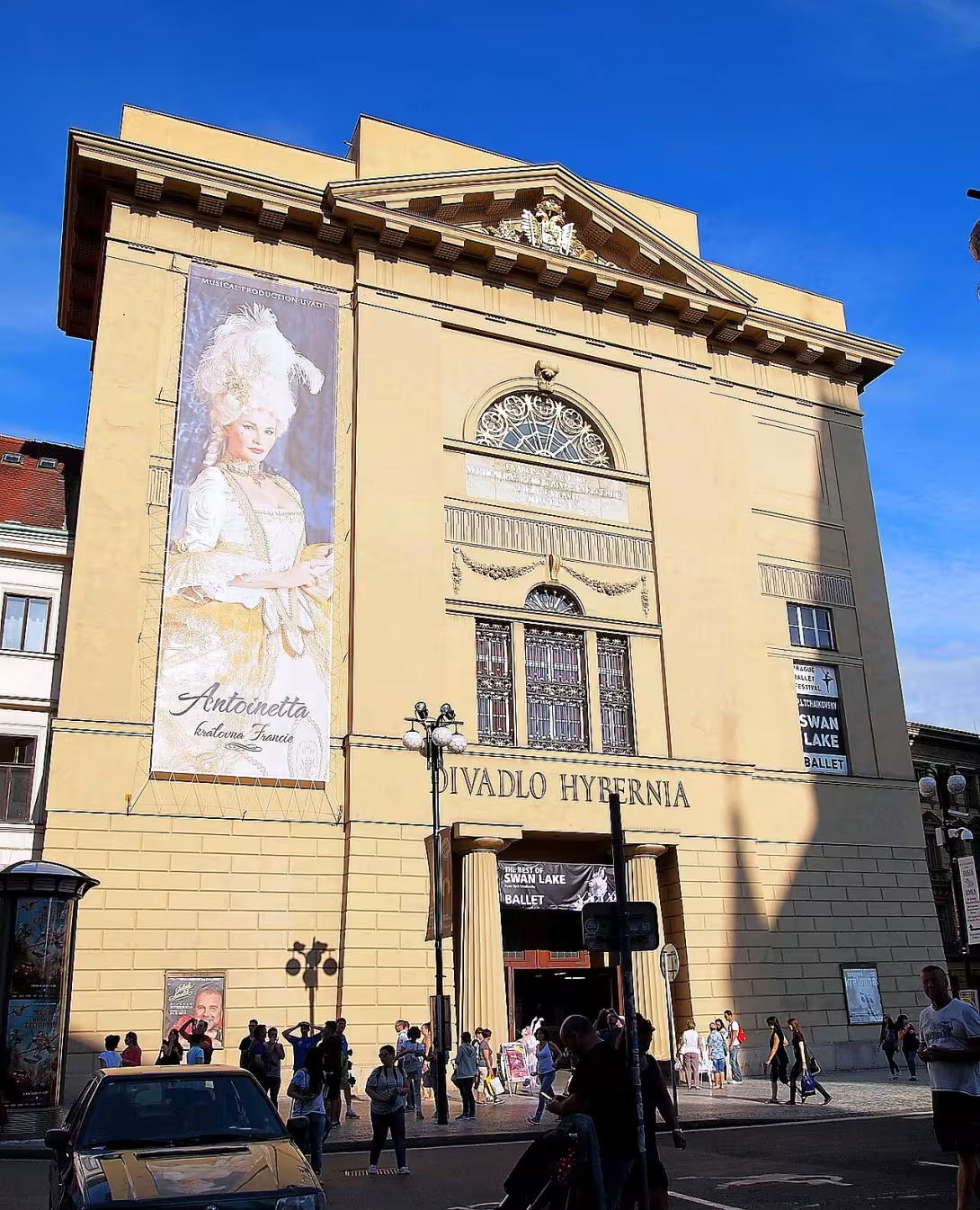
Dům U Hybernů, located on the Prague 1 flag in the street axis On the moat, it is a historical monument with a rich past and contemporary cultural significance. This building, which today serves as a musical theatre of Hybernia Theatre, has its origins in the 17th century as a Baroque church of Immaculate Conception of the Virgin Mary built for Irish Franciscan, also known as the Hyberns. Its transformation to its present form took place over several centuries, each phase bringing a new layer of history and architecture.
The original church dates back to 1652-1659. It was built with the monastery of Irish Franciscan, who at that time were part of a wider movement of anti-Reformation and Baroque buildings of monasteries. The monastery, based on the wishes of the Emperor Karel IV., was to be the seat of the benedictines of the Ambrozian Rite with the Gothic Church of St. Ambrose. However, this historic site was abolished in the context of the Josephin reforms in 1785, which opened the way for further transformation.
Empire reconstruction, which took place between 1811 and 1813, was a key moment in the history of the building. After the abrogation of the monastery of Irish Franciscan, it was decided to rebuild it in customs. This project was run by Prague architects Josef Zobel and Georg Fischer together with Vienna's Louis Montoyer. The reconstruction created a characteristic Empire facade which is a free replica of the Old Berlin Mint facade from 1798-1800. Sculpture decoration was the work of F. X. Lederer.
After the operation of the Bouda Theatre, which was performed here since 1792, the space was overpatted and divided into residential units. The partitions were demolished in 1940, which opened the way for further use of the building.
In the years after World War II, the National Company Exhibition took over the administration of the building. Since 1960 he served as a large exhibition hall where various thematic exhibitions and cultural events took place. Among the important events were, for example, one of the last exhibited exhibitions of contemporary Czech art in Prague in 1969 or a large exhibition of 40 years of Czechoslovak national film in 1986.
The last reconstruction in 2005- 2006 turned the House of Hyberns into a musical scene. Architect Michael Klang made sure the exterior appearance of the building was preserved and the original ceiling vault was respected. On the roof of the house was created a terrace accessible to tourists overlooking the city. The collapse of the reconstructed house took place on 27 September 2006.
On November 23, 2006 the Hybernia Theatre was opened with the premiere of the Czech musical Golem. Since then, the theatre has become one of the leading Czech musical scenes, where not only own production, but also guest performances are shown. The repertoire of the theatre is diverse and includes such premieres as The Legend Of Golem, Švejk, Dracula, Nikita & Checkmate, Baron Prasisil, Quasimisto and many others.
Dům U Hybernů is not only a cultural institution but also a part of the lively architectural landscape of Prague 1. There are other important institutions such as the Tower Palace (now the Kempinski Hotel), the Municipal House, the Swéerts-Spork Palace, the Losy Palace of Losinthal (People's House), the Masaryk Railway Station and the residence of the Belwitz Palace. This site is therefore not only a historical monument, but also part of the modern cultural life of Prague.
Today the Hybernia Theatre is worth visiting not only for musical lovers, but also for those who want to notice the rich history and architecture of this unique object. Its transformation from the Baroque church through the Empire customs to the modern musical theatre is a testament to the constant development and adaptation of culture in Prague.
Then and now
Drag the slider to compare how the landmark may have looked when it was built with the view today.
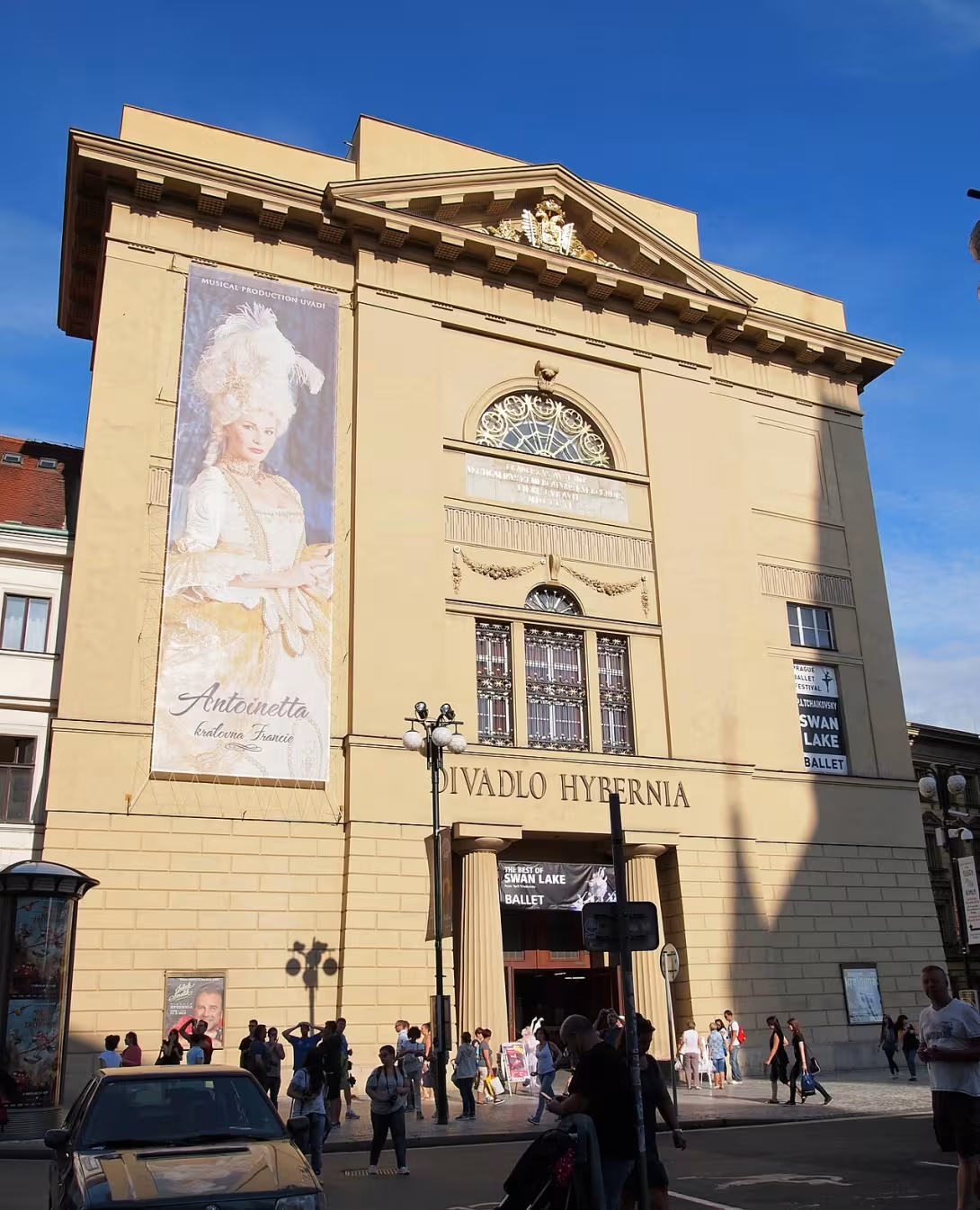

The historical appearance on the left is an AI-generated visualisation and serves as inspiration only.
Historical milestones
- 1652
- Construction of the baroque Church of Immaculate Conception of the Virgin Mary.
- 1785
- The abolition of the monastery of Irish Franciscan.
- 1811
- The beginning of the Empire building reconstruction.
- 2006
- The opening of the musical Theatre of Hybernia.
Architectural development
The original Baroque church from 1652- 1659 was rebuilt in 1811- 1813 into an empirical style. The facade of the building is a free replica of the architecture of the old Berlin Mint. The last major reconstruction took place in the years 2005- 2006 for theatre needs.
Historical events
1785: The abolition of the monastery of Irish Franciscan in the context of Yosefin reforms. 1811-1813: Empire building reconstruction. 2006: Opening of the Hybernia Theatre.
Owners
National enterprise Exhibition (after 1960)
Points of interest
- Dům U Hybernů has its origins in the 17th century as a Baroque Church of Immaculate Conception of the Virgin Mary built for Irish Franciscan, also known as Hyberns. - Empire reconstruction between 1811 and 1813 was conducted by Prague architects Josef Zobel and Georg Fischer together with Vienna's Louis Montoyer. The reconstruction created a characteristic Empire facade which is a free replica of the Old Berlin Mint facade. - After the abolition of the monastery of Irish Franciscan, it was decided to rebuild to customs. Sculpture decoration was the work of F. X. Lederer. - In years after World War II he served as a large exhibition hall where various thematic exhibitions and cultural events took place. Among the important events were, for example, one of the last exhibited exhibitions of contemporary Czech art in Prague in 1969. - The last reconstruction that took place in 2005- 2006 turned the House of Hyberns into a musical scene. Architect Michael Klang made sure the exterior appearance of the building was preserved and the original ceiling vault was respected.
Guide
Show guide text
This text was created by artificial intelligence and has not been editorially reviewed. It may contain inaccuracies.
Welcome to the heart of our historic metropolis. Right now, listening to these words, you're standing in a place where the past meets the present and where every brick and every line of the building tells the story of human needs and urban life. Look around you at the surrounding streets and feel the strange atmosphere of Prague's first district, which is so close to the square of the Republic. In front of you is a building that looks very noble and peaceful, but its true nature is much more dynamic than it might seem. It's a place that constantly changes its face to match the time it's in.
Let's go back deep into the past together to understand where this house comes from. Its roots are not only perceptible as an ordinary building, but as a place of deep spiritual significance. It all began in six hundred and fifty-two, when a baroque building intended for divine service was built here. Specifically, the Church of Immaculate Conception of the Virgin Mary. This space was home to Irish Franciscan back then. These scholars and monks brought their own culture and tradition to Prague, which later significantly influenced the name of this place. Those Irish brothers are the key to understanding the identity of this house.
At a time when Prague grew and changed its political and religious tensions, the monastery had undergone great changes. In the year seven hundred and eighty-five a decision was made, which had to be difficult for the local community at that time - the monastery of Irish Franciscan was abolished. With this end of the old order came the need to find a whole new direction for the building. The building was no longer just a place of prayer, but it became part of the civilian life of the city.
Now pay attention to the very form of the building you are currently observing. If you look at her facade, you'll see a trail of an entirely different era. Although the Baroque church originally stood here, what you see now is the result of a large and strong reconstruction that took place in the early nineteenth century. Between eight hundred eleven and eight hundred thirteen, there was a real architectural revolution. The building was transformed into a style called Empire, which brought to Prague a new measure of elegance, order and tranquility.
This new look is not a work of chance but a result of the work of very competent architects. At that time, Josef Zobel and Georg Fischer joined this project, working with a Vienna master named Louis Montoyer. Their task was to create a space that was modern for its time and dignified at the same time. Thanks to their work, the building has acquired the current, balanced look you perceive in it. Looking at the walls and the line of the building you can see the effort for purity of shapes and harmony that is so typical of this style. It is an architecture that does not act loudly, but rather emits certainty and stability.
But the history of this place is full of unexpected twists. After the monastic life disappeared, the building served completely different purposes that the monks of the seventeenth century might not have expected. For some time there was a customs office, a place where taxes and goods were dealt with within the city. Later, space transformed into an exhibition hall where people came to watch new things and cultural trends. So we saw how the sacred place became both administrative and commercial.
In these events, the names of the important figures that relate to Prague and its history are constantly moving. Although this particular house was built much later than the time of the great king Charles the fourth, this whole neighborhood is deeply rooted in the history that he has laid. Over the centuries, people who formed Prague society have moved around here, and even though their lives have intertwined with the different functions of this house, they were all part of the same great story fabric of the city.
You may now be interested in one interesting thing that links the name of this place to its ancient past. Why is it called Dům U Hybernů? The answer lies in those Irish Franciscan. The word hyberne is an old mark for Ireland. It is precisely because the Irish brothers lived here that this place was written in the people's memory by that name. It is a beautiful example of how the religious identity of one group of people can turn into a permanent name for a place that can survive even their very presence.
So how did this house become what it is today? After years of service as customs and exhibition space, there was another big change. In the year two thousand and six, space reopened to the general public, but this time in a completely different form. Today it is a modern musical theatre that brings music, dance and emotion to this historic part of town. It's fascinating how the roles of the church, monastery, customs and theatre can alternate in one building. Each era has left an invisible mark in the atmosphere you're feeling.
Now that you know the secret of this place, I suggest you look at its walls again, this time with a new consciousness. Feel the interplay between Empire elegance and the historical depth you find here. Let yourself be carried away by the feeling that you are standing in a place that never stops growing and changing.
Thank you for spending this moment with us and discovering the secrets of the House of Hyberns. We hope that this view of the past has helped you better understand the beauty of our Prague. We wish you a pleasant continued walk through the city full of other constant surprises. Goodbye.
Tips for visitors
The best time to visit Dom U Hyberns is in the spring or autumn season when the weather is pleasant and the place is not crowded. This house has a historical look, which is particularly popular in these months.
We recommend the use of public transport, which is very efficient and easily accessible here.
When visiting, remember protective clothing or umbrella in case of uncomfortable weather. The pictures here can be captured especially in the afternoon, when the light is fine and the sun lights decorate the architecture.
In the vicinity of Dom U Hyberne you can visit Municipal house or building of the Czech National Bank, which are beautiful examples of historical buildings. Also explore the Dust Gate, which is an important monument to the city.
For families with children this place is suitable for short walks and exploring history. Children can become interested in architecture and stories associated with this historic house.
Frequently asked questions
Can the monument be visited?
The building is in use (offices, a school, shops and the like). The interior is generally accessible only during operating hours and tours are not usually offered; we have not verified the details. You can see the exterior from the street.
Where is the monument?
Location: Praha 1, Hlavní město Praha. The map on this page shows the exact spot.
Why is the monument protected?
It is listed in the Central List of Cultural Monuments of the Czech Republic as a cultural monument (register no. 1000151876_0001). It is protected as part of a larger listed ensemble.
Businesses nearby
Do you run a restaurant, accommodation, shop, museum, rental, wellness or other visitor service near this monument? Show yourself directly to the people heading to it — this is how they will see you in the app and on the web:
Events nearby

Zdroj akcí: otevřená data měst a obcí ČR (Národní katalog otevřených dat) a kalendář akcí Národního památkového ústavu.
Nearby
Obecní dům, budova České národní banky a Prašná brána.
Accommodation nearby
Trips and activities nearby
Guided tours, tickets and activities nearby from GetYourGuide
Affiliate link: if you buy from the partner, we may receive a commission. The price for you does not change.
Search tours and activities →Themed route
Thematic cruise route: Historical center of Prague
1. Dům U Hybernů (theatre) - Type: Theatre building - Why is it worth a visit: This historic building is home to the theatre, which offers a variety of programming from classical to modern productions. It is an ideal place to warm up to the spirit of Prague's artistic traditions.
2. Municipal House - Type: Historical administration building - Why is it worth a visit: Located near the House U Hyberns and is famous for its architecturally interesting facade. The former seat of the Old Town Council offers a view of the history of the city and its administration.
3. Czech National Bank Building - Type: Bank building - Why is it worth a visit: This elegant building is an example of historical architectural art. Its rich interior and significant role in the Czech economy make it interesting for visitors interested in financial history.
4. Dust gate - Type: Historical city gate - Why is it worth visiting: This iconic gate structure is one of the most famous monuments of Old Town. It is an ideal place for understanding the history of Prague defence systems and provides beautiful views of the surrounding streets.
This route allows visitors to explore key historical and architectural monuments in the centre of Prague, each point offering a unique view of the urban past.
Seasonal recommendations
Spring brings freshness to the centre of Prague and the waking greenery in the surrounding streets. The building is easy to use during this period and light falls into the space pleasantly and gently. We recommend visiting a monument in the morning when it is quieter in the surroundings. Wear light layers because spring weather is very variable.
In the summer months it dominates intense sun and hot air, which creates a dynamic atmosphere in the city centre. The interior of the house offers a pleasant escape from heat. Due to the large number of visitors in the main summer season, come as soon as possible to avoid the biggest crowds. Choose breathable clothes from natural materials.
Autumn covers the surroundings with golden colors and foggy grey, which gives the historical facade a mysterious touch. The atmosphere is quieter and more focused on the inner experience. An ideal visit in the afternoon is accompanied by a warm coat. There are significantly fewer people in this building than during the summer months.
Winter turns space into a cosy refuge with lit windows that contradict freezing outdoor air. In Advent Time, expectations and festive mood rule. Remember very warm clothes, wool accessories and tight shoes. Follow the current opening times that may be shorter in this period.
Visualizations and artistic views


The visualisations are generated by artificial intelligence and serve as inspiration.
Photos from the area
Real photos taken near the monument


Zdroj a licence jsou uvedeny u každého snímku.
Tips from visitors
No tips yet. Be the first!
Log in and add your tip.
Sources and literature
Photos: Tiia Monto / CC BY-SA 4.0 — Wikimedia Commons. The author and licence also appear when you hover over the image.
Faktickým podkladem tohoto textu byl článek na Wikipedii, jehož autory jsou přispěvatelé Wikipedie. Článek je dostupný pod licencí CC BY-SA 4.0.
Location on the map
Příběhy a pověsti
Legendy, pověsti a příběhy spjaté s touto památkou
Fotografie návštěvníků
Zatím žádné fotografie. Buďte první, kdo přidá fotografii z návštěvy!
Log in a přidejte svou fotografii nebo hodnoťte.
Za ověřenou návštěvu v aplikaci získáte víc bodů — poznáme podle GPS, že jste na místě.
Reviews and comments