






dům U tří mouřenínů House
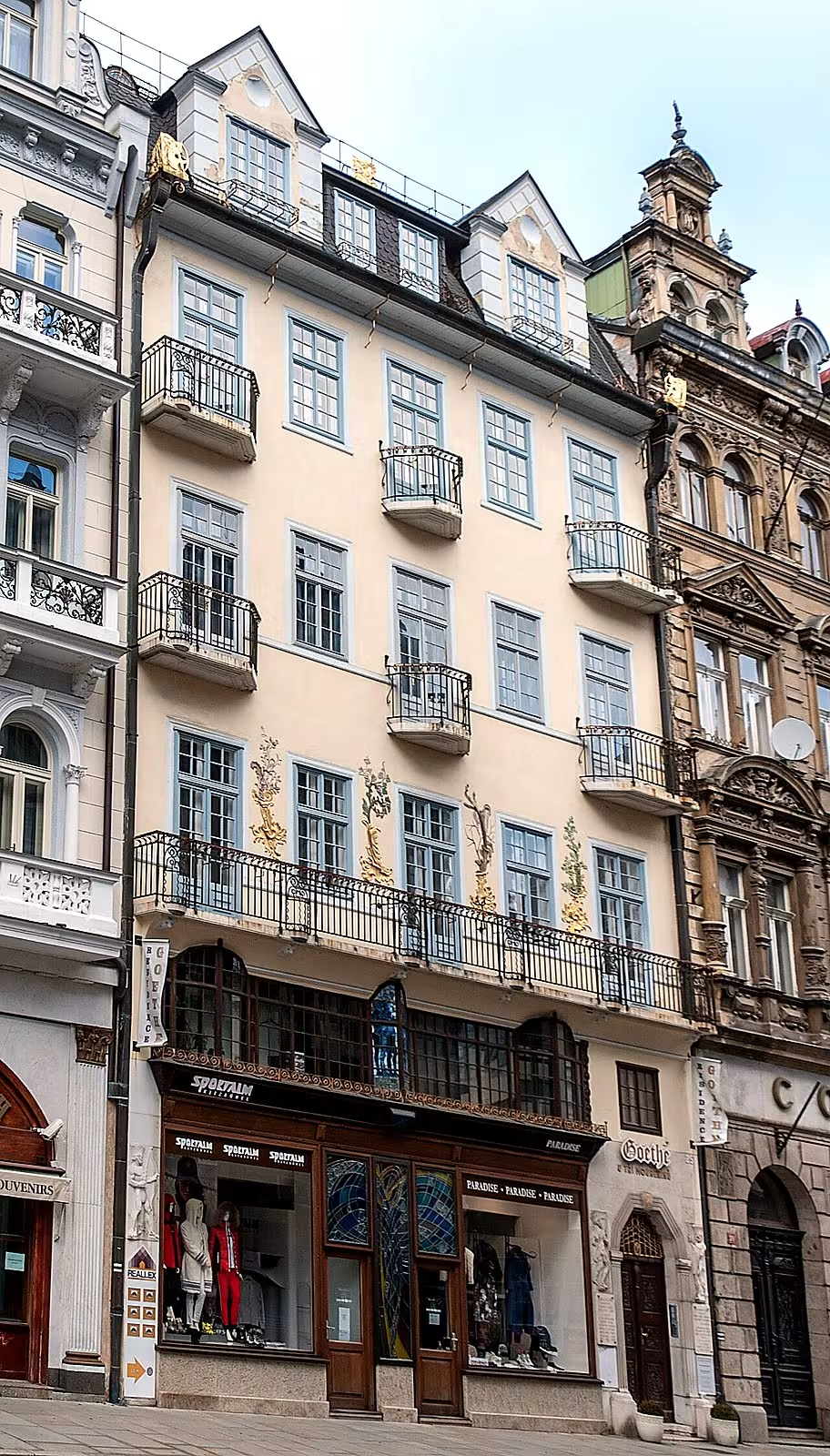
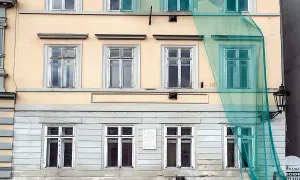
The House U of the three young men is located in the centre of the spa part of Karlovy Vary on the street Market 377 / 25. This is a four-storey, Vienna-style Art Nouveau house, which is important in its historical context with Johann Wolfgang Goeth and integration of elements from previous buildings. The building is protected as a cultural monument.
The original building at this place was built in 1715 under the name U Trí měřenínů and belonged to the Heilingötter family for generations. In 1759 there was a fire that destroyed not only this house, but also two-thirds of 224 Karlovy Vary houses within six hours. Josef Heilingötter built a new brick rococo house in 1759-1760 with a decoration including the relief of the discovery of Vrádle Charles IV and painting of four seasons.
Since 1803 they have been owners of Bernard and Lucie Heilingötter, under whose governments in 1806 he hosted Johann Wolfgang Goethe for the first time, who lived here nine times between 1806-1820.
At the end of the 19th century the Vienna Councils Franz and Wilhemine Stüdl became owners of the house. In 1899 the original house was torn down, causing resistance to the inhabitants of Karlovy Vary. After a decade of controversy, he was demolished in 1909. The new construction was designed by architect Karl Heller in 1909-1910 with the contribution of Friedrich Ohmann, who incorporated original rococo elements into the facade.
The current object has a laminated portal with embossed figures of the three wisers of Karl Heller's work. Next to the entrance there are marble slabs, one indicating Goeth's entrance and the other its stays in Karlovy Vary. The first floor is glazed with stained glass windows of three young men and a ship with forged railing. On the second and third floors there are balconies, above the fourth floor there is a Mansard.
After World War II, the object was renamed Dagmar in 1945, but that name was not preserved. In 1999 the house was renovated, during which the memorable doors were restored. Today it is owned by Seika KV s. r. o.
The House of the Three Honeymen combines the Rococo history and Art Nouveau architecture of Karlovy Vary, bearing traces of significant personalities and dramatic events of the city. It is a monument worthy of an attentive view while walking through the spa centre.
Then and now
Drag the slider to compare how the landmark may have looked when it was built with the view today.
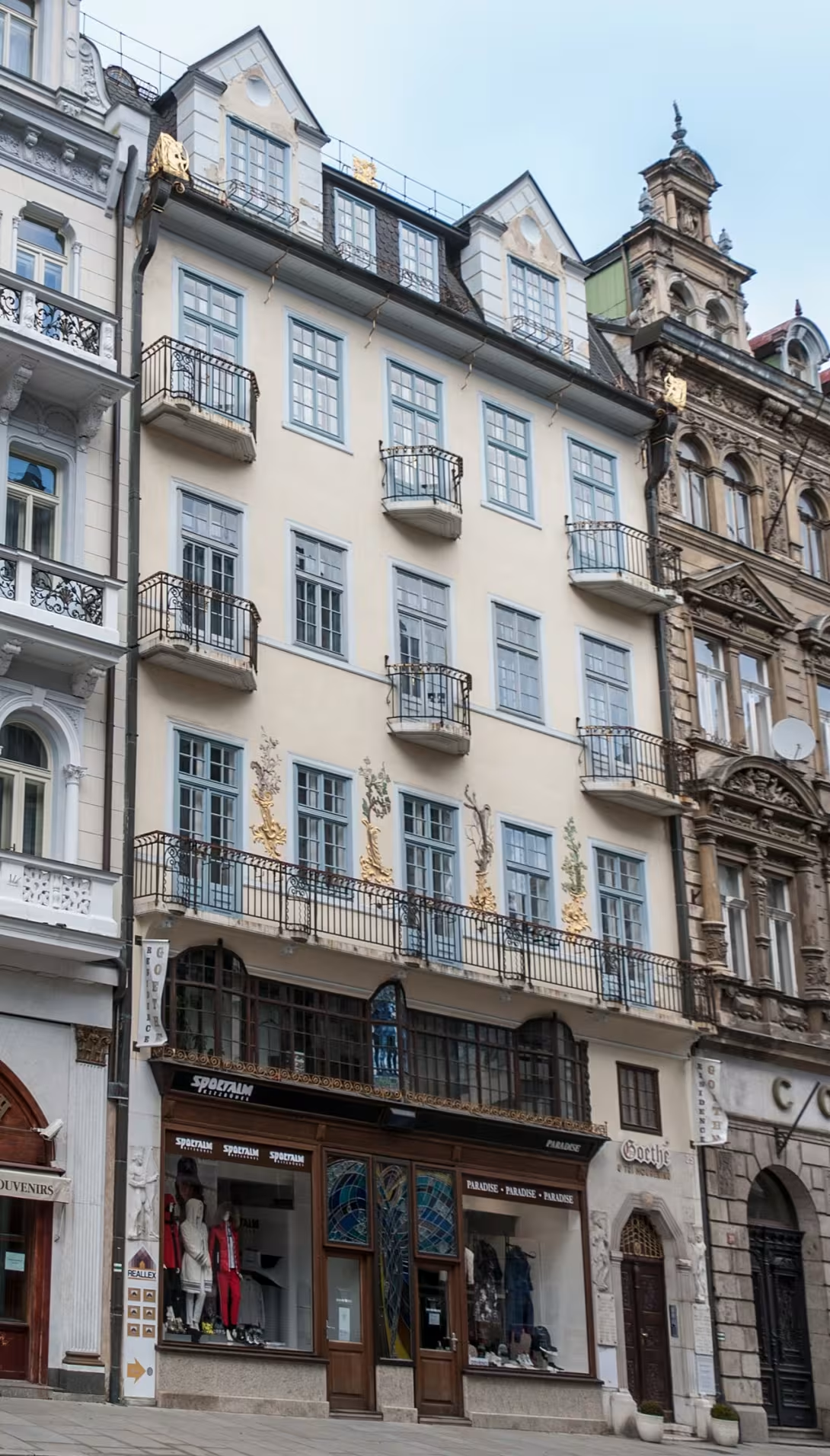
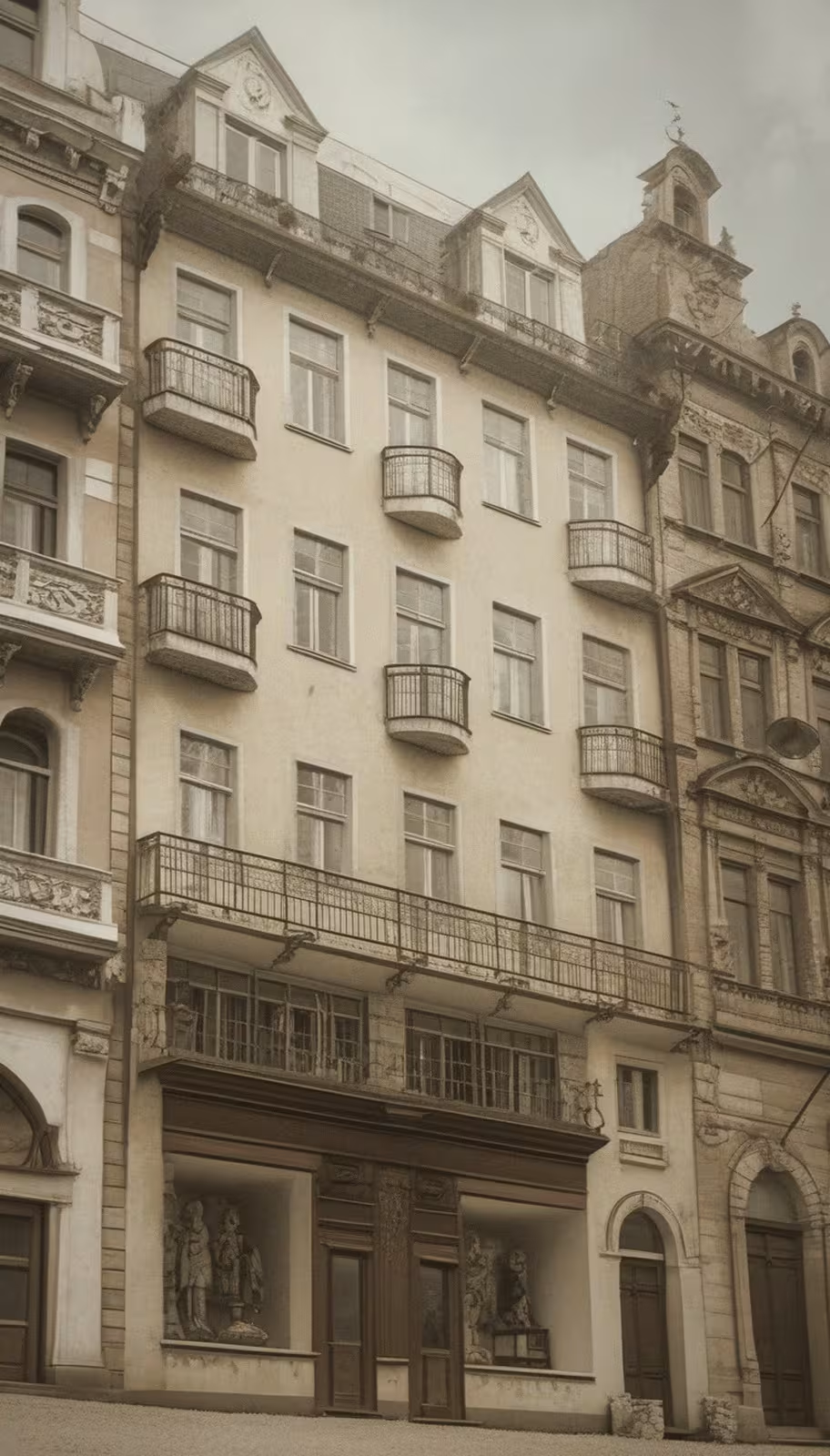
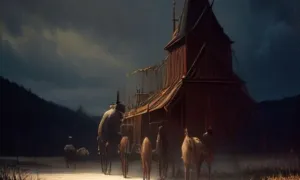
The historical appearance on the left is an AI-generated visualisation and serves as inspiration only.
Historical milestones
- 1715
- origin of the original house
- 1759
- fire burning two thirds of Karlovy Vary
- 1909
- breaking down the old house
- 1910
- completion of contemporary art nouveau construction
- 1958
- declaration for cultural monument
Architectural development
The original building from 1715 was replaced by a Rococo house in 1759-1760 after the fire. In 1909-1910 a contemporary Art Nouveau building was built into which the original rococo stucco moles and wooden doors were incorporated.
Historical events
1759: Indifference in the house caused a fire that destroyed two thirds of the city. 1806-1820: The nine-time stay of Johann Wolfgang Goethe. 1909: Demolition of the old house and the start of construction of the current building.
Owners
The family of Heilingötter (until the 19th century), Bernard and Lucie Heilingötter (from 1803), Franz and Wilhemine Stüdle (end of 19th century), Seika KV s. r. o. (towards 2021).
Points of interest
- It's a four-storey, Vienna-style Art Nouveau. - The object is a significant historical connection with Johann Wolfgang Goeth. There was a fire in 1759 that destroyed the original building. - The architect Karl Heller designed a new construction in 1909-1910. - The current object has a laminated portal with embossed figures of three young men.
Guide
Show guide text
This text was created by artificial intelligence and has not been editorially reviewed. It may contain inaccuracies.
Welcome to the heart of the spa city, where history meets elegance and where every stone tells stories of ancient glory. Right now you're standing in Market Street and your eyes have stopped in front of one of the most important buildings in this district. House of the Three Blueberry. At first glance, you may think it's just another beautiful building in a row of houses, but believe me, there is a deep story beneath this facade that goes far beyond the borders of today. Imagine they just stopped in time. Feel the atmosphere of this place, feel the calm brought by the spa architecture, and allow me to guide you through the centuries that have lived through this house.
The view of this building immediately brings you to the thoughts of the turn of the century, when the world was changing and the old ways of building gave way to new, bold ideas of beauty. But before we immerse ourselves in the modern form you see right now, we need to go much further back into the past. This location was inhabited a long time ago. The first traces of the original house in this place can be traced back to a thousand seven hundred and fifteen. At the time there was a completely different building, probably with much simpler shapes. But history can be unpredictable and harsh. In the year one thousand seven hundred fifty-nine, the Karlovy Vary struck a devastating disaster. A huge fire that fired two-thirds of the city at the time changed the face of this neighborhood forever. The original house that stood here was probably hit by this disaster, which began a long era of transformations.
For years, this place evolved into the rhythm of spa life until a major breakthrough in the early twentieth century. In the years of a thousand nine hundred nine to a thousand nine hundred ten, it was decided that the old world must give way to a new world. The old house has been demolished so that this current object can be created that you admire today. It was a period of huge boom when Karlovy Vary became the world's metropolis of spa culture. It is in these years that the construction that you are now observing has been completed, and it immediately excelled with its modernity and courage.
Now pay attention to what's right in front of you. Take a look at the overall shape of this four-story terraced house. Feel his line fitting into the neighboring structures, and yet he stands out with his unique stylist. It's a Vienna Art Nouveau. This style was not just about ornament, it was about life force, about new lines and about trying to connect architecture with nature and motion. Notice how the building seems to be alive. The architects behind this work were the true masters of their time. Karl Heller and Friedrich Ohmann created a work that combines modern Art Nouveau elements with a deep sense of detail. Even if you look at the finished structure today, in its details you can feel the effort for perfection that these creators put into every design. Look at the shape of the roof, which has this specific, laminated character, and see how this geometry gives the whole house a sense of stability and dynamics at the same time. The whole facade looks harmonious, even though it's rich in its style.
But when we look at this house, we cannot forget the most important soul that once lived here. This house isn't just about stone and mortar, it's about people. And the biggest one was definitely Johann Wolfgang Goethe. Imagine that famous German poet, thinker and scientist walking these streets. Goethe was a man who formed the ideas of Europe, and Karlovy Vary was a place for him to find peace and inspiration. In the years of a thousand eight hundred and six to a thousand eight hundred twenty he hosted here nine times. Imagine those moments when he was sitting in the interior, which at that time had not yet offered Art Nouveau beauty, but had his own, then atmosphere, and watched a city that was slowly built into its future glory. His presence here gives this place incredible weight. When you look at the windows of this house, you can imagine in your mind that just behind one of them in the last century was one of humanity's greatest geniuses looking at the same streets you see.
There's something magical about this building becoming a bridge between two different worlds. On the one hand, we have an era of classical spa traditions and great personalities such as Goethe, and on the other, we have a modern Art Nouveau revolution that came a hundred years later. This house is the perfect ally of these two epoch. It is this ability to connect the old to the new, tradition with innovation that makes it such a valuable object. This is because in the year one thousand nine hundred fifty-eight it was officially declared a cultural monument. The state and the city have acknowledged that this house is not just an ordinary house, but part of our common memory and identity.
If you're looking for a little mystery or interesting stuff that makes you look at the house even more carefully, think about how much this street has changed. You see a harmonious whole here today, but in the year one thousand seven hundred fifty-nine, there was probably chaos, smoke and fear of fire. The House of the Three Blueberry is a symbol of overcoming obstacles. It is proof that even after the biggest disasters, something more beautiful and durable can arise than the original. Every layer of this house, from its historical roots to its Art Nouveau face, is a story about renewal and a constant search for beauty.
Now that you know the secret and history of this place, I suggest you continue your walk. The Karlovy Vary is filled with similar treasures waiting to be discovered. Don't forget to stop by other buildings, see their shapes, colors and details. You may find another house telling you a story about a great artist or an unexpected architect. Every street here has its own rhythm. Thank you for stopping by this very house and paying attention to his story. Read the atmosphere of this city, enjoy its beauty and continue to discover these wonderful spa streets. See you on your next survey.
Tips for visitors
The best to visit the house of the Three Fires in the early afternoon, when there are fewer people and the sun illuminates the building from the best angles. This time allows you to explore the details of architecture without obstacles to the crowd.
Parking in the centre of Karlovy Vary can be difficult, therefore we recommend using public transport. The location is easily accessible by bus or tram; the current connection can be found in the online search engine.
When visiting, remember the protective sunglasses and plenty of drinking, especially during the summer. The entrance to the building is free of charge or a small admission fee is paid, the price information can be found on the official website.
To photograph the building, choose the time close to noon for the best lighting. The best places are especially the streets of Market, where the house stands out against the background of other historical buildings.
It is possible to visit the Castle Colonnade and explore the centre of Karlovy Vary. For families with children it is fun to walk the streets and discover local sights.
Businesses nearby
Do you run a restaurant, accommodation, shop, museum, rental, wellness or other visitor service near this monument? Show yourself directly to the people heading to it — this is how they will see you in the app and on the web:
Nearby
Centrum Karlových Varů, ulice Tržiště, v blízkosti Zámecké kolonády.
Accommodation nearby
Trips and activities nearby
Guided tours, tickets and activities nearby from GetYourGuide
Affiliate link: if you buy from the partner, we may receive a commission. The price for you does not change.
Search tours and activities →Themed route
1. Centre of Karlovy Vary, city area, start tour in the busy heart of the city. 2nd Street Market, street, the road leads along this track to the main monument. 3. dům U tří mouřenínů, historical construction, main destination trip with exceptional appearance. 4. Castle colonnade, construction, final stop near the main destination.
Seasonal recommendations
Spring: In the spring period dům U tří mouřenínů appears in a new light, when the sun's rays illuminate its historic facades. Flowers begin to bloom and green nature comes alive around the monument, which gives the atmosphere a mild temperature and sweetness. It is advisable for visitors to visit the weather without freezing when the flowers flourish the most. It is recommended to dress at mild temperatures and sunglasses against the sun for a more comfortable walk. The spring season is often less demanding on crowds, which allows for a more peaceful look at historical details and surrounding green nature.
Summer: In the summer dům U tří mouřenínů gains life when hot sunlight illuminates its facade. The atmosphere is full of vitality and often the surrounding green nature becomes a haven for visitors looking for shadows. In this period it is recommended to visit the earlier on the day to avoid the hottest hours and crowds. Hot clothes suitable for hot weather, umbrella and tissue against UV radiation are key. In addition, it is convenient to carry drinking water to maintain hydration during walks.
Autumn: In autumn dům U tří mouřenínů gains the atmosphere of melancholy when the leaves fall and the trees color. Sun rays illuminate the golden and red shades of nature around the monument, creating a unique atmosphere. This period is ideal for quiet visits as the crowd load decreases and the opening time may be shorter. Clothes suitable for colder weather and the possibility of rain protection are designed because autumn weather can be irregular. Looking at a historical monument at this time offers a peaceful experience with beautiful landscapes.
Winter: During winter dům U tří mouřenínů is dressed in snow, which gives its historic facade a romantic atmosphere. Sun rays illuminating the snow-covered courtyard create a magic that attracts visitors even on cold days. The winter season is suitable for visiting in groups or families looking for a quiet entertainment program because the crowd load is decreasing and the opening time may be shorter. Hot clothes with wind and rain protection such as hat, gloves and leather shoes are recommended. You would visit the memory more during the day to use sunlight and less cold hours.
Visualizations and artistic views


The visualisations are generated by artificial intelligence and serve as inspiration.
Photos from the area
Real photos taken near the monument

Zdroj a licence jsou uvedeny u každého snímku.
Tips from visitors
No tips yet. Be the first!
Log in and add your tip.
Sources and literature
Photos: Zorka Sojka / CC BY-SA 4.0 — Wikimedia Commons. The author and licence also appear when you hover over the image.
Faktickým podkladem tohoto textu byl článek na Wikipedii, jehož autory jsou přispěvatelé Wikipedie. Článek je dostupný pod licencí CC BY-SA 4.0.
Location on the map
More monuments – Karlovy Vary
Show all in the municipality
Příběhy a pověsti
Legendy, pověsti a příběhy spjaté s touto památkou
Fotografie návštěvníků
Zatím žádné fotografie. Buďte první, kdo přidá fotografii z návštěvy!
Log in a přidejte svou fotografii nebo hodnoťte.
Za ověřenou návštěvu v aplikaci získáte víc bodů — poznáme podle GPS, že jste na místě.
Reviews and comments