



dům U Tří zlatých řetězů House
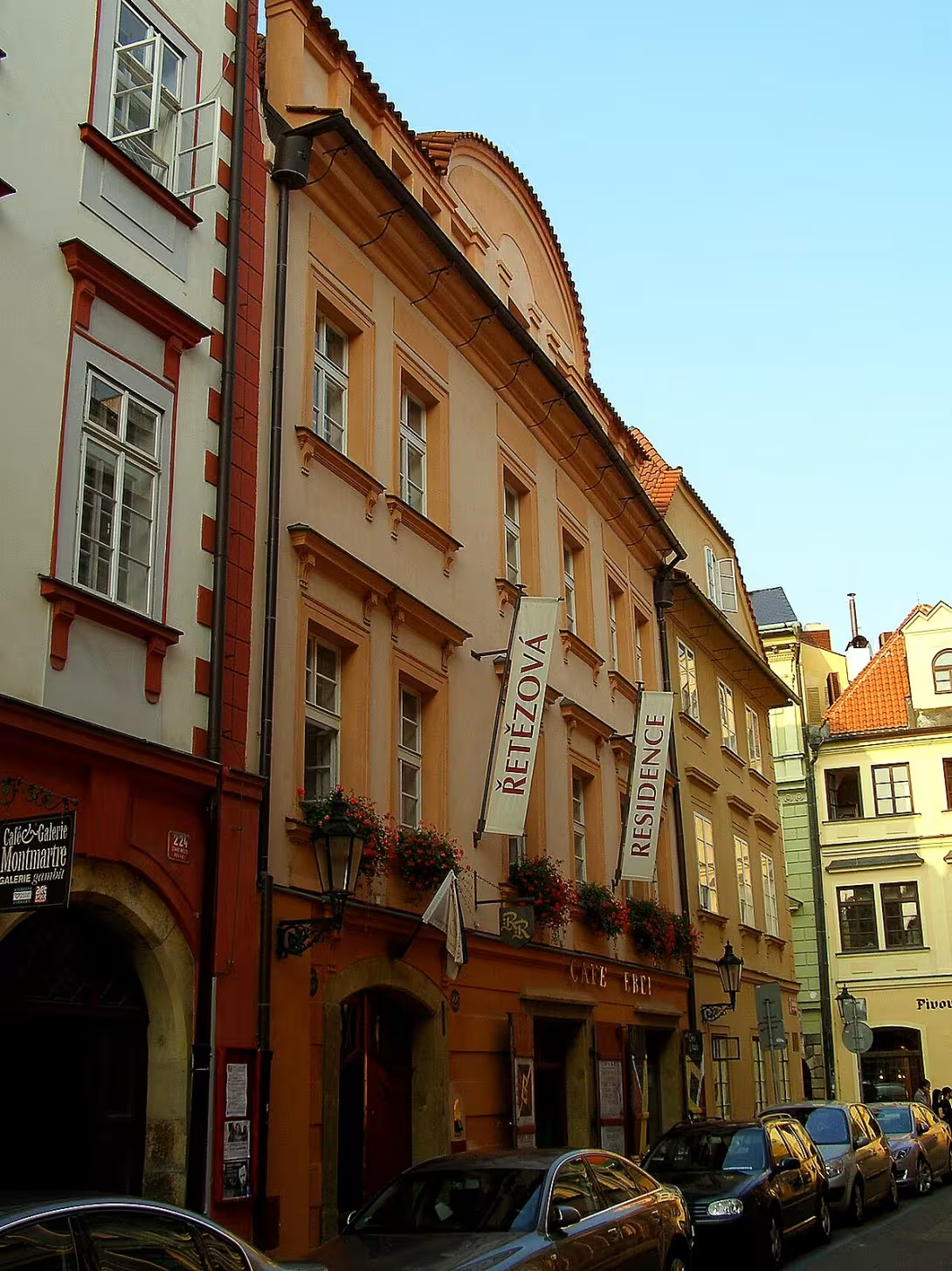
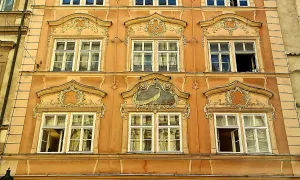
House U Three gold chains is a historical building in Prague 1 on Old Town in Chain Street. The building dates from the 14th century and represents an architectural development from Gothic to Renaissance to Classicism. This is an important witness to the urban development of the oldest parts of Prague.
The first records of the construction and street, which was called Kožeshnicki until the 17th century, dates back to the 14th century. In this area, the masters of the fur guild were concentrated, with the fur mill established in Old Town in 1418. In the building there were originally furry workshops, which were successful thanks to the success of this craft.
The building is built on Gothic foundations and its ground floor is also Gothic. At the beginning of the 17th century, a Renaissance reconstruction took place, which brought the ceiling vaults on the ground floor and the first floor. Two ports and an oval tympanone were added to the main facade at the end of the 18th century. In the first half of the 19th century, the facade gained its classical appearance today. The most valuable details include painted Renaissance ceiling beams, classicist doors in corridors, first and second floor beams and antique balconies on both floors.
The long-term owner of the house was the furrier Václav Hofleich. In 1998 the property was purchased by Mirto s.r.o.
The name of the house and street are likely to be related to a chain that was strained across the river for the purpose of holding ships and wasps until the crew paid the customs fee. Historical sources also suggest the possibility that the name was created by the house itself or by chains preventing access to the Anen monastery.
Between 1998 and 2000 the last major reconstruction took place according to the design of architect Aleš Kletenski. Since 2000, the Residence Chain has been housed in the building.
The monument offers a unique view of the layered history of Prague architecture and the craft tradition of Old Town. It is advisable to include it in a sightseeing walk through the oldest streets of the centre of Prague.
Historical milestones
- 1418
- He established a fur house in Old Town
- 1998
- Mirto s.r.o. purchased real estate
- 2000
- The Residence Řetěová hotel started to reside in the building
Architectural development
The building stands on Gothic foundations and its ground floor is Gothic. At the beginning of the 17th century, a Renaissance reconstruction took place with the installation of ceiling vaults, while the end of the 18th century brought an oval tympanon and the first half of the 19th century a classical facade.
Historical events
1418: He established a fur shop in the Old Town. 1998- 2000: The last major reconstruction of the building took place.
Owners
Václav Hofleich (furrier), Mirto s.r.o. (since 1998)
Points of interest
- The building dates from the 14th century and shows architectural developments from Gothic to Renaissance to Classicism. - The street was called Kožešnický until the seventeenth century and there were originally successful fur workshops in the house. - The most valuable details include painted Renaissance ceiling beams, classicist doors, beams and antique balconies. - The name of the house is probably related to a chain stretched across the river to collect customs duties, or to chains preventing access to the monastery. - A hotel has been housed in the building since the 20th century, with the last major reconstruction taking place between a thousand and nine hundred ninety-eight and two thousand.
Guide
Show guide text
This text was created by artificial intelligence and has not been editorially reviewed. It may contain inaccuracies.
Welcome to the heart of old Prague, one of those alleys where time seems to be stopped and where every stone tells its own story. You're standing in front of the Three Gold Chains house. Stop for a moment, take a breath and feel the atmosphere of this place. In front of you is a building that is not just an ordinary house, but a real witness to the centuries of our city's history. Look at her facade, which welcomes you with its calm and balanced form. It is a place where history meets the present and where the development of European construction is mirrored in one single construction.
Let us now return together in time much deeper than our imagination allows. The first records of this house dates back to the 14th century. Imagine what this area looked like at that time. It was not a tourist attraction, but a vibrant, noisy and hardworking neighborhood. The street you're standing in right now was called Leatherneck until the 17th century. That name wasn't random. This area was the absolute center of the fur trade at the time. In the year of a thousand and four hundred and eighteen, he established a fur house in Old Town. At that time, the guilds were powerful organizations that kept the quality of the products, determined prices and cared for their members. In this house and in the surrounding buildings there were successful fur workshops. Imagine the smell of processed leather, the sound of tools and the excitement of craftsmen, who made luxury furs for the richest citizens of Prague and for noble families. This house was therefore connected from the beginning to work, and to business.
Now pay attention to the architecture of the building itself. What you see in front of you is a classic facade that gives the house its contemporary, elegant and moderate appearance. Classicism has tried to return to order and simplicity, as you see in the lines of this house. But dům U Tří zlatých řetězů is like a book where each layer tells a different story and each era leaves its mark. If we could see through the walls, we would find that on the ground floor there are still elements from the Gothic era. Gothic was a period of strength and verticality, and the oldest foundations and parts of the ground floor remind us of when the house was newly founded. Later came the Renaissance, which brought new priorities, more light and a different approach to space. Over the centuries, the building has undergone several reconstructions that have made it an architectural palimpsest, a layered text, where the new one did not overlay the old but supplemented it. For example, the architect Aleš Kletenský, who helped the house to maintain its dignity in the newer times, was behind more modern design and modifications.
When we think about people who lived and worked here, we think about Václav Hofleich, for example. Personalities like him were the ones who owned the house, managed it and sought their happiness in it. Each of them put a piece of his energy into the house and helped him survive the riots, fires and changes in the regimes that Prague has been going through over the centuries. It's fascinating to think how many generations of people have come through the same door as the hotel guests.
And now I want to impress you with one interesting thing that lies deep in the interior, even if you can't see it from the street. The most valuable details of this house include painted Renaissance ceiling beams. Imagine these wooden structures that once supported ceilings and were decorated with colors to express the owner's wealth and taste. These beams are silent witnesses to the time when the house served as a residence for successful craftsmen. It's a fascinating contrast when we realize that under the classic facade that you're watching right now, there's a Renaissance soul and a Gothic heart asleep. It is this layery that makes the House of Three Gold Chains such an important architectural object.
But time continues to flow and the building had to adapt to new times. After a long history of artisanal workshops and private flats, a new capital impulse came. In the year one thousand nine hundred ninety-eight property was purchased by Mirto. and then the building was sensitively renovated. In the year two thousand, the Residence Chain hotel was established here. Today, the building serves as a resting place for travelers from all over the world who want to feel a hollow space of history and sleep in places where furry business once ruled. It is a beautiful example of how the historical monument can still be useful in a modern city without losing its identity.
If you look again at the house in front of you, you probably don't see it as just one of the many buildings on Prague Street. You see a foot of the 14th century, you feel the presence of furs from the year one thousand four hundred and eighteen, and you perceive the elegance of classicism. This house is a small mirror to the entire development of the Old Town.
Thank you for stopping by the Three Gold Chains house for a moment. I hope you're interested in his story and that you will take away a sense of respect for the craft and architectural taste of our ancestors. We now invite you to explore further the narrow streets of Prague, where there is another secret waiting on every corner. We wish you a pleasant continuation of your journey and enjoy every second you spend in this magical city. Goodbye.
Tips for visitors
The best time to visit the House of Three Gold Chains in Chain Street is early morning or morning. At this time you will meet the least people here and you can quietly admire the historic atmosphere of the ancient Old Town. For transport to the place use public transport, because the historical centre of Prague is not ideal for cars. The current connection is easy to verify in the traffic search engine. Take your comfortable shoes with you, as you will move around the historic pavement, as well as a camera to capture picturesque corners. The best light for photographing this 14-hundred-dollar building, which used to serve furriers, is during the morning sun, which perfectly illuminates a narrow alley. In the vicinity of the monument you can visit the Old Town of Prague and the Anen Monastery within 30 minutes of walking, which are listed in historical background. If you travel with children, we recommend you choose a slower pace walking and take a break in some of the quiet old-town streets where children can relax.
Frequently asked questions
Can the monument be visited?
This is a residential or farm building, not a museum with opening hours. Please view it from public space and respect the owners' privacy. We have no information about access to the interior.
Where is the monument?
Location: Praha 1, Hlavní město Praha. The map on this page shows the exact spot.
Why is the monument protected?
It is listed in the Central List of Cultural Monuments of the Czech Republic as a cultural monument (register no. 1000150320).
Businesses nearby
Do you run a restaurant, accommodation, shop, museum, rental, wellness or other visitor service near this monument? Show yourself directly to the people heading to it — this is how they will see you in the app and on the web:
Events nearby

Zdroj akcí: otevřená data měst a obcí ČR (Národní katalog otevřených dat) a kalendář akcí Národního památkového ústavu.
Nearby
Staré Město pražské, Anenský klášter
Accommodation nearby
Trips and activities nearby
Guided tours, tickets and activities nearby from GetYourGuide
Affiliate link: if you buy from the partner, we may receive a commission. The price for you does not change.
Search tours and activities →Themed route
Here is the proposed thematic cruise route:
1. Anen monastery Type: Historical area Why is it worth visiting: This ancient spiritual set of buildings offers a unique atmosphere of old Prague and shows what medieval building monuments in this neighborhood looked like. It's just outside our main destination.
2. House of Three Gold Chains Type: Town house Why is it worth a visit: The main destination of our trip is a wonderful example of historical urban architecture in Old Town. It will capture its rich history and picturesque facade in the streets of the Prague Monument Reserve.
3. Old Prague City Type: Historical Quarter Why is it worth a visit: The whole area surrounding the main destination consists of (p) years of crooked streets and historic houses. Walk through this space breathes an unrepeatable spell of ancient centuries.
Seasonal recommendations
Spring in the streets around the historic House of Three Gold Chains in Prague brings one a awakening nature and a specific light that is reflected from old facades. The atmosphere is full of optimism because trees in nearby parks are beginning to bloom and paved streets attract to the first long walks without strong winter coats. The practical advice for the spring season is to head out in the morning when the sights are the most quiet before the main wave of afternoon visitors arrive. Put on comfortable laminated clothing and solid shoes suitable for uneven cubes, as spring weather is usually variable and cold.
Summer at the Old Town near this important house offers long sunny days and an unrepeatable atmosphere, which is drawn by the setting rays of the sun coloring the Gothic and Renaissance towers into golden shades. The air is warm and the streets live long into the night. Due to the large number of tourists in the high season, the best time for a tour early in the morning is right after dawn, when the city is getting up and the crowds are not up yet. For warm summer days, choose light breathable clothes, sunglasses, headgear and don't forget to carry a bottle of drinking water to ensure drinking mode while exploring the corners of Prague one.
Autumn around the House of Three Gold Chains covers the whole place in a nostalgic mood, formed by falling leaves of trees and often appearing fine fog over Vltava. The lighting is soft due to the low sun and creates ideal conditions for lovers of historical architecture photography. During dry days, people's movement is a little smaller, allowing them to enjoy a genius loci with more intimacy. For the autumn visit, bring a waterproof jacket or coat, a warm scarf and waterproof shoes, because autumn showers and slippery tiles can surprise you.
Winter at this Prague monument breathes deep peace and mystery, especially when the ancient neighborhood is covered with a layer of fresh snow. The atmosphere in advent time is magical thanks to the dim evening lighting of lamps and earlier dimming, which makes the architectural details of the house stand out. From a practical point of view, it is necessary to expect a shorter time of daylight, so plan your arrival for afternoon hours when historical lanterns are lit. Due to the freezing weather, it is essential to wear a quality winter jacket, a warm hat, gloves and shoes with anti-slip soles for safe movement.
Visualizations and artistic views


The visualisations are generated by artificial intelligence and serve as inspiration.
Photos from the area
Real photos taken near the monument

Zdroj a licence jsou uvedeny u každého snímku.
Tips from visitors
No tips yet. Be the first!
Log in and add your tip.
Sources and literature
Photos: Michal Kmínek / CC BY-SA 3.0 — Wikimedia Commons. The author and licence also appear when you hover over the image.
Faktickým podkladem tohoto textu byl článek na Wikipedii, jehož autory jsou přispěvatelé Wikipedie. Článek je dostupný pod licencí CC BY-SA 4.0.
Location on the map
Příběhy a pověsti
Legendy, pověsti a příběhy spjaté s touto památkou
Fotografie návštěvníků
Zatím žádné fotografie. Buďte první, kdo přidá fotografii z návštěvy!
Log in a přidejte svou fotografii nebo hodnoťte.
Za ověřenou návštěvu v aplikaci získáte víc bodů — poznáme podle GPS, že jste na místě.
Reviews and comments