



Dům U Zlatého lva House
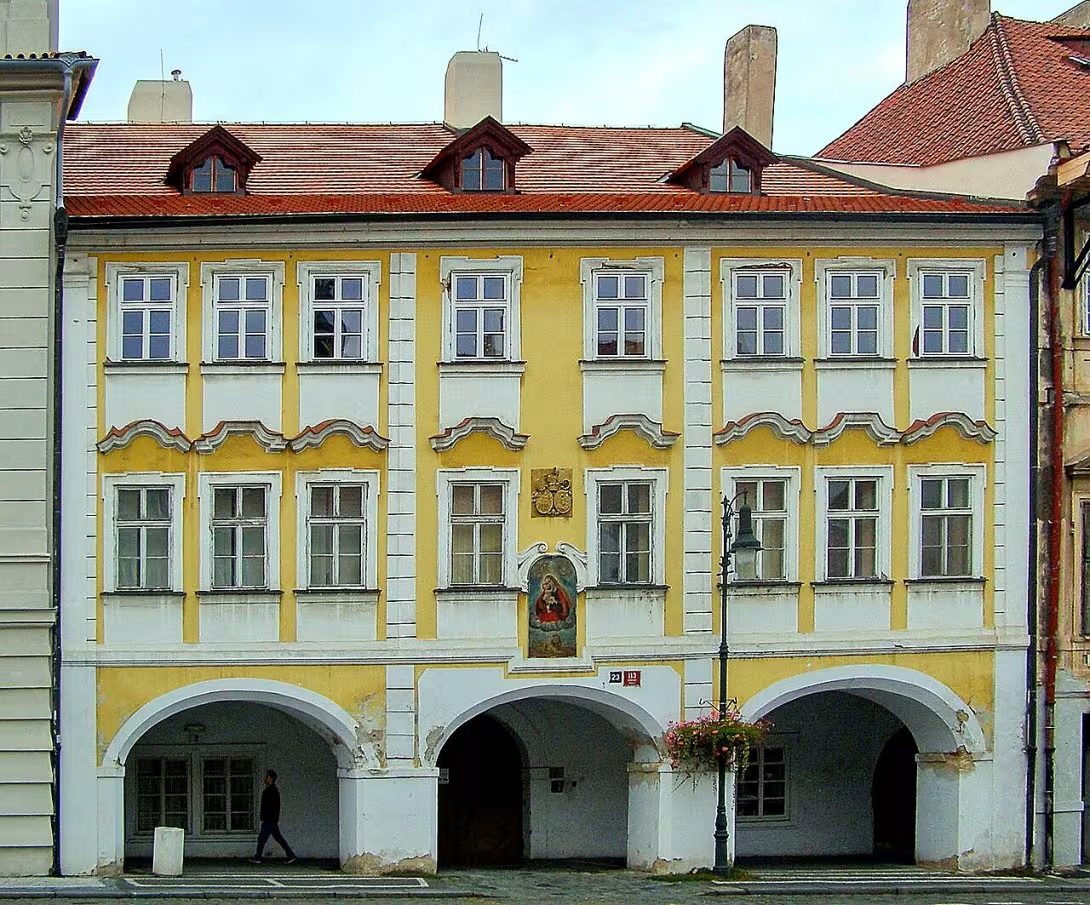
Dům U Zlatého lva also known as At Frýdla or Strahov rectory, there is a two-storey historical building with an arch in Prague's Pohořelec street in Hradčany. This cultural monument of Gothic origin has undergone Renaissance and Baroque adaptations over the centuries. Since 1964, the house has been protected historically.
The oldest roots of the building reach into Gothic, which is evidenced by a preserved medieval cellar from an abandoned block wall. Written sources of owners have existed since 1379, when the townsman Ulric is documented. During the 14th century, many other owners and tenants took turns in the house. In the 16th and 17th centuries the building underwent Renaissance reconstruction, in the 18th century it was modified for the needs of the rectory and economic operation.
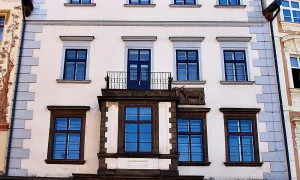
The architectural house stands out for the symmetrical Baroque southern facade, which is eight-axis on both floors. The ground floor is dominated by three arcades and well-rounded arches with passports. The entrance portal has a stone-plated lining. The gate door is a new copy of the original door from 1991. There is an early Baroque wooden two-arm staircase from the entrance to the yard. The yard facade is simple, the west wing complements a short stroller with a metal railing. The baroque home sign is an important element of the facade. It consists of a painting of the Pasov Madonna with Jesus painted on a zinc sheet under which is depicted the golden lion and silhouette of the Strahov monastery. Above the sign are stucco coats of arms Abbot František Michael Daller with half figure of St. Norbert.
The property history of the object is varied. After the town of Ulric, it is reminded of Jan Frydle as a small house in the late 16th century. At the beginning of the 17th century it was owned by Filip Folgenoch and in 1614 Strahov monastery rented the garden of Jan Salzprun's house. The fundamental change came in 1671 when the owner became the bell tower and uterus Mikuláš Löw. It was after him that the house in 1674 got its name at the Golden Lion. In the 18th century the building served as a touring pub with extensive stables and bows in the courtyard wings. During the Bavarian-French invasion in 1741 and 1742, the house was badly damaged by Austrian artillery fire. After repairs, it was taken over in 1773 by Strahov monastery, which set up its rectory.
Dům U Zlatého lva is a valuable proof of the historical development of Hradčan, which integrates medieval foundations with later Baroque modifications. Visiting this location offers an opportunity to see the history of Prague's urban housing and administration of church property. The building is part of a monument of value near Strahov Monastery, Loreta and Prague Castle.
Historical milestones
- 1379
- First written mention of the owner of the house, townie Ulric.
- 1674
- House got a name A golden lion and a Marian home sign.
- 1773
- The building was acquired by Strahov monastery and established a rectory in it.
- 1964
- The house was declared a cultural monument.
Architectural development
Originally a Gothic house with a preserved medieval cellar from an optic wall was remodeled in the 16th and 17th centuries. The main south facade has acquired a baroque form, with an arches with valleys on the ground floor. In the 18th century the building was modified for the needs of the rectory and economic operation.
Historical events
Between 1741 and 1742, the house was badly damaged by Austrian artillery shootings during the Bavarian-French invasion. In 1773 the Strahov monastery regained the object and set up its rectory.
Owners
Urban Ulric (from 1379), Jan Frydl (from the end of the 16th century), Filip Folgenoch (from the beginning of the 17th century), Mikuláš Löw (from 1671), Strahov monastery (from 1773).
Points of interest
- The house has a gothic origin, which is evidenced by a preserved medieval basement from an abandoned block wall. - Part of the facade is a baroque home sign with the painting of the Pasov Madonna, the golden lion and the silhouette of the Strahov monastery. - The house got its name in 1674 after the bell tower and the artillery of Nicholas Löw. - In the eighteenth century, the building served as a traveling pub with extensive stables and bows. - During the invasion of foreign troops in 1741 and 1742, the house was badly damaged by Austrian artillery sniping.
Guide
Show guide text
This text was created by artificial intelligence and has not been editorially reviewed. It may contain inaccuracies.
Welcome to Prague Hradčany, in the heart of one of the most beautiful and peaceful places of the capital. You're standing in front of the Golden Lion House, which is quietly and modestly in Pohořelec Street. It may seem like a common townhouse to you, but beware, behind this seemingly undemanding appearance, there is a story that goes deep into the Middle Ages. Look at the facade, which is oriented towards the street. You can see here a two-story building with a typical arch, which in the past served as a protection against rain and sun for merchants as well as random passing. This building has its roots in the Gothic period, which is quite rare and valuable for buildings in this part of Prague. The atmosphere here is different from the busy Old Town. Here there is peace, which complements the proximity of the famous Strahov monastery, whose silhouette you can easily see in the background.
Let's move back a few steps in time to understand how this house came into being. The first written mention of the owner of the house dates back to 1379. Back then, this property belonged to a township named Ulric. He was a common citizen who ran his business and household here. The house was therefore not built as a royal palace or as a castle tower, but as a residential and business house for the township layer. This gives him a certain human and accessible side. Over the centuries, the house has gone through many hands and many changes. The original Gothic building was gradually modified in the spirit of the Renaissance and later Baroque. Every epoch on the facade and interior has left a print, so today you see a set of elements that form a harmonious whole together.
Now pay attention to the particular architectural details you have in front of you. Notice the arches that are typical of Prague streets. These arcades have served in the past as a covered corridor where people could meet, trade or just relax. Look up at the facade. Whether you're looking at windows or wall lines, see how different building styles intersect here. The main and most significant element that you should not overlook is the baroque home sign. You'll find him on the south side of the house. This is a real sign. It shows the Pasovsky Madonna, the Virgin Mary and Jesus, which is protected by a golden lion. This combination of symbols is not random. The Golden Lion is a symbol of strength and protection here, while Madonna represents spiritual comfort and hope. You will also see the silhouette of the Strahov monastery as a sign, which clearly shows the strong ties of this house to this spiritual centre.
But who was the one who gave the house his famous name? In 1674, the house got its mark today at Golden Lion. Behind this name stands an interesting personality, bell tower and uterus Mikuláš Löw. He was the master of his craft, famous for making bells and cannonballs. His name became closely linked to this building. The house became a place where people from different disciplines came together, and there was also a traveling pub. This means that travellers, businessmen and clergymen could find accommodation and food here. So it was a living and active house, full of life and excitement, unlike today's quiet atmosphere.
Later, in 1773, there was a fundamental change in the fate of this object. The house was won by Strahov Monastery. The monks of this famous monastery set up a parish here. It had a great influence on the character of the building. The house became a place of spiritual life where worship took place and where the believers could pray. This phase has brought peace and dignity to the house, which remain here to this day. Strahov monastery has always been an important patron and owner of many properties in Prague, and this house was one of the important points in its network.
If you look more closely at the history and context, you can see other interesting personalities related to this place. Along with Nicholas Löw, many other people like Jan Frydl, Filip Folgenoch, Jan Salcprun or František Michael Daller walked here. Each one brought something of their own to the history of the house. They were businessmen, craftsmen or clerics who lived or worked here. Their stories are part of the tissue of this place, although we now know less about them than we do about the bell tower Löw. The house was also declared a cultural monument in 1964, which ensures its protection and conservation for future generations.
The interesting thing that might interest you is the fact that the house has a Gothic origin, which proves a preserved medieval cellar. Although we're not looking at him directly from the street, his existence is proof of how old this building is. The cellar is built from an excavating block wall, which is a material typical of medieval architecture in this area. Opuka is a soft sandstone that works well and is why it has been used in the past. This cellar is therefore a kind of time capsule, which reminds us that the building stood here long before the baroque sign or Renaissance windows appeared.
Another interesting thing is the home sign itself. Pasovska Madonna is depicted here in a typical Baroque style, with an emphasis on emotions and spiritual depth. The golden lion that protects it is a symbol that often occurs in the heraldry. But in this case, it's not a family coat of arms, it's a symbol of protection and strength that protects the house from evil. The silhouette of the Strahov monastery as a sign is a direct reference to its owner and patron. This combination of symbols creates a unique visual identity of a house that is easily recognizable.
So Dům U Zlatého lva is much more than just a building. It's a place where history, architecture and spiritual life intersect. Its history dates from medieval township Ulric to bell tower Mikuláš Löw to monks from Strahov. Each generation added something of its own, whether it was a building modification or a new use of the building. Today, this house is a cultural monument that we can enjoy and study.
Before we say goodbye, look at the facade again. Feel the calm that exists here. Hear the silence of Pohořelec Street, which is so different from the noise of the main square. This house reminds you that Prague has many faces. In addition to the famous palaces and cathedrals, it also has modest townhouses that have their own story and dignity. Dům U Zlatého lva is one of them. It's where history touches the present.
If you want to explore the area, I suggest you take a walk along Pohořelec Street. This street is full of other interesting buildings and beautiful views of Hradčany. You can also stop
Tips for visitors
We recommend a visit in the morning during the working week when Pohořelec Street has a smaller movement of people and you can relax to see the Gothic elements and the arch house.
The place is available by public transport and walking from nearby stops; For specific connections and current timetables please check the official connection search.
Take comfortable shoes suitable for historical tile and camera. The best light to capture the south facade of the house is in the afternoon when the sun lights the facade facing the street.
Within 30 minutes' walk there is a Strahov monastery, extensive Petrín orchards, a spiritual place of Loreto and an extensive area of Prague Castle.
The location is suitable for families with children due to the proximity of parks and gardens where children can relax; the house itself offers an interesting example of historical architecture, which can be educational for older schoolchildren.
Frequently asked questions
Can the monument be visited?
This is a residential or farm building, not a museum with opening hours. Please view it from public space and respect the owners' privacy. We have no information about access to the interior.
Where is the monument?
Location: Praha 1, Hlavní město Praha. The map on this page shows the exact spot.
Why is the monument protected?
It is listed in the Central List of Cultural Monuments of the Czech Republic as a cultural monument (register no. 1000151734).
Businesses nearby
Do you run a restaurant, accommodation, shop, museum, rental, wellness or other visitor service near this monument? Show yourself directly to the people heading to it — this is how they will see you in the app and on the web:
Events nearby

Zdroj akcí: otevřená data měst a obcí ČR (Národní katalog otevřených dat) a kalendář akcí Národního památkového ústavu.
Nearby
Strahovský klášter, Petřínské sady, Loreta, Pražský hrad.
Accommodation nearby
Trips and activities nearby
Guided tours, tickets and activities nearby from GetYourGuide
Affiliate link: if you buy from the partner, we may receive a commission. The price for you does not change.
Search tours and activities →Themed route
1. Dům U Zlatého lva - historical building. Right at the entrance you can immerse yourself in the atmosphere of old Prague houses and admire preserved interiors.
2. Strahov monastery - Baroque monastery complex. Just a few minutes' walk from the house, it offers an impressive library and a monastery garden where spiritual peace and treasures are united.
3. Loreto - Baroque chapel with rich decoration. A short walk along Strahov Road will lead you to this pilgrimage place where you can admire detailed statues and bells.
4. Petrin orchards - large green area on top of Petrin. From Loreta you will take a slightly rising path (about 500 m) and enjoy city views, romantic paths and shady benches.
5. Prague Castle - the largest castle complex in the Czech Republic. From Petrín orchards, after a short descent (about 600 m), you can reach the majestic castle towers where you can explore the historical halls and courtyard.
Seasonal recommendations
Spring brings freshness and fine light to the Prague streets, which beautifully highlights the historical details of the house. In the surroundings, the green begins to bloom, creating a pleasant atmosphere for walking. I recommend a visit around noon, when the light is most stable. Dress well, because the morning cold can still feel when the sun is shining.
In the summer months in this part of the city, there is the greatest rush and crowds of people. The sun shines very strongly and reflections from the old walls can be intense. The best thing to do is to come first thing in the morning before the hottest amount of people starts. Dress lightly and remember enough water to avoid fatigue from high temperatures.
Autumn season offers a magical atmosphere thanks to fog and golden shades in the surroundings. The light is softer at this time and the color of the building is very warm. The ideal time for a tour is this afternoon, when the sun falls below. Prepare your coat and shawl, because in narrow alleys there may be an unpleasant draught in colder weather.
Zimą is a quieter atmosphere and in advent time many lights are lit in the surroundings. The days are short, so the light disappears quickly. A shorter opening time and total cold must be expected. Dress very warm and choose stronger shoes in case of snow or frost on historic tiles.
Visualizations and artistic views


The visualisations are generated by artificial intelligence and serve as inspiration.
Photos from the area
Real photos taken near the monument


Zdroj a licence jsou uvedeny u každého snímku.
Tips from visitors
No tips yet. Be the first!
Log in and add your tip.
Sources and literature
Photos: Michal Kmínek / CC BY-SA 3.0 — Wikimedia Commons. The author and licence also appear when you hover over the image.
Faktickým podkladem tohoto textu byl článek na Wikipedii, jehož autory jsou přispěvatelé Wikipedie. Článek je dostupný pod licencí CC BY-SA 4.0.
Location on the map
Příběhy a pověsti
Legendy, pověsti a příběhy spjaté s touto památkou
Fotografie návštěvníků
Zatím žádné fotografie. Buďte první, kdo přidá fotografii z návštěvy!
Log in a přidejte svou fotografii nebo hodnoťte.
Za ověřenou návštěvu v aplikaci získáte víc bodů — poznáme podle GPS, že jste na místě.
Reviews and comments