



Dům uměleckého průmyslu Department store
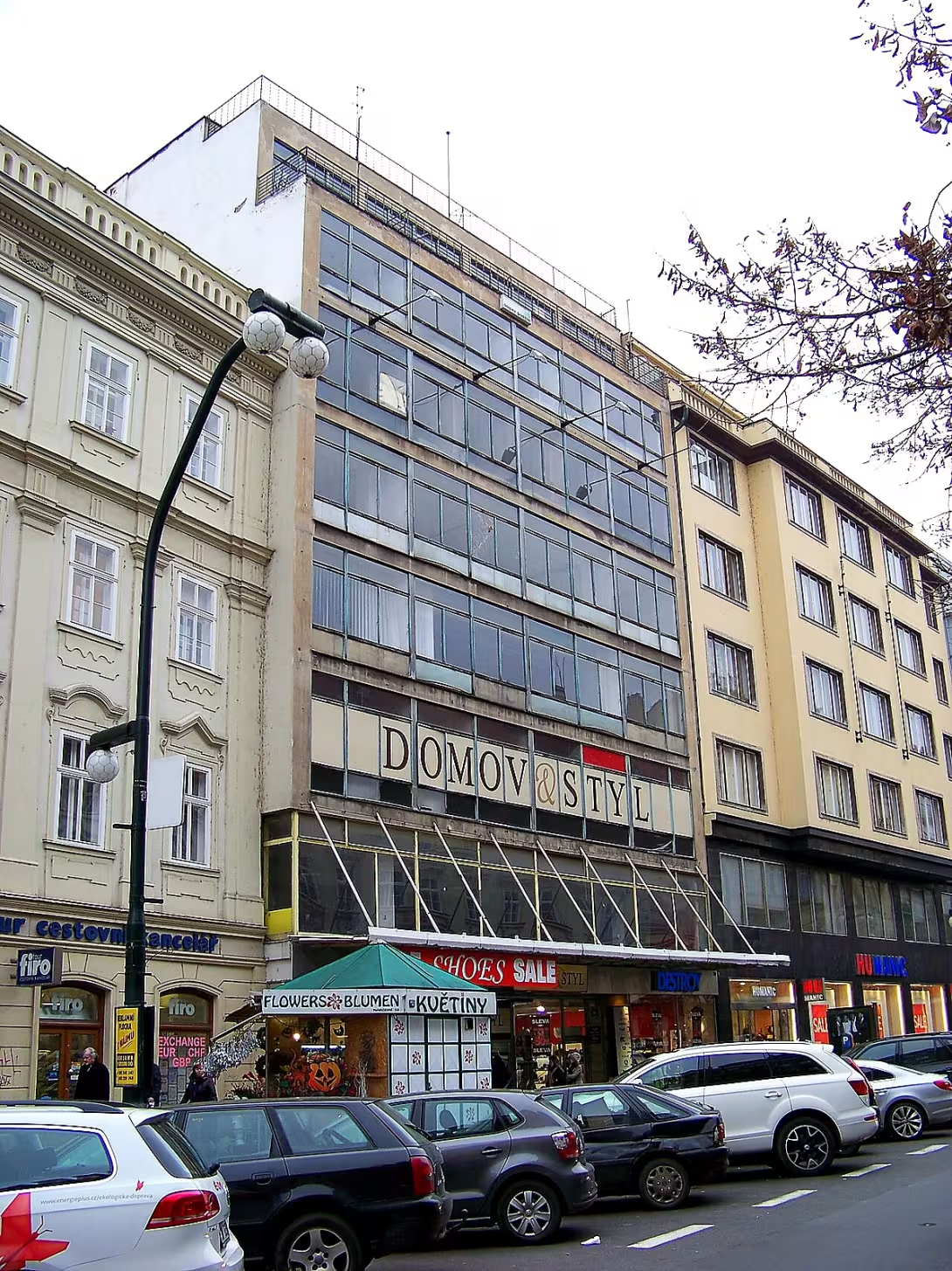
Dům uměleckého průmyslu on Prague's National Class is a significant functionalist building. It was created between 1936 and 1938 for the Association of Czechoslovak Works. The L-shaped building is one of the most important monuments of modern architecture in Prague. Historically he served as a centre of design and publishing.
Parcel in National Class, where used to be a historic house For three bells, the Association obtained Czechoslovak works in 1929. The original plans were prepared by architect František Kavalír. After his death in 1932, the Director of the Union Karel Cink took the initiative. The project was developed in 1934 by architect Oldřich Starý, one of the pioneers of Czech functionalism. The construction was carried out by Freiwald-Böhm. The wing to the National Class was finished in 1936, the wing to Charvat street with facade from architect František Zelenka followed in 1938.
The building stands on a reinforced concrete skeleton with eight main pillars. The architectural solution includes a glazed facade and an inner atrium with an opening roof, which originally illuminated luxers. Part of the interior was a passage connecting the National Class with Charvat Street, equipped with chrome metal elements and rounded glass. The building has seven above and three underground floors. On the roof there is a terrace overlooking the city.
After completion, the building became the headquarters of the company Beautiful scar, which was the centre of modern design, art shops and exhibition halls. At the same time, there was a publishing house called Cooperative Works, later known as Odeon. After privatization in 1994, the house had long been decayed and its premises were used only limited. Since 2024, Caluma a.s. is the owner of the company of the entrepreneur Ludek Fabinger.
The opening of the art club DUP39 in 2017 was an important event in modern history, thanks to which the building became available to the public again. The X10 Theatre was opened and exhibitions, concerts, lectures and fashion shows took place. After 1989, the Black Theatre performed here briefly. Currently, the basement space serves as a building and cultural space, while the parter is used commercially.
Dům uměleckého průmyslu represents valuable evidence of the development of modern residential design and useful art in interwar Czechoslovakia. Visiting this place offers a unique opportunity to learn about the authentic environment of functionalist architecture, which is once again a part of Prague's cultural life after years of decline.
Then and now
Drag the slider to compare how the landmark may have looked when it was built with the view today.
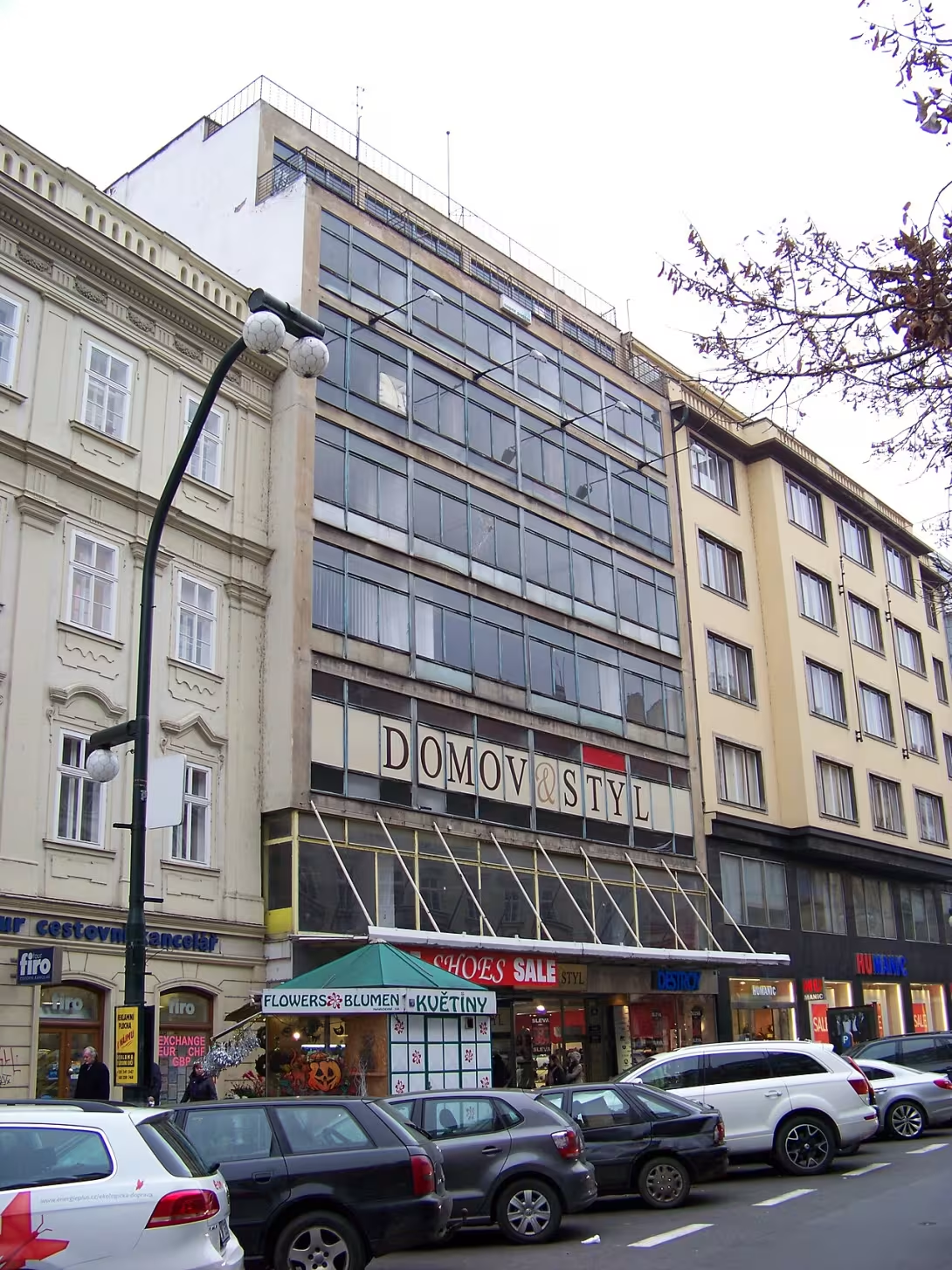

The historical appearance on the left is an AI-generated visualisation and serves as inspiration only.
Historical milestones
- 1929
- The Association of Czechoslovak Works acquired a plot for the construction of a new building.
- 1936
- Complete wing to the National Class, including the courtier.
- 1938
- Complete wing to Charvat Street.
- 2017
- The house was opened to the public after a long time as a cultural space of DUP39.
Architectural development
The building was built as a reinforced concrete skeleton carried by eight main pillars. The architectural design underwent the development from František Kavaliř to the final project Oldřich Old. The facade of the wing to Charvat Street was designed by František Zelenka, with a passage with chrome elements and rounded windows.
Historical events
1936 completion of the wing to the National Class, 1938 completion of the wing to Kharvat Street, 1994 privatisation and subsequent decay of the building, 2017 opening of the art club DUP39.
Owners
Association of Czechoslovak Works (since 1929), after 1994 private owners, since 2024 company Caluma a.s.
Points of interest
- The construction has an L-shaped floor plan and stands on a reinforced concrete skeleton with eight main pillars. - The building has an internal atrium with an opening roof, which was originally illuminated by glass blocks. - The building has seven above and three underground floors and has a terrace on the roof overlooking the city. - In the interior there was a passage connecting two streets, which was equipped with chrome metal elements and rounded glass. - At the site of today's construction, there was a historic house called The Three Bells.
Guide
Show guide text
This text was created by artificial intelligence and has not been editorially reviewed. It may contain inaccuracies.
Welcome to the heart of our metropolis, a place where history meets the constant movement of a modern city. You are standing in front of one of the most important examples of construction which defined Prague's face in the period between the two world wars. Look around you at the National Class. Feel the energy, the constant flow of people and vehicles that surround this space. Now, focus on the building in front of you. This object, known as Dům uměleckého průmyslu, stands out with its purity and clarity. Its shapes are not filled with ornaments, but instead they offer you strength through their lines and dimensions. The first impression that radiates from this building is the feeling of incredible stability associated with ease. It's just that special quality that you must be interested in right now.
To understand why this house is standing right here and why it looks like this, we need to go back to when our country was shaped as a modern state. The whole story started in a thousand nine hundred twenty-nine. That's when the Union of Czechoslovak Works acquired the land on which you are standing. The aim of this union was to create a dignified and modern residence for the flourishing of indigenous art and craft. The construction was not the work of one night. It was a process that required time and precise planning. The first large part of this main class, including the courtyards, was completed in the year one thousand nine trăm thirty-six. Two years later, in the year one thousand and nine trăm thirty-eight, another wing was completed, which stretches towards Charvat Street. This completed the whole form of this magnificent work, which was to serve as a centre for the latest art directions and artistic creation.
Now pay attention to the architecture itself and try to look at the details that are right in front of your eyes. Notice how the whole building is woven into the shape of an L. This shape is not random, but it is a brilliant way to use space effectively while creating an inner space for light. The entire object is on a very solid reinforced concrete skeleton. This skeleton is supported by eight major pillars that bear the full weight of this massive building. It is thanks to this interior construction that the building does not have to hide behind thick walls. Look at the glass façade. The vast surfaces of glass you see are typical of this sense of construction. Glass allows light to penetrate deep into the interior of the building and creates a constant dialogue between the outside world and the inner space.
If you had the opportunity to enter, you would encounter something quite extraordinary - the internal atrium. It's the heart of the whole house. And you know the most amazing thing about him? His roof can be opened. Imagine the beauty where the inner space suddenly connects to the open sky. In the past, glass blocks, which brought soft and scattered light into the space, illuminated this place, creating an atmosphere of calm in the middle of busy Prague. This whole object is very large and complex. It has a total of seven floors above the ground and three floors below the ground are added. On the top of the terrace you can follow the panorama of the city.
A trio of brilliant men, who believed in the power of modern thinking, were behind this successful work. Architects František Kavalír, Oldřich Starý and František Zelenka were able to combine technical maturity with pure aesthetics. This house was not just an empty shell, but a living organism. He served as a centre for modern art directions and was the seat of a major company Beautiful South. Ideas were born in these areas to influence the appearance of objects in our everyday life. Other names such as Karel Cink or Luděk Fabinger are closely associated with this place, who were involved in its importance and flowering.
Perhaps now you're interested in one thing that carries a certain mystery. Although this building is made of heavy iron concrete and stands on massive pillars, it acts as if it is almost intangible thanks to all the glass surfaces. It's a constant game between what's solid and hard and what's light and transparent. This balance is what makes this house so fascinating. It's like architecture is trying to deny the laws of matter and create a space that is as solid as a rock and light as air.
Today, this house serves a new purpose, but its spirit remains the same. After a long time, it was reopened to the public as a cultural space under the name DUP39. It is a place where history constantly meets new creation and where you can experience an atmosphere that is not found elsewhere in Prague. I suggest you continue your search and allow yourself to drift through this space. You may encounter an interesting exhibition or just stop and watch the light change during the day in this special place. Thank you for stopping by this monument. We wish you a beautiful and inspiring walk through the city.
Tips for visitors
We recommend a visit in the morning during the working week, where there is less noise in the vicinity of the National Class, allowing you to better perceive functionalist architecture and facade details in peace.
The location is located in the heart of the metropolis, therefore it is best to use public transport. Find the current connection in travel applications.
Take with you comfortable shoes for walking on historic tiles and camera. It is ideal to use morning or late afternoon light to capture architecture, which highlights the clean line of construction.
Within 30 minutes you can visit the National Theatre, the New Scene, the Palace of Adria, the Church of Our Lady of Snow or walk through the historical centre of Prague.
The location is suitable for families with children due to the proximity of theatres and historical monuments offering interesting stimuli. We recommend planning the route to include breaks in nearby parks or cafés.
Frequently asked questions
Can the monument be visited?
The building is in use (offices, a school, shops and the like). The interior is generally accessible only during operating hours and tours are not usually offered; we have not verified the details. You can see the exterior from the street.
Where is the monument?
Location: Praha 1, Hlavní město Praha. The map on this page shows the exact spot.
Why is the monument protected?
It is listed in the Central List of Cultural Monuments of the Czech Republic as a cultural monument (register no. 1000151889).
Businesses nearby
Do you run a restaurant, accommodation, shop, museum, rental, wellness or other visitor service near this monument? Show yourself directly to the people heading to it — this is how they will see you in the app and on the web:
Events nearby

Zdroj akcí: otevřená data měst a obcí ČR (Národní katalog otevřených dat) a kalendář akcí Národního památkového ústavu.
Nearby
Národní divadlo, Nová scéna, palác Adria, kostel Panny Marie Sněžné, historické centrum Prahy.
Accommodation nearby
Trips and activities nearby
Guided tours, tickets and activities nearby from GetYourGuide
Affiliate link: if you buy from the partner, we may receive a commission. The price for you does not change.
Search tours and activities →Themed route
1. Dům uměleckého průmyslu - building with exposures. A place with magnificent architecture and spaces for art. 2. Palace Adria - architectural monument. A building with a very distinctive facade and rich details. 3. Church of the Virgin Mary Snow - Temple. A very spacious church with an important history. 4. National theatre - theatre. The symbol of Czech culture with beautiful interior. 5. New scene - theatre. Modern part of the theatre complex.
Seasonal recommendations
Spring brings gentle light and a feeling of awakening to Prague streets. The trees are beginning to bloom in the area, which gives the urban environment a more pleasant feel than in the freezing months. It's an ideal time for a tour because the air is fresh and pleasant. I recommend a visit in the morning when it is still quiet and the sun is still not burning. Dress up in layers because the morning cold may be surprising, but the afternoon will be nice.
In the summer months it is very hot in the centre of the city and the sun shines the strongest, which highlights the architectural details of the building beautifully. Yet, at this time, there are the most tourists around the world. To avoid the great crowds, come as soon as they open. Clothes should be light and airy, don't forget drinking drink and sun protection.
Autumn offers a magical atmosphere thanks to golden shades of leaves in nearby parks and soft, orange light. There is often a fog that gives the historical place a mystery. There are a lot less people here than in the summer, so you can enjoy a quieter tour. Prepare your coat or scarf because the evenings are wet and cold. The best is to visit the place in the afternoon when the light is the most beautiful.
Zimą days are short and light is weak, which creates a very cozy but a little dark mood. In Advent time, it can be busier around here because of people looking for a Christmas atmosphere. Due to the cold and wind in the streets, it is recommended to wear strong jackets, gloves and a hat. Visit the building rather in the middle of the day, because at this time it is the most daylight and you will not have to wait for darkness.
Visualizations and artistic views


The visualisations are generated by artificial intelligence and serve as inspiration.
Photos from the area
Real photos taken near the monument


Zdroj a licence jsou uvedeny u každého snímku.
Tips from visitors
No tips yet. Be the first!
Log in and add your tip.
Sources and literature
Photos: ŠJů (cs:ŠJů) / CC BY-SA 3.0 — Wikimedia Commons. The author and licence also appear when you hover over the image.
Faktickým podkladem tohoto textu byl článek na Wikipedii, jehož autory jsou přispěvatelé Wikipedie. Článek je dostupný pod licencí CC BY-SA 4.0.
Location on the map
More monuments – Praha 1
Show all in the municipality

Příběhy a pověsti
Legendy, pověsti a příběhy spjaté s touto památkou

Fotografie návštěvníků
Zatím žádné fotografie. Buďte první, kdo přidá fotografii z návštěvy!
Log in a přidejte svou fotografii nebo hodnoťte.
Za ověřenou návštěvu v aplikaci získáte víc bodů — poznáme podle GPS, že jste na místě.
Reviews and comments